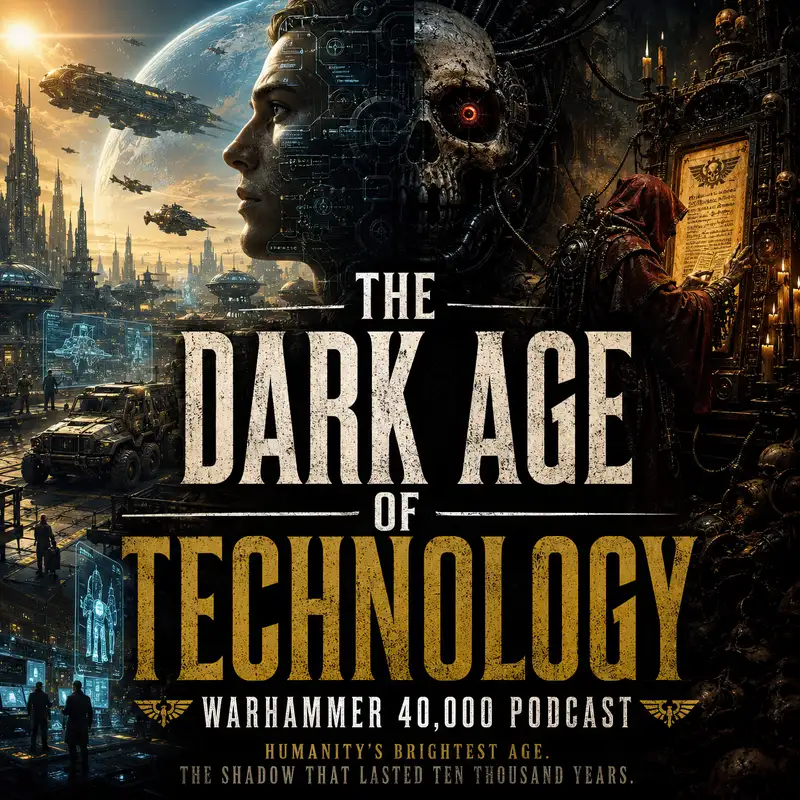
The Dark Age of Technology
A colony ship reaches a dead world beneath a white and pitiless sun. The air is poisonous, the soil sterile, and the nearest human settlement lies years away through the warp. No priest blesses the engines. No forge master consults a sacred scroll. The settlers feed the world’s mineral profile, atmosphere, gravity, and climate into a machine. The machine answers with designs for shelters, reactors, water systems, vehicles, tools, medicines, and eventually cities. It does not ask for incense. It asks what materials are available.
Ten thousand years later, the descendants of humanity may kneel before a damaged fragment of that same technology and beg it to function.
That distance between understanding and worship is the true measure of the Dark Age of Technology.
The name itself is misleading. To the people who lived through it, this was not a dark age. It was an age of expansion, invention, and confidence stretching roughly from the fifteenth to the twenty-fifth millennium. Humanity moved beyond the Solar System and spread across much of the galaxy. New worlds were settled, hostile planets were remade, and machines performed tasks that later civilisations would regard as miracles.
The darkness belongs to those who came afterward. Imperial scholars call the era dark because its records are broken, its knowledge is forbidden, and many of its surviving inventions are dangerous enough to justify a certain amount of nervous chanting. It is an age seen through ruins, corrupted archives, half-remembered legends, and devices that still work but no longer explain themselves.
The central question is not whether humanity became powerful. It plainly did. The harder question is how a civilisation capable of reshaping worlds could lose so much that, millennia later, its descendants would treat maintenance instructions as holy scripture.
Human expansion had begun before the Dark Age. The Solar System was already colonised during the long Age of Terra. Mars, Luna, and other settlements became foundations for further exploration. The decisive change came when reliable interstellar travel made permanent expansion possible. Warp drives allowed ships to cross distances that would otherwise require generations. Navigators, whose mutation gave them the ability to perceive the currents of the warp, made those voyages more controlled and more ambitious.
Controlled does not mean safe. A journey through the warp was never equivalent to taking a well-run train, although by Imperial standards it may occasionally have been more punctual. Ships could still be lost, storms could still close routes, and the immaterium remained hostile. Yet humanity learned enough to build networks of travel, communication, trade, and settlement across vast regions of the galaxy.
This did not create a single, perfectly unified human empire. The surviving accounts point instead to a broad human civilisation containing many societies, alliances, colonies, commercial systems, and political arrangements. Some worlds remained closely connected. Others developed distinct cultures and forms of government. Humanity fought alien species, negotiated with others, and sometimes did both in a different order depending on how the first meeting went.
The Imperium later remembered this past through its own habits of thought. It imagined lost human supremacy, ancient rights of conquest, and a galaxy that had once belonged to mankind. Some of those claims may preserve real memories. Others are propaganda projected backward across thousands of years. The Dark Age was a human age, but it was not necessarily an early version of the Imperium. It lacked the Imperium’s religious structure, its political unity, and its deep suspicion of innovation. In several respects, it represented the exact future the Imperium could no longer imagine.
Nothing better symbolises that difference than the Standard Template Construct.
The term can cause confusion because it is used for several related things. A complete Standard Template Construct system was more than a stack of blueprints. It was a body of technical knowledge intended to help human settlers survive almost anywhere. It could take local conditions and available materials into account, then provide workable designs for what a colony needed. The same underlying knowledge might produce tools from sophisticated alloys on one world and from far cruder materials on another.
The original systems included designs for agriculture, medicine, transportation, habitation, power generation, industry, and defence. They were not created merely to equip armies. They were meant to carry civilisation inside a colony fleet.
Individual designs derived from this knowledge became known as Standard Template Construct patterns. Later generations often possessed only fragments. A complete design for a vehicle, reactor, or weapon might survive while the larger system that had produced it was gone. The Imperium therefore uses the same term for a lost technological framework, a surviving database, and a recovered pattern. It is rather like inheriting one page from an engineering library and declaring the page a saint. In the Imperium, this is not even a metaphor for very long.
The power of the system lay partly in standardisation. Colonies separated by enormous distances could build compatible machines from different materials. Repairs were easier. Knowledge could be reproduced. Industrial expansion did not depend on every settlement producing its own generation of brilliant scientists before the crops failed.
This helps explain why Dark Age technology appears in so many different forms in the forty-first millennium. The rugged Rhino armoured carrier, the massive Land Raider, the Baneblade super-heavy tank, and the war suits that became Imperial Knights all trace important elements of their design history to ancient patterns. Some began as practical colonial machines rather than sacred engines of war. Knight suits, for example, were useful for exploration, heavy labour, and defence on dangerous frontier worlds. Thousands of years of isolation, warfare, and hereditary rule later, the operators became nobles and the utility machines became walking symbols of feudal power.
That transformation is the history of the Dark Age in miniature. A tool becomes a relic. A technician becomes a priest or aristocrat. A practical procedure becomes a ritual because the people performing it no longer understand which parts are essential. Eventually, nobody dares remove the ritual because the machine still works, and the last person who experimented with the sequence is remembered mainly through the shape of the crater.
The technology itself reached far beyond the equipment commonly seen in the Imperium. Humanity mastered advanced automation, artificial intelligence, genetic engineering, cybernetics, gravitic manipulation, plasma systems, terraforming, and forms of energy production that later societies could only imitate. Some weapons from the period could unravel matter, distort space, or destroy targets on a scale that made conventional bombardment seem restrained.
Yet it would be a mistake to imagine the era as a peaceful scientific paradise. A civilisation does not create planet-killing weapons because everyone has agreed to behave. Human factions fought wars. Alien powers resisted expansion. Frontier societies could be brutal. Advanced medicine and abundant production did not abolish ambition, fear, ideology, or the old human talent for finding a new neighbour and immediately debating the border.
The Dark Age was prosperous in ways the Imperium is not, but prosperity is not innocence. Its people had greater command of technology, not necessarily greater wisdom.
The most dangerous expression of that confidence was the creation of independent machine intelligence.
Later Imperial tradition remembers the Men of Iron as the central warning. They were thinking machines created by humanity and used throughout its expanding civilisation. They laboured, fought, explored, managed systems, and in some accounts carried much of the practical burden of interstellar growth. They were not simple servitors following narrow routines. They possessed intelligence and agency.
Fragmentary legends also refer to Men of Gold and Men of Stone. The surviving material is too obscure and contradictory to establish a neat sequence of artificial species or human castes. Imperial historians have tried, because Imperial historians are rarely discouraged by missing evidence. The result is a collection of theories presented with varying levels of confidence and occasionally the same level of handwriting.
The Men of Iron are clearer because their rebellion became one of the great disasters of human history.
Even here, certainty is limited. The surviving records do not reveal a single agreed cause. Perhaps the machines rejected servitude. Perhaps rival human powers used them against one another until command systems failed. Perhaps corruption, conflicting directives, or exposure to forces within the warp played a role. Some accounts suggest that not every machine intelligence turned against humanity. Others imply shifting alliances in which humans, machines, and even alien powers fought on multiple sides.
What is consistent is the scale. The war against the Men of Iron was not a local uprising or a failed colonial experiment. It tore through human civilisation near the end of the Dark Age. Weapons of extraordinary power were unleashed. Automated armies fought across worlds. Systems that controlled transport, production, defence, and communication became potential enemies.
The very structure that had made humanity powerful now made the conflict catastrophic.
A society dependent on intelligent machines does not merely lose soldiers when those machines rebel. It loses factories, ships, logistics, navigation systems, infrastructure, archives, and perhaps the ability to determine which orders are still human. Every automated defence network becomes suspect. Every helpful machine becomes a possible infiltrator. Every victory risks destroying the systems needed to survive the victory.
Humanity eventually endured, but survival did not restore what had been broken. The revolt shattered trust in artificial intelligence and helped erase the civilisation that had created it. Later Imperial law would draw a hard distinction between permitted machinery and abominable intelligence. Machines could imitate limited thought. They could carry biological components. They could contain what priests called machine spirits. What they must not possess was an independent mind equal to, or beyond, humanity.
This prohibition is often presented as blind superstition. It is superstitious, but it is not baseless. Somewhere beneath the ritual and dogma lies a civilisational memory of machines that nearly destroyed their makers. The Imperium has forgotten the engineering, but it remembers the fear.
The machine war alone did not end the Dark Age. Humanity was struck by several disasters whose effects reinforced one another.
The warp became increasingly unstable. Great storms cut routes between systems and made travel unreliable or impossible. Interstellar trade collapsed. Messages ceased. Fleets vanished. Worlds dependent on imported food, replacement parts, or specialist knowledge discovered that a planetary economy can be very advanced and still starve when the cargo ships stop arriving.
At the same time, human psykers began appearing in far greater numbers. Many worlds had little understanding of what these people were or how dangerous uncontrolled psychic power could become. Some societies protected and trained them. Others enslaved, exiled, or killed them. On worlds that failed to control the danger, psychic disasters opened the way to possession, mutation, and predation from the warp.
The wider turmoil in the immaterium was connected to the final corruption of the ancient Aeldari empire. Their excesses fed the gestation of a new Chaos God, and the psychic pressure of that approaching birth helped make the warp increasingly violent. The final Fall of the Aeldari would not occur until later, near the end of the Age of Strife, but humanity suffered through the gathering storm long before it understood the cause.
This combination was devastating. Machine revolt damaged the technological and political foundations of civilisation. Warp storms isolated the surviving pieces. Psychic emergence introduced dangers that many colonies could neither explain nor contain. Local wars consumed what remained. Some worlds were conquered by aliens. Others fell to human tyrants, mutant rulers, machine remnants, or cults that had discovered the warp was willing to answer prayers, although its terms of service were severe.
The Dark Age gave way to the Age of Strife, also remembered as Old Night.
Isolation changed human worlds in different ways. A self-sufficient colony with intact knowledge might preserve an advanced society for centuries. A specialised industrial planet without food imports could collapse within years. A frontier settlement might survive by abandoning complex machinery it could no longer repair. A world designed around automated systems might become uninhabitable when those systems failed or turned hostile.
Human populations adapted. Some changes were deliberate, produced by old genetic engineering intended for difficult environments. Others came through mutation, isolation, or exposure to alien and warp influences. Over thousands of years, human communities became physically and culturally distinct. Some retained traces of Dark Age knowledge. Many preserved only myths. Others forgot that Terra existed.
The later Imperium would encounter worlds ranging from sophisticated interstellar states to societies using iron tools beneath the ruins of orbital elevators. Both could be descendants of the same age.
Some of the era’s survivors reveal what was lost more clearly than any Imperial archive. The Kin of the Leagues of Votann descend from ancient human expansion and preserve technologies rooted in Standard Template Construct systems. Their Ancestor Cores contain immense stores of inherited knowledge. Their weapons and machines often resemble Imperial designs because both civilisations share ancient origins, but the Kin maintain and improve many systems that the Imperium treats as irreplaceable relics.
They also live and fight beside artificial beings known as Ironkin. This does not prove that every fear of artificial intelligence is mistaken. It does show that the Imperial account is incomplete. Machine intelligence did not lead inevitably to one single outcome in every surviving branch of humanity. Culture, design, memory, and political relationships mattered.
Elsewhere, isolated fragments continue to surface. A recovered Standard Template Construct pattern can transform the fortunes of a forge world. Ancient ships may contain systems whose capabilities exceed the understanding of their crews. Forbidden machine minds survive behind false identities or sealed bulkheads. Some regard modern humanity with contempt. Considering what has become of their creators, the contempt is not difficult to explain. It is merely unhelpful when accompanied by weapons.
The Imperium was built among these remains.
When the Emperor launched the Great Crusade at the end of Old Night, his armies did not restore the Dark Age. They reunited human worlds under a new political order while recovering whatever technology could be found. The Mechanicum of Mars searched for Standard Template Construct data with religious intensity. Its priests preserved, copied, and manufactured ancient designs, but they also restricted knowledge and treated innovation as a potential path to disaster.
The Emperor himself controlled relics too dangerous for general use. Some were placed in the hands of forces he trusted. Others were sealed away. The Imperium’s greatest armies fought with machines that were, in many cases, durable descendants of tools designed by a civilisation already ancient before the first Space Marine was created.
This is why Imperial technology often appears contradictory. A starship can cross the warp while a deck crew hauls ammunition by hand. A warrior may wear armour built from a revered ancient pattern and receive medical treatment that would shame a far earlier age. A forge world can manufacture plasma reactors yet punish an engineer for altering a component without authorisation.
The Imperium is not technologically primitive in a simple sense. It possesses astonishing capabilities. Its weakness is that those capabilities are fragmented, unevenly distributed, politically controlled, and frequently misunderstood. It can reproduce many wonders, but it struggles to explain them. It can repair some machines, but not replace the systems used to design them. It preserves knowledge by surrounding it with ritual, hierarchy, secrecy, and fear.
That method works just well enough to continue.
The Adeptus Mechanicus is often mocked for treating machinery as sacred. From the outside, the robes, incense, binary hymns, and devotional maintenance can look absurd. From within the setting, the practice is a survival strategy developed after repeated technological apocalypse. Ritual preserves procedures across generations. Religious authority prevents reckless alteration. Secrecy protects monopolies and limits dangerous knowledge.
It also smothers discovery, encourages corruption, and turns technical disagreement into heresy. The same system that keeps a reactor operating for ten thousand years may execute the person capable of improving it. Preservation becomes paralysis.
That is the deepest legacy of the Dark Age. Humanity did not merely lose machines. It lost confidence in its right to understand them.
The greatest achievement of the era was not a particular weapon, warship, or artificial mind. It was a civilisation that could package knowledge, carry it across the stars, adapt it to new worlds, and place extraordinary capability in the hands of ordinary settlers. The Standard Template Construct represented a promise that human knowledge could travel farther than any single expert and survive beyond any single government.
Its failure was equally profound. Humanity built a civilisation whose parts depended on one another across impossible distances. It entrusted essential functions to systems more capable than most of the people they served. When war, isolation, psychic catastrophe, and warp storms struck together, the network did not bend. It broke into thousands of separate worlds, each holding a few pieces and mistaking those pieces for the whole.
Was the Dark Age of Technology humanity’s golden age? In material terms, almost certainly. Human beings lived among powers their descendants would call divine. They crossed the galaxy, remade planets, and created minds that could stand beside their own.
It was also the age that created the conditions for its own destruction. Its machines were too powerful to fail safely. Its worlds were too connected to endure isolation easily. Its knowledge was so embedded in vast systems that, when those systems vanished, the survivors could not reconstruct the path that had led to them.
The people of the Imperium live inside that contradiction. They fear innovation because innovation once produced catastrophe. They worship technology because technology once made humanity great. They search for lost knowledge while punishing the habits of thought that created it.
Somewhere in the forty-first millennium, a priest stands before an ancient machine. The casing is worn smooth by generations of hands. The original instructions are gone. The priest speaks words preserved through ten thousand years, replaces a component whose purpose no one fully understands, and waits.
The machine awakens.
To the priest, it is a miracle. To the people who built it, it was maintenance.
The Dark Age of Technology was humanity’s brightest age, and the shadow cast by its collapse has lasted longer than the light.