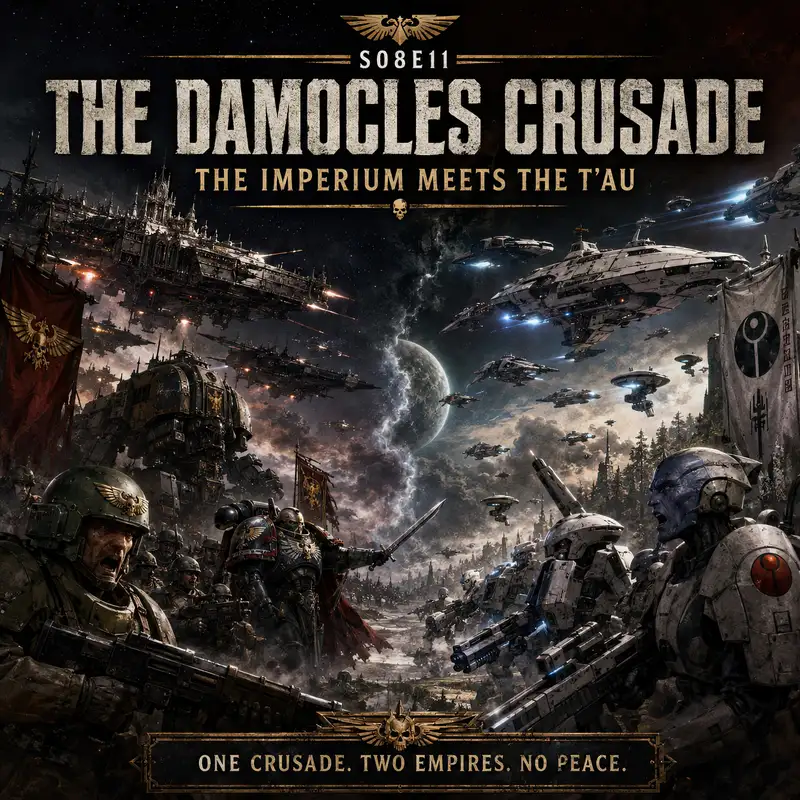
The Damocles Crusade: The Imperium Meets the T’au
The first warning was not a fleet. It was a trade agreement. On the eastern fringe of the Imperium, human frontier worlds began exchanging goods with blue-skinned visitors who spoke politely, arrived with useful technology, and asked questions before opening fire. To the T’au Water Caste, this was the beginning of a relationship. To the Imperium, it was evidence of contamination. A governor might see better tools, stronger markets, and a chance to survive far from reliable Imperial support. An inquisitor saw disloyalty wearing the pleasant face of commerce. The Water Caste had made a sale. The Imperium filed it under treason.
That difference explains nearly everything that followed. The T’au Empire was young, ambitious, and expanding through what it called the Second Sphere. Its leaders believed that other peoples could be persuaded, pressured, or defeated into serving the Greater Good. Diplomacy and conquest were not opposites in T’au policy. They were two stages of the same process, with the Water Caste opening doors that the Fire Caste could widen if negotiations became inconvenient. The Imperium had no comparable interest in coexistence. Humanity’s empire was ancient, wounded, and held together by faith, fear, bureaucracy, and overwhelming force. It did not meet new civilizations. It classified them.
The T’au had encountered humans before the Damocles Crusade, but mostly as isolated populations along a neglected frontier. Those communities did not reveal the true scale of the Imperium. They revealed its distance. Imperial authority could be slow, supplies irregular, and local rulers desperate enough to consider arrangements that would have horrified officials nearer the galactic core. T’au diplomats offered trade, protection, and eventual membership in a growing commonwealth. Some humans accepted because they believed in the promise. Others accepted because a pulse rifle, a medical system, or a functioning agricultural machine is persuasive when the nearest Imperial relief fleet may arrive several generations after everyone is dead.
By seven hundred and forty-two of the forty-first millennium, Imperial investigators had found enough evidence to act. Cardinal Esau Gurney of Brimlock called for a crusade to purge the alien influence beyond the Damocles Gulf. Admiral Jallaque would command the naval arm, while General Wendall Gauge directed the main ground forces. The crusade gathered roughly a dozen Imperial Navy capital ships, nineteen Imperial Guard regiments, and provisional companies drawn from several Space Marine Chapters. By Imperial standards, it was a substantial regional expedition rather than an empire-wide mobilization. To the T’au, who had not yet understood what humanity could assemble when truly frightened, it looked like the arrival of an entire civilization under arms.
The crusade’s first targets were not T’au worlds. They were human colonies in the Timbra sub-sector, including Garrus and Kleist, where Imperial subjects had traded and lived alongside the aliens. Imperial authority was restored through arrests, trials, and punishment. The message was deliberate. The campaign was not merely intended to push back a foreign power. It was meant to erase the idea that cooperation had ever been possible. For the T’au, a human community could become part of a broader political order. For the Imperium, a human community touched by alien influence had become suspect at the level of blood, belief, and memory.
The first major clash in space came in the Hydass system. T’au cruisers struck at range with powerful torpedo salvos, surprising Imperial commanders who had expected primitive vessels from a minor species. The T’au ships were fast and dangerous, but they were not built to trade punishment in the same way as the armoured cathedrals of the Imperial Navy. Once the Imperial line closed and brought its heavy weapons to bear, the balance shifted. A Space Marine strike cruiser helped break the T’au formation, and the Navy won the engagement. The victory encouraged the belief that the aliens were clever but manageable. That belief survived just long enough to become expensive.
On Sy’l’kell, the ground war offered a harsher lesson. Brimlock troops and Space Marines of the Scythes of the Emperor met Fire Caste soldiers equipped for rapid movement, coordinated fire, and disciplined withdrawal. Hammerhead grav-tanks could threaten the heavy armour of the Imperial Guard, while T’au infantry used range and technology to avoid the close assaults in which Imperial forces were strongest. The defenders were eventually overcome, but not easily, and Imperial troops took losses that did not fit the reassuring picture of a weak frontier species. The civilian population was exterminated after the world fell. The crusade had come to destroy an enemy state, but it was also teaching the T’au what Imperial victory meant for anyone left alive beneath it.
The lesson was repeated at Viss’el. Imperial commanders judged the world to have little strategic value, then bombarded it from orbit and melted its polar ice caps, purging life rather than spending soldiers to occupy it. This was not an accident or a fit of anger. It was the logic of the campaign expressed with administrative clarity. A world that could not be usefully reclaimed could still be denied to the alien. The T’au had gone to war expecting territorial calculations, negotiations, and perhaps a settlement after sufficient losses. They were beginning to understand that the Imperium could consider annihilation a form of housekeeping.
The crusade then crossed the Damocles Gulf itself, a dangerous region of nebulae and unstable passage that formed a natural barrier between Imperial space and the heartward T’au septs. The journey took roughly five months. Time inside a troop transport has a way of turning confidence into routine, and routine into dread. Imperial commanders had won every major encounter so far, but they were moving farther from secure supply lines with damaged ships, finite ammunition, and no clear understanding of how deep T’au territory extended. The campaign had been planned as a punitive thrust. It was becoming an invasion.
Beyond the Gulf lay Dal’yth, one of the T’au Empire’s major sept worlds and a center of trade with other species. Here the crusade finally encountered not a frontier outpost, but a developed system prepared to defend itself. Orbital stations guarded the approach. Air Caste warships waited in strength. Kroot warspheres added the mass and unpredictability of an allied species the Imperium had not expected to find integrated into T’au operations. The crusaders had assumed Hydass represented the upper limit of T’au naval power. Dal’yth corrected that assumption with missiles, torpedoes, and a great deal of burning wreckage.
The battle in orbit was an Imperial victory only in the strictest sense. Admiral Jallaque’s flagship, the Blade of Woe, helped break the defenders, and the destruction of a Kroot warsphere prevented the Imperial line from being overwhelmed. Yet the crusade lost capital ships and numerous escorts taking control of the approaches. Those losses could not be replaced on campaign. Every ship destroyed reduced the fleet’s ability to protect its transports, support troops on the surface, and survive the return journey. The T’au had failed to stop the invasion in space, but they had made the price of landing dangerously close to the price of retreat.
General Gauge committed the ground army to Dal’yth. At first, the advance appeared to vindicate Imperial confidence. T’au roads carried columns of Leman Russ tanks, infantry, and towering war engines toward their objectives. Titans moved at the head of the assault, machines built to reduce fortresses and enemy morale with equal efficiency. Open ground favored Imperial mass, and the crusaders advanced rapidly. Then the terrain narrowed into wooded hills around Gel’bryn, and the T’au stopped giving them the battle they wanted.
T’au warfare was built around mobility, coordination, and the controlled application of firepower. Two principles later became famous even beyond the Empire. Mont’ka, the killing blow, sought the decisive strike against a vulnerable center. Kauyon, the patient hunter, drew an enemy into a position where destruction became inevitable. Neither was a rigid recipe. Both demanded timing and an accurate understanding of the opponent. On Dal’yth, the Fire Caste did not try to defeat the entire crusade in one heroic collision. It divided the Imperial advance, forced different arms to fight separate battles, and turned distance into a weapon.
The Imperial spearhead split into three wedges. Titans found themselves harried by Manta gunships and volleys of guided missiles. Guard veterans who used cover well were still drawn into close fighting with Kroot, whose presence shattered the comfortable Imperial belief that the T’au would always avoid hand-to-hand combat. Space Marines from several Chapters encountered Crisis battlesuits, elite pilots whose armour combined heavy weapons, sensors, and jump-assisted movement. The battlesuits were not equal to an Adeptus Astartes warrior in every circumstance, but they did not need to be. They could concentrate fire, withdraw, and strike again before the Imperial formation could bring its full strength to bear.
The woods became a machine for consuming momentum. Imperial units dug in to escape the worst of the missile fire, only to discover that T’au night optics gave the defenders another advantage after sunset. Raids cut at exposed positions. Patrols disappeared. Supply lines stretched. Space Marines could punish attackers and stabilize threatened sectors, but there were too few of them to be everywhere. Above the planet, the battered Navy watched for another T’au fleet that it might no longer be strong enough to defeat. The crusade had reached a point familiar to many armies in many ages. It could still win battles. It was losing the ability to decide which battles mattered.
The encounter was equally unsettling for the T’au. Fire Caste commanders had expected human soldiers. They found an enemy that could absorb losses on a scale the young Empire struggled to comprehend. Imperial Guard regiments kept advancing through conditions that should have broken them. Titans turned engineering into theology and theology into siege artillery. Most disturbing were the Space Marines, warriors whose speed, resilience, and violence did not fit ordinary T’au categories. They could be killed, and the T’au learned how, but each encounter suggested that humanity possessed military traditions older than the entire T’au civilization.
Later T’au accounts place Commander Farsight among the leaders shaped by the campaign. A gifted student of Commander Puretide, Farsight favored Mont’ka and used sudden, concentrated attacks to punish Imperial forces. His reputation grew because the crusade rewarded exactly the qualities that would later make him both a hero and a problem for the Ethereals: aggression, independence, and a willingness to act before permission arrived. Yet even a commander skilled at the killing blow could see the larger danger. The Imperial army on Dal’yth was not humanity’s full strength. It was a fraction sent by a distant region of a distracted empire.
General Gauge understood the same problem from the opposite side. The crusade had struck a major T’au world with insufficient forces, and reinforcements were arriving for the defenders faster than the Imperium could replace its losses. Some Imperial voices favored escalating to planetary annihilation. Gauge chose a more practical answer. In an operation later remembered as Hydra, he massed Titans and Brimlock regiments against the T’au right flank while Navy aircraft attacked enemy airfields. The assault captured a bridge, threatened to trap large numbers of T’au troops against the sea, and seized a starport. It looked like the decisive success the crusade had been seeking.
It was, in fact, an exit. The T’au withdrew during the night rather than allow themselves to be encircled, and Gauge used the captured starport to begin evacuating his own forces. This was not cowardice, though some crusaders considered it close enough to be insulting. It was operational judgment. The ground army could continue fighting, but the fleet above it was damaged, the supply situation was worsening, and the enemy was growing stronger. A commander who mistakes the ability to attack for the ability to win eventually gives the enemy a useful corpse and his superiors a complicated report.
Then the wider galaxy intruded. Inquisitor Kryptman brought orders recalling the crusade’s forces in response to a threat moving toward Imperial worlds: Hive Fleet Behemoth. The Imperium had discovered an alien empire and found it dangerous. It had also discovered the Tyranids and found them hungry. The distinction was strategically persuasive. Forces that might have been spent grinding Dal’yth into ruin were needed against an enemy that consumed planets and left nothing to reconquer. The crusade’s withdrawal was therefore not simply forced by T’au resistance. It was compelled by the Imperium’s permanent condition, too many wars and never enough armies for all of them.
The Water Caste recognized the moment and opened negotiations. A settlement allowed the Imperial fleet to withdraw while the T’au retained the world the crusade had come to break. Both sides could shape the result into a useful story. Imperial commanders had punished collaborators, destroyed T’au worlds, defeated alien fleets, and departed under orders to confront a greater danger. T’au leaders had survived an invasion by a terrifying foe and forced that foe to leave. Neither version was entirely false. Neither admitted how close the campaign had come to catastrophe.
The settlement did not create trust on either side. After the crusade, Imperial authorities descended on human worlds that had dealt with the T’au and punished collaboration with the familiar tools of interrogation, confiscation, and purge. The aim was to close the political breach before it widened. Within the T’au Empire, survival could be presented as proof that unity beneath the Greater Good had defeated a vastly larger aggressor. That interpretation strengthened morale, but it also concealed a dangerous fact. The invading force had not represented the whole Imperium. It had been one crusade, assembled on one frontier, and withdrawn when another war became more urgent.
So who won the Damocles Crusade? On Dal’yth, the T’au held the field after the Imperium withdrew. Strategically, the T’au Empire survived, continued expanding, and gained confidence from resisting an enemy that had intended its extermination. By those measures, the T’au won. The Imperium, however, was not defeated in the sense the T’au first imagined. It had not committed anything close to its total strength, and its retreat did not mean acceptance of T’au sovereignty. It meant another emergency had moved higher on an endless list. The Imperium did not make peace with the T’au. It postponed their destruction.
The T’au victory therefore carried a warning. Before the crusade, many within the young Empire had viewed humanity through the scale of frontier settlements and local armies. Damocles revealed a political entity spread across much of the galaxy, able to lose regiments and warships without ceasing to function. The T’au learned that the Imperium was neither united enough to negotiate as one rational power nor weak enough to be absorbed through ordinary expansion. It was a continent-sized ruin that could still reach across the dark and strike with a mailed fist.
The Imperium learned something equally important, though it was slower to respect the lesson. The T’au were not a primitive species awaiting easy extinction. Their technology was advanced, their commanders adapted quickly, and their method of war could blunt larger forces by refusing the sort of battle Imperial doctrine preferred. Their alliance with the Kroot also demonstrated that the Greater Good could turn diplomacy into military strength. Every human world persuaded rather than conquered might become a supply base, a political example, and a wound in Imperial authority. That made the Water Caste as dangerous in its own way as any battlesuit cadre.
The deepest conflict was never over a single sept world. It was over two incompatible ideas of order. The T’au believed different species could be arranged beneath one purpose, though always under T’au direction and Ethereal authority. The Imperium believed humanity survived only by refusing such arrangements altogether. One empire offered inclusion that could become domination. The other offered purity enforced by fire. Between them stood frontier populations who had seen enough neglect to doubt Imperial promises and enough T’au generosity to miss the conditions attached. Their choices helped start the war, and both empires made certain they would pay for it.
Damocles became the pattern for the wars that followed. The T’au would keep expanding, learning, and using speed, persuasion, and technology to take worlds the Imperium could not properly defend. The Imperium would return with larger armies whenever its attention could be spared, treating each T’au advance as both a military intrusion and an ideological infection. Later campaigns would be more destructive, and the names of Farsight, Shadowsun, and other commanders would become bound to the Gulf. Yet the first crusade remained the moment when each side saw the other clearly enough to be afraid, but not clearly enough to stop.
The Imperium met the T’au expecting a minor species that could be erased by a disciplined expedition. The T’au met the Imperium expecting another civilization that could be reasoned with, outmaneuvered, and eventually brought into the Greater Good. Both were wrong. The T’au survived because they fought intelligently and because a greater horror pulled the crusade away. The Imperium withdrew because survival elsewhere mattered more than victory on Dal’yth, not because its hatred had softened. The sword hanging over the Damocles Gulf did not fall. It remained suspended, held up by distance, distraction, and the certainty that sooner or later, one of those supports would break.