The Cursed Founding: When Space Marine Creation Goes Wrong
The Twenty-First Founding was meant to prove that the Imperium could improve on the work of the Emperor. Instead, it produced Space Marines whose bones became weapons, whose bodies burned without being consumed, whose luck seemed poisoned, and whose very existence forced the Imperium to decide whether loyalty mattered more than purity. Later generations would call it the Cursed Founding, as though the name explained everything. It did not. A curse is convenient because it requires no audit trail, no admission of error, and no surviving official willing to say who approved the experiment.
A Space Marine Chapter begins with gene-seed, the inherited biological legacy of a primarch. Through a sequence of implanted organs, an ordinary human recruit is remade into something faster, stronger, harder to kill, and increasingly distant from the people he is supposed to defend. Those organs are not independent parts in a simple machine. They develop together, react to the recruit, and carry traits that have accumulated across thousands of years. The progenoid glands preserve the genetic material needed for the next generation. Every Chapter therefore carries its past inside the bodies of its warriors.
That past was never perfectly clean. Some gene-lines produced stable warriors but had lost the function of particular organs. Others carried flaws that could become physical, psychological, or both. The Blood Angels and their descendants lived beneath the shadow of the Red Thirst and the Black Rage. The Space Wolves depended on a fiercely particular genetic inheritance. The Raven Guard endured the consequences of ancient damage to their stock. Even the most celebrated lineages were not standardized products. They were dynasties of engineered flesh, shaped by history as much as biology.
Normally, a new Founding was an act of replication under strict control. Gene-seed tithes were collected, tested, multiplied, and used to create new Chapters. The process took years and demanded a level of coordination that the Imperium rarely achieved without losing several clerks, a transport fleet, and perhaps a minor moon. Yet the Twenty-First Founding was different. Shortly before the Age of Apostasy, the High Lords authorized the largest creation of new Chapters since the Second Founding. Surviving accounts suggest that the project was not content merely to reproduce existing gene-lines. The intention was to correct them.
To produce a Chapter, the Mechanicus could not simply open a vault and issue a thousand completed warriors. Individual genetic implants had to be cultivated, monitored, and multiplied through successive generations before enough material existed to begin mass recruitment. A defect introduced early could spread through an entire founding stock before it became obvious in battle. Laboratory stability did not guarantee stability during implantation, adolescence, combat stress, psychic exposure, or centuries of reproduction. The people directing the Twenty-First Founding were changing a system whose failures might not reveal themselves until the original project staff were dead.
The Magos Biologis of the Adeptus Mechanicus appear to have attempted deliberate improvements. Deficiencies might be repaired. Hereditary weaknesses might be removed. Useful traits might be strengthened. The official language is fragmentary, and much of the record was sealed or destroyed, but the ambition is clear. The Imperium wanted Space Marines who retained the strengths of their primarchs without inheriting the inconvenient parts. It was an understandable military requirement. It was also the biological equivalent of removing one stone from a cathedral because it looked untidy, then discovering that the stone had been holding up the roof.
The project emerged from a contradiction at the heart of the Imperium. Gene-seed was sacred, because it descended from the primarchs and ultimately from the Emperor. Gene-seed was also a military resource, measured, stored, tested, and allocated by institutions that expected practical results. The Mechanicus treated biological knowledge through ritual, precedent, and guarded expertise. It knew a great deal, but it did not necessarily understand every relationship inside the systems it preserved. The Twenty-First Founding asked those institutions to innovate while pretending that no true innovation was taking place.
That distinction mattered. Open experimentation permits failure to be studied. Secret experimentation encourages failure to be buried. The Chapters of the Cursed Founding were created beneath layers of classification, doctrinal anxiety, and political urgency. When abnormalities appeared, investigators were not simply asking whether the warriors remained effective. They were asking whether someone had tampered with the Emperor’s design, whether forbidden gene-stock had been used, and whether visible mutation proved spiritual corruption. Biology had become evidence in a heresy trial.
The word cursed was applied afterward, once enough tragedies had accumulated to form a pattern. That matters because retrospective labels change the evidence they describe. A Chapter from an ordinary Founding might vanish in the warp and be remembered as unlucky. A Chapter from the Twenty-First could suffer the same fate and become proof of genetic doom. Every mutation, defeat, rebellion, and disappearance was added to the same indictment. Successes received less attention, because a functioning Chapter quietly defending an obscure frontier does not make a particularly satisfying warning.
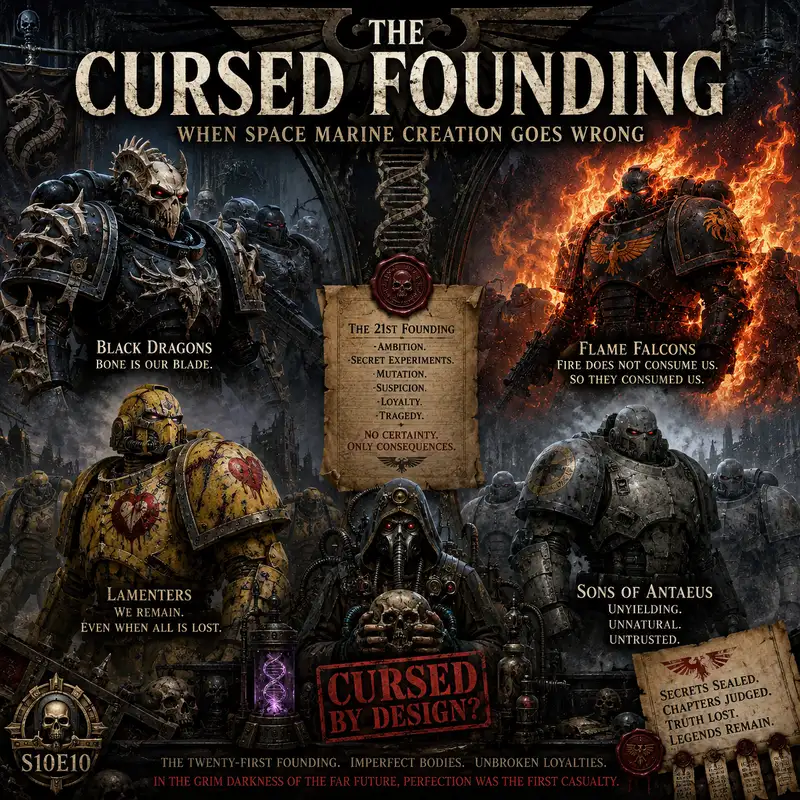
The Black Dragons offer the clearest example. Their mutation affected the ossmodula, the implanted organ that regulates skeletal growth. In some warriors, particularly those gathered into the Chapter’s feared Dragon Claws, the bones of the skull and forearms grew into ridges, crests, and blade-like protrusions. These were not decorative changes. The Black Dragons sharpened some of the growths and reinforced them for use in close combat. To their enemies, the result was terrifying. To Imperial observers, it was the sort of thing normally followed by a report written in red ink.
Yet the Black Dragons did not simply collapse into madness or rebellion. They continued to fight for the Imperium. Their culture adapted to the mutation, turning it into a mark of martial distinction. That adaptation created further suspicion. Apothecaries who selected recruits for pronounced bone growth could be accused of encouraging the very instability they were meant to control. The Chapter’s gene-seed tithes attracted intense scrutiny, and stories accumulated around what its officers concealed. The Black Dragons survived, but they survived under the permanent assumption that their bodies might testify against them.
Their existence complicates the word cursed. A mutation had plainly occurred, and the Chapter had built a warrior tradition around it. That did not make its warriors traitors. The Imperium often preferred a clean category. Pure meant loyal. Mutant meant corrupt. The Black Dragons refused to fit the equation. They were visibly altered, institutionally suspect, and still willing to die in Imperial wars. Their greatest offense may have been forcing officials to admit that purity and loyalty were not the same thing.
The Flame Falcons presented an even more dangerous problem because their transformation looked like a miracle. During battle, warriors of the Chapter began to ignite. Fire wreathed their armour and bodies, yet did not consume them. To those fighting beside them, the sight could be read as divine favor. Here were the Emperor’s angels advancing through flame, unharmed and terrible. In another age, on another world, statues might have been raised before the smoke cleared.
Imperial authorities saw something else. A sudden, unexplained transformation spreading through a Chapter could be a mutation, a psychic phenomenon, a sign of warp contamination, or all three. The Flame Falcons were declared irredeemably compromised. The Grey Knights were sent against them, and the Chapter was officially destroyed. The Imperium is quite comfortable with holy fire in stained glass. It becomes less relaxed when the fire starts moving between squads.
The fate of the Flame Falcons reveals that the failure of the Founding cannot be measured only in unstable organs. It must also be measured in the Imperial response. Perhaps the Chapter was truly dangerous. The surviving records do not settle the question. Perhaps the flames were the first stage of a deeper corruption. Perhaps they were an uncontrolled but loyal psychic manifestation. The authorities chose extermination because uncertainty itself had become intolerable. In a civilization built on fear of contamination, an unexplained miracle is only a mutation awaiting the correct tribunal.
The Lamenters seem, at first, to represent the opposite outcome. They were created from the lineage of the Blood Angels, and early accounts suggested that they had escaped the worst hereditary afflictions of that bloodline. If the goal of the Twenty-First Founding was to remove flaws while preserving strength, the Lamenters looked like proof that the experiment could work. They were capable, disciplined, and unusually willing to place themselves between civilians and destruction. Their badge, a bleeding heart, proved less a symbol than a forecast.
Disaster followed them with such consistency that later observers treated misfortune as part of their gene-seed. Campaigns ended in catastrophic losses. Reinforcements arrived late or not at all. Victories became traps. Their compassion often placed them where the fighting was worst, which is a noble habit but a poor method of preserving a Chapter. The Lamenters did not merely suffer bad luck. They repeatedly made choices that exposed them to risk because they believed that protecting ordinary Imperial lives was worth the cost.
Their most damaging decision came during the Badab War. Bound by honor and obligation, the Lamenters sided with the secessionist forces led by the Astral Claws. Their support did not mean that they had embraced Chaos, and their motives were more complicated than simple rebellion. Complexity provided little protection once the war turned against them. Defeated by the Minotaurs, they were forced into a century-long penitent crusade and forbidden to replace their losses. Later encounters with the Tyranids reduced them still further. A Chapter that may have represented a genetic success was nearly destroyed by politics, honor, and administrative punishment.
The Lamenters therefore embody a different kind of curse. Their bodies were not their greatest problem. Their place within the Imperium was. They inherited the suspicion attached to the Founding, then confirmed every dark expectation by becoming involved in a rebellion for reasons that did not fit neatly into the official verdict. Their tragedy is not that they were secretly monsters. It is that they remained recognizably humane inside a system that often treats humanity as an operational weakness.
Other Chapters of the Founding suggest that the experiments were not uniform. The Sons of Antaeus were described as unusually large, dense, and extraordinarily difficult to kill. Their resilience invited comparisons with the ancient Death Guard, and those comparisons fed rumors that forbidden gene-seed from the Traitor Legions had been used. No surviving evidence proves the charge. The rumor endured because the project was secret, the results were strange, and the Imperium had already decided that the explanation must be worse than the paperwork admitted.
The Fire Hawks carried another shadow. They survived for centuries as a functioning Chapter before disappearing during a warp translation. Later legends connected them to the Legion of the Damned, the spectral Space Marines who appear without warning on hopeless battlefields and vanish when the killing is done. The connection has never been conclusively established. Yet once a Chapter belonged to the Cursed Founding, every later disaster could be read backward as proof that doom had been present from the beginning.
Even the name Minotaurs appears in disputed accounts of the Founding, though the relationship between those early records and the later Chapter that served as the High Lords’ brutal enforcers remains uncertain. That uncertainty is typical. Records were lost, identities were reused, and official histories were rewritten to serve current needs. The Cursed Founding is not one clean file marked failure. It is a damaged archive filled with redactions, contradictory names, and conclusions reached before the evidence was assembled.
Rumors of Traitor Legion gene-seed sit at the darkest edge of the story. The logic is easy to understand. If loyal gene-lines carried flaws, perhaps stable material could be taken from other sources. The Emperor had created twenty primarchs, and the genetic legacy of the traitors did not become biologically useless simply because their sons turned against him. A sufficiently ambitious Magos might have argued that loyalty could be engineered independently of origin. A sufficiently alarmed Inquisitor would call that argument a confession.
The available records do not prove that such material was used. They do show why the suspicion mattered. Space Marine identity is built around descent. A Chapter does not merely receive organs. It receives a history, a set of expectations, and a place within the sacred family of the Imperium. To create loyal warriors from a condemned bloodline would challenge the belief that treachery flowed naturally from ancestry. To create unstable warriors from loyal stock would challenge the opposite belief. Either result threatened a political theology far larger than the laboratory.
There was also a practical problem. Gene-seed does not create a Chapter by itself. Recruits are selected from particular populations. Apothecaries interpret standards. Chaplains shape belief. Officers decide which traits are honored, hidden, or eliminated. A mutation can become a stigma, a weapon, a ritual, or a secret depending on the culture built around it. The Twenty-First Founding may have altered biology, but each Chapter then lived for centuries inside different wars and different institutions. The experiment did not end when the first warriors left the implantation chambers.
Suspicion then became part of the experiment’s outcome. A Chapter watched as a potential contaminant will hide weaknesses that another Chapter might report. Apothecaries may protect their gene-line from outside seizure. Commanders may embrace visible mutations as symbols of pride because the alternative is shame and extinction. Imperial investigators then interpret secrecy as guilt, which encourages more secrecy. By the time the cycle is established, no laboratory test can separate the original biological problem from the behavior produced by persecution. The Imperium did not merely observe the Cursed Founding. It helped shape what the founding became.
That is why no single technical failure explains the results. If one flawed procedure had corrupted every Chapter in the same way, the evidence would be simpler. Instead, the known outcomes range from skeletal mutation to unexplained flame, unusual resilience, apparent freedom from hereditary illness, catastrophic misfortune, and later disappearance. Some of these may have shared a cause. Others probably did not. The label Cursed Founding gathered unlike events into one moral story because the Imperium prefers a warning to a diagnosis.
The warning was simple. Do not improve the Emperor’s work. Yet the Imperium never fully obeyed it. It continued to screen gene-seed, repair stocks, establish new Chapters, and make decisions about which mutations were acceptable. Millennia later, Belisarius Cawl would unveil the Primaris Space Marines after an even more ambitious program of genetic intervention. The difference was not that one age experimented and the other did not. The difference was authority, scale, political protection, and who was still alive to condemn the result.
The Twenty-First Founding also exposes the danger of measuring success too narrowly. A Chapter can be genetically stable and morally disastrous. It can be visibly mutated and fiercely loyal. It can be tactically effective yet politically unusable. It can preserve civilians and still be condemned for choosing the wrong allies. The High Lords wanted improved weapons, but Space Marines are not weapons in the simple sense. They are self-governing military cultures with centuries to interpret whatever has been placed inside them.
This is where the phrase creation goes wrong becomes misleading. Some creations truly did go wrong. The Flame Falcons may have become a danger that could not be contained. Unknown Chapters may have degenerated, vanished, or been erased so completely that only the silence remains. Yet other sons of the Founding did not fail. They endured. Their mutations were survivable, their loyalties real, and their service undeniable. The Imperium called them cursed because their existence made institutional certainty impossible.
The greatest failure was therefore not one unstable organ or one forbidden sample. It was the decision to demand perfection from a process that the Imperium only partly understood, to conduct that process in secrecy, and then to treat every unexpected result as evidence of spiritual crime. The project combined scientific ambition with religious fear and political urgency. That is a reliable way to produce bad conclusions even when the laboratory work is sound.
The Cursed Founding created monsters, martyrs, survivors, and inconvenient heroes. It may also have created some of the Imperium’s most revealing Space Marines, because every one of them had to answer a question the older Chapters could avoid. Were they defined by the blood placed inside them, by the mutations written across their bodies, or by the choices they made after both had been judged?
The sealed vaults offer no final answer. The Black Dragons still turn their altered bones against the enemies of mankind. The Lamenters continue to endure losses that should have ended them. The Flame Falcons survive only as ash, accusation, and doubt. The experiment went wrong long before the first implant mutated, when the Imperium decided that it wanted perfection but could not tolerate surprise.