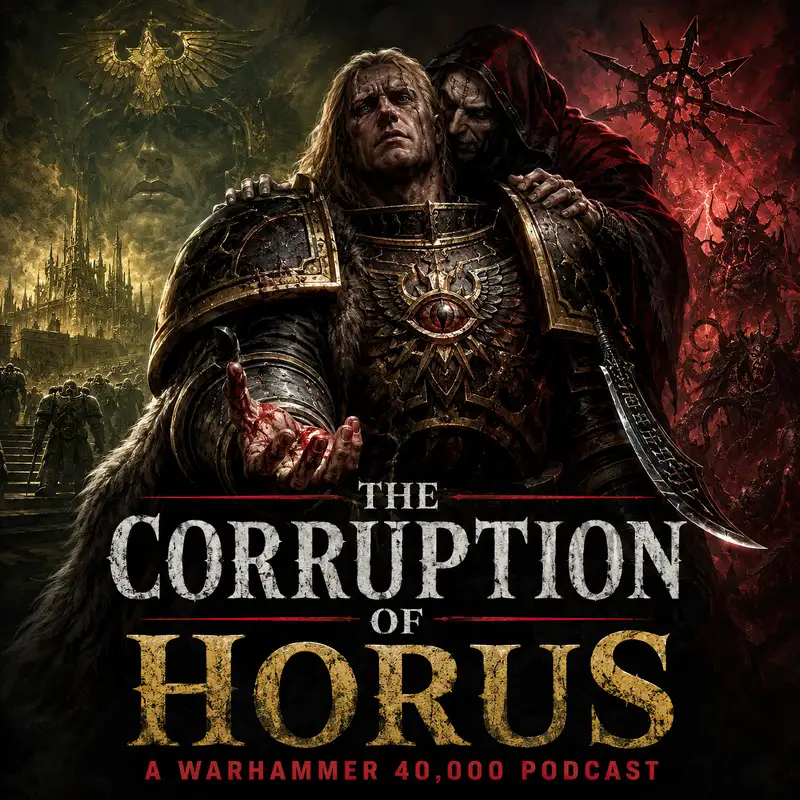
The Corruption of Horus
The wound that broke the Imperium did not look important. Horus had survived battlefields that erased cities and campaigns that consumed fleets. On the moon of Davin, he was cut by a single blade in the hand of a dying man. The Warmaster remained standing long enough to win the duel. Then the wound began to kill him.
That moment is often treated as the fall of Horus, as though the greatest son of the Emperor was loyal before the blade touched him and a traitor the instant it did. The truth is more dangerous. The weapon opened his body, but the path into his mind had been prepared in advance. His corruption was not one event. It was a campaign, planned with patience, fought through pride, fear, secrecy, grief, and carefully selected truths.
Only a short time earlier, Horus had stood at the summit of Imperial power. Ullanor had ended in triumph. The largest Ork empire yet encountered by the Great Crusade had been broken, the Emperor had named Horus Warmaster, and the Luna Wolves had become the Sons of Horus. Among the primarchs, Horus was first in honour and first in responsibility. He commanded the armies that were meant to reunite humanity.
Then the Emperor left.
He returned to Terra without fully explaining why. The hidden purpose was the Imperial Webway project, an attempt to free humanity from dependence on the warp. Horus did not know that. Most of the primarchs did not know it. What Horus saw was abandonment. The father who had raised him above his brothers had handed him the crusade, withdrawn behind the walls of the Imperial Palace, and allowed civilian authorities to assume increasing control over the worlds the Legions had conquered.
The appointment was an honour, but it was also an impossible job. Horus had to manage rival primarchs, expeditionary fleets, compliance campaigns, supply lines, and the growing demands of the Council of Terra. He was expected to speak with the authority of the Emperor while lacking the one thing that had made the Emperor’s authority unquestionable. He was not the Emperor.
Horus had always been more than a battlefield commander. He understood ceremony, persuasion, personal loyalty, and the value of making another man feel seen. He could bring difficult brothers into agreement because he knew when to flatter, when to challenge, and when to listen. He had genuine warmth. He also needed recognition. The same gift that allowed him to read other people made him acutely aware of how they judged him.
That was the first fault line.
The Emperor’s departure did not create Horus’s pride, but it gave that pride a grievance. Every new order from Terra could be interpreted as a vote of no confidence. Every bureaucrat who questioned a campaign seemed to diminish the sacrifice of the Legions. The Council began sending administrators and tax officials into compliant worlds with the confidence peculiar to people who had not conquered them. Horus increasingly wondered whether the warriors of the Great Crusade were being used to build an empire that would soon have no place for them.
His doubts were not entirely foolish. The Imperium really was changing. Civilian government was expanding. The primarchs had not been told what role they would have when the crusade ended. The Emperor really had concealed his greatest work. A lie becomes easier to sell when it is built around questions that honest men have refused to answer.
Horus still possessed voices capable of challenging him. The Mournival, his council of four senior captains, existed partly to provide disagreement without public humiliation. Ezekyle Abaddon represented force and certainty. Horus Aximand offered discipline and thought. Tarik Torgaddon brought instinct and irreverence. Garviel Loken, newly appointed after the death of Hastur Sejanus, brought conscience.
The Mournival was not a formal command body. It was a pressure valve. Its members could argue positions Horus needed to hear, allowing the Warmaster to consider alternatives while preserving authority. The system depended on trust. It also depended on the counsel reaching Horus before someone else shaped the question.
Erebus understood that.
The First Chaplain of the Word Bearers arrived as a brother, advisor, and honoured guest. The Word Bearers had already turned from the Emperor, though their betrayal remained hidden. After the humiliation of Monarchia, Lorgar’s Legion had sought new gods and found the powers of the warp. They did not intend merely to rebel. They intended to convert the Imperium’s greatest champion.
Horus was the obvious target. A revolt led by Lorgar could be dismissed as vengeance. A revolt led by one angry primarch could be contained. A revolt led by the Warmaster could divide every expedition, every Legion, and every oath of loyalty in the Imperium. Horus did not simply command armies. He connected them.
Erebus approached him without appearing to attack anything. He encouraged doubts that already existed. He offered sympathy where the Emperor had offered silence. He was exceptionally skilled at being present when another man believed he had reached an idea alone.
The first decisive move came during contact with the Interex. They were a human civilisation that had developed alongside the alien Kinebrach and possessed a sophisticated understanding of the danger represented by Chaos. Horus saw in them a chance to prove that compliance did not always require conquest. He wanted negotiation. He wanted a victory that demonstrated he could lead the Great Crusade with judgment rather than imitation.
The possibility mattered because Horus was already trying to define what kind of Warmaster he would be. The Emperor had united Terra and expanded through overwhelming force. Horus wished to show that he could complete the work with diplomacy where possible. Peace with the Interex would have been a political achievement, not merely a military one.
Erebus destroyed it.
Inside the Interex’s Hall of Devices was an anathame, a weapon of Kinebrach manufacture associated with the powers the Interex understood as Chaos. Erebus stole it. The theft confirmed every Interex fear about the Imperium. Suspicion became violence, negotiations collapsed, and Horus’s attempt at a different kind of compliance ended in blood.
The Warmaster believed he had failed. He did not yet understand that the failure had been arranged.
The anathame passed from Erebus into the hands of Eugen Temba, a man Horus had once trusted. Temba had been left to govern Davin. By the time Horus returned, he had become the centre of a rebellion and the servant of a corruption spreading across Davin’s moon. The distress call was bait, but it was bait chosen with care. Temba’s betrayal was personal. Horus could not leave it to subordinates without appearing afraid or indifferent.
The Sons of Horus descended into a landscape transformed by disease and the warp. The dead did not remain properly dead. The air, the soil, and the enemy all carried the touch of decay. Temba waited at the centre of it, swollen by unnatural power and armed with the stolen anathame.
Horus confronted him because that was what Horus did. He led from the front, and his presence turned danger into loyalty. Against ordinary enemies, this was one of his greatest strengths. Against an enemy who had prepared a weapon for him specifically, it became a predictable route to the target.
Temba was no match for a primarch in any normal contest. The contest was not normal. The anathame had been prepared to recognise Horus. It needed only one wound.
The Warmaster killed Temba, but the blade cut him. The injury resisted every effort of the Legion’s apothecaries. His primarch body, capable of surviving damage that would destroy an armoured vehicle, began to fail. The Sons of Horus had built their identity around a commander who seemed impossible to kill. Now they watched him dying from a wound they could not understand.
Fear changed the balance around him.
The return to the Vengeful Spirit made the Legion’s panic visible. Sons of Horus carrying their wounded primarch forced a path through mortal personnel who had gathered in confusion. People were knocked down and killed beneath the advance of warriors who could think of nothing except reaching the apothecaries. It was not a planned atrocity. In some ways, that made it more revealing. The Legion that claimed to fight for humanity treated individual humans as obstacles the instant its father was threatened.
The scene exposed the emotional structure of a Legion built around a primarch. Horus was commander, symbol, and source of identity. If he died, the Sons of Horus would not merely lose a general. They would lose the man whose name they had taken. Their fear made almost any remedy acceptable and made anyone urging caution appear disloyal.
The Mournival and the senior officers faced a crisis for which neither doctrine nor medicine offered an answer. Some resisted the only alternative presented to them. Others were willing to risk anything. Secret warrior lodges had already spread within the Legions, offering fraternity across rank and a private space outside formal command. That could sound harmless. Armies have long invented ways to complain about officers without inviting the officers. The danger was not fellowship. It was loyalty hidden from scrutiny.
On Davin, the lodge tradition led to the Serpent Lodge. Its priests claimed they could heal Horus through rituals outside Imperial reason. Entrusting the Warmaster to a secret cult on a corrupted world was not an ideal medical procedure. Desperation has lowered more impressive standards.
Horus was carried into the lodge while his sons argued over whether saving him justified the means. That decision mattered almost as much as the wound. The conspiracy did not need every officer to understand Chaos. It needed enough of them to accept secrecy, break procedure, and silence opposition in the name of loyalty.
Within the ritual, Horus entered a realm of visions. There Erebus approached him wearing the appearance of Hastur Sejanus, the dead friend whose place in the Mournival had never fully ceased to hurt. The disguise was chosen with precision. Erebus did not appear as a monster demanding worship. He appeared as someone Horus loved and trusted.
The visions showed Horus fragments of a possible future. He saw an Imperium where the Emperor was worshipped as a god despite having condemned religion. He saw monuments honouring some primarchs while others, including Horus, had been erased or condemned. He saw humanity ruled by fear, ritual, and stagnation. The future resembled the Imperium of the forty-first millennium.
The images were not necessarily false. That was what made them effective.
A vision can be accurate and still be a lie. Context determines meaning. Horus was shown the outcome without being shown the chain of choices that produced it. He saw the Emperor worshipped, but not how the Heresy would make that worship politically and emotionally inevitable. He saw himself condemned, but not the rebellion that would earn the condemnation. He saw loyal primarchs remembered, but not the price they would pay resisting him.
Chaos offered him a future partly created by his own reaction to seeing it.
He was also shown the primarch project and the scattering of the Emperor’s sons, framed as evidence that the Emperor had hidden bargains, manipulated his children, and planned to use them as tools. Some of these suspicions touched real mysteries. The Emperor had concealed the origin of the primarchs. He had concealed the nature of the warp. He had forbidden religion without giving his sons the full truth about the beings that would exploit it.
Secrecy had created empty spaces. Erebus filled them.
Horus’s deepest fear was not death. It was irrelevance. He had been first found, favoured son, commander of the crusade, and the brother expected to hold the others together. The visions suggested that all of this was temporary. The Emperor would ascend, humanity would forget Horus, and the Warmaster would be discarded when his usefulness ended.
That fear was tied to a second wound. Horus believed he had earned trust, yet the Emperor had not trusted him with the truth. He had been given responsibility without understanding. In his mind, the concealment became evidence that the Emperor’s love had always been conditional.
Magnus the Red attempted to intervene. Through his own psychic power, he entered the vision and warned Horus that he was being deceived. He exposed Erebus’s disguise and urged his brother to reject what he had been shown. For a moment, the conspiracy stood in the open.
Horus now knew that Erebus had lied to him.
This is the point where the story becomes a tragedy of choice rather than a tale of simple enchantment. Horus did not accept the vision because he remained completely fooled. He accepted its central accusation because it spoke to fears he had already begun to prefer over trust. Magnus could reveal the false guide, but he could not explain the Emperor’s secrecy. He could warn Horus about manipulation, but he could not give him the reassurance the Emperor had withheld.
Horus chose to believe that rebellion was liberation.
He did not wake from the Serpent Lodge describing himself as a servant of dark gods. He saw himself as a leader who had uncovered a betrayal. He believed he could use the powers of the warp without kneeling to them. He imagined an alliance in which he remained master of his purpose.
Chaos rarely begins by asking a proud man to call himself a slave. It offers him the chance to become more fully himself.
The healing of the wound seemed to confirm the bargain. Horus returned to his Legion alive, restored, and carrying a new certainty. To those who loved him, survival looked like proof that the lodge had saved him. Few could see that the man who emerged had reorganised the meaning of every grievance he carried.
The change was not so complete that everyone could see it at once. Horus still laughed, persuaded, remembered old comrades, and spoke in the language of the Great Crusade. He remained capable of affection and tactical brilliance. Corruption did not replace him with a stranger wearing his face. It altered the conclusions he drew from the same memories and gave his worst impulses a moral purpose.
That continuity made him far more dangerous. A visibly possessed Warmaster would have united the Legions against him. A familiar Horus, wounded by apparent betrayal and still speaking of humanity’s future, could recruit brothers who would never have followed a daemon. His fall had to look, at first, like judgment.
The Emperor’s silence was no longer painful. It was evidence.
The Council of Terra was no longer inconvenient. It was the machinery of dispossession.
The coming age of civilian rule was no longer a difficult transition. It was a plan to discard the Legions.
The Imperial Truth was no longer an imperfect defence against superstition. It was a deception hiding the real powers of the universe.
Each conclusion contained enough truth to survive examination. Together they formed a false world in which betrayal appeared to be duty.
Horus began to test loyalties, draw conspirators closer, and isolate those who might resist. He did not announce his new allegiance to every son. The corruption spread through controlled disclosure. Officers already tied to the lodges received trust. Those who valued the old ideals of the crusade were watched. The Warmaster who had once used personal understanding to unite men now used the same gift to divide them.
His charisma did not disappear when he fell. It became a weapon.
That is why the corruption of Horus cannot be reduced to Erebus, the anathame, the Serpent Lodge, or the visions. Erebus designed the trap. The blade made Horus vulnerable. The lodge created the encounter. Chaos supplied the images and the power. The Emperor’s secrecy supplied the unresolved doubts. Yet none of these elements alone completed the fall.
Horus supplied consent.
That does not mean his choice was free in the ordinary sense. He was dying, isolated, deceived, and subjected to powers no human court could sensibly treat as fair persuasion. His fears were deliberately magnified. His memories were manipulated. The people around him had been selected and influenced. The entire sequence was an ambush conducted against the mind.
Even so, the ambush worked by making treason resemble the fulfilment of Horus’s virtues. His responsibility became the belief that only he could save humanity. His loyalty to his brothers became anger that the Emperor had used them. His desire for peace became hatred of a system he believed would betray every compliant world. His confidence became certainty that he could bargain with gods and remain independent.
He did not abandon his identity. He allowed Chaos to explain it to him.
The final irony is that Horus acted to prevent the future he had seen and became its principal author. His rebellion shattered the secular project of the Emperor. It forced desperate loyalists to build symbols of unity around the Emperor’s person. It destroyed institutions that might have restrained religious rule. It killed, corrupted, or scattered the primarchs. It made Horus the name that Imperial history could remember only as a curse.
The gods did not need to show him a false future. They needed only to hide his place in causing it.
On Davin, a primarch entered the Serpent Lodge believing he was the abandoned son of a secretive father. He emerged believing he was the only man capable of rescuing humanity from that father. Between those two beliefs lay the corruption of Horus: not the extinction of his will, but its redirection toward a lie powerful enough to make betrayal feel like command.