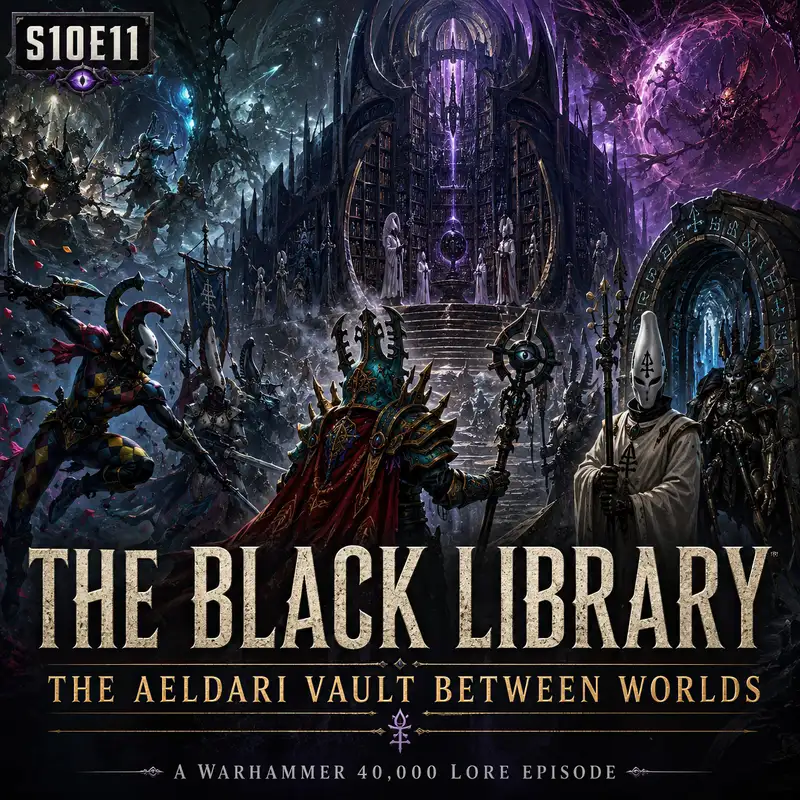
The Black Library: The Aeldari Vault Between Worlds
There is a place that Ahzek Ahriman has hunted for almost ten thousand years, and when he finally came within sight of it, the Aeldari chose to destroy the road rather than let him pass. The road was a living artery of the Webway, one of the hidden passages crossing the spaces between reality and the warp. Harlequins and warriors from Ulthwe and Lugganath fought among those impossible corridors until the dead clogged the way. When Ahriman was driven back, the breach was sealed. A whole section of the Webway was lost forever. That was considered the safer outcome.
At the end of that ruined road stood the Black Library, the most secret archive in Aeldari civilisation. It is called a library, but that word is almost misleading. It is an artificial world, a fortress, a quarantine vault, a temple of memory, and perhaps a weapon whose ammunition consists of truths. Its shelves are said to hold the most complete surviving knowledge of Chaos. That raises the central question. Why would the Aeldari preserve knowledge so dangerous that they would kill, deceive, and even amputate part of the Webway to keep others from reading it?
The first part of the answer is its location. The Black Library exists wholly within the Webway, the ancient network of psychoactive tunnels that allows travellers to cross vast distances without sailing directly through the warp. The Webway is not ordinary space, but neither is it the open immaterium. It is a sealed road system passing through hostile territory, built in an age when the galaxy possessed engineers with an unreasonable degree of confidence. Much of it is now broken. Some routes end in ruins, some open into daemonic danger, and others no longer lead where they once did.
A place hidden within that maze has no simple address. It cannot be reached by plotting a course across a star chart. The paths must be known, opened, and survived. Some accounts describe guarded Webway gates. Others speak of the Endless Stair, a coiling vortex of silver runes through which White Seers and their strange engines can move from one portal to another. Even these routes are controlled secrets, obscured by those who understand the labyrinth better than any Imperial navigator.
The Library is often described as a dark craftworld, though it is not simply another vessel like Ulthwe or Iyanden. It is made from wraithbone and possesses the scale of an artificial world, yet its structure reflects the shifting Webway around it. Corridors may not remain familiar. Chambers need not respect ordinary geometry. The Library is a labyrinth inside a labyrinth, enclosed by a formidable psychic barrier and protected by a mind of its own. Those judged weak, corruptible, or unworthy may find that the building itself refuses them.
Its origin is deliberately uncertain. Some traditions connect it to the Old Ones. Others place its creation in the hands of the ancient Aeldari or their gods. Cegorach, the Laughing God, is most closely associated with it and may have founded it, though anything designed by the divine patron of riddles, reversals, and concealed jokes should be approached carefully. Cegorach survived the Fall when most of the Aeldari pantheon did not. A hidden archive protected by his servants may be an act of preservation. It may also be a stage on which a plan has been unfolding for millennia.
The Fall explains why preservation became necessary. Before their catastrophe, the Aeldari possessed a civilisation of immense psychic and technological power. They also developed the appetites and obsessions that fed the birth of Slaanesh. When the new Chaos God awakened, the heart of their empire was consumed, their gods were broken or scattered, and uncounted worlds vanished into the Eye of Terror. The survivors carried fragments of what had existed. Craftworlds preserved what they could, but they drifted apart, followed different paths, and were destroyed one by one across the long millennia.
Knowledge became another endangered population. A tradition held by one craftworld might disappear when that craftworld died. A warning understood by one school of seers might be lost with its last teacher. Archives could be shattered, corrupted, or stranded beyond reach. The Black Library became the one surviving repository of Aeldari knowledge about Chaos that remained largely intact after the Fall. Its custodians did not merely stack ancient volumes and admire the binding. They continued to collect, compare, transcribe, and contain what the galaxy kept learning the hard way.
That last word matters. Chaos is not a passive subject. A military historian can read about an old campaign without the campaign reading back. A scholar of the warp enjoys no such guarantee. Names can summon attention. Symbols can carry influence. A ritual recorded to warn future generations can also become instructions for the ambitious. The promises of Chaos are dangerous because they are not always lies. They may offer power, knowledge, revenge, healing, or escape, then collect payment in a currency the victim did not know was being spent.
The Black Library therefore holds both information and infection. Its psychically locked chambers contain studies of daemons, sorcery, cults, corrupted artefacts, and the many ways the Ruinous Powers enter mortal thought. Some records concern the temptations of Chaos. Others describe its forms, servants, rituals, and weaknesses. A copy of the Book of Magnus is said to rest there. Other works deal with the Rhana Dandra, the final battle of Aeldari prophecy, the fate of the fallen Phoenix Lord Arhra, and mysteries connected to ancient star gods. Rumour adds still more, because secrecy produces a remarkably generous catalog.
The contents are not limited to ordinary books. Aeldari records may be crystal, song, psychic impression, living memory, or devices that cannot be separated neatly into text and machine. Dangerous objects are placed within nullifying containers and sealed vaults. White Seers use methods of suppression rather than assuming that a locked door is an adequate response to daemonic influence. The Imperium also uses vaults, purity seals, armed guards, and prayers, though it often applies them after someone has already opened the box. The Black Library prefers the guards to arrive first.
Preserving such material creates a permanent contradiction. The knowledge must remain available to those fighting Chaos, because ignorance allows old corruptions to return under new names. Yet the same knowledge must be denied to those who would use it. The Library is not a public university. It is a controlled arsenal. Every record may be a defence, a lure, or both. The custodians are not only librarians. They are armourers deciding who may be trusted with a weapon that can fire in several directions, including inward.
The most visible guardians are the Harlequins, servants of Cegorach who move between the divided branches of Aeldari society. To outsiders they can appear theatrical, brightly dressed, and almost frivolous. This impression usually lasts until the performance reaches the part where the audience is killed. Harlequins preserve Aeldari history through ritual drama, especially the Fall, but for them art and war are not separate occupations. A masque may carry a warning, manipulate a campaign, assassinate a leader, or redirect an enemy toward another enemy, all while following a pattern only its Shadowseers fully understand.
Their relationship with the Library is natural because both institutions turn memory into action. Harlequins use what the archive preserves in their war against Chaos, and guard the approaches so others cannot do the same for less admirable reasons. They know hidden routes through the Webway and deliberately confuse those routes for everyone else. A map can be falsified. A gate can become an ambush. A traveller may believe he has discovered a path when he has actually been allowed to discover the place where the guardians intend to kill him.
Solitaires hold a particularly ominous place in this defence. They are Harlequins who perform the role of Slaanesh in the great dramas of the Fall, and their souls stand in a dangerous relationship with the god they portray. They are among the few said to come and go from the Library freely, and some accounts suggest they alone know the truest paths to it. This is appropriate in the bleak way the Aeldari often consider appropriate. The route to their most sacred vault may be entrusted to those who spend their lives playing the enemy that destroyed them.
Beyond the Harlequins stand the Guardian-Scribes, figures described as among the most terrible perils of the Webway. Their title sounds administrative, which is a useful reminder that Aeldari administration may include psychic judgement, ancient war constructs, and immediate execution. They watch over the collection, collate its knowledge, and prepare material that can be passed to the wider Aeldari when necessity demands. Other defenders include pledged Rangers and wraith constructs, because even a sentient fortress benefits from guards at the doors.
The White Seers serve as curators, wardens, and specialists in containing Chaos. They dedicate themselves to opposing Slaanesh and the other Ruinous Powers, learning rituals of defiance and methods for suppressing corrupt influence. Their plain white robes and featureless masks contrast sharply with the colour and movement of the Harlequins. Where a masque meets Chaos with speed, misdirection, and performance, the White Seers meet it with disciplined denial. They handle artefacts too dangerous for ordinary guardians and wield devices capable of unmaking daemonic forms rather than merely injuring them.
A Black Council of powerful farseers is also associated with the Library, advising its custodians and judging rare petitioners. This matters because the institution belongs to no single craftworld or military command. It stands above many divisions that have shaped Aeldari survival since the Fall. Biel-Tan, Ulthwe, Iyanden, Alaitoc, and others may disagree profoundly about the future of their species, but none can afford to treat the knowledge of Chaos as someone else’s departmental problem.
Entry is not granted merely because someone finds a gate. The Library’s psychic defences are said to test those who approach, barring minds vulnerable to corruption. Harlequin escorts and the judgement of the custodians add further layers. Even trusted visitors do not wander alone with a lamp and a note saying they will return the forbidden grimoire by the end of the week. Access is a calculation. What does the visitor know, what do they seek, what might they become after learning it, and who will suffer if that calculation is wrong?
A small number of humans have nevertheless been admitted. This shows that the Library is strategic rather than merely sacred. The Aeldari do not distribute their most dangerous secrets to the Imperium out of neighbourly warmth. A human may enter when that person’s war against Chaos, knowledge, or future usefulness outweighs the risk. The best-known case is High Inquisitor Bronislaw Czevak, an Imperial scholar whose expertise concerning the Aeldari made him valuable, irritating, and difficult to ignore.
Harlequins invited Czevak after years spent studying Aeldari civilisation. He understood that accepting could mean never returning to the Imperium, and he went anyway. That decision captures the appetite defining many great inquisitors. They pursue forbidden knowledge because someone must understand the enemy, and because they are certain they are the someone. Czevak later became entangled with Ahriman, torture, Harlequin intervention, and the theft of the Atlas Infernal, a living map connected to secret Webway routes.
Czevak escaped carrying the Atlas and argued that it had once been Imperial property. This was technically a position. It was not one likely to impress the owners of the vault he had fled. The artefact demonstrates why location is as important as walls. A fortress hidden in the Webway depends on control of approach, and a map revealing forgotten gates can be more dangerous than a battleship. Ahriman wanted it because a reliable path toward the Black Library could end the search that had consumed most of his existence.
Ahriman is the perfect enemy for the Library because he does not think of himself as a mere destroyer. He is a scholar, sorcerer, and former chief librarian of the Thousand Sons. His greatest crime was committed as an attempted cure. The Rubric he cast to save his Legion from mutation reduced many of his brothers to dust sealed inside their armour, while transforming the surviving psykers into beings of formidable power. He has spent millennia seeking knowledge that might reverse his failure, master fate, and escape the designs of Tzeentch.
That search makes him more dangerous than a conqueror who wants to burn the shelves. Ahriman wants the names, patterns, prophecies, and hidden mechanisms that could make Chaos predictable. He believes knowledge can free him from manipulation, even though his patron is the Chaos God of change, sorcery, ambition, and schemes within schemes. The contradiction is so complete that it may be the point. Every step toward perfect understanding may also be another step along a path Tzeentch prepared for him.
Shortly before the thirteenth Black Crusade, Ahriman and his forces broke into the Webway and drove toward the Library. The fighting was not a conventional siege. There were no open fields or tidy lines of advance. The battlefield consisted of tunnels that could shift, gates that could be sealed, and passages whose loss might isolate entire regions. Harlequin masques fought beside warriors from Ulthwe and Lugganath, an alliance shaped less by affection than by the shared desire to prevent a catastrophe.
Ahriman advanced close enough to see the Library, according to surviving accounts. After millennia of pursuit, the prize stood before him, an impossible dark world holding answers he believed could change his fate. The defenders still drove him back. The dead filled major arteries of the Webway, and the damage caused by the sorcerers could not be repaired safely. The Aeldari sealed the breach and sacrificed the route. They did not defeat the threat without cost. They removed the ground on which the threat advanced.
This was not the response of curators protecting rare antiques. It was the response of soldiers defending a strategic weapon from capture. Losing part of the Webway could strand communities, close military routes, and erase paths that had survived since before humanity’s recorded history. Those consequences were accepted rather than risk Ahriman reaching the collection. The calculation tells us what the Black Library contains more clearly than any catalog could. Whatever lies inside, the Aeldari believe its misuse could cost more than irreplaceable roads between worlds.
The Library also preserves prophecies that shape Aeldari action. For ages, a crystal tome bound by chains of light rested upon an obsidian plinth at its heart. As foretold events came to pass, the chains vanished one by one. The final locks faded around the destruction of Dúriel, the maiden world also known as Valedor, where Aeldari forces destroyed the planet to prevent two Tyranid hive fleets from combining. The tome opened shortly before the Great Rift tore the galaxy apart.
Its writings were attributed to Cegorach and described a final act overturning the expected end of the Aeldari story. Instead of Slaanesh completing their destruction during the Rhana Dandra, the Laughing God would somehow trick the Dark Prince into expending her own power to save those she meant to consume. The meaning remains uncertain. The Ynnari, followers of the death god Ynnead, offer one interpretation, but Aeldari prophecy is not a railway schedule. It shows patterns, choices, and prices, often while withholding the courtesy of explaining which is which.
Then the Great Rift proved that even the best-hidden vault was not beyond catastrophe. Warp storms damaged the Webway and affected the Library itself. A section was lost into the raw warp and fell under the influence of Slaanesh. The White Seers could not cleanse or recover it. The enemy did not pass the guards. Reality failed around the collection, and part of the fortress crossed the boundary it had been built to resist. Records gathered to understand Slaanesh now lay within the domain of the power they were meant to oppose.
That loss makes the Black Library a wounded institution rather than an untouched sanctuary. Its knowledge can be stolen. Its roads can be broken. Its prophecies can be misunderstood. Its chambers can fall. Yet it remains valuable because its custodians preserve evidence, failed rituals, enemy methods, and warnings written by a civilisation that has already seen knowledge become appetite and appetite become a god. Their wisdom lies less in knowing everything than in refusing to pretend that all knowledge is safe.
The Library’s independence carries its own danger. Craftworld seers may consult it, Harlequins may act upon its designs, and rare outsiders may enter when their usefulness is great enough, but none truly owns it. Its standards are shaped by ancient custodians and the hidden purposes of Cegorach. A prophecy may be read too narrowly. A visitor may escape with more than intended. A sealed record may contain an answer desperately needed elsewhere. Secrecy prevents corruption, but it also prevents accountability. In the forty-first millennium, even wisdom travels armed and under suspicion.
The Black Library is black not because it belongs to Chaos, but because it preserves the shadow cast by knowledge. It holds what the Aeldari cannot afford to forget and cannot safely remember without restraint. It is hidden between worlds because ordinary distance is not enough protection. It is guarded by performers, seers, sentient walls, and killers because a locked archive of Chaos is still an archive of Chaos. And when Ahriman stood close enough to see it, the Aeldari destroyed the road behind their own defenders.
The vault exists because the Aeldari understand that learning can become contamination, temptation, or conquest. Survival depends on preserving dangerous truths without surrendering to them. The Black Library stands in the Webway as both memory and warning, a dark artificial world surrounded by paths that may change while they are being walked. Somewhere within, the last intact records of ancient disasters wait behind psychic seals. Somewhere outside, seekers still hunt for the door. Between them lies a road the Aeldari are always prepared to erase.