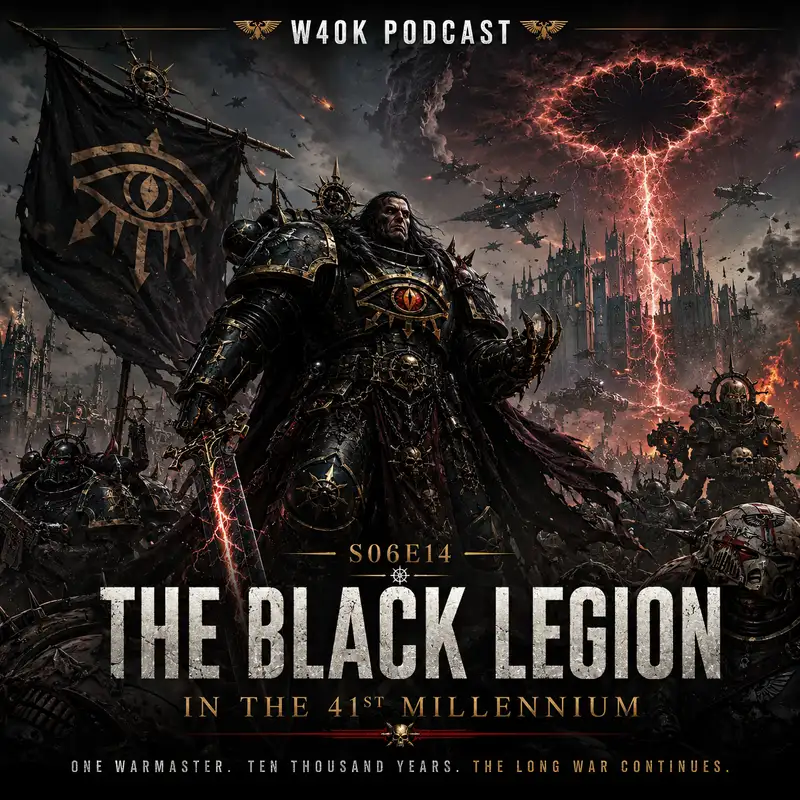
The Black Legion in the 41st Millennium
Cadia did not fall because Abaddon the Despoiler finally discovered how to win a war. It fell because he had been fighting the same war for ten thousand years, while the Imperium kept insisting that each earlier campaign had ended in failure. When the fortress world finally broke, the black-armoured warriors beneath the Eye of Horus were not celebrating a single victory. They were watching a strategy older than most Imperial institutions reach its intended conclusion.
That is the central fact of the Black Legion in the forty-first millennium. It was not simply the largest surviving fragment of the Sons of Horus, nor a guard preserving a dead primarch’s memory. The Black Legion was an attempt to create something Chaos rarely sustains: a military identity broad enough to unite bitter rivals, durable enough to survive centuries of defeat, and focused enough to keep returning to the same objective. That objective was the Long War against the Imperium.
The Legion began in disgrace. When Horus died aboard the Vengeful Spirit and the assault on Terra collapsed, his sons carried a special burden into exile. Every Traitor Legion had failed, but the Sons of Horus had been the Warmaster’s own. Their primarch had led the rebellion, promised victory, and died at the instant when everything depended upon him. In the Eye of Terror, that made his surviving sons less respected than blamed. Former allies hunted them, mocked them, and stripped away their remaining strength.
The Eye of Terror was not a refuge in any ordinary sense. Time moved unevenly. Worlds shifted beneath impossible skies. Daemons bargained from behind familiar faces, and the Traitor Legions turned upon one another in the wars that followed the Heresy. Supplies, slaves, gene-seed, ships, and defensible territory became prizes. Ancient brotherhoods fractured into warbands. The rebels who had nearly conquered Terra discovered that damnation did not provide a functioning quartermaster corps.
Abaddon, once the First Captain of the Sons of Horus, withdrew from this collapse. The surviving accounts describe a long period of isolation and wandering, during which he rejected both the immediate scramble for power and the simple worship of his fallen father. Whether this was discipline, wounded pride, or refusal to join a losing contest remains uncertain. What matters is that he returned with a conclusion. Horus had failed, and any future war built around imitating Horus would fail with him.
The break became brutally literal when the body of Horus was stolen and used by Fabius Bile in his experiments. A clone of the dead Warmaster was created, wearing the face that had once commanded half the Legiones Astartes. Abaddon confronted it and killed it. He took the Talon of Horus, but he did not kneel to the memory attached to the weapon. The act was both inheritance and execution. He claimed the authority of the past by destroying its attempt to return.
From that contradiction came the Black Legion. Its warriors abandoned the sea-green colours associated with the Sons of Horus and took black and gold. The change was not merely cosmetic. It announced that the old Legion was dead, that shame would not be hidden behind nostalgia, and that service to Abaddon’s cause mattered more than descent from a single primarch. The Eye of Horus remained, but its meaning shifted. It no longer proclaimed loyalty to Horus as a living commander. It became the gaze of the Long War.
This distinction explains why the Black Legion could grow while so many other Traitor forces became narrower. Membership was not limited to the gene-sons of Horus. Veterans of other Legions, renegade Space Marines, dispossessed champions, sorcerers, pirates, and entire warbands could take the black. They did not need a shared father. They needed a shared enemy, sufficient ambition, and the willingness to accept Abaddon’s supremacy. For warriors raised to believe bloodline defined identity, this was close to revolutionary.
It was also practical. The old Legions preserved grievances from the Horus Heresy with impressive dedication and little administrative benefit. The Black Legion offered a new beginning without requiring anyone to become less hateful. A former World Eater could still worship violence. A sorcerer of the Thousand Sons could still pursue forbidden knowledge. A warrior marked by Nurgle, Tzeentch, Khorne, or Slaanesh could retain that devotion. The black armour covered difference. It did not erase it.
For that reason, the Black Legion was never a perfectly uniform army. It was a legion in ambition and scale, but a confederation in daily practice. Its hosts contained warbands with their own commanders, cults, traditions, grudges, and patrons. Some obeyed Abaddon from conviction. Some followed because he offered plunder and access to wars worth fighting. Some had calculated that defiance would be brief and educational. The lesson usually ended when the shooting stopped, though not always for the student.
Abaddon’s greatest achievement was therefore political before it was military. He made himself the one warlord whom other servants of Chaos could not safely ignore. He bargained with daemon princes, humbled rival champions, rewarded useful service, and destroyed threats that could not be bought. He did not command every Traitor Legion at all times. Even the title Warmaster of Chaos did not grant that kind of tidy authority. It meant that, when he called a Black Crusade, enough powers answered to make the Imperium tremble.
That tension defines his command. Abaddon needs the Ruinous Powers, but he cannot allow any one of them to own the Black Legion. A force dedicated wholly to Khorne would lose the sorcerers. A host surrendered to Tzeentch would repel those who prefer their treachery with fewer footnotes. The Black Legion therefore operates beneath the broad banner of Chaos Undivided, not because its members agree, but because Abaddon’s war requires their disagreements to remain temporarily less important than the Imperium.
The result is unity without trust. Black Legion commanders cooperate while watching one another for weakness. Champions compete for favour, relics, ships, and positions near the Warmaster. Possession, mutation, ambition, and ancient hatred constantly threaten cohesion. Abaddon does not solve these problems. He manages them. His Legion survives not because Chaos has become orderly, but because he turns rivalry outward often enough to prevent it from consuming the whole force.
Militarily, the Black Legion carries forward the aggressive tradition of the Luna Wolves and Sons of Horus. Abaddon favours the speartip assault, a concentrated strike against the enemy’s command, leadership, or decisive point. Rather than grind evenly across an entire front, the attack seeks the place where violence will cause the largest collapse. Terminators, chosen warriors, teleport assaults, boarding actions, and sudden orbital strikes all suit this method. It is a doctrine built around momentum, shock, and the removal of anyone likely to give sensible orders.
The speartip does not mean the Legion fights only with elite Space Marines. A Black Legion invasion can include mortal cultists, Traitor Guard, mutants, daemon engines, corrupted Titans, Dark Mechanicum support, allied warbands, and daemonic hosts. Its fleets carry slaves, artificers, navigators, priests, and everyone required to keep ancient warships moving where reality is optional. The armoured giants receive the legends. The war machine beneath them is far larger, and considerably less likely to receive a statue.
This breadth helps explain the Black Crusades. They were not thirteen repetitions of the same invasion plan. Each was a major eruption from the Eye of Terror with its own mixture of objectives, allies, and targets. Some sought weapons. Some broke Imperial defenses, tested routes, destroyed enemies, or secured knowledge needed later. Imperial authorities could claim victory whenever Abaddon withdrew, because the Imperium still held territory and the enemy had returned to the Eye. That assessment was comforting. Comfort was not the same as accuracy.
Later crusades deepened the pressure. Their exact purposes were not always visible to Imperial observers, and some records remain contradictory or shaped by propaganda. Even when a campaign fell short, it could damage the defenses surrounding the Eye, expose weaknesses, or remove an obstacle. This does not mean every reverse was secretly a flawless victory. Chaos is fully capable of losing a battle without improving anyone’s character. It means only that the larger war cannot be judged by territorial maps alone.
The twelfth Black Crusade, known as the Gothic War, revealed the scale Abaddon could command. He assembled a vast fleet and struck across the Gothic Sector in a conflict that lasted more than two decades. At its center were the Blackstone Fortresses, ancient installations of extraordinary destructive potential. By the war’s end, Abaddon had captured two of them. The Imperium had survived another invasion. The Despoiler had acquired weapons that would matter when he returned to Cadia.
The Legion also attracted renegades born long after the Horus Heresy. A Space Marine Chapter that turned against the Imperium might have no personal memory of Horus, Terra, or the original betrayal. The Black Legion did not require that memory. It could offer protection, purpose, and access to the largest anti-Imperial campaigns in existence. By the forty-first millennium, the Legion was both ancient and renewed, carrying Heresy veterans beside warriors whose hatred had recent causes.
The old Traitor Legions maintained their own identities, and they did not become subdivisions of Abaddon’s army. Word Bearers still pursued their faith. Iron Warriors still built and broke fortresses. Night Lords still used terror with the enthusiasm of specialists defending a professional reputation. The Black Legion drew contingents from such forces when interests aligned. Abaddon could create coalitions that no other warlord could reliably assemble, though reliability remained a relative term when several participants considered betrayal a sacrament.
His relationship with the daemon primarchs was even more complicated. They possessed immense power and the authority of their bloodlines, but they were also bound closely to their patron gods and their own obsessions. Abaddon could not simply issue orders to them as Horus once had. He had to bargain, provoke, persuade, or create circumstances in which participation served their desires. The Black Legion was strongest when the goals of many monsters briefly pointed in the same direction.
Abaddon’s contempt for Horus was part of that ideology. He saw the old Warmaster as a figure who had surrendered too much to the gods and allowed their power to consume his purpose. Abaddon intended to avoid that fate. Yet he carried Horus’s claw, commanded Horus’s ship, used Horus’s eye, and claimed a version of Horus’s title. He escaped his father’s shadow by turning it into a uniform. The contradiction did not weaken the Black Legion. It gave the Legion its central myth: inheritance without obedience.
The Imperium preferred a simpler story. In that version, Abaddon launched twelve Black Crusades and failed twelve times. The claim served morale, and from the perspective of individual defenders it often seemed true. Worlds held. Fleets survived. Crusades were driven back. The enemy disappeared into the Eye. What the official account missed was accumulation. Each war cost ships, soldiers, knowledge, and stability while forcing the Imperium to defend an enormous frontier. Each apparent victory preserved a gate that Abaddon was learning how to break.
By the closing days of the forty-first millennium, Cadia stood as the lock upon that gate. Its location near the most stable route from the Eye of Terror made it the foundation of Imperial containment. The Cadian pylons helped restrain the surrounding warp storms, though the Imperium understood little of their function. Generations of Cadians had been raised beneath the literal gaze of the Eye, trained from childhood to meet the invasion everyone knew would come. Eventually, it did.
The thirteenth Black Crusade was not merely another raid. Abaddon committed forces on a scale intended to shatter the Cadian Gate. The Black Legion stood at the center, joined by hosts from across the forces of Chaos. War spread through the surrounding systems and across Cadia itself. Imperial defenders fought knowing that retreat would open the road beyond the Eye. This was the kind of battle the Imperium understood well: hold the fortress, kill the invaders, and trust endurance.
For a time, endurance worked. Cadia’s defenders inflicted terrible losses, and the battle did not unfold as an effortless Chaos triumph. Abaddon’s ground assault met resistance fierce enough to frustrate any clean victory. The Blackstone Fortress known as the Will of Eternity was crippled in orbit. Then Abaddon turned defeat into a weapon. He sent the broken mass of the ancient fortress down upon Cadia. The impact shattered the planet. The defenders had held the ground, and the ground ceased to exist.
This was the Black Legion’s defining achievement in the forty-first millennium. It proved that a force born from the failure of the Horus Heresy could learn, adapt, and pursue a campaign across ages. The Legion endured because it was not limited to one bloodline, one god, or one style of war. It could absorb new hatred, recruit new traitors, and give ancient grudges a common direction. Its diversity was dangerous. Its discipline was conditional. Its purpose held them together.
That purpose also reveals the Legion’s weakness. The Black Legion is inseparable from Abaddon. Its warlords may command enormous hosts, but his authority gives the confederation meaning. Remove him, and the old divisions would immediately compete with the newer loyalties. The gods might divide the spoils. Rival champions might claim the title. Former Legions might reclaim their warriors. A structure built around one man’s refusal to submit remains vulnerable to the day when that refusal ends.
The black armour therefore means more than mourning. It is a declaration that failure can be made into identity, that broken armies can be rebuilt around a cause, and that ten thousand years is not too long to prepare an answer. At Cadia, the Imperium finally heard that answer. The planet cracked, the Great Rift opened, and beneath the dying light of the forty-first millennium, the Eye of Horus was still watching.