The Badab War: Rebellion Among the Space Marines
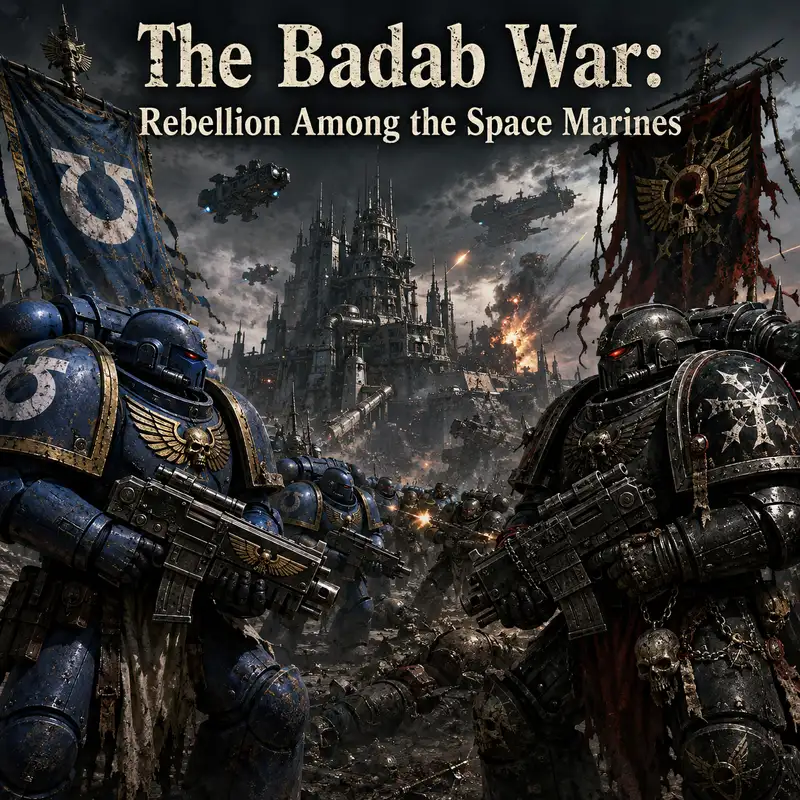
The first clear image of the Badab War is not a rebel banner or a Chaos altar. It is a corridor inside the Palace of Thorns, choked with smoke, broken masonry, and the bodies of Space Marines. On one side advance the Star Phantoms, sent to end a rebellion. On the other wait the Astral Claws, veterans who once defended the Imperium with distinction. Both wear armour built by the same civilisation. Both invoke duty, honour, and the Emperor. Both have spent years killing warriors who were supposed to be their brothers. By the time they meet beneath Badab’s guns, the question is no longer whether a line has been crossed. The question is how so many lines were crossed without enough people noticing. The Badab War did not begin with daemons whispering in a fortress monastery. It began with authority, resources, pride, and a commander who decided that only he understood what had to be done.
The surviving record is deliberately incomplete. Imperial accounts were placed under an Edict of Obliteration, and the fragments do not always agree. The conflict is usually reckoned from nine hundred and one to nine hundred and twelve of the forty-first millennium, although open warfare between Chapters began in nine hundred and four. For several years, the crisis remained something the Imperium is exceptionally good at producing: a lethal dispute that different offices insisted belonged to somebody else. Trade authorities called it a tithe problem. Naval officers treated it as piracy. Space Marines saw questions of honour and jurisdiction. The Inquisition arrived later and discovered that everyone had omitted useful details. By then fleets had vanished, worlds had burned, and transhuman warriors were settling administrative disagreements with boarding torpedoes. The Imperium had finally achieved clarity, but only after clarity had become expensive.
At the centre stood Lugft Huron, Chapter Master of the Astral Claws and ruler of Badab. He was not an obscure malcontent waiting for an excuse to betray the Emperor. The Astral Claws possessed an exceptional record of service, and Huron had earned a reputation as a gifted commander. His Chapter formed the leading element of the Maelstrom Warders, Space Marine Chapters assigned to guard the region around the Maelstrom. The Maelstrom was a vast wound where the Warp and realspace overlapped, sheltering pirates, renegades, xenos raiders, and worse things that tended to make routine patrol reports rather short. Huron believed the Warders were being asked to contain an expanding strategic threat with insufficient forces. On that point, he was probably correct. His proposed solution was a great crusade into the Maelstrom, led by himself, to destroy the danger at its source. The High Lords refused. Imperial troops were needed elsewhere, as they nearly always were.
Huron treated that refusal as proof that distant rulers neither understood nor valued the frontier he defended. After a failed coup against Badab’s existing governor, he assumed direct control of Badab Primaris and then claimed authority over the wider sector. He presented the move as a security necessity. There was precedent for Space Marines governing substantial territories, most famously in Ultramar, so the act was not automatically treason. It was, however, a warning. A Chapter Master who commanded a fleet, controlled recruitment, ruled planets, directed trade routes, and interpreted Imperial law for himself had begun to resemble a sovereign. Huron still spoke in the language of service, but service increasingly meant obedience to his judgement. The difference between protecting a realm for the Imperium and possessing that realm personally can appear very small from a throne. It becomes clearer when someone asks to inspect the accounts.
Badab’s wealth and strategic resources normally passed through neighbouring authorities in the Karthago Sector. Huron began retaining them for local defence. He also withheld the Astral Claws’ gene-seed tithe, the biological material Chapters submitted for testing and oversight. To Huron, these resources were being wasted while the Maelstrom remained unsecured. To the trade lords of Karthago, he was strangling their economy and leaving them responsible for quotas they could no longer meet. To the Adeptus Mechanicus, the missing gene-seed was evidence that a Chapter had escaped supervision. Yet for roughly a century and a half, Huron faced no decisive punishment. The Imperium’s vastness protected him. Messages travelled slowly, institutions competed, and a famous Space Marine commander received more latitude than an ordinary governor would have enjoyed for approximately seven minutes. That delay allowed necessity to become entitlement. Huron fortified the sector, created the Tyrant’s Legion from Space Marines and human troops, and secretly expanded the Astral Claws beyond normal Chapter strength. He also concealed survivors of the supposedly lost Tiger Claws within his own ranks.
The Codex Astartes limited a Chapter to roughly a thousand battle-brothers because the Imperium remembered what happened when too much military power gathered beneath one charismatic commander. Huron considered the limit absurd for the task he had been given. He might reasonably argue that the Maelstrom required more defenders. He could not reasonably claim that secret armies, false records, and hidden gene-seed were the normal tools of loyal disagreement. In nine hundred and one, an Imperial tithe fleet entered the Badab system and demanded the resources long withheld. Badab’s forces ordered it to halt at the system’s edge. The fleet asserted Imperial authority and continued inward. What happened next remains disputed in detail. The result does not. The tithe fleet was destroyed. Huron claimed it had ignored navigation instructions and threatened violence. His opponents saw the attack as open rebellion. Two punitive expeditions sent by Karthago later disappeared, while piracy increased across the region. Whether every loss was Huron’s doing is unclear. He nevertheless used the uncertainty and treated investigation as an assault on rights he had defined for himself.
Huron gathered the other Maelstrom Warders and issued the Articles of Just Secession. The name captures the strange legalism of the rebellion. He did not declare that he served Chaos or rejected the Emperor. He argued that the Maelstrom Zone should separate from neighbouring Imperial authorities so the Warders could continue defending it without interference. In his version, secession was purified loyalty. The Lamenters and Mantis Warriors supported him. The Executioners later joined because of an old blood debt owed to the Astral Claws. These allies were not simply extensions of Huron’s ambition. The Lamenters were bound to the Warders’ cause and saw Huron as a proven commander abandoned by distant officials. The Mantis Warriors defended territory they had guarded for generations. The Executioners believed an honour debt must be paid. Huron’s most dangerous weapon was not deception alone. It was a grievance credible enough for honourable warriors to carry farther than wisdom allowed.
The shooting war began aboard a single vessel. In nine hundred and four, the Fire Hawks entered territory watched by the Mantis Warriors while investigating the missing fleets. Their ship, the Red Harbinger, refused demands to halt and explain its presence. The Mantis Warriors crippled and boarded it. The Fire Hawks refused to submit, and Space Marines exchanged fire at close range. That clash transformed a political crisis into an Astartes civil war. The Mantis Warriors saw an armed intrusion into their domain. The Fire Hawks saw unlawful resistance by secessionists already suspected of murder. Neither Chapter was inclined to retreat. Once blood had been shed, honour demanded a response, and then another response to the response. The early war remained confused. The Marines Errant arrived to aid the Fire Hawks, yet hesitated to fight the Lamenters because the two Chapters shared bonds forged in earlier campaigns. Space Marines are engineered for war, but they are not blank machines. Oaths accumulated across centuries, and Badab forced them to decide which obligation mattered most.
The Imperium finally intervened in force after Space Marines began killing one another too openly to dismiss. Envoys demanded a ceasefire and ordered the secessionist leaders to surrender for questioning. Huron refused. That refusal was decisive. He had destroyed Imperial ships, withheld tithes, expanded his forces, and claimed regional authority. Submission might have exposed everything. It also would have required him to accept that someone else possessed the right to judge him. The Imperial response brought in Chapters including the Red Scorpions, Raptors, Salamanders, and Fire Angels. It also investigated the original accusers. The trade lords of Karthago were found guilty of serious crimes and punished with the usual Imperial restraint, meaning generations of servitude for an entire population. Their guilt did not vindicate Huron. It demonstrated that corrupt officials and a rebel tyrant could oppose one another while both remained thoroughly guilty.
As loyalist strength grew, the war became a contest of systems rather than isolated battles. Huron possessed fortified worlds, experienced fleets, and territory prepared over decades. His Tyrant’s Legion allowed human soldiers to hold ground while the Astral Claws concentrated their strength. It was effective and revealing. Huron had built a regional war machine centred on his authority. Loyalist commanders answered with blockade, interdiction, and the seizure of routes connecting the secessionist Chapters. There were great fleet engagements and brutal planetary assaults, but the strategic pattern was gradual constriction. Supply lines were cut. Allies were separated. Safe harbours became traps. Worlds that had formed a defensive network became isolated fortresses. Huron had argued that only unified control could save the Maelstrom Zone. The war proved that he had indeed created unified control. It also proved how dangerous that control had become.
The conflict did not make the loyalist side noble by default. The Fire Hawks answered frustration with vengeance and fire-bombardment. The Minotaurs entered the war as an instrument of overwhelming violence, eventually crushing the Lamenters in close fleet actions and boarding assaults. Later, the Carcharodons were unleashed against the Endymion Cluster, using terror and systematic destruction to force the Mantis Warriors into battle. Some loyalist Chapters were disturbed by these methods. The Fire Angels withdrew partly because of losses and partly because of disgust. The Salamanders resisted efforts to remove them when the Inquisition sought commanders considered more willing to finish the war without hesitation. Badab was not a simple contest between honourable loyalists and depraved traitors. It was an Imperial civil war, which meant loyalty could be demonstrated through mercy, extermination, obedience, or refusal, depending on which authority was writing the judgement.
Huron’s cause grew darker as pressure increased. Astral Claws Apothecaries recovered gene-seed from the dead, including loyalist casualties, to sustain their swollen ranks. Heretical allies and forbidden weapons entered the story. On Sagan, the Astral Claws released virus weapons when defeat threatened, inflicting terrible losses without reversing the outcome. Then a captured Apothecary revealed that warriors of the supposedly lost Tiger Claws had been hidden among Huron’s forces. Inquisitorial investigation connected the secret to the withheld gene-seed and the unexplained resilience of the Astral Claws. They had not merely exceeded normal strength during an emergency. They had maintained a long-term clandestine programme to rebuild military power beyond lawful oversight. This was the central fear behind the post-Heresy structure of the Space Marines: an autonomous army with its own worlds, fleet, recruitment, and ideology could gradually become loyal only to itself. Huron believed limits made him weaker before the Maelstrom. The Imperium believed those limits made humanity safer from men like Huron.
The coalition then came apart. The Lamenters were trapped by the Minotaurs and forced to surrender after being reduced to a few hundred survivors, many wounded. The Mantis Warriors, isolated in their own territory, were driven into a hopeless defence by the Carcharodons’ campaign of terror. The Executioners eventually separated themselves from Huron’s cause after discovering how far the Astral Claws had fallen. None escaped consequence. The Lamenters, Mantis Warriors, and Executioners were condemned to century-long penitent crusades, stripped of territories or honours, and ordered to fight without replacing losses until their sentences were fulfilled. The punishments recognised a distinction between Huron’s deliberate rebellion and the compromised loyalties of his allies, but Imperial mercy remained a stern and heavily armed thing. The ordinary humans who had fought for Badab received less consideration. They were surrendered to Imperial institutions for punishment or servitude, because empires often reserve nuance for the powerful.
By nine hundred and twelve, the loyalists had reached Badab itself. The Palace of Thorns stood as Huron’s final stronghold, protected by immense defensive batteries and a garrison that knew every passage. The Star Phantoms led the assault beneath a colossal orbital bombardment, descending by drop pod and gunship into a fortress designed to kill attackers in layers. Hundreds of Space Marines fought through chambers, tunnels, and shattered halls. Assault squads abandoned jump packs for stealth in confined spaces. Terminators pushed into prepared killing grounds. Astral Claws struck from hidden routes, withdrew, and struck again. Above them, warships exchanged fire with ground batteries powerful enough to contest the sky. This was the end point of Huron’s project: a fortress world, a private army, and loyal warriors defending a realm they had once claimed to hold for the Emperor. The walls had been built against enemies from the Maelstrom. In the end, they were used against the Imperium.
The fortress did not fall through a grand duel at its gates. Star Phantoms infiltrated beneath the Palace through sewer networks and destroyed the generators feeding Badab’s defensive guns. Once the batteries failed, Imperial forces poured into the breach and the Astral Claws began to retreat. Captain Zhrukal Androcles of the Star Phantoms confronted Huron during the withdrawal and struck him with melta fire. The blast ruined much of Huron’s body, but did not kill him. More than two hundred Astral Claws escaped into the Maelstrom carrying their broken master. There, Apothecaries and artificers rebuilt him, and darker powers helped preserve what Imperial weapons had failed to finish. Lugft Huron became Huron Blackheart. The Astral Claws became the Red Corsairs. The commander who had demanded more strength to protect the Imperium turned the Maelstrom into a base for piracy, conquest, and war against it.
It is tempting to read that transformation backward and declare that Huron had always been a servant of Chaos. The evidence supports a less comfortable answer. His ambition was present early. So was his genuine strategic ability, and so was a danger Imperial authorities failed to address. Huron identified a problem, proposed a solution, and concluded that refusal proved the system illegitimate. He gathered resources without permission, removed oversight, concealed military expansion, destroyed investigators, and redefined loyalty until it meant agreement with him. Chaos did not need to invent his grievance. It only needed to offer survival after every lawful road had been closed by choices he had made. The Badab War shows that treason in the Imperium does not always begin with hatred of the Emperor. Sometimes it begins with a man insisting that only his disobedience can preserve the Emperor’s realm.
The war also reveals why Space Marine autonomy is both indispensable and frightening. Chapters must act independently because the Imperium is too large and slow to direct every battle from Terra. They are trusted with fleets, arsenals, gene-seed, recruiting worlds, and traditions older than many planetary cultures. That freedom lets them respond when orders never arrive. It also lets a Chapter mistake local necessity for permanent sovereignty. The Badab rebels were separate Chapters drawn together by honour, frustration, and loyalty to one another. Their fall shows that decentralisation can prevent one catastrophic legionary betrayal while still permitting smaller rebellions to form through networks of obligation. The Imperium answered by sending other autonomous Chapters, each carrying its own temperament and grudges. The system corrected itself, but in the manner of a fortress repairing a cracked wall by firing artillery into both sides of it.
At Badab, there were traitors, but also loyal warriors who made one compromised decision and defended it until the cost became unbearable. There were loyalists who restored Imperial authority through acts resembling collective punishment. There were corrupt bureaucrats, late investigators, and commanders whose honour prevented retreat while pride made reconciliation impossible. The rebellion was not a failure of courage. Courage was abundant. It was a failure of limits. Huron accepted no limit on what he could command. His allies accepted no limit on what honour required. The Imperium accepted no limit on the violence needed to reassert control. The Palace of Thorns fell, but the logic that built it survived wherever necessity was claimed as exemption from judgement.
The final image is Huron being carried into the Maelstrom, burned almost beyond recognition yet still alive. Behind him, Badab is lost, his allies are broken, and the Chapter he led with such pride has ceased to exist. Ahead lies a new empire assembled from renegades, stolen ships, and warriors who abandoned the Imperium for reasons of their own. He did not win independence for the Maelstrom Zone. He became one of its greatest predators. That is the answer to the Badab War’s central contradiction. The Astral Claws rebelled because their master claimed he needed freedom to defend the Imperium more effectively. Step by step, that freedom became secrecy, sovereignty, coercion, and open war. Huron began by arguing that the Imperium could not survive without men like him. He ended by proving why the Imperium had always feared them.