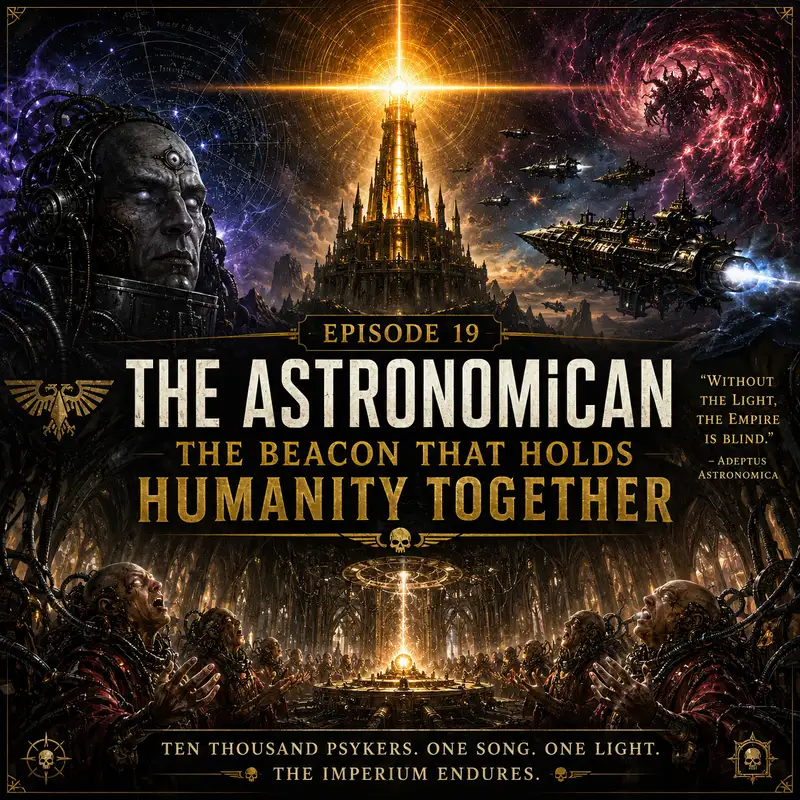
The Astronomican: The Beacon That Holds Humanity Together
For ten thousand years, Imperial Navigators had looked into the Warp and found a light. Then, in the closing days of the forty-first millennium, it vanished. Across the galaxy, captains watched their astropaths collapse, their charts become guesses, and their plotted roads dissolve into a storm without a horizon. Ships already in transit were thrown off course. Worlds that relied upon regular convoys became islands in a single night. On Terra itself, the darkness lasted thirty-three days. That was long enough to prove what Imperial propaganda usually concealed. Humanity's empire was not held together by borders. It was held together by a beacon.
The Astronomican is often described as a psychic lighthouse, which is accurate in the same way that calling a battleship a large boat is accurate. It points toward the right idea while stepping around the scale, the danger, and the machinery full of dying people. From its sanctuary beneath the mountains of Terra, the Astronomican shines into the Warp as the greatest fixed reference known to Imperial Navigators. It does not carry ships. It does not calm the Warp. It does not guarantee that anyone arrives alive. What it provides is orientation, and in the immaterium, orientation is the beginning of civilisation.
The Warp is not empty space with unpleasant weather. It is a parallel realm shaped by emotion, thought, memory, and forces that do not obey the rules of matter. Distances stretch or collapse. Time may pass differently for the traveller and the world left behind. Currents can carry a vessel rapidly toward its destination, or drag it into regions where no sane captain intended to go. A starship can enter near one system and emerge far from its planned route, years late, centuries early, or not at all. Human technology can open the way. Surviving the journey requires something more.
That something is the Navigator. Navigators are altered humans with a third eye capable of perceiving the Warp directly. They do not all experience it in the same way. One may interpret it as an ocean of currents and reefs. Another may perceive sound, colour, geometric forms, or impossible landscapes. Whatever private language the mind uses, the task is the same. The Navigator must read a realm that resists being read, steer a ship through it, and locate a point where realspace can safely be re-entered. The Astronomican gives one dependable answer to a vital question. Where is Terra?
That answer does not automatically reveal the destination. A sailor who can see a northern star still needs charts, experience, and some idea of where the rocks are. Imperial Navigators rely on inherited route lore, local psychic markers, known currents, astropathic beacons, and the guarded knowledge of their Houses. The Astronomican is the great constant against which those lesser signs can be judged. If its apparent position changes, the Navigator knows the vessel has been turned. If its light weakens, a storm or obstruction may lie between the ship and Terra. If it disappears, every other judgment becomes more dangerous.
This is why the Astronomican holds the Imperium together without commanding a regiment. The Imperium is not one continuous nation spread neatly across the stars. It is a web of inhabited systems separated by distances that ordinary travel could never cross in useful time. Food worlds feed hive worlds. Forge worlds arm armies they will never see. Black Ships carry psykers toward Terra. Merchant fleets move ore, fuel, medicine, pilgrims, prisoners, and ammunition. The Administratum may claim ownership of a million worlds, but ownership means little when the tithe ship cannot find the system. The Imperium can lose a planet in paperwork. Losing the route to it is much faster.
The beacon was created in the thirtieth millennium, before the Great Crusade carried the Emperor's armies across the galaxy. Its heart was built within the Hollow Mountain, beneath the old Himalazian heights of Terra. The work demanded immense labour, esoteric technology, and the involvement of the Emperor's servants and the Mechanicum. At the time, it was among the greatest structures raised on humanity's battered home world. Surviving records disagree over how much of the earliest power came directly from the Emperor and how much came from trained psykers. They agree that his mind shaped the signal into something coherent and visible across immense distance.
With that light behind them, the expeditionary fleets of the Great Crusade could attempt journeys impossible during the worst centuries of Old Night. The Astronomican did not remove the hazards of Warp travel, but it gave scattered fleets a common point of reference. Legions could be reinforced. Compliance fleets could follow routes opened by earlier formations. Astropathic networks and naval bases could be linked into an expanding system. Every new conquest extended the Imperium's reach, but it also increased dependence on the light that made the conquest reachable.
The Emperor appears to have regarded that dependence as temporary rather than humanity's final condition. His secret Webway project sought a route between worlds that did not require exposure to the open Warp in the same way. Had it succeeded, Navigators, Warp lanes, and perhaps the Astronomican itself would have become less central to human survival. The irony is severe even by Imperial standards. The attempt to escape dependence on the Warp ended by trapping the Emperor upon the Golden Throne and making the Astronomican more important than ever.
The disaster began when Magnus the Red breached the wards protecting the Imperial Webway project. Whatever his intentions, the result forced the Emperor to devote his strength to containing a catastrophe beneath the Palace while the Horus Heresy spread. The beacon still had to burn. Fleets still had to move. Terra still had to be found. During the crisis, the burden of sustaining the Astronomican shifted decisively toward choirs of trained psykers. A wartime emergency became a permanent institution, as wartime emergencies often do when the people responsible for ending them are killed.
The Golden Throne and the Astronomican are connected, but they are not the same device. This matters because Imperial imagery tends to fuse every sacrifice on Terra into one enormous religious machine. The Golden Throne sustains the Emperor and contains the broken gateway beneath the Palace. The Astronomican is a separate psychic beacon maintained by the Adeptus Astronomica. Psykers are consumed in service to both systems, but through different processes and for different purposes. The Emperor does not simply sit on the Throne like a lamp connected to a very alarming power cable.
Modern descriptions present the Astronomican as a choir whose psychic energy is focused and directed by the Emperor. Beneath the Hollow Mountain lies a vast spherical chamber lined with places for the Chosen who serve within it. At the centre, their combined power becomes a concentrated psychic radiance. The architecture is part temple, part engine, and part execution ground, although the officials responsible would object to the last description. They prefer words such as duty, transcendence, and service. The machinery remains unmoved by vocabulary.
The Adeptus Astronomica exists to keep that machinery supplied, trained, and controlled. Its acolytes study psychic discipline, philosophy, the nature of the Warp, and the traditions surrounding the beacon. Those who reach the required state become the Chosen and wait until summoned into the Chamber. The organisation's master holds a permanent place among the High Lords of Terra.
The psykers who enter this system begin far from the Hollow Mountain. Across Imperial space, the Black Ships gather those born with psychic ability. Some are dangerous. Some are barely aware of what they are. Some have hidden for years from populations taught to fear witches, often for good reasons and just as often with terrible methods. They are tested, sorted, trained, condemned, or assigned according to the needs of the state. A fortunate few become sanctioned psykers or astropaths. Others are sent toward duties from which there is no return.
Those selected for the Astronomican are trained to control and release their power as part of a collective psychic act. Imperial accounts describe selection as an honour and the final service as spiritual fulfilment. That belief may be sincere for many of the Chosen. It is also produced within an institution that controls their education, their future, and the language available to describe their deaths. Calling them willing volunteers is too simple. Calling them mindless fuel is also incomplete. They are human beings taught to make meaning from a fate the Imperium has already chosen for them.
When their turn comes, the Chosen join the choir and pour their strength into the beacon. The process drains life as well as psychic power. Some endure for weeks. Some last for months. None can serve indefinitely. Older Imperial accounts commonly place the losses at roughly one hundred psykers each day, although exact figures are uncertain and may vary with the beacon's condition. Their places are filled by those waiting beyond the chamber. The song continues because the supply continues. It is one of the purest expressions of Imperial survival. A miracle is maintained by logistics.
The human cost is easy to hide because the result is visible only to minds capable of entering the Warp. Most citizens will never see the Chamber, meet a Navigator, or understand the difference between the Astronomican and the Golden Throne. They know only the religious promise that the Emperor's light guides humanity. The promise is true. It is also incomplete. The light carries the Emperor's will, but it is fed by thousands of lesser lives, each consumed quietly beneath a mountain while fleets cross the stars above them.
The Emperor's exact condition within this process remains one of the Imperium's great uncertainties. His body has endured upon the Golden Throne for ten thousand years, neither living nor dead in any ordinary sense. His consciousness reaches through the Warp in ways even the most learned Imperial psykers cannot explain. The beacon appears to require his focusing will, yet the boundary between deliberate action, reflex, dream, and divine manifestation is impossible to draw. Imperial priests call it his holy light. Navigators are more practical. Whatever it is, they would prefer that it remain visible.
The Astronomican is not necessarily perceived as a neat golden star. It may appear as radiance, music, pressure, pain, or a presence too intense to face directly. Near regions touched by the Eye of Terror, its power may appear as destructive fire that scourges daemonic things. Its range is immense but not unlimited, and surviving records offer different measurements. The light reaches across most Imperial territory, growing weaker toward the galactic fringe and far eastern reaches. Warp storms can mask it. Great disturbances can distort its apparent position.
Even beneath a clear Astronomican, Warp travel remains dangerous. The Gellar field must keep the vessel's pocket of reality intact. Engines must survive pressures they were not built to explain. The Navigator must read currents that change without warning. Local charts may be centuries out of date. A stable passage can become a storm front between voyages. The beacon does not prevent possession, mechanical failure, mutiny, daemonic attack, or a captain deciding that a forbidden shortcut looks reasonable. It makes long travel possible. It does not make it sensible.
Its greatest effect is strategic rather than mechanical. An Imperial crusade is not merely an army. It is a moving chain of fuel, food, replacement crews, munitions, repair ships, astropaths, Navigators, and orders. Break the chain and even Space Marines become isolated warriors with finite ammunition. A sector capital cannot govern worlds it cannot contact. A forge world cannot meet a tithe it cannot deliver. The Astronomican allows the Imperium to concentrate force, recover from loss, and turn distant populations into parts of the same war machine. Every fleet following its light is one more stitch holding the empire together.
The Horus Heresy offered an early warning of what happened when that stitch failed. The Ruinstorm obscured reliable passage between loyalist territories. In Ultramar, the primarchs and their fleets used the ancient Pharos on Sotha as an alternative navigational beacon. It was powerful enough to guide ships through the storm, but it was not another Astronomican and could not replace Terra's light for the entire Imperium. Its existence proved that other beacons were possible. Its fate proved that powerful lights in the darkness tend to attract attention.
For ten thousand years, the Astronomican remained the constant around which Imperial civilisation arranged itself. Navigator dynasties built their wealth upon routes measured against it. Naval wars assumed its presence. Pilgrimages, tithes, crusades, and Black Ship circuits depended upon the same fixed point. The Imperium treated that dependence as permanent because admitting fragility would have required planning for failure, and planning for failure can sound suspiciously like doubting the Emperor. Then Cadia fell, the Cadian pylons shattered, and the Great Rift tore a wound across the galaxy.
The Astronomican was not destroyed, but its light was smothered beneath the psychic violence. Astropathic communication failed. Navigators lost their reference. On countless ships, the systems still functioned and the crews were still alive, yet the road beneath them had disappeared. A vessel in realspace could remain where it was. A vessel already in the Warp had no such comfort.
The event became known as the Noctis Aeterna, the Blackness, or the Days of Blindness. Its duration was not consistent because time itself had become unreliable. On Terra, the Astronomican was dark for thirty-three days. Elsewhere, the isolation lasted days, months, years, or longer. Riots and cult uprisings spread. Daemons broke into reality. Lost ships emerged far from their intended destinations, sometimes after impossible absences. Terra itself was assaulted at the Lion's Gate. Thirty-three days had been enough to bring the centre close to ruin.
When the beacon returned, it did not restore the old galaxy. The Great Rift remained, dividing the Imperium into two unequal realms. On the Terra-facing side, the light could again guide fleets, although routes had shifted and the Warp had become more violent. Beyond the Rift lay the Imperium Nihilus, where the Astronomican was often faint, distorted, or invisible. Almost half the Emperor's realm had been pushed beyond dependable sight of Terra. The map still coloured those worlds Imperial. The Warp had developed its own opinion.
Life in the Imperium Nihilus demonstrates the difference between survival and unity. Individual systems can endure. Fleets can make short jumps. Skilled Navigators can use local phenomena, ancient routes, secondary beacons, and dangerous calculation. Space Marine Chapters can protect clusters of worlds. Governors can declare loyalty to an Emperor whose orders may never arrive. What becomes difficult is coordination across distance. Reinforcements cannot be promised. Tithes cannot be scheduled. News becomes rumour. A war may be won after the world that requested help has already been dead for a century.
Roboute Guilliman's Indomitus Crusade was therefore more than a military counterattack. It was an attempt to reconnect the machinery of empire before separation became permanent. Fleets carried soldiers, but also administrators, astropaths, Navigators, supplies, and political authority. Restoring a world meant restoring its route to other worlds. The crusade could reclaim territory only where ships could reach, communicate, and return. The Astronomican remained the foundation of that effort.
Why does the Imperium not build another Astronomican? It can create lesser psychic beacons, and some ancient devices perform related functions across limited regions. None offers the same range, stability, infrastructure, and psychic direction. The Astronomican is not a standard machine awaiting a second production line. It is a singular complex tied to Terra, the Hollow Mountain, ten thousand trained psykers, and the mind of the Emperor. Replicating it would require knowledge the Imperium may no longer possess and a focal intelligence it has never replaced.
There is also a political truth inside the technical one. The Astronomican does not merely show ships where they are. It shows them where the centre is. Every Navigator who fixes upon its light is orienting a vessel toward Terra, whether the ship is travelling there or fleeing from it. The beacon turns the Emperor's throne world into the fixed point of human space. A network of equal beacons might make navigation safer, but it would also make the Imperium less dependent on one capital, one priesthood, and one sacred body. Imperial institutions rarely hurry to make themselves optional.
Does the Astronomican hold humanity together? Not all humanity. Human worlds exist beyond Imperial rule, and some survive beyond the beacon's reach. Nor does the light create loyalty, justice, or peace. It cannot stop rebellion or make the Imperium govern wisely. What it holds together is the possibility of an empire spanning the stars. It allows isolated worlds to become supply lines, crusade routes, tax districts, pilgrimage networks, and military commands. Without it, the Imperium does not vanish at once. It fragments, which may be worse because every fragment continues fighting alone.
The deepest irony is that the beacon embodies both the Emperor's triumph and the failure of his design. He created the means to reunite humanity, then sought to free it from the dangerous realm that made the beacon necessary. The Webway project failed. The Great Crusade became civil war. The ruler who intended to lead humanity beyond dependence on gods and Warp-born powers became the silent focus of a sacred light sustained by ritual sacrifice. The Imperium survived, but it survived by making permanent the emergency he had tried to escape.
Beneath the Hollow Mountain, the choir continues. New voices take the places of those that have burned away. Above them, ships enter the Warp carrying armies, grain, machine parts, prisoners, saints, and desperate messages from worlds already under attack. Their Navigators open their third eyes and search for the one fixed radiance in a realm where nothing else can be trusted. That is how the Astronomican holds the Imperium together. Not by making humanity safe, and not by making it one, but by giving its scattered worlds a direction home while ten thousand mortal lives sing that direction into the dark.