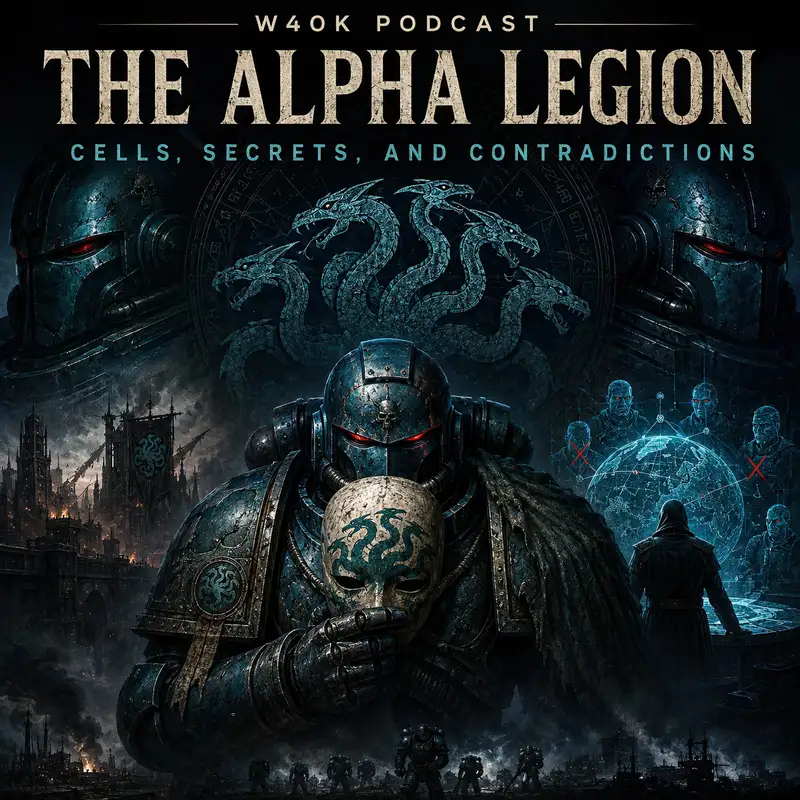
The Alpha Legion: Cells, Secrets, and Contradictions
An Imperial governor receives a warning that his chief astropath is a traitor. He orders the palace sealed and the defence regiments redirected toward the capital. Three weeks later, the astropath is innocent, the outer continents are in revolt, and the regiments are exactly where the rebels need them. Somewhere in the confusion, a transmission repeats a simple claim. The Alpha Legion planned everything. That may be true. It may have been planted by someone who wanted the Alpha Legion blamed. It may even be both. With the sons of Alpharius, uncertainty is not fog around the war. Uncertainty is the weapon.
The Alpha Legion is the twentieth of the Space Marine Legions, symbolised by the many-headed hydra and remembered for infiltration, sabotage, covert manipulation, and plans that begin before their enemies realise a campaign has started. Calling them stealthy Space Marines is accurate in the same way that calling an orbital bombardment loud is accurate. It notices the obvious while missing the method. The Alpha Legion does not merely hide warriors. It hides causes, loyalties, objectives, and sometimes the war itself. Its ideal victory is not an honourable clash of armies. It is an enemy command structure collapsing because every officer is acting on information prepared by the same unseen hand.
That approach changes the meaning of battle. A bridge explodes before reinforcements cross it. A trusted adjutant issues orders with the correct codes and the wrong destination. A labour dispute becomes a planetary uprising after weapons appear in the right warehouses. A loyal commander is murdered by soldiers convinced he was about to betray them. Only after communications fail and the defenders begin firing at one another do the legionaries emerge. Even then, the armoured giants may not be decisive. They are the final pressure applied to a structure weakened from within. The Imperium expects enemies to attack its walls. The Alpha Legion prefers to learn who holds the keys, who resents the gatekeeper, and which clerk alters the watch roster.
Their culture was built around concealment before the Horus Heresy, and the concealment began with their origin. Accounts of Alpharius being discovered do not agree. Some place his recovery early, close to Terra and the Emperor. Others present Horus as the brother who found him much later. Another strand reveals the deeper secret that Alpharius had a twin, Omegon, whose existence was hidden from almost everyone outside the Legion. Even the names are unstable because the brothers could exchange identities. One could stand before allies as Alpharius while the other operated elsewhere as Omegon. A Legion founded on secret identities possessed two primarchs who treated identity as an operational resource. The family record was compromised before the gathering had properly begun.
The phrase “I am Alpharius” is often treated as a joke, but inside the Legion it expressed doctrine. Legionaries sometimes gave the primarch’s name when questioned, and selected warriors could serve as doubles. Alpharius and Omegon were unusually capable of blending among their sons, especially when armour, posture, and deliberate misdirection did the rest. The point was larger than impersonation. The Alpha Legion wanted outsiders to believe command could be anywhere and removing one leader might change nothing. A name became a mask, rank became a temporary function, and the individual mattered less than the operation. The hydra did not depend upon one visible head. Ideally, the enemy could not tell which head had spoken.
Before the Heresy, this idea shaped the Legion’s organisation. Its formations were flexible, assembled for campaigns, and broken apart when their purpose was complete. Titles such as Harrowmaster described authority within an operation rather than a permanent rung on a familiar ladder. Planning could include voices that other Legions expected to remain silent, including mortal operatives. Recruits were tested as groups, reinforcing the belief that success belonged to the whole unit rather than the most theatrical individual. This made the Alpha Legion adaptable and difficult to decapitate. It also encouraged a dangerous confidence that every problem could be mastered through preparation. They did not simply want to win. They wanted to prove they understood the enemy more completely than the enemy understood itself.
Mortal agents were essential to that ambition. A Space Marine can infiltrate a fortress, but he remains an eight-foot transhuman warrior wearing enough armour to make subtlety an optimistic description. Human operatives could remain inside governments, fleets, manufactorums, cults, and military staffs for years. Some were recruited through ideology, grievance, coercion, or conditioning. The Legion called certain seeded agents the Sparatoi, the sown men. They might live ordinary lives until a coded phrase, a symbol, or a prepared circumstance activated them. One operative could redirect supplies, compromise an identification system, or place a rumour where frightened officials would spread it for free. The Alpha Legion understood that institutions are made of people, and people carry ambitions, debts, and private wounds through every security checkpoint.
This method produced remarkable victories, but it also revealed the Legion’s central flaw. Alpharius often preferred elaborate campaigns that demonstrated his doctrine even when a simpler attack might work. During the Great Crusade, the Alpha Legion became notorious for allowing enemies time to organise so they could be dismantled through layered ambushes, sabotage, and psychological pressure. The result could be brilliant and needlessly costly at once. Other primarchs saw vanity disguised as strategy. Alpharius saw proof that his Legion could solve the hardest version of the problem. The plan had elegance, depth, and one minor weakness. It sometimes required the enemy to behave exactly as predicted, which is a generous expectation in war and an extravagant one in the Imperium.
When Horus rebelled, the Alpha Legion joined him openly enough to be counted among the traitor Legions. It participated in the betrayal at Isstvan Five and fought loyalist forces across the widening civil war. That much is not seriously in doubt. The reason is less secure. One influential account describes Alpharius and Omegon meeting the Cabal, a secretive alliance opposed to Chaos. The Cabal presented a terrible forecast. If the Emperor prevailed, humanity would endure in misery and eventually feed Chaos on a galactic scale. If Horus won, his victory would consume humanity quickly, and humanity’s extinction would starve the Dark Gods of their greatest source of power. The twins appeared to accept a mission in which betraying the Imperium might save the galaxy.
That explanation does not make their conduct simple. It makes it almost impossible to judge. The Cabal’s vision could have been accurate, manipulated, incomplete, or misunderstood. Alpharius may have accepted it fully. Omegon may have disagreed. The brothers may have pursued different interpretations while presenting a single face. Individual cells may have received orders without knowing their purpose. Some Alpha Legion operations clearly assisted Horus. Others appear to have hindered the traitor cause or preserved loyalist strength. A scheme intended to produce one future could resemble treason, loyalty, or incompetence depending on which fragment survived. The Alpha Legion made compartmentalisation a virtue, then entered a civil war where no one could safely confirm what the compartments were meant to achieve.
The campaign around Chondax captures this uncertainty. The Alpha Legion moved against the White Scars while the Khan was still deciding whether Horus or the Emperor had betrayed the Imperium. Yet actions attributed to Omegon’s side helped break the communications interference that kept the White Scars isolated. The result allowed the Khan to receive a warning and choose loyalty to Terra. Was this an attempt to save a loyal Legion, a factional struggle inside the Alpha Legion, or one layer of a larger plan? The record supports more than one reading. The Alpha Legion could fight an enemy while creating the conditions for that enemy to escape. Most commanders consider that a contradiction. Alpharius would have called it operational flexibility.
Their attack on the Raven Guard was less ambiguous and more intimate. After the massacre at Isstvan Five, the Raven Guard sought to rebuild using genetic knowledge granted by the Emperor. Alpha Legion infiltrators penetrated their ranks through stolen identities, altered appearances, and information taken from the dead. The operation corrupted the Raven Guard’s attempt at rapid renewal and turned hope into catastrophe. This was not merely sabotage of a weapon or supply line. It was an assault on a Legion’s future, delivered by agents wearing the faces of its fallen sons. The episode shows why the Alpha Legion inspires a different fear from armies that simply destroy cities. Destruction can be seen. Infiltration makes every survivor wonder which familiar face helped cause it.
Near the end of the Heresy, Alpharius led an assault into the defences of the Sol System. At Pluto, the Alpha Legion tested the Imperial Fists and confronted Rogal Dorn, the primarch defending Terra. Alpharius appeared to believe he was demonstrating weaknesses in Dorn’s preparations, perhaps forcing the Praetorian to recognise threats a straightforward defence would miss. Whether this was a disguised warning, a genuine attack, or both remains debated within the story’s logic. Dorn was not interested in the performance. He killed Alpharius in single combat. Far away, Omegon sensed the loss of his twin and took up the name Alpharius. For a Legion claiming any head could be replaced, the death proved both the strength and cruelty of the idea.
Omegon’s later fate is uncertain. Old accounts claim an Alpha Legion primarch was killed by Roboute Guilliman on Eskrador, but the report’s reliability has long been questioned, and even the identity involved is unclear. The surviving twin may have died, disappeared, or continued behind another name. No answer has been secured strongly enough to end the argument. This matters because the post-Heresy Alpha Legion cannot be understood as a conventional army waiting for its primarch to issue orders. Whether Omegon survived or not, the Legion entered the long war without a publicly verifiable centre. Its doctrine of distributed command was no longer merely a clever method. It became the condition of its existence.
Unlike many traitor Legions, the Alpha Legion did not depend entirely upon retreat into the Eye of Terror. Its warriors scattered through and beyond Imperial space, establishing concealed bases, independent warbands, cult networks, and dormant cells. Some operated from forgotten stations, barren worlds, or vessels hidden in the debris of old wars. Others embedded mortal agents in functioning Imperial societies. A cell might spend decades preparing a revolt meant not to hold a planet but to draw a fleet elsewhere. Another might attack a munitions depot, not for ammunition, but to expose which Inquisitorial office responded. The apparent objective could be bait. The real objective could be information about the response. There was always room for another door behind the door.
Compartmentalisation keeps such a network alive. Members of one cell may know little about another. Mortal operatives may understand only a single task. A warband can be destroyed without revealing every hidden base or sleeper agent. Orders can move through cut-outs, coded rituals, false identities, and intermediaries. The Imperial investigator who uncovers one layer may be rewarded with a convincing lie designed to end the investigation. This is efficient until communication fails, a commander dies, or an activation order arrives centuries after its purpose has vanished. A hidden cell can preserve a mission. It can also preserve a mistake with exceptional discipline.
Secrets are therefore both shield and poison. A commander who tells subordinates only what they need reduces the damage caused by capture. He also makes it difficult for them to recognise when the larger plan changes. An operative may believe she is weakening a corrupt governor for the Imperium, while another cell intends to replace that governor with a Chaos cult. A warband may receive a genuine order through a channel compromised by rivals. Two Alpha Legion forces can pursue opposing goals while each believes the other is performing necessary deception. When everyone is trained to suspect appearances, trust becomes more precious than ammunition and considerably harder to manufacture.
That problem explains the contradictions among Alpha Legion warbands in later millennia. Some are committed servants of Chaos and use cults, sorcery, and daemonic power without apology. Some behave like renegades pursuing power, revenge, or survival rather than devotion to a god. Some claim they remain loyal to the Emperor, arguing that their attacks expose weakness, punish corruption, or serve a hidden purpose established during the Heresy. Others regard such claims as delusion or useful camouflage. There is no reliable reason to assume every cell shares the same theology, political goal, or understanding of the past. The Legion’s common inheritance is a method of war, not a single confession of faith.
Claims of secret loyalty deserve caution. An Alpha Legionary may sincerely believe he serves humanity while organising rebellions and killing Imperial citizens. He may consider atrocity a necessary sacrifice within a plan too important to explain. He may also use the language of loyalty to avoid admitting that ten thousand years of treachery have become an identity. Stories support the existence of warriors who think themselves loyal, but belief does not settle the moral question. A hidden noble purpose cannot be tested when every failure can be explained as another layer of the plan. The Alpha Legion is skilled at turning uncertainty into an excuse, including uncertainty within its own conscience.
Chaos corruption adds another division. Alpha Legion forces have often operated outside the Eye of Terror, and some retain a more controlled appearance than warriors from Legions saturated in the Warp. That does not make them immune. Alpha Legion cells have fielded possessed warriors, made pacts with dark powers, employed sorcerers, and cultivated Chaos worship among mortals. Other groups may use the symbols and resources of Chaos as tools while insisting they remain masters of the bargain. The distinction is rarely as secure as they imagine. Chaos has always been patient with people who believe they are exploiting it. The Alpha Legion’s talent for self-deception simply gives the process more paperwork.
To an Imperial defender, an Alpha Legion campaign may look like unrelated emergencies. Food shipments disappear. Pilgrims riot after hearing a shrine has been desecrated. A defence laser fires on a friendly transport because its recognition code was altered. An officer discovers evidence that her superior belongs to a cult, and the evidence is convincing because the Alpha Legion planted both the cult and the investigation. By the time legionaries strike, defenders are exhausted, suspicious, and concentrated in the wrong places. The attack succeeds because institutions meant to resist it have been persuaded to attack themselves. The Imperial response is often swift, decisive, and directed toward whichever target the Alpha Legion prepared in advance.
This style of war exploits the Imperium’s own character. The Imperium is vast, secretive, hierarchical, and dependent upon records that may take years to cross the void. Authority is divided among organisations that distrust one another and guard information as jealously as territory. An Inquisitor may refuse to share evidence with a planetary commander. The commander may conceal losses to protect his career. The priesthood may interpret sabotage as spiritual failure. The Mechanicus may close access to a damaged system because outsiders lack the correct rites. The Alpha Legion does not need to invent every weakness. Often it introduces pressure and lets Imperial procedure perform the sabotage.
The same methods impose severe limits. Complex plans create more points of failure. False information can mislead friendly cells as easily as enemies. A warband that trusts no one struggles to form lasting alliances, and a Legion divided into independent heads cannot concentrate force without exposure. Pride remains dangerous. Alpha Legion commanders may pursue elegant manipulation when direct action would be faster, or assume an enemy’s apparent mistake is part of a counterplot. Sometimes a locked door is merely locked. Sometimes the obvious convoy is the real convoy. A warrior trained to see seven hidden meanings can be defeated by an opponent who arrives early and brings enough artillery.
Modern attempts to unite the Legion reveal how deep the fracture has become. Solomon Akurra, leader of the Serpent’s Teeth, sought the title of Harrowmaster and tried to bind disparate Alpha Legion forces into a larger purpose after the Great Rift. His rise shows that cells and warbands can cooperate when a commander offers opportunity, leverage, and a convincing vision. It also shows that unity cannot simply be ordered. Every ally brings private ambitions, rival histories, and suspicions about who manipulates whom. The hydra can turn many heads toward one enemy, but each head still watches the others. For the Alpha Legion, assembling an army is not only logistics. It is an argument about whether a Legion still exists.
This is why contradictory accounts cling to the Alpha Legion more tightly than to any other force. Some come from lost records, Imperial propaganda, unreliable witnesses, and ten thousand years of war. Others were deliberately created by the Legion. Not every inconsistency conceals a master plan, and assuming it does grants Alpharius a competence the stories do not support. The Alpha Legion fails, miscalculates, fractures, and lies to itself. Yet uncertainty remains useful. An enemy forced to investigate five explanations has already surrendered time and attention. Even a failed deception can survive as a rumour, and a rumour can shape the next campaign.
The Alpha Legion endures because it does not require every warrior to agree on the truth. It requires them to value concealment, preparation, distributed action, and the power of making an enemy doubt what he sees. Its cells survive commanders. Its names survive those who carried them. Its plans can cross centuries, though not always with their original meaning intact. That is the answer to the Legion’s central contradiction. The hydra remains alive because no single head contains the whole creature. The price is that no head can be certain what the creature now wants. After ten thousand years of secrets, the Alpha Legion’s greatest achievement may also be its deepest defeat. It has made its purpose impossible to prove, even to itself.