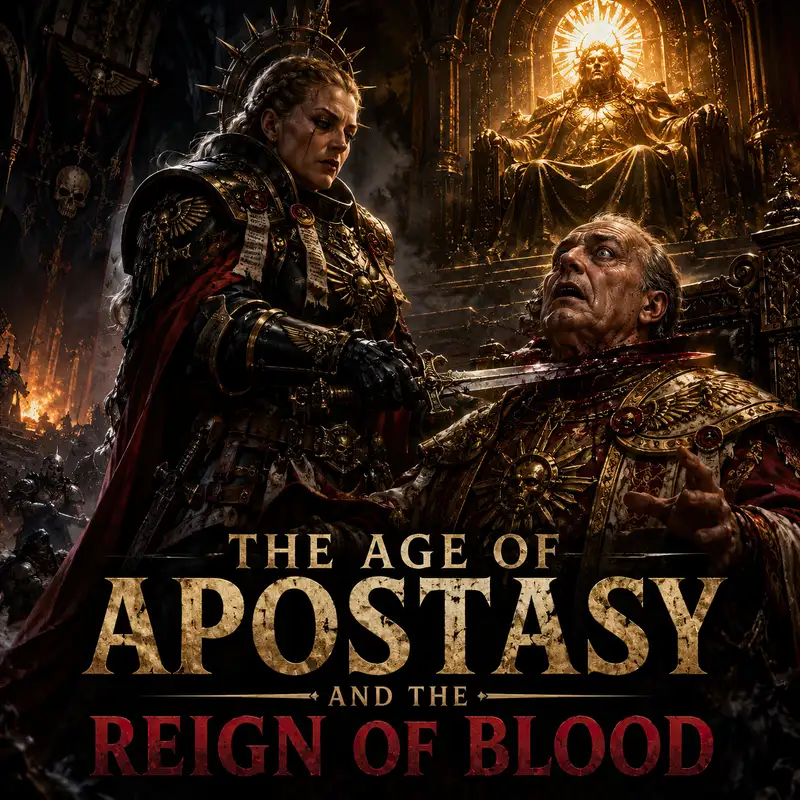
The Age of Apostasy and the Reign of Blood
The man who held the Imperium’s government in one hand and its church in the other did not die beneath an orbital bombardment. He did not fall to a Space Marine champion, an assassin, or a rival High Lord. Goge Vandire died in his own palace, at the hands of Alicia Dominica, the warrior who had guarded him with absolute devotion. Moments earlier, she had stood within the innermost sanctum of the Imperial Palace, before the Golden Throne itself. Whatever she saw there was never entered into any reliable public record. What is known is that she returned with her certainty transformed. The ruler she had defended as the chosen servant of the Emperor was suddenly revealed as a traitor. One stroke ended his life. It did not immediately heal the Imperium, but it ended the Reign of Blood.
That ending poses the central question of the Age of Apostasy. How could the Imperium, a civilisation built around obedience, hierarchy, and survival, place almost unlimited power in the hands of a man as unstable as Vandire? The easy answer is that he was a uniquely gifted tyrant. The more troubling answer is that he inherited institutions already prepared for him. He did not create the Imperium’s fear, its distance, its bureaucracy, or its hunger for spiritual certainty. He learned how to make those forces agree with one another. When they did, resistance became not merely unlawful but heretical, and the difference between a bad order and a sacred command became dangerously difficult to see.
The Age of Apostasy unfolded during the thirty-sixth millennium, roughly five thousand years after the Horus Heresy. By then, the Imperium was ancient even by its own standards. The Emperor had sat upon the Golden Throne for millennia, and the primarchs had passed into legend. The institutions created to govern humanity had become vast, ritualised, and jealous of their authority. Two of the greatest were the Administratum, which managed the Imperium’s bureaucracy, and the Ecclesiarchy, also called the Adeptus Ministorum, which governed the Imperial faith. One directed resources and recognised orders. The other claimed authority to explain what the Emperor demanded. A disagreement between them could become a constitutional crisis, though the Imperium naturally preferred the term heresy.
The Ecclesiarchy had grown powerful because the Imperial Creed served a real purpose. Across a million scattered worlds, human societies followed different customs and sometimes barely understood that other Imperial worlds existed. Worship of the Emperor gave them a common identity. It made sacrifice meaningful and obedience sacred. It also gave the priesthood influence over governors, generals, workers, pilgrims, and High Lords. Cardinals could steer military priorities, redirect wealth, and condemn opponents. A governor accused of poor administration might defend his record. A governor accused of betraying the God-Emperor generally had less time for paperwork.
Over the centuries, spiritual authority acquired material weight. The Ecclesiarchy collected enormous tithes, built palaces and shrines, and competed in displays of magnificence. Its leaders shifted their centre of power between Terra and Ophelia the Seventh, each move demanding new construction, new taxes, and declarations that the expense was necessary. More important, the church raised armies and fleets known as the Frateris Templars. They were organised military forces capable of crushing revolts and rivaling the armies of Imperial governors. The Ecclesiarchy could preach obedience, define disobedience as heresy, and then dispatch warships to settle the theological details.
The strain worsened when warp storms spread across the Imperium. Travel and communication between systems became unreliable or impossible. Worlds were isolated. Tithes failed to arrive, and orders came too late, if at all. Ork invasions, Chaos raiders, rebellions, and predatory cults prospered in the confusion. On many planets, the Imperial Creed fractured into local movements, each insisting that it alone understood the Emperor’s will. The church answered dissent with purges, while dissenters answered the church with uprisings. At the centre, the Administratum and Ecclesiarchy spent precious energy struggling against each other. Humanity was surrounded by enemies, while its governing institutions debated which office had the right to make matters worse.
Goge Vandire rose through this crisis as Master of the Administratum. Surviving accounts portray him as ruthless, manipulative, and comfortable with assassination as personnel management. He first helped place a weak Ecclesiarch in office, then undermined the church he had helped control. When the moment came, Vandire led armed officers into the Ecclesiarchal Palace, denounced the sitting Ecclesiarch as a heretic, and had him killed. He then claimed the vacant religious office for himself. The Imperium had responded to a struggle between its bureaucracy and its church by giving both to one man. This simplified the chain of command considerably. It also removed nearly every meaningful barrier between Vandire’s suspicion and the resources of the state.
Vandire now controlled the machinery that issued decrees and the priesthood that declared those decrees holy. He replaced resistant cardinals, promoted obedient ones, and used the disappearance of his enemies as evidence that the Emperor favoured him. Madness alone did not maintain his tyranny. It depended on clerks who copied his orders, officers who enforced them, priests who justified them, and frightened officials who decided that survival required cooperation. Some believed him. Others knew better but obeyed anyway. In an empire where messages could take decades to cross the stars, a forged instruction carrying the proper seals might be more real than the truth.
The period became known as the Reign of Blood because Vandire’s commands brought punishment on a galactic scale. Worlds were bombarded, populations purged, and officials executed for imagined disloyalty. Imperial military forces were diverted toward enforcing his authority while external enemies advanced elsewhere. Vandire presented cruelty as purification and paranoia as vigilance. He had his pronouncements recorded for a posterity he assumed would be grateful. The surviving picture is of a ruler increasingly detached from reality, yet still able to turn private terror into public policy. His insanity mattered, but the deeper disaster was that the Imperium possessed mechanisms capable of giving insanity fleets, armies, prisons, and a liturgy.
His spies eventually reported an isolated religious sisterhood on the world of San Leor. The Daughters of the Emperor were a small, all-female order devoted to discipline, martial training, and purity of purpose. They had survived beyond direct Ecclesiarchal control, which made them suspicious in Vandire’s eyes and valuable in his calculations. He travelled to San Leor with an immense ceremonial procession, arranging crowds, gifts, and public devotion along the route. Praise was encouraged with weapons close at hand. The display presented obedience as spontaneous, a technique neither invented nor perfected by the Imperium, though it applied the method with admirable logistical commitment.
The Daughters initially refused to recognise Vandire’s authority. He answered not with an immediate assault, but with theatre. Inside their temple, he prayed and ordered one of his own guards to shoot him. The weapon struck, light flared, and Vandire remained unharmed. The Daughters believed they had witnessed the Emperor’s protection. In reality, Vandire wore the Rosarius of the Ecclesiarch, a badge of office containing a powerful protective field. He had gambled that the isolated sisterhood would not recognise the technology. The Daughters swore loyalty, and Vandire renamed them the Brides of the Emperor.
This deception is important because it explains more than Vandire’s cunning. The Brides were not foolish caricatures waiting to be tricked. They lived in a civilisation where miracles, relics, energy fields, psychic phenomena, and genuine manifestations of faith could all appear in similar forms. They had limited information and strong reasons to trust what seemed to be a direct sign of divine favour. Vandire exploited their virtues rather than their weaknesses. Discipline made them formidable, faith made them loyal, and isolation made the lie difficult to test. Once they accepted his legitimacy, every attack on Vandire appeared to confirm that enemies surrounded the Emperor’s chosen servant.
Taken to Terra, the Brides became Vandire’s personal guard and most reliable military force. They received advanced weapons, armour, and training. Their presence gave his regime a powerful symbol. Here were warriors of evident courage and purity defending him without hesitation. To ordinary citizens, that devotion could look like proof. To Vandire’s enemies, it created a nearly impossible problem. The Brides were not corrupt courtiers protecting their privileges. They believed they were defending the faith itself. Defeating them by force might be necessary, but it would not expose the lie that held them. It would simply produce more martyrs for Vandire’s version of events.
His reign continued for roughly seven decades. As monuments bearing his authority rose elsewhere, the great Ecclesiarchal Palace on Terra decayed around him. Dust gathered in abandoned halls. Relics went untended. Light struggled through filthy windows, and accounts describe Vandire retreating from it when the weather briefly cleared the glass. The image may have gained symbolic weight in later retellings, but it suits the regime. Vandire ruled through spectacle while his centre of power rotted. He spoke for the Emperor while fearing illumination. He claimed mastery over an empire he could not truly see, receiving reports through the same broken channels he had learned to manipulate.
Resistance finally found a voice on Dimmamar, where a preacher named Sebastian Thor denounced Vandire as a traitor. Little about Thor’s early life is certain. He was not a primarch, a Space Marine, or a High Lord commanding ancient institutions. He was a human preacher whose authority came from his ability to persuade people that obedience to Vandire was disobedience to the Emperor. This distinction transformed the conflict. A purely secular revolt could be dismissed as ambition. Thor offered a competing religious judgement. He did not ask Imperial citizens to abandon their faith. He argued that their faith required them to oppose the man who had captured its institutions.
Around Thor grew the Confederation of Light. His message travelled from world to world, carried by pilgrims, soldiers, officials, and ordinary believers. Entire systems rejected Vandire’s representatives. When Vandire dispatched a powerful fleet to destroy Dimmamar, the ships vanished into a vast warp storm. The disaster became known as the Storm of the Emperor’s Wrath. Whether it was divine intervention, a natural convulsion of the warp, or something less easily separated into those categories is not settled by the surviving record. Politically, the distinction scarcely mattered. Vandire had promised judgement. His fleet had been judged instead.
The destruction of that fleet gave Thor’s movement momentum no decree could contain. Rebellion spread across the Segmentum Obscurus and beyond. Vandire’s officials were driven out or killed. The Confederation swelled into an army and began its long movement toward Terra. Stories claimed that warp routes opened before Thor while storms hindered his enemies. Such accounts may preserve genuine miracles, later devotional embellishment, or the understandable tendency to describe successful navigation as providence. What mattered to those living through the crisis was that Thor seemed to move while Vandire remained trapped inside a collapsing system. One man possessed every title. The other possessed belief.
Other Imperial powers could no longer remain detached. The Adeptus Mechanicus and several Space Marine Chapters concluded that Vandire had become a traitor to the Imperium. The Black Templars, Imperial Fists, and other forces joined the struggle, while the Mechanicus committed troops and siege engines. Vandire responded by dissolving the High Lords and ordering attacks against those who opposed him. Some commanders refused and paid for it with their lives. By then, the conflict had reached its strangest and most dangerous form. Loyal Imperial forces prepared to assault Terra, not to seize the Golden Throne, but to remove a ruler who claimed to defend it.
The siege of the Ecclesiarchal Palace became a war within the throneworld. Mechanicus guns battered ancient defences. Space Marines fought through positions held by Imperial troops. The Brides of the Emperor defended Vandire with extraordinary determination. Their numbers had grown into the thousands, and the palace gave them ground where skill and devotion offset the attackers’ greater strength. Months of bloodshed failed to resolve the central problem. The attackers could breach walls, but they could not easily break a faith that interpreted every assault as confirmation of its own righteousness.
Deep within the Imperial Palace, the Adeptus Custodes had continued their vigil over the Emperor. They were not a normal political faction, and their long isolation limited their awareness of the full crisis beyond the inner precincts. Once they understood what Vandire had done, a Custodian Companion sought contact with the Brides. Arguments alone failed. Alicia Dominica and her sisters had heard accusations before. Vandire had taught them that such words came from traitors. The Custodian therefore offered something no preacher, cardinal, or general could match. He would take Dominica and five of her companions into the presence of the Emperor.
They passed through hidden ways into the most sacred chamber in human space. What occurred before the Golden Throne remains deliberately uncertain. Later belief holds that the Emperor revealed Vandire’s treachery to them. Perhaps they received a vision. Perhaps they were shown evidence that could not be denied. Perhaps the sight of the Emperor and the Custodes’ testimony broke the last structure supporting Vandire’s lie. The records do not settle the matter, and the silence is part of its power. Six women entered as the Brides of the Emperor. They emerged knowing that the man who had given them that name had used their faith against them.
Dominica returned to Vandire’s throne room. The armies outside had not yet won. The palace walls still stood, and Vandire still possessed loyal forces. None of that mattered once the Brides withdrew the legitimacy on which his final defence depended. Dominica condemned him and cut off his head. The Reign of Blood ended not because Vandire’s enemies finally possessed a larger weapon, but because his most faithful protectors recognised that their oath had been obtained through fraud. His power had rested on the claim that serving him meant serving the Emperor. When that claim failed, the empire he had built around himself became only a room containing a frightened old man and an armed woman who no longer believed him.
Vandire’s death did not restore order. Officials had to be removed and institutions rebuilt across worlds still isolated by war and storm. Sebastian Thor was eventually brought before Imperial authority and tried as a traitor, an irony severe enough to be entirely plausible on Terra. He was acquitted and ultimately accepted the office of Ecclesiarch. Thor then worked to reform the church whose corruption he had opposed. The Frateris Templars were disbanded, and the Decree Passive forbade the Ecclesiarchy from maintaining men under arms. No future Ecclesiarch should possess a private military machine capable of repeating Vandire’s coup.
The Daughters of the Emperor presented a complication. They had helped sustain the tyrant, but they had also ended him. Their martial power was dangerous, yet their final act demonstrated loyalty to the Emperor above loyalty to an officeholder. Thor preserved and reorganised the sisterhood as the Adepta Sororitas. The wording of the Decree Passive prohibited men under arms, and the all-female Sisterhood fell outside its literal restriction. It was a sincere reform, a practical necessity, and a legal loophole large enough for an armoured convent to march through. Imperial governance is rarely content to be only one thing.
The Sororitas became defenders of holy sites, warriors of the faith, and a lasting reminder of the Age of Apostasy. Alicia Dominica and the five companions who entered the Golden Throne’s presence became the great matriarchs around whom the Orders Majoris would later form. Their inheritance was not simple triumph. The Sisterhood’s origin contained deception, misplaced obedience, repentance, and judgement. That history helps explain the severity of the Adepta Sororitas. Purity is not an abstract virtue to them. Their founding memory teaches that a faithful warrior can be brave, disciplined, and catastrophically wrong when a human ruler places himself between belief and truth.
The reforms did not make the Imperium secular, tolerant, or safe from religious power. Thor did not dismantle the Ecclesiarchy. He restored it. The Imperial Creed remained one of the strongest bonds holding humanity together, and the church continued to wield enormous influence. Nor did the Decree Passive permanently end every Ecclesiarchal army in practice. The Imperium is too vast, its laws too old, and its emergencies too frequent for clean solutions. What changed was the distribution of authority. Vandire’s fusion of bureaucracy, priesthood, and military force became a warning written into institutions, even if later generations often treated warnings as decorative inscriptions.
The Age of Apostasy therefore was not merely the story of one mad ruler. It was the story of an empire whose strengths became vulnerabilities. Faith unified worlds, so Vandire used faith to demand obedience. Bureaucracy connected distant systems, so he used bureaucracy to conceal and transmit tyranny. Military institutions defended humanity, so he redirected them against human resistance. Distance made central rule necessary, and that same distance made central abuse difficult to expose. Sebastian Thor defeated him by claiming the same spiritual language for rebellion, while Alicia Dominica ended him by placing loyalty to the Emperor above loyalty to the man who claimed to speak in the Emperor’s name.
That is why the Reign of Blood remains one of the defining crises of Imperial history. The Imperium survived, but it did not escape the contradiction that created Vandire. It still demands obedience while venerating those who disobey the wrong master. It still fears divided authority while knowing concentrated authority can become monstrous. Its church still carries weapons, though its laws insist the matter has been carefully settled. And at the centre of the memory stands Alicia Dominica, walking back from the Golden Throne through a palace under siege, carrying no new army and no public decree. She carried only certainty. For Goge Vandire, that was enough.