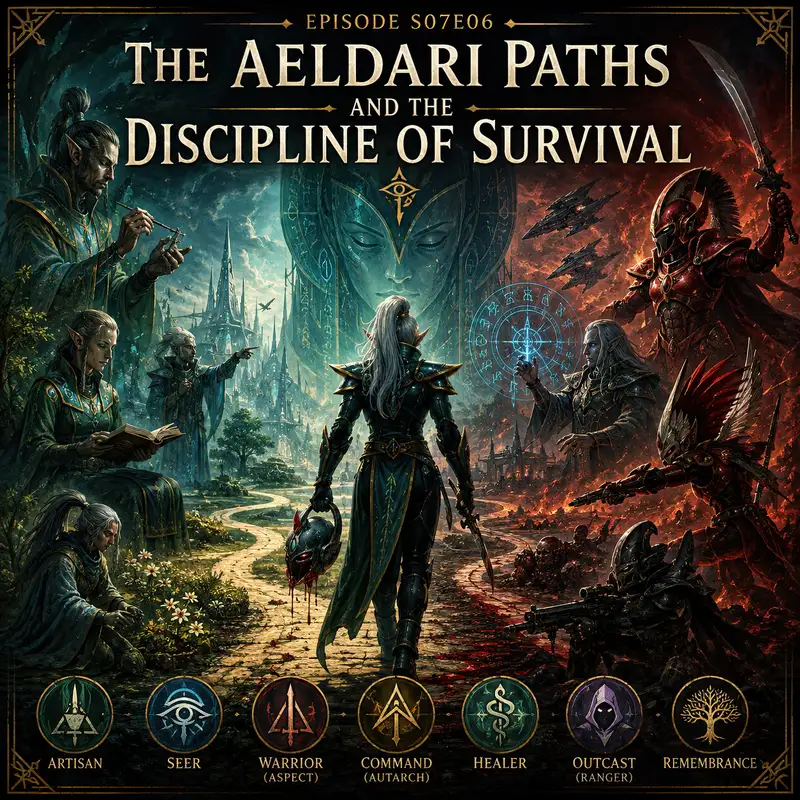
The Aeldari Paths and the Discipline of Survival
An Aeldari warrior can return from battle, remove a blood-streaked helm, and walk home as though the killer who wore it has been left behind. That is not hypocrisy. It is survival. The same hands that carried a chainsword may later shape wraithbone, tend a garden, compose a lament, or study the movement of distant stars. The warrior remembers what happened, but the violence has been given boundaries, a name, and a place in the mind. At least, that is how the system is meant to work. For the people of the craftworlds, the greatest danger is not simply an enemy fleet or a hungry daemon. It is the possibility of becoming trapped inside one desire until nothing else remains. Their civilisation once followed appetite without limit and created a god from the consequences. The Paths are the answer they built afterward. They are disciplines designed to let an Aeldari become something completely, then stop before complete devotion becomes complete possession.
The craftworld Aeldari, who call themselves the Asuryani, are survivors of the Fall. Before that catastrophe, their ancestors ruled an empire of almost effortless abundance. Machines answered need. Psychic power reshaped matter. Long lives offered time for any experience, and then time to become bored with it. As restraint weakened, sensation had to grow sharper to remain satisfying. Art became transgression, transgression became cruelty, and private obsession accumulated within the warp until Slaanesh was born. The psychic shock destroyed the old empire and consumed uncounted Aeldari souls. Those aboard distant craftworlds survived, but survival did not remove the qualities that had made the disaster possible. They remained psychically gifted, emotionally intense, long-lived, and capable of pursuing an idea far beyond the point at which a human would tire, age, or collapse. The Fall was not merely an event behind them. It was evidence carried in every living mind. The Paths emerged as a way to prevent personal intensity from becoming civilisational ruin again.
Calling a Path a career is convenient, but misleading. A human career usually describes work performed while the rest of life continues around it. An Aeldari Path is closer to a deliberately constructed way of being. It governs attention, habit, emotional expression, and the meaning given to experience. Someone on the Path of the Artisan does not merely produce objects during assigned hours. The artisan studies perception, form, technique, and the reactions stirred by creation. Someone on the Path of the Mariner does more than crew a vessel. The mariner learns to understand motion through the void as a complete discipline. An Aeldari may remain upon one Path for decades, reach mastery, and then leave it for another. The skill is not erased, but the identity built around that skill must be set down. This is the crucial movement. The Path permits total commitment without declaring that commitment permanent. It offers depth, followed by an exit.
That exit matters because the Aeldari do not regard moderation as a reliable answer to their nature. Telling an Aeldari to enjoy an experience casually would be rather like advising an Imperial priest to keep a sermon brief. The request is clear. The cultural machinery supporting it is not. The Asuryani instead narrow the field of experience. A chosen discipline becomes a channel through which powerful emotion can move without flooding every part of the self. This does not make them cold. Their calm is often the product of effort, ritual, and constant self-observation. Joy, grief, anger, curiosity, ambition, and desire remain present, but each must be approached with methods that prevent it from becoming sovereign. The Path is therefore neither simple repression nor unrestricted expression. It is controlled immersion. The Aeldari enter an emotion deeply enough to understand and use it, while trusting that training and community will help them return.
This is why craftworld society contains far more Paths than those commonly seen on a battlefield. There are disciplines devoted to healing, service, artistry, scholarship, command, navigation, dreaming, remembrance, cultivation, and many other needs. Some Paths appear almost ordinary until one considers the emotional purpose beneath them. A healer must live with hope and disappointment while tending bodies and spirits that may not recover. A mourner can give full voice to grief that others fear would overwhelm them. A dreamer explores the inner mind under conditions meant to keep imagination from becoming escape. A servant studies attentiveness and empathy, performing necessary work without treating it as humiliation. These are not merely occupations assigned by a central office. They are methods for handling experiences that an Aeldari mind can magnify dangerously. Craftworld life survives because someone is trained not only to perform each task, but also to bear the emotion attached to it.
The system is voluntary in the sense that an Aeldari chooses a Path, but no choice occurs outside culture. Every craftworlder grows up surrounded by the memory of the Fall, the presence of spirit stones, and the knowledge that Slaanesh waits for unprotected Aeldari souls. The Path does not replace the spirit stone. One disciplines the living mind. The other safeguards the soul at death so it can join the craftworld's infinity circuit rather than be taken by She Who Thirsts. Together they shape a civilisation in which psychology, religion, and practical survival cannot be separated cleanly. An Aeldari who changes Paths is not simply retraining. They are dismantling one carefully formed identity and consenting to become a novice again. That can be liberating, humiliating, or frightening. It is also proof that mastery is not the final goal. The deeper goal is to remain capable of change.
The Path of the Warrior shows the system at its most dramatic. Anger and aggression cannot be wished away, especially in a galaxy that repeatedly tries to exterminate the Aeldari. Instead, the Asuryani give violence its own temples, teachers, symbols, and limits. A warrior joins an Aspect Shrine devoted to one facet of Khaine, the shattered Aeldari god of war. Dire Avengers embody disciplined martial skill. Howling Banshees turn speed, fury, and terror into a precise assault. Striking Scorpions cultivate patience and sudden brutality. Fire Dragons focus destructive wrath upon armour and fortification. Dark Reapers make death distant, deliberate, and inescapable. Each Aspect is a tactical specialisation, but it is also an emotional grammar. The shrine teaches the warrior how to feel battle in one controlled form rather than surrendering to violence without shape.
When an Aspect Warrior goes to war, the change is more than equipment. Through training and ritual, the warrior assumes a state of mind commonly described as the war mask. Behind it, fear, rage, predatory instinct, and the memory of killing can be expressed without consuming the civilian identity beneath. The mask is not a claim that battle has no moral cost. It exists because the cost is understood to be severe. Afterward, the warrior must be able to remove it. A former Aspect Warrior may remember every movement of a blade and every face seen through a helm, yet those memories are placed within a part of the self that can be closed. This compartmentalisation is one reason ordinary craftworld citizens can be summoned as Guardians when disaster reaches their home. Many have known the Warrior Path before. The craftworld does not create soldiers from nothing. It asks citizens to reopen a door they had hoped could remain shut.
The failure of that return is embodied by the Exarch. An Exarch is not simply an experienced squad leader who earned a promotion through excellent attendance. An Exarch is an Aeldari who has become lost upon the Path of the Warrior and can no longer leave it. The war mask has ceased to be a mask. Violence, discipline, shrine, and identity have fused. Exarchs become priests of Khaine, guardians of their shrines, and teachers of new Aspect Warriors. Their skill is extraordinary because their devotion no longer ends. Yet craftworld society regards that permanence with unease. The Exarch is needed, honoured, and trapped. In some traditions, even the armour carries the accumulated presence of those who held the role before, drawing the current wearer into a lineage larger than the individual. The shrine preserves mastery by accepting a life that the Path was designed to prevent.
The Path of the Seer presents the same danger in quieter form. Every Aeldari possesses psychic potential, but those who walk this Path cultivate it with exceptional care. Seers learn to work through runes, symbols, and disciplined perception rather than reaching nakedly into the warp. Some guide spirit stones and commune with the dead. Warlocks are seers who previously walked the Warrior Path, combining psychic practice with the experience of the war mask. Farseers look along branching possibilities, searching for futures in which their people survive. None of this is simple fortune-telling. The future appears as a skein of choices, consequences, obscured motives, and paths that alter when observed. A Farseer may prevent one disaster only to make another more likely. The great temptation is not merely power. It is certainty. To believe that one has seen the necessary future can turn wisdom into tyranny with very elegant posture.
Farseers are those who have become lost upon the Path of the Seer. Like Exarchs, they possess greatness shaped by an inability to step away. Their lives become devoted to guidance, prophecy, and the survival of the craftworld. With age, some slowly crystallise within the psychic heart of their vessel, joining the silent seers who remain linked to its infinity circuit. It is a fitting end and a disturbing one. The seer spends a life studying possible futures, then becomes part of the structure whose future was being protected. Their sacrifice also explains why Aeldari foresight should never be confused with omniscience. A Farseer sees more than almost any mortal commander, but sees through uncertainty, opposition, and the distortions of the warp. Accounts of Aeldari plans often look impossibly subtle from the outside because outsiders see only the intervention, not the hundreds of futures rejected before it.
The Autarch represents another answer to the problem of mastery. An Autarch has walked several martial Paths, learned the methods of multiple Aspect Shrines, and then taken the Path of Command. Where an Exarch becomes perfect within one form of war, an Autarch succeeds by leaving each form before it becomes a prison. The commander can understand the patience of the Striking Scorpion, the speed of the Swooping Hawk, the resolve of the Dire Avenger, and the destructive focus of the Fire Dragon without becoming permanently bound to any one of them. That breadth allows an Autarch to assemble specialised forces into a coherent warhost. It also gives Aeldari command its characteristic precision. Their armies are not built to exchange casualties until the larger reserve wins. Every warrior lost is a wound to a dwindling people. The ideal campaign is therefore brief, exact, and decided before the enemy understands where the true battle was.
Yet no system built around discipline can avoid producing rebellion. Some Aeldari feel confined by the Paths and leave their craftworlds for the open galaxy. They become Rangers, Corsairs, wanderers, and adventurers, often grouped beneath the misleading phrase Path of the Outcast. In the strict sense, the Outcast walks outside the Path system. That freedom is exhilarating because it allows sensation, movement, and identity without the craftworld's constant boundaries. It is also dangerous. An Outcast has fewer protections against obsession and fewer companions trained to recognise when freedom has become self-destruction. Many eventually return, carrying knowledge of alien worlds and a renewed willingness to accept discipline. Others remain away until wandering becomes its own form of captivity. Craftworld society needs these departures more than it likes to admit. A structure with no door leading outward would preserve order by turning the entire craftworld into a shrine.
Different craftworlds interpret the balance differently. Alaitoc is famous for strict adherence to the Paths, and the pressure of that severity has driven many of its people into periods of exile. Saim-Hann preserves a more independent, clan-based culture whose passions sit less comfortably beneath formal restraint. Biel-Tan places exceptional value upon martial purpose and the restoration of Aeldari power. Ulthwé, long exposed to the dangers surrounding the Eye of Terror, has relied heavily upon seers and the futures they discern. These differences matter because the Asuryani are not a single mind wearing different coloured armour. The Paths provide a shared survival framework, but culture decides which disciplines receive honour, which emotions are feared, and what risks a craftworld will accept. The result can be wisdom, rigidity, courage, arrogance, or several of these before the evening meal.
The Path system also explains the strange mixture of compassion and ruthlessness found in Aeldari decisions. A Farseer may perceive a chain of events in which the death of thousands of humans prevents the destruction of a craftworld. To the Imperium, the resulting intervention appears treacherous and monstrous. To the Aeldari, it may appear as the least terrible branch still available. Their discipline allows them to act with frightening focus, but focus can narrow moral vision as effectively as it narrows emotion. The survival of a dwindling people becomes the measure against which every outsider's life is weighed. Aeldari foresight does not remove responsibility for that choice. It makes the burden more intimate, because the seer may believe they have witnessed the consequences of refusing. The Paths protect the Aeldari from being ruled by impulse. They do not guarantee that reason will produce mercy.
Their way of war is craftworld society made visible. Aspect Warriors arrive in specialised formations, each trained for a precise role. Seers shape the moment of attack. Autarchs combine experiences gathered across different shrines. Guardians leave civilian disciplines to defend the vessel that contains their families, ancestors, and the souls of the dead. Speed and concentration replace mass. Aeldari forces can appear almost effortless when the plan succeeds, striking one point and vanishing before retaliation. When the plan fails, their fragility becomes painfully clear. Specialists caught in the wrong fight die like anyone else, and the loss cannot be repaired by opening another recruitment office. The Path makes extraordinary warriors, but it does not create more Aeldari. Every victory must therefore be judged against the lives spent achieving it.
Other branches of the Aeldari people reveal that the Paths were a choice, not an inevitable law of their species. The Exodites escaped decadence through hardship, distance, and lives tied to demanding worlds. The Drukhari preserved themselves through predation, replenishing what Slaanesh drains from them by feeding upon the suffering of others. Corsairs accept freedom with fewer restraints. Harlequins surrender themselves to sacred roles under the protection of Cegorach. The Asuryani chose disciplined succession, moving from one bounded identity to another. Each response addresses the same inherited catastrophe, and each extracts a price. The craftworlders' price is that ordinary life becomes a continuous act of self-command. Even art, love, grief, ambition, and curiosity must be approached with an awareness that pleasure without an ending once destroyed almost everything.
That burden can make the Paths look like chains, and sometimes they are. An Aeldari can hide inside discipline, avoid unresolved feeling, or mistake emotional control for moral superiority. One who becomes lost may achieve magnificent mastery while surrendering the ability to become anyone else. A craftworld may praise restraint so highly that its young seek danger simply to breathe. Yet the system endures because it accepts a hard truth about survival. The Asuryani cannot return to innocence. They know what their civilisation did, what was born from it, and what still waits beyond death. Their answer is not to become less intense. It is to give intensity form. They enter each discipline fully, learn what it has to teach, and then face the most difficult test of all: leaving mastery behind.
The defining moment of the Aeldari Path is therefore not the taking up of a weapon, the casting of a rune, or the completion of a flawless work. It is the moment the practitioner decides that the work is finished. Somewhere within a craftworld, an Aspect Warrior removes a helm and hears battle recede. Nearby, an Exarch remains inside the shrine because that return is no longer possible. The difference between them is the entire promise and tragedy of the Paths. Discipline saves the Asuryani not by preventing them from feeling, but by teaching them that no single feeling may possess the whole self. Their civilisation survives through repeated acts of departure, each Aeldari becoming complete for a time and then choosing to become unfinished again.