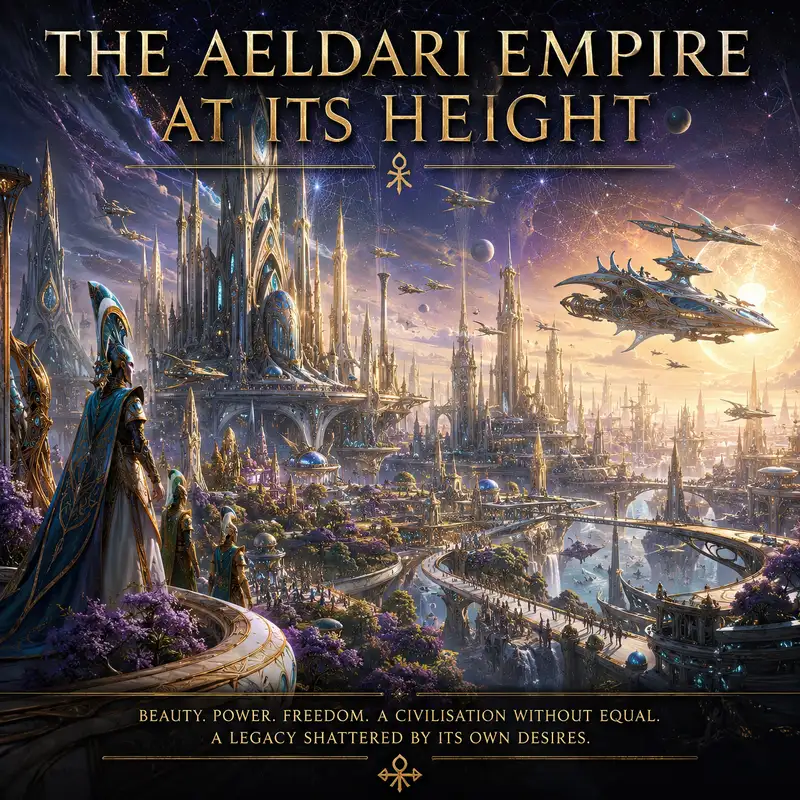
The Aeldari Empire at Its Height
At the height of the Aeldari empire, the most dangerous place in the galaxy was not a battlefield. It was a room in which an Aeldari had become bored.
That sounds flippant, but it reaches the heart of their civilisation. The Aeldari had survived the greatest war the galaxy had known. Their oldest enemies had withdrawn into tombs beneath forgotten worlds. The Old Ones were gone. The Krork had been broken down by time into the Orks of later ages. Other species rose, fought, and vanished while the Aeldari endured. For millions of years, they did not merely inhabit the galaxy. They possessed the confidence of a people who believed the galaxy had already been decided in their favour.
The empire they built was not an early version of the Imperium of Man. It did not depend upon endless columns of administrators, chained labourers, slow fleets, and planetary governors praying that their reports reached the correct office before the rebellion did. The Aeldari did not need to cover every star with a flag. Their dominion rested on something more flexible and, in its own way, more complete. They controlled the routes that mattered, the worlds they desired, and the means to destroy almost anything capable of challenging them.
Later traditions called this realm the Aeldari Dominion, and sometimes the Empire of Ten Million Suns. The precise form of its government is unclear. Surviving accounts suggest many rulers, councils, nobles, and local powers rather than one throne commanding every world. That uncertainty is appropriate. The old empire lasted so long that its political systems probably changed many times. Human history struggles to describe a few thousand years without argument. The Aeldari had ages in which entire human civilisations could have risen, declared themselves eternal, and become an archaeological inconvenience.
What bound the empire together was not a single capital or bureaucracy. It was the Webway.
The Webway was an artificial labyrinth running between reality and the Warp, created in the age of the Old Ones and mastered by the Aeldari who followed them. Through its tunnels, gates, chambers, and hidden passages, travellers could cross immense distances without exposing themselves directly to the full violence of the Immaterium. A city could possess doors leading to worlds beneath unfamiliar suns. Fleets could emerge where no conventional route should have allowed them to arrive. Colonies separated by thousands of light years could remain part of the same cultural world.
To younger species, interstellar distance is a strategic fact. It delays armies, isolates settlements, distorts messages, and turns every frontier into a gamble. For the Aeldari, distance became partly a matter of architecture. A hostile fleet might spend years crossing realspace toward an Aeldari world, only to discover that its defenders had already arrived through a gate the invaders did not know existed. It was difficult to surprise a civilisation that had hidden roads through the universe.
Those roads connected worlds shaped with the same confidence. The Aeldari did not merely colonise planets. They cultivated them. They altered climates, redirected ecosystems, raised cities whose structures seemed grown rather than assembled, and prepared beautiful Maiden Worlds for future settlement. A human empire might call a planet habitable when the air did not immediately kill the tax collectors. The Aeldari standard was rather higher.
Their architecture expressed the nature of their technology. Much of it was psychically responsive, formed through methods that blurred the line between engineering, art, and ritual. Wraithbone, shaped by gifted artisans often remembered as Bonesingers, could become a wall, a vessel, a weapon, or the skeleton of a world-sized ship. Machines responded to thought. Vehicles moved with the grace of living things. Weapons channelled forces that later civilisations could imitate only crudely, if they understood them at all.
This was not magic wearing a decorative coat of science, nor ordinary machinery with a few runes attached. Aeldari technology emerged from a civilisation in which psychic ability was normal. Every Aeldari possessed a soul that burned brightly in the Warp, and in that earlier age their psychic potential appears to have been far less restrained than it would become after the Fall. Their minds, senses, tools, and environment interacted in ways that make human categories feel inadequate. To an Aeldari engineer, emotion and intention could be relevant physical inputs. To an Imperial engineer, emotion is usually what happens when the replacement part does not fit.
The empire’s machines relieved its people of almost every necessity. Automated systems performed labour. Sophisticated constructs produced goods, maintained cities, and handled much of the work required to sustain entire worlds. The Aeldari did not need enormous populations chained to agriculture, mining, manufacturing, or military service. Scarcity, at least within the secure heart of their civilisation, had largely ceased to organise daily life.
That freedom matters. It is easy to describe the old empire only through the catastrophe that ended it, as though every street had always been stained with blood and every artist had been quietly designing a new form of murder. That was not the civilisation at its height. For much of its existence, the Aeldari empire was a genuine wonder. Its people had time to study, create, travel, debate, perform, explore, and refine their abilities over lifespans that made human careers seem painfully brief.
An Aeldari might devote decades to music, then centuries to a branch of philosophy, then leave a settled world to cross the Webway in search of experiences unavailable at home. There was no Path system dividing life into disciplined vocations. The Paths followed by the craftworld Aeldari were created after the disaster, as a defence against obsession. In the old empire, an individual could move from one pursuit to another with far greater freedom, guided by curiosity rather than a social structure designed to keep the soul under control.
That freedom produced art of astonishing subtlety. It also produced science, if that word is broad enough, capable of reshaping matter and mind. The Aeldari explored dreams, memory, sensation, and the boundaries between the material world and the Warp. Their finest works may not have been objects at all. They could have been shared psychic experiences, living environments, or performances understood through senses that humans do not possess with the same intensity.
The surviving Aeldari are not simply more graceful humans with longer ears and an unfortunate relationship with prophecy. Their minds and emotions operate at greater extremes. Joy is more vivid. Grief cuts deeper. Obsession can become consuming. Their psychic nature gives those emotions weight beyond the individual. In the old empire, this intensity was not automatically a curse. It was the fuel of their culture. It allowed devotion, creativity, love, and insight on a scale that helped make their civilisation magnificent.
Their relationship with death also appears to have been very different. Later Aeldari traditions speak of an age when souls could pass into the Warp without being seized by She Who Thirsts, and some accounts suggest a cycle of rebirth that made death less final than it became after the Fall. The surviving evidence is fragmentary and mixed with myth, but one point is clear. The terror that governs modern Aeldari existence did not yet exist. There were no spirit stones worn as protection from Slaanesh, because Slaanesh had not been born. There was no need to bind the dead within an infinity circuit to keep them from eternal predation.
The gods of the Aeldari belonged to this older world. Asuryan, Isha, Kurnous, Vaul, Morai-Heg, Khaine, and Cegorach appear in myths that may preserve memories of the War in Heaven, psychic truths, cultural allegories, or all three at once. It is unwise to force Aeldari religion into a human choice between literal history and symbolic story. In a psychic civilisation, a symbol can acquire power, and a story repeated by countless minds can become more than a story.
At the empire’s height, the pantheon gave the Aeldari a shared language for creation, conflict, fate, fertility, wisdom, and death. Temples, performances, and rituals connected the present to the species’ ancient origins. Yet even here, certainty is dangerous. The Aeldari of the forty-first millennium remember their gods through ruins, masks, fragments, and trauma. What the old empire truly believed across millions of years cannot be reduced to one tidy creed.
Military power remained beneath all this beauty. The Aeldari were not harmless aesthetes protected by good manners and superior interior design. Their civilisation had been forged during the War in Heaven, when gods, star-born entities, psychic species, and weapons of impossible scale fought across reality. The Aeldari inherited tools and knowledge from that age, then developed them over an immense span of time.
By the later period of the empire, many wars could be fought by machines or ended before they threatened Aeldari society. Orks were contained, scattered, or treated as a recurring infestation rather than an equal civilisation. Other hostile species were defeated or driven away from the regions the Aeldari valued. The empire’s strength did not require every citizen to become a soldier. It required potential enemies to understand, usually after one unfortunate demonstration, that escalation favoured the Aeldari.
This superiority shaped their view of everyone else. Younger species appeared crude, hurried, and trapped by problems the Aeldari had solved before those species learned to name the stars. Even advanced civilisations could seem temporary. Humanity expanded dramatically during its Age of Technology, but the surviving record of direct relations between the two powers is incomplete and contradictory. What can be said is that the Aeldari did not regard humanity as the rightful inheritor of the galaxy. Humanity was one more energetic young species building loudly in spaces the Aeldari had not chosen to occupy.
That distinction helps explain how two great powers could exist in the same galaxy. The Aeldari empire was vast, but it was not necessarily interested in possessing every barren system or supervising every lesser civilisation. Its heartlands, Webway domains, cultivated worlds, and hidden cities mattered more than colouring a map. It could ignore enormous stretches of realspace while still remaining the dominant power. An empire does not need to stand in every room when it owns the corridors and holds the keys.
Craftworlds were part of that wider system long before they became the great refugee arks known in the later age. They travelled between Aeldari worlds as immense trading vessels, carrying goods, travellers, ideas, and communities across the empire. Their crews spent long periods away from the heartlands and therefore saw changes that settled populations could ignore. When the civilisation began to decay, some craftworlders recognised the danger earlier precisely because they returned home and noticed that home no longer behaved as it once had.
Other Aeldari lived in Webway settlements and subrealms. Some of these places were commercial centres, private domains, laboratories, retreats, or refuges beyond conventional oversight. Commorragh began within this broader network long before it became the Dark City of the Drukhari. At the empire’s height, the Webway offered privacy as well as movement, and privacy on that scale could shelter brilliance, eccentricity, and eventually acts that respectable society preferred not to examine too closely.
No surviving branch of the Aeldari preserves that old civilisation intact. The craftworlders retain much of its art, psychic craft, and memory, but live under Paths that would have seemed alien to their ancestors. The Drukhari preserve elements of its personal freedom, hidden Webway culture, and forbidden technology, but their society has been reshaped by the need to escape Slaanesh through predation. The Exodites preserve the refusal that led some to abandon the heartlands, not the heartlands themselves. The Harlequins preserve stories, but stories told through masks.
Asking which modern Aeldari faction truly represents the empire is therefore like asking which shard represents a shattered vessel. Each holds part of the pattern. None contains the whole. The old empire was broader than any of its survivors, capable of discipline and excess, beauty and cruelty, public splendour and hidden corruption, often at the same time.
The empire’s success therefore created several different kinds of freedom. Freedom from hunger. Freedom from compulsory labour. Freedom from most external enemies. Freedom to move between worlds. Freedom to transform the self through art, study, psychic practice, or sensation. Freedom from the fear of death as later Aeldari would know it.
The question is not why such freedoms were desirable. The question is what restrained a people who possessed them.
For much of the empire’s history, culture, tradition, relationships, and belief appear to have provided that restraint. The Aeldari were not born decadent. They built and maintained a civilisation across an age so long that its endurance is almost impossible to imagine. Their emotional intensity could be disciplined by purpose. Their curiosity could produce knowledge. Their pride could support standards of excellence rather than simple contempt.
Yet the conditions of their greatness slowly removed the pressures that force societies to reconsider their behaviour. A failed human policy may produce famine, defeat, bankruptcy, or revolution within a generation. A failed Aeldari fashion could unfold for centuries while automated systems kept the lights burning and ancient weapons kept enemies away. Consequences became distant. The civilisation could absorb mistakes without appearing to suffer from them.
That made warning signs easy to dismiss. When an artist pursued increasingly extreme experiences, it could be called innovation. When a philosopher rejected old limits, it could be celebrated as liberation. When private societies explored dangerous psychic states, they could claim that lesser minds merely feared what they did not understand. Often, that defence may even have been correct. A civilisation does not achieve the Aeldari height by obeying every inherited prohibition.
The danger came from scale and repetition. The Aeldari did not merely feel powerful emotions. They projected them into the Warp. The accumulated psychic life of a species can shape the Immaterium, especially when that species is as psychically potent as the Aeldari. Every fixation, hunger, triumph, cruelty, and desire left an impression. At first those impressions were diffuse. Over immense spans of time, they began to gather.
None of this means that the empire’s highest achievement and its final depravity were the same moment. The descent took ages. Most Aeldari did not wake one morning and agree to destroy their civilisation before lunch. Social change moved unevenly. Some worlds remained orderly while others embraced radical movements. Some citizens withdrew into private pursuits. Others condemned the growing excess. Some left the central domains for distant Maiden Worlds. Others would later take refuge aboard craftworlds. Many probably believed the disturbances would pass, because every previous crisis had passed.
That belief was the empire’s deepest vulnerability. The Aeldari had defeated enemies that came from outside. They had survived cosmic war, mastered inherited wonders, contained rival species, and turned hostile nature into designed beauty. Their history taught them that every problem could be understood, shaped, or overcome by Aeldari power.
The emerging crisis did not look like an invasion. It had no fleet to intercept and no capital to bombard. It appeared as fashion, philosophy, entertainment, private obsession, and the gradual erosion of limits. Its earliest victories could be mistaken for personal freedom. Its soldiers did not wear uniforms. Its supply lines ran through appetite.
Those who objected faced a difficult argument. How do you persuade an effectively post-scarcity civilisation that pleasure is a strategic threat? How do you warn immortals about consequences they may not see for thousands of years? How do you demand restraint from people whose entire history seems to prove that restraint is for species with fewer options?
Some answered by leaving. The ancestors of the Exodites abandoned much of the empire’s technology and settled distant worlds, choosing hard labour and close ties to the land as safeguards against corruption. Craftworld communities began turning their great vessels from instruments of trade into means of escape. These departures were not signs that the empire had already vanished. They were signs that a few Aeldari had looked upon its splendour and recognised that splendour was no longer the same thing as health.
Most remained. Why would they not? The cities still shone. The Webway gates still opened. Machines still answered thought. No enemy fleet darkened the stars. The empire had never been richer, safer, or more capable. Its citizens stood at the summit of galactic history and found no rival waiting there.
That is what the Aeldari empire looked like at its height. It was not merely wealthy, advanced, or powerful. It had conquered necessity itself. It offered its people lives of freedom and depth that later civilisations could barely imagine. Its tragedy was not that these achievements were false. Its tragedy was that they were real, and therefore seemed to prove that the Aeldari could survive anything.
They had mastered distance through the Webway, matter through psychic technology, nature through world-shaping, labour through automation, war through overwhelming superiority, and perhaps even death through the ancient journey of the soul. One frontier remained unconquered: the limit of desire.
Across ten million suns, the lights of the empire burned without fear. Beneath them, in palaces, hidden chambers, theatres, gardens, and private realms, a civilisation with no enemy left to defeat began searching for something new to feel. The galaxy still belonged to the Aeldari. In the Warp, something born from that certainty was beginning to believe that the Aeldari belonged to it.