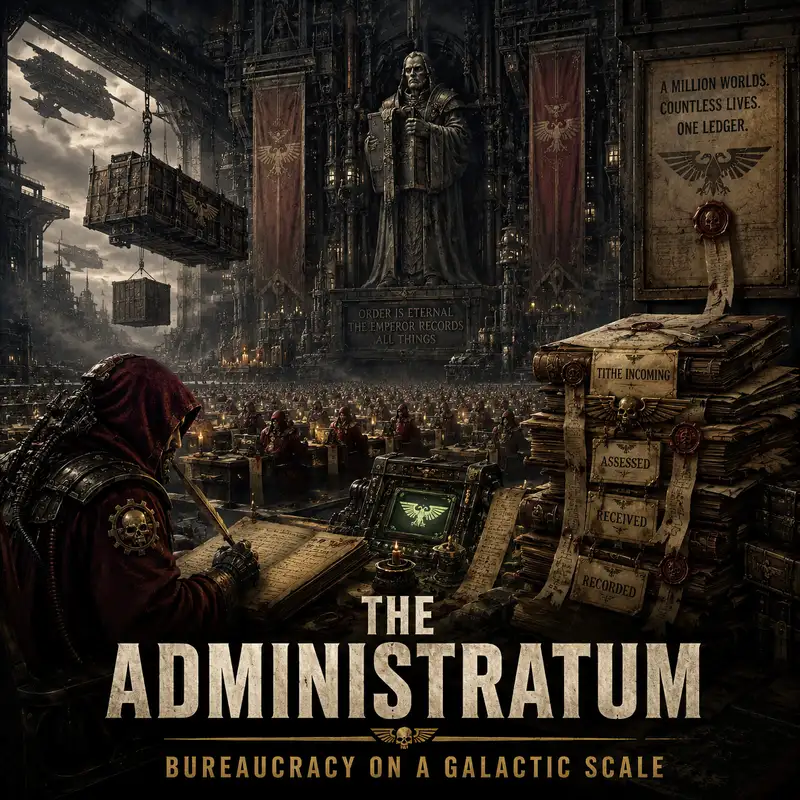
The Administratum: Bureaucracy on a Galactic Scale
On a Munitorum storage world designated A N zero six point zero one, the ammunition never stopped arriving. Cargo ships descended through the polluted sky and unloaded mountains of sealed crates, each one entered into the ledgers by diligent adepts. Long before, those supplies had been meant to continue onward to distant armies. Then the collection fleets stopped coming. Perhaps they were destroyed. Perhaps the war they served had ended. Perhaps an order vanished inside an office whose name no living person remembered. The reason no longer mattered. The command to deliver remained valid, so generations of workers continued to mine, manufacture, pack, ship, receive, count, and store. The stockpiles spread until they covered the world and threatened the ground beneath them. When there was nowhere left to place the cargo, the adepts recorded each new delivery and destroyed it. The shells were never fired. The forms were completed.
It is tempting to treat that world as a joke about Imperial incompetence. It is certainly absurd. It is also a near-perfect image of how the Imperium survives. The Adeptus Administratum is the largest bureaucracy in human history, an institution so vast that it cannot fully describe itself, much less control every office operating in its name. It wastes resources, loses planets, misdirects armies, preserves obsolete commands, and occasionally discovers that a war ended several centuries ago. Yet remove it, and the Imperium would not become freer or more efficient. It would come apart. Hive worlds would starve without imported food. Forge worlds would lack ore. Regiments would remain on their home planets while besieged systems waited for soldiers who had never been raised. The Administratum is both the connective tissue of the Imperium and one of the diseases consuming it.
The Administratum belongs to the Adeptus Terra, the immense collection of institutions that govern in the Emperor’s name. Its servants conduct censuses, classify worlds, calculate tithes, preserve legal records, register populations, issue charters, track shipments, and turn the demands of distant rulers into instructions that can be carried across the stars. Its military branch, the Departmento Munitorum, raises and supplies the armies of the Astra Militarum. Other offices assess taxes, maintain archives, record titles, and determine which obligations bind each planet. Calling these people clerks is accurate in the same way that calling an Imperial battleship a means of transportation is accurate. The word is not wrong. It simply fails to communicate the scale of the consequences.
That scale is the first problem. The Imperium claims authority over a million or more worlds, scattered across a galaxy where distance is not merely inconvenient. Ships must cross the Warp, where journeys are unpredictable and entire fleets can arrive late, early, or not at all. Messages travel through astropaths, human psykers who transmit dreams, symbols, pain, and fragments of meaning through the same hostile dimension. A report from a frontier world may take months or years to reach the office responsible for acting upon it. By the time an answer returns, the governor who requested aid may be dead, the invasion may be over, and the planet may have acquired a different name in the official archive. The Administratum does not govern a connected empire. It governs an archipelago of isolated worlds by passing instructions through a storm.
Its origins lie in a far more confident age. During the rise of the Imperium, the Emperor and Malcador required an administration capable of supporting the Great Crusade. Conquered worlds had to be recorded, assessed, supplied, and brought into a growing political order. Expeditionary fleets needed fuel, ammunition, replacement troops, food, and repair facilities. Early administrative systems were tools of expansion. The Departmento Munitorum grew from the logistical machinery that served those fleets. After the Horus Heresy shattered the old Imperium, the emergency institutions remained. Ten thousand years of decrees, reforms, counter-reforms, religious rulings, political bargains, and local exceptions accumulated around them. What began as administration became tradition. What became tradition acquired ritual. What acquired ritual eventually became sacred.
The Administratum’s central task is to make the galaxy legible. Before the Imperium can demand anything from a world, it must decide what that world is. Is it an agri-world capable of feeding distant populations? A mining world rich in strategic minerals? A hive world with billions of potential workers and soldiers? A fortress guarding a vital route? A shrine world whose value cannot be measured in ordinary production? These classifications are not neutral labels. They determine obligations, priorities, exemptions, and expectations. Once entered into the correct archive, a classification can shape a planet for generations. A world declared agricultural may be forced to increase food production until its soil is exhausted. A population assessed as suitable for military service may discover that its most reliable export is its children.
The Imperial tithe is the mechanism that turns those classifications into power. Each subject world owes something to the wider Imperium. The payment may be grain, ore, weapons, vehicles, manufactured goods, trained specialists, or human beings for the Astra Militarum. The precise demand is supposed to reflect the planet’s resources and capacity. In theory, this allows a diverse empire to draw from each world according to what it can provide. In practice, the assessment may have been written by officials who never visited the planet, based on surveys that were already old when they reached the archive. A productive century may lead to a higher tithe that remains in force after famine, rebellion, invasion, or ecological collapse. The figures look orderly on Terra. On the world that must meet them, order can resemble a firing squad.
For a planetary governor, paying the tithe is one of the clearest conditions of survival. The Imperium usually allows enormous freedom in local rule, provided that the governor remains loyal, maintains acceptable worship of the Emperor, controls forbidden threats, and delivers what is owed. A governor may be enlightened, brutal, hereditary, elected, or barely distinguishable from a warlord. The Administratum is less interested in political philosophy than in whether the ships are loaded on schedule. Failure is not treated as a minor accounting dispute. It can lead to removal, execution, punitive intervention, or the classification of an entire world as rebellious. The bureaucracy therefore exerts pressure without administering every street. It sets the demand, and local rulers decide how much suffering is required to satisfy it.
This arrangement explains why the Imperium can appear both highly centralized and wildly decentralized. Terra claims absolute authority, but it cannot manage daily life on every planet. Instead, it imposes obligations and recognizes intermediaries. Sector officials, subsector commands, planetary governors, chartist captains, military quartermasters, and local adepts make decisions because waiting for direct instruction would often be fatal. The Administratum is less a single chain of command than a forest of overlapping hierarchies. Some branches cooperate. Some compete. Some have not communicated in centuries. A local office may possess the authority to raise emergency levies for a nearby war while a distant superior is still considering whether the war officially exists.
Inside this machinery are human beings, although the institution works hard to make that fact difficult to notice. Untold billions of adepts labour in archives, counting houses, tithe stations, data vaults, and offices that extend through the Imperial Palace and far beyond Terra. Some are educated specialists. Others perform one narrow task learned from a parent who learned it from another parent. Positions can be hereditary. A family may spend generations maintaining a single register, translating one category of report, or carrying sealed bundles between departments whose entrances lie days apart. An adept may never understand the purpose of the information passing across the desk. Understanding is not always required. Correct procedure is.
The tools of this bureaucracy are a mixture of the ancient, the advanced, and the stubbornly impractical. Cogitators and data-slates exist, but so do mountains of vellum, wax seals, ink, filing cords, stamped plates, and handwritten copies. Physical records can survive electrical failure, machine corruption, and incompatible systems. They can also burn, rot, vanish into the wrong vault, or be eaten by creatures that have evolved comfortably inside the archives. The use of parchment is not simply a comic preference for old-fashioned office supplies. It reflects a civilization that distrusts innovation, fears corrupted technology, and values methods sanctified by long use. The result is an empire whose most important decisions may depend upon whether an exhausted scribe copied one symbol correctly several hundred years earlier.
Procedure becomes a form of faith. An order is valid because it bears the proper seals. A record is true because it occupies the approved place in the archive. A claim without the correct documentation may be treated as though it does not exist, even when the claimant is standing in front of the clerk and the evidence is on fire behind him. This is not merely stubbornness. The Administratum faces endless fraud, heresy, rebellion, sabotage, and misinformation. Authentication matters in an empire where an altered command can redirect a fleet. The tragedy is that a system designed to resist deception also resists correction. Once a mistake has survived enough inspections, it acquires the protective armour of precedent.
Time then turns error into policy. A misplaced digit can alter a tithe. A mistranslated name can separate a regiment from its supplies. A duplicated entry can create two official versions of the same world, while an omitted entry can erase a real population from Imperial concern. Most mistakes do not produce immediate catastrophe. They pass quietly from ledger to ledger until someone acts upon them years later. By then, the original clerk is dead, the source document is buried, and correcting the problem requires approval from offices that may not agree on which error is official. The Imperial response can be swift and decisive once all required petitions have been reviewed, verified, countersigned, archived, rediscovered, and forwarded to the correct dead man.
Records also create political reality. The Administratum does not merely describe the Imperium. It decides which description the Imperium will recognize. A governor’s title, a regiment’s honour, a world’s loyalty, a noble family’s charter, and the existence of an ancient obligation all depend upon documents. Some offices revise records judged dangerous or subversive. Others reconcile contradictory histories, often by selecting the version least disruptive to current authority. This gives the bureaucracy a quieter power than an army, but not necessarily a smaller one. A fleet can conquer a planet. An archive can determine who legally owns it afterward. In a civilization built upon inherited duty, whoever controls the record controls the past that justifies the present.
The Departmento Munitorum reveals the same logic in war. It is responsible for raising regiments, moving troops, allocating equipment, maintaining supply lines, and feeding campaigns whose fronts may span entire sectors. Its failures are notorious. Requests can spend years moving through distant offices. Supplies may arrive after the unit that requested them has been destroyed. Troops can be delivered without adequate transport, while transport waits elsewhere for troops assigned under a different designation. Yet the remarkable fact is not that the Munitorum fails. The remarkable fact is that it ever succeeds. Every Imperial crusade depends on countless clerks matching soldiers, ships, ammunition, fuel, food, replacement parts, medical stores, and destinations across routes that may change while the paperwork is in transit.
War reduces lives to quantities, and the Administratum is comfortable with quantities. When Imperial planners prepared the reconquest of the armoury world of Vraks, their calculations accepted a campaign lasting roughly twelve years and consuming millions of Guardsmen. The projected cost was judged tolerable because the world mattered. That arithmetic was brutal, but it was not irrational within the Imperial system. The Administratum does not ask whether a sacrifice is humane. It asks whether the expenditure is proportionate to the strategic value recorded in the ledger. A million soldiers can become a column of figures. Once converted into figures, they are easier to approve.
This coldness is not always produced by cruelty. Often it comes from distance. The adept assigning grain shipments to a hive world may save billions of lives without seeing a single face. The official diverting those shipments to a war zone may condemn the same population while believing the decision necessary. Both may be working from incomplete information. Neither controls the ships, the Warp, the weather, the enemy, or the local governor. Bureaucracy divides responsibility into pieces small enough for individuals to carry. It also divides guilt until no one person appears to possess very much of it. The decision emerges from the system, properly authorized and almost parentless.
Reform is therefore extraordinarily difficult. No official knows the entire organization. Departments guard their authority, traditions, and archives. A procedure that looks useless may be the only remaining link between two distant systems. Removing it could save decades of labour or cause a sector-wide famine. New rules are added to prevent the last disaster, but old rules are rarely removed because someone, somewhere, may still depend upon them. Every exception creates another office. Every office develops ranks, privileges, rivals, and reasons to survive. The Administratum is not a machine that can be switched off and rebuilt. It is the scaffolding around a collapsing structure, and much of the scaffolding has become load-bearing.
At the summit stands the Master of the Administratum, one of the High Lords of Terra and among the most powerful officials in the Imperium. The title suggests control. The reality is more complicated. No single person can direct an organization of such size in detail. Power comes from influence over priorities, appointments, access, and the flow of information. A favourable assessment can increase a world’s importance. A delayed petition can leave it isolated. A change in classification can redirect wealth across a sector. Yet even the Master is trapped inside inherited processes and competing institutions. The person at the top of the maze may have the finest chamber, but it remains a maze.
The adepts below are not uniformly foolish, corrupt, or indifferent. Many are diligent. Some are brilliant. Some understand that a line in a ledger represents people who will live or die. They work through sleepless shifts, failing machinery, contradictory orders, and archives too large for any human mind. The Imperium would fall more quickly without their discipline. That does not absolve the institution. It makes the tragedy sharper. Competent people can preserve a destructive system because the immediate alternative appears worse. A clerk who questions an order may delay ammunition needed at the front. A clerk who obeys may send it to a depot that has not supplied a front in centuries.
The Great Rift made every weakness more severe. Worlds were cut off behind Warp storms. Astropathic communication failed or became dangerously uncertain. Routes vanished. Records describing a united Imperium continued to circulate after the galaxy had been torn into regions that could barely reach one another. Officials attempted to govern emergencies with information from before the disaster. Local commanders assumed powers that central authorities could no longer exercise. The Administratum did what it had always done. It copied, classified, requisitioned, and issued commands. Some of those actions held isolated regions together. Others preserved a map of the Imperium that no longer matched the stars.
This is why the Administratum cannot be dismissed as a side joke about paperwork. It expresses the central contradiction of Imperial rule. Humanity’s empire is too large to govern directly, too endangered to leave entirely alone, and too frightened of change to rebuild the systems connecting it. The bureaucracy offers continuity, but continuity preserves mistakes. It distributes resources, but distribution requires reducing worlds to categories. It creates accountability, but its procedures can hide responsibility. It remembers, but it also determines what may be forgotten. Every virtue carries the seed of a corresponding horror.
The Imperium survives through obligations that outlive the people who created them. A tithe order can endure after its purpose is lost. A military classification can endure after the enemy changes. A hereditary office can continue a task whose origin has become a matter of legend. This endurance is wasteful, oppressive, and sometimes monstrous. It is also one reason a political order shattered by civil war, invasion, and ten thousand years of decay still functions at all. The Administratum does not keep the Imperium healthy. It keeps the Imperium moving, which is a different achievement and, in the forty-first millennium, often the only one available.
On A N zero six point zero one, another shipment descends. Somewhere, a world has mined the metal, forged the casings, filled the shells, packed the crates, and surrendered the labour of countless citizens. Somewhere else, soldiers may be dying for lack of ammunition. The depot adepts receive the cargo with care. They verify the seals. They enter the delivery. They follow the standing order and consign the shells to destruction. No villain needs to command them. No traitor needs to interfere. Every person can perform the assigned duty correctly, and the result can still be madness. That is bureaucracy on a galactic scale. The Imperium survives because the form is processed. Sometimes it dies for exactly the same reason.