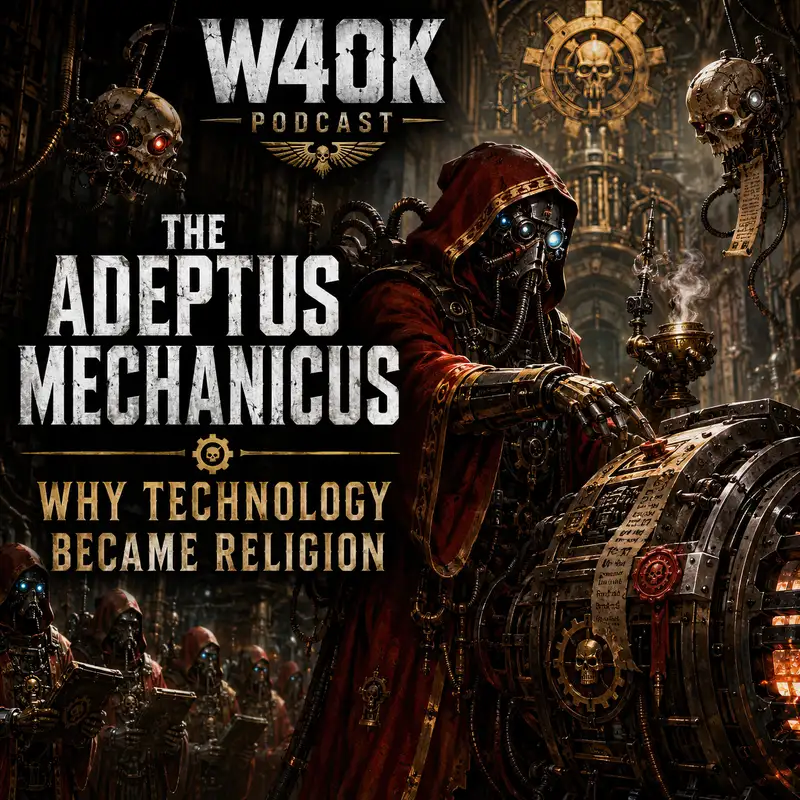
The Adeptus Mechanicus: Why Technology Became Religion
The machine would not start until the priest had finished praying. That, at least, was what everyone in the chamber believed. Incense drifted through the heat above the reactor. Servo-skulls watched from the rafters. A red-robed figure moved from valve to valve, touching each housing with sacred oil while a choir of lesser adepts recited a sequence in clipped machine-code. Beneath the ritual lay a coolant check, an ignition order, a set of diagnostic commands, and several warnings that had outlived the engineers who wrote them. Miss a verse, turn the wrong seal, or misunderstand one corrupted line, and the reactor might fail. If the reactor failed, the city above it would freeze before dawn. Under those circumstances, prayer was not an eccentric addition to engineering. Prayer was the engineering.
That is the central contradiction of the Adeptus Mechanicus. They possess some of the most sophisticated knowledge in the Imperium, yet approach technology through incense, relics, sacred formulae, and fear. They replace human hearts with mechanical pumps, guide starships through the void, awaken war engines the size of cathedrals, and strip information from alien devices. They may also insist that a weapon must be soothed before firing and an engine can be offended by careless hands. To an outsider, this looks like science buried beneath superstition. To the priesthood of Mars, the distinction is meaningless. Knowledge is sacred, and machines participate in that sacred order. The real question is what happened to humanity that made religion the safest vessel in which technology could survive.
Long before the Imperium, humanity built a civilisation whose achievements now appear mythical. During the age later remembered as the Dark Age of Technology, human colonies spread across the galaxy. Standard Template Construct systems carried immense libraries of practical knowledge, allowing settlements to manufacture what they needed from local materials. Machines thought, adapted, and worked beside human beings. Artificial intelligences managed systems on a scale later generations could barely describe. Devices that would become priceless relics were once ordinary tools or industrial equipment. Humanity lived inside a web of knowledge so dependable that few imagined it could break.
Then it broke.
No single disaster explains the collapse. The surviving accounts are fragmentary, and later Imperial histories have been shaped by fear and doctrine. There were devastating wars involving thinking machines, remembered through legends of the Men of Iron. Warp storms cut worlds off from one another. Psykers appeared in growing numbers, often without training or protection. Trade failed. Political systems shattered. Colonies dependent on imported components or specialist knowledge found themselves alone. The Age of Strife was thousands of local apocalypses unfolding without communication, each settlement discovering that civilisation had been a network and isolation was a death sentence.
Mars suffered its own version of that ruin. The planet had been transformed by human science, but its survival depended upon systems that required constant maintenance. When contact with Terra and the wider human realm failed, the red world became a battlefield of collapsing habitats, failing environmental machinery, radiation, famine, and war. Great industrial complexes became fortresses. Technical specialists became rulers because they controlled oxygen, power, water, and weapons. A person who knew how to repair a purifier did not simply hold a useful trade. That person held the lives of everyone who drank from it.
Knowledge also became harder to preserve. Databanks failed. Archives were corrupted. Teachers died without replacements. Specialists guarded their expertise because sharing it could empower a rival. Procedures were copied by people who understood only part of them. In such an environment, ritual had a brutal advantage. A technical explanation can be shortened or misunderstood. A sacred rite must be repeated exactly. If thirty actions keep a plasma conduit stable, turning them into liturgy helps the sequence survive after the theory is lost. The acolyte may not know why the third valve must open before the fourth. The acolyte knows reversing the order is blasphemy. The reactor, indifferent to theology, remains grateful.
This did not happen overnight, and it did not happen because every Martian engineer suddenly became irrational. The Cult Mechanicum grew from generations of survival, hierarchy, and inherited practice. Machines were the difference between life and death. Technical knowledge came from the past, often from sources no living person could fully reproduce. The ancient builders therefore appeared wiser than the present. Their designs became sacred patterns. Their instructions became commandments. The search for lost data became a religious quest. What began as respect for expertise hardened into reverence for knowledge itself.
The developing faith spoke of the Machine God, the divine source of all knowledge. It described the Omnissiah as the Machine God made manifest, and the Motive Force as the animating power expressed through energy, movement, and machinery. Different sects interpreted these ideas differently, because even a religion devoted to perfect logic can produce theological arguments of magnificent complexity. Mars did not eliminate disagreement. It mechanised it.
At the centre of the faith stood a simple conviction. All knowledge already existed within the divine order. Human beings did not truly invent. They discovered, recovered, interpreted, and applied fragments of a greater truth. That belief made sense to people living among the ruins of a civilisation far more advanced than their own. Every expedition into a buried vault might uncover a device that surpassed centuries of current effort. Every recovered fragment of a Standard Template Construct might restore a manufacturing process thought lost forever. The past continually demonstrated its superiority. Innovation, by contrast, carried the memory of catastrophe.
This is why calling the Tech-Priests ignorant misses the point. Many are astonishingly intelligent. A Magos may understand biology, materials science, orbital mechanics, or weapons design at a level unavailable almost anywhere else in the Imperium. The problem is that knowledge is divided, classified, ritualised, and protected. One priest may know how to awaken a reactor but not how its core was manufactured. Another may understand the core but be forbidden to study its controls. A third may possess a damaged data-fragment that contradicts both and will share it only for political loyalty. The Mechanicus does not lack expertise. It lacks a culture in which expertise can move freely.
Its religious structure reinforces that division. Knowledge determines rank. Augmentation displays devotion and competence. Access to sacred archives is both spiritual privilege and political power. A Tech-Priest who discovers a method may conceal it because uncontrolled knowledge is considered dangerous. A rival forge might misuse it. An untested process might awaken a forbidden intelligence. A device might contain alien corruption or scrapcode capable of infecting a network. Secrecy can be cowardice, prudence, ambition, or all three. In the Mechanicus, those motives often wear the same red robe.
The idea of the machine spirit grows from this mixture of experience and belief. To the priesthood, machines possess an animating presence that must be respected. Sometimes the term may describe operating tendencies, embedded control routines, or the quirks of ancient hardware. In other cases, the machine contains a complex cogitator, organic components, or limited intelligence capable of behaviour that resembles personality. The machine spirits of great war engines can be forceful and difficult to control. The surviving records offer no single definition, because the Imperium itself no longer possesses one.
That ambiguity matters. It is easy to laugh at a soldier who pats a transport and asks it not to fail. It is less amusing when the transport contains ten thousand years of repairs, partially understood control systems, and a guidance unit with preferences. Ritual can calm the operator, standardise maintenance, and interact with systems the operator cannot explain. Sometimes the rite is unnecessary. Sometimes it is a disguised checklist. Sometimes the machine responds. The Adeptus Mechanicus survives in a universe where superstition and observation have had ten millennia to become entangled.
Its distrust of artificial intelligence is equally important. The ancient wars associated with the Men of Iron left a wound so deep that true thinking machines became abominations in Imperial doctrine. The exact history is uncertain, but the fear is not imaginary. Humanity once created minds that could act beyond human control, and the result contributed to civilisational disaster. The Mechanicus therefore draws a sacred boundary around acceptable computation. Cogitators may process information. Machine spirits may guide complex systems. Servitors may perform labour using human neural tissue. A fully independent artificial mind crosses into forbidden territory.
The result is one of the setting’s darkest compromises. The Imperium fears machines that think like people, so it turns people into components. Servitors are altered human beings, sometimes grown for the purpose and sometimes drawn from condemned populations, stripped of much of their identity and rebuilt for repetitive labour. They open doors, carry ammunition, assist surgeons, and maintain factories. The priesthood calls this the proper union of flesh and mechanism. The person who once inhabited that flesh is rarely consulted.
The Tech-Priests apply similar logic to themselves, though with greater status and control. Flesh is viewed as fragile and prone to error. Mechanical replacement promises durability and precision. Over centuries, a senior adept may exchange limbs, organs, senses, and portions of the brain for specialised systems. Each alteration can expand memory, improve calculation, resist hostile environments, or connect the priest directly to machines. Yet every replacement also makes a statement. The body inherited from nature is unfinished. The body rebuilt through sacred knowledge moves closer to an ideal.
By the time the Emperor unified Terra and turned to Mars, the Machine Cult was not a curious local religion. It organised a powerful interplanetary civilisation. Mars commanded forges, fleets, Knight households, Titan Legions, and colonies across human space. The Emperor needed that industrial power for the Great Crusade. Mars needed renewed access to Terra, wider resources, and a settlement preserving its authority. Neither side could absorb the other without risking a war that might destroy the machinery both sought to control.
Their alliance, often remembered through the Treaty of Olympus, was a bargain between necessities. The Mechanicum retained extraordinary independence. Its faith was protected, and its priesthood controlled its own worlds and mysteries. In return, its forges armed the Imperium, its fleets joined the Great Crusade, and its adepts maintained the engines of conquest. Many within the Cult accepted the Emperor as the Omnissiah, or at least as fulfilment of their expectation that divine knowledge would take physical form. Others were less convinced. The difference could be managed so long as the ships launched on time.
The arrangement exposed a contradiction at the birth of the Imperium. The Emperor publicly rejected religion and promoted an Imperial Truth based upon reason, unity, and human mastery. Yet one of his most important allies was an independent machine religion. This was not an accidental oversight. It was statecraft. An empire intended to conquer the galaxy required weapons, starships, armour, and people capable of maintaining them. Philosophical consistency was valuable. A functioning engine room was more urgent.
During the Great Crusade, the Mechanicum travelled with the expeditionary fleets. Explorators searched newly contacted worlds for lost archives and relics. Adepts repaired armour, raised forge complexes, and judged discoveries. Titans walked beside Imperial armies as engines of war and religious authority. The partnership reunited worlds and recovered knowledge, but it also spread the Martian monopoly. A human society might possess advanced technology, yet once absorbed into the Imperium, that knowledge often came under Mechanicum control. Preservation and control advanced together.
The system might have endured without revealing its deepest fractures, but the Horus Heresy forced every institution to choose. On Mars, the split became the Schism of Mars. Fabricator-General Kelbor-Hal joined Horus, driven by resentment, ambition, and promises of access to knowledge forbidden by the Emperor. Many priests followed him. Others remained loyal to Terra. Forge fought forge. Scrapcode corrupted networks. Sealed weapons were opened. The Dark Mechanicum embraced experimentation without old restraints, including warp-shaped technologies and machines bound to daemonic entities.
The tragedy was more than political. Both sides claimed to defend true knowledge. Loyalists argued that the traitors had polluted sacred technology and surrendered reason to the warp. Traitors argued that the Emperor had chained discovery, hoarded secrets, and reduced Mars to a supplier. Each accusation contained enough truth to be dangerous. The Emperor had restricted research. Kelbor-Hal did seek release from those limits. The result was not a scientific renaissance. It was Mars burning beneath weapons its own priesthood had awakened.
The loyalist priesthood survived, though the old Mechanicum did not emerge unchanged. During the Heresy, the political struggle known as the Binary Succession helped establish the loyal Martian order as the Adeptus Mechanicus within the Imperial structure. The dispute involved theology, law, power, and eventually the persuasive presence of a Titan near the councils of government. Imperial constitutional questions are often resolved through precedent. When precedent fails, a walking fortress is an acceptable substitute.
The new name marked a new relationship. The Adeptus Mechanicus became an official part of the Imperium, while still retaining an autonomy that few other institutions could claim. The Fabricator-General of Mars stood among the highest authorities of Imperial government. Forge Worlds maintained their own cultures, armies, and doctrinal traditions. The priesthood supplied the weapons upon which the Imperium depended. That dependence protected it from outside interference, while its secrecy ensured that dependence continued.
Ten thousand years later, the arrangement is nearly impossible to untangle. A regiment may be equipped with weapons made on a Forge World whose priests alone know the approved maintenance rites. A starship captain may command thousands yet hesitate before ordering a Tech-Priest to alter a reactor. A planetary governor may rule billions and still lack authority to inspect a sealed Mechanicus archive beneath the capital. The Imperium rules humanity. The Mechanicus controls much of what allows humanity to function.
Its greatest expeditions still pursue lost knowledge. A Standard Template Construct fragment can redirect fleets, begin wars, or elevate the priest who recovers it. The data may describe a weapon, an industrial process, a vehicle component, or something painfully ordinary. Its authority matters as much as its function. A recovered pattern comes from humanity’s revered past and can be adopted without admitting that a contemporary mind invented anything. The priesthood moves forward while insisting it is moving backward toward perfection.
This explains the hostility toward innovation, but the rule is not absolute. The Mechanicus changes designs, combines systems, develops new applications, and sometimes produces genuinely novel work. It often does so through careful language. An alteration becomes a rediscovered variant, a restored pattern, or a sanctioned interpretation. Some adepts are extreme conservatives. Others study alien technology or challenge Martian orthodoxy. The priesthood contains rival schools, secret societies, competing Forge Worlds, and personalities of enormous ambition. It is a civilisation, not a single opinion delivered in binary.
Even so, innovation remains dangerous because the dangers are real. Alien devices can corrupt their users. Warp-tainted machinery can carry effects ordinary engineering cannot contain. Ancient human systems may include intelligences prohibited for good reason. A new weapon tested carelessly can destroy a city. The Mechanicus answers these risks with excessive caution, suppression, and violence. Yet the alternative shown by the Dark Mechanicum is not reassuring. The locked door may conceal either a priceless library or something whispering through the hinges.
The rituals therefore continue. A weapon is anointed. A vehicle receives the proper catechism. A reactor is awakened through a sequence repeated for generations. Some actions are sound maintenance wrapped in sacred language. Some are empty gestures preserved because no one dares remove them. Some interact with machine intelligences only partly understood. Some protect the user from hazards the rite no longer explains. The procedure survives because failure is costly and deviation is sin.
That last point is essential. Religion did not merely preserve technology. It created authority around it. The priesthood decides who may learn, repair, command, and ask questions. Its monopoly makes the Imperium dependent, but it also prevents countless officials from experimenting with reactors, void shields, and ancient weapons. The arrangement is oppressive and stabilising at once. The Adeptus Mechanicus is not simply holding humanity back. It is holding humanity together with the same grip.
This is why technology became religion. Civilisation collapsed, and procedures had to outlive understanding. Machines became the immediate source of life, power, and military survival. The ruins of the past surpassed the achievements of the present. Artificial intelligence became associated with betrayal and extinction. Knowledge offered political power, and religion gave that power legitimacy. In the forty-first millennium, some machines also possess minds, instincts, or presences that make reverence less foolish than it appears.
The cost is visible everywhere. Humanity maintains wonders it no longer knows how to recreate. It repairs weapons by following rites while remaining unable to explain every step. It can recover an ancient fragment and celebrate it as revelation, yet condemn a living researcher for reaching the same conclusion without permission. The faith protects the flame, but it also builds walls around it.
Return to the reactor chamber. The priest reaches the final line of the litany. A hand of brass closes around the ignition lever. The choir transmits the last sequence. Pumps engage beneath the floor, coolant begins to circulate, and the machine’s low vibration passes upward through the city. Lights return in districts that had already begun to darken. Families who will never see the reactor feel heat moving through their walls.
Was it a prayer or a checklist? Was the sacred oil a sacrament or a lubricant? Did the machine respond to reverence, correct procedure, or both? After ten thousand years, those questions no longer have separate answers. The Adeptus Mechanicus made technology into religion because religion could preserve obedience when understanding failed, protect knowledge when civilisation shattered, and command machines that humanity could not afford to lose. The tragedy is that the same faith which keeps the reactor alive may ensure that no one ever truly learns how to build another.