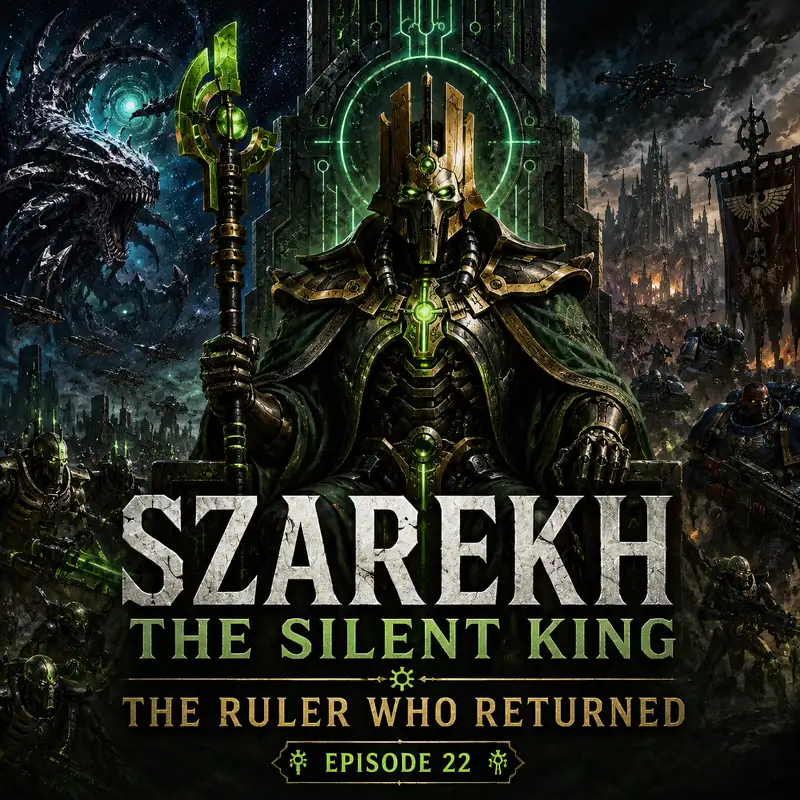
Szarekh the Silent King: The Ruler Who Returned
Beyond the last stars of the galaxy, where even the light of dying suns had faded behind him, Szarekh saw something moving through the dark. It was not a fleet in any ordinary sense. It was hunger given direction, a living tide crossing the emptiness between galaxies. The creatures would come in numbers great enough to strip worlds to stone and reduce whole civilizations to raw material. For sixty million years, the last Silent King had carried his guilt away from the people he had ruined. In that moment, exile ceased to be penance. It became neglect. Szarekh turned his throne toward home.
His return was not the homecoming of a beloved monarch. The Necrons had slept through the rise and fall of species, the birth of human empires, and the slow poisoning of reality by the Warp. Their tomb worlds were scattered, damaged, occupied, or insane. Their nobles had awakened into private kingdoms and personal obsessions. Some still remembered Szarekh as the sovereign of a civilization that had ruled the stars. Others remembered him as the ruler whose greatest decision had cost them their souls. The Silent King returned with a claim to absolute authority and no longer possessed the power that once made obedience automatic.
That contradiction defines Szarekh. He is the most exalted ruler in Necron history, yet his reign rests upon an act he cannot undo. He defeated the Old Ones. He broke the star gods. He preserved his people across an age longer than human history can comfortably imagine. He also delivered the Necrontyr into biotransference, transforming a living species into a civilization of deathless machines. Every later victory stands in the shadow of that choice. To understand why the Silent King returned, it is necessary to understand why he left.
Before the Necrons, there were the Necrontyr. They were a proud, brilliant, and bitter people born beneath a cruel star. Radiation and disease marked their bodies. Their lives were short, their deaths came early, and their culture grew around the certainty that time was an enemy. They built dynasties, monuments, armies, and tombs with the intensity of a people who expected the grave to arrive before the paint had dried. Their rulers fought one another constantly. The Necrontyr responded to brief lives by spending a remarkable portion of them making other lives briefer.
Above these rival dynasties stood the Triarch, a ruling council headed by the Silent King. The title was not poetic decoration. By tradition, the Silent King did not address the people directly. His commands passed through the other members of the Triarch, giving royal will the appearance of something distant, formal, and beyond argument. Szarekh was the final holder of that office before the transformation of his species. His task was to bind together dynasties whose pride was almost as durable as their monuments.
The Necrontyr looked upon the Old Ones and saw everything they had been denied. The Old Ones possessed long lives, mastery of the Webway, and a command of biological and psychic science that appeared almost miraculous. The Necrontyr sought relief from their inherited suffering. The Old Ones refused them. The surviving accounts do not make the reasons entirely clear, and Necron memory is hardly neutral on the matter. What matters is that refusal became grievance, grievance became ideology, and ideology gave Szarekh a weapon against division.
War with the Old Ones offered the Necrontyr a common enemy. It also offered disaster. Their technology was formidable, but the Old Ones could move through the Webway and strike across distances the Necrontyr could not control. The campaign intended to unite the dynasties instead exposed the limits of their power. Defeat threatened Szarekh’s authority, and the old rivalries began to return. A ruler who had gambled on war now needed something greater than victory. He needed transformation.
The answer came from the C’tan, ancient beings that fed upon stars. Given bodies of living metal, these star gods could speak, bargain, and deceive. The most dangerous among them was the Deceiver, who offered the Necrontyr what the Old Ones had withheld. They could escape disease. They could escape age. They could become immortal and gain the strength to defeat their enemies. Orikan the Diviner was among those who warned that the offer concealed catastrophe. Szarekh accepted it anyway.
The process was called biotransference. Across the Necrontyr domains, immense furnaces received a living people and produced metal bodies. Minds were copied or transferred into forms made from self-repairing necrodermis. The C’tan consumed the life essence released in the process. Nobles and gifted specialists retained much of their intellect and personality, though memory and emotion were damaged in ways that would deepen over time. Most common Necrontyr emerged as obedient warriors with only fragments of the people they had been. Immortality had been delivered. The person who was supposed to enjoy it was often missing.
Szarekh received more than a new body. The C’tan placed within him command protocols that gave him control over the transformed race. The quarrelling dynasties became a single war machine because their king could compel them to act. The Necrons marched against the Old Ones with weapons that tore matter apart and engines that bent the laws of reality. The War in Heaven spread across the galaxy. Species were created, worlds were ruined, and forces were unleashed whose consequences would outlive nearly everyone who began the conflict.
The Necrons and their star gods eventually broke the power of the Old Ones, but victory revealed the full shape of the betrayal. The C’tan had not liberated the Necrontyr. They had consumed them. Szarekh possessed a race of immortal soldiers and ruled over the remains of a people. The accounts suggest that he understood the truth during the war and concealed his intention until the Old Ones were defeated. He had been deceived once. He would not give the C’tan time to prepare for his answer.
At Szarekh’s command, the Necrons turned their weapons upon the star gods. The revolt was one of the most audacious acts in the history of the galaxy. The C’tan could not be killed in any simple sense, so the Necrons shattered them into fragments and imprisoned those shards within living metal vaults. Gods became weapons, batteries, and captives. Szarekh earned titles celebrating the destruction of beings who had once claimed mastery over him. It was a triumph vast enough to become myth. It still did not restore a single soul.
The Necrons emerged from the War in Heaven exhausted. The Aeldari, created and guided by the Old Ones, were rising into dominance. Even the victorious dynasties could not safely fight another galactic war. Szarekh chose patience. Tomb worlds were prepared, armies entered stasis, and the Necrons began the Great Sleep. They would wait sixty million years while flesh-born empires rose, decayed, and vanished. When the galaxy had forgotten them, they would awaken and reclaim it.
Before the tombs closed, Szarekh made one final decision. He destroyed the master command protocols that allowed him to control the entire Necron race. Perhaps this was remorse. Perhaps it was an admission that no ruler who had made such a choice should retain absolute power. Perhaps it was the only gift of freedom he could still give. The surviving record does not settle his private motive. It does establish the consequence. When the dynasties awakened, they would follow their own rulers, ambitions, grudges, and damaged minds. Szarekh then left the galaxy.
His vessel crossed into the intergalactic void, accompanied by loyal elements of his own dynasty. There were no younger empires to conquer there, no court whose praise could soften the past, and no organic distractions from memory. Necron minds often degrade across immense spans of time. Some become obsessed. Some succumb to the Destroyer curse or the Flayer curse. Szarekh appears to have retained an unusual degree of memory, including the burden of what life had once felt like. For millions of years, the ruler who had silenced a civilization had nothing but silence.
The precise purpose of his exile remains uncertain. Penance is the most obvious interpretation, but Szarekh was never merely a mourner. Later sources suggest that he continued seeking a way to reverse biotransference and restore his people to organic existence. Whether such a restoration could recover lost souls, reproduce only bodies, or create something entirely new is unknown. The ambition itself reveals what he believed had been lost. Many Necron nobles value immortality and regard flesh as weakness. Szarekh seems to regard their metal forms as a prison built from his own command.
Then he encountered the Tyranids. The hive fleets were approaching from beyond the galaxy, consuming biological life wherever they found it. To humanity, the threat was straightforward. If the Tyranids won, humanity would be eaten. To Szarekh, the danger was more complicated. A galaxy stripped of living biomass would leave no material from which the Necrons might rebuild organic bodies. The Tyranids threatened not only Necron territory but the possibility of Necron restoration. They could make his ancient mistake permanent.
This does not make the Silent King a defender of life in any generous sense. He did not return because he had developed affection for humanity, the Aeldari, or the countless species occupying former Necron worlds. He returned because dead galaxies offer poor foundations for restored empires. Preserving organic life could serve his people, even if the preserved populations were later conquered, studied, or used. Szarekh’s motives contain responsibility, guilt, and ruthless calculation in proportions that no surviving account can cleanly separate.
By the later centuries of the forty-first millennium, the Silent King had turned back toward the Milky Way. At first, he moved indirectly. Triarch Praetorians carried his influence between tomb worlds. Loyal agents encouraged awakenings, shaped alliances, and prepared dynasties for a threat many nobles did not yet understand. Secrecy was practical. Szarekh had surrendered the mechanism that once compelled loyalty, and sixty million years is a long absence even by Necron standards. Several rulers had become rather attached to being in charge.
His return also forced him to deal with the younger species as tools rather than simple vermin. During the wars around the Gehenna system, Necrons and Blood Angels faced a Tyranid threat neither could conveniently ignore. Szarekh sought a temporary alliance with Commander Dante. At their meeting, the Silent King appeared behind a golden mask shaped in the image of Sanguinius, and his court claimed that he had known the primarch. Whether this was truth, calculated theatre, or an elegant mixture of both remains uncertain. The alliance served its purpose. Neither side mistook cooperation for friendship.
The episode revealed how Szarekh intended to fight the Tyranids. Necron armies alone were powerful, but the galaxy contained many expendable forces that could be directed toward the same enemy. Humans could bleed where Necrons preferred not to. Rival factions could be maneuvered into defending worlds Szarekh needed preserved. Temporary truces cost less than rebuilding destroyed legions. The Silent King had returned from exile with the habits of a strategist, not a penitent wandering from shrine to shrine.
The opening of the Great Rift made his task more urgent. Warp storms split the galaxy, Chaos expanded, and psychic instability spread across regions already weakened by war. For the Necrons, the Warp is both alien and dangerous. Their civilization was built without the psychic dependence common to many younger species. Ancient blackstone technology could interact with Warp energy, amplifying or suppressing it depending on how the material was used. Szarekh began turning that capability into a galactic project.
The Pariah Nexus is the clearest expression of his return. Across the Nephilim region, Necron pylons and networks of blackstone impose a growing stillness upon reality. Psychic powers weaken. Warp activity recedes. Living beings suffer exhaustion, despair, and a numbing loss of purpose. To Necrons, the effect offers order, protection, and strategic dominance. To human survivors, it can feel as though the soul itself is being smothered. Szarekh’s answer to the madness of the Warp is not healing. It is silence enforced on a regional scale.
From a military perspective, the logic is formidable. A stable, Warp-suppressed realm denies Chaos one of its greatest advantages. It limits enemy psykers, protects Necron operations, and creates a controlled zone in which Szarekh can rebuild power. It may also support whatever work he intends toward reversing biotransference. The cost is borne largely by living populations, which is consistent with the Silent King’s approach to responsibility. He regrets destroying his people. He has not therefore concluded that other peoples should be permitted to interfere.
The Pariah Nexus also announced that the Silent King was no longer acting only through rumor and intermediaries. His fleets confronted the Indomitus Crusade, and the Necron dynasties began to gather around his authority. The Imperium now faced something more dangerous than isolated tomb worlds. It faced the possibility that the Necrons might become a civilization again, coordinated by the ruler who once directed them through the War in Heaven. A single awakened dynasty can erase armies. A united Necron empire could revise the ownership of the galaxy with administrative finality.
Unity, however, is precisely what Szarekh cannot command. The destruction of the master protocols gave the Necrons freedom, and freedom produced rivals. Some phaerons honour the old Triarch. Others question whether the king who doomed their species deserves a second reign. Many have built kingdoms during his absence and see no reason to surrender them. Mechanical immortality has preserved pride with impressive efficiency.
The greatest challenge comes from Imotekh the Stormlord, ruler of the powerful Sautekh Dynasty. Imotekh is not a malfunctioning subordinate waiting to be corrected. He is a brilliant conqueror who has already united vast territories through his own victories. He rejects Szarekh’s claim to automatic supremacy and opposes the dream of returning the Necrons to flesh. Where Szarekh sees metal bodies as evidence of catastrophe, Imotekh sees superiority. Their disagreement is political, personal, and philosophical.
That conflict has grown into open struggle within the Pariah Nexus. Dynasties loyal to Szarekh fight those aligned with Imotekh even while Imperial forces, Chaos powers, and other invaders press into the region. The Silent King returned to unite his people against extinction and instead helped create a Necron civil war. The irony is not accidental decoration. It is the direct consequence of his final act before exile. He freed the dynasties from compulsory obedience, and now they are free to tell him no.
Szarekh still possesses advantages no rival can easily match. His own Szarekhan Dynasty commands relics from the height of Necron power. The Triarch Praetorians preserve ancient law and lend legitimacy to his cause. His knowledge reaches back to the age of the Old Ones and the C’tan. On the battlefield, he is surrounded by machinery and retainers that embody the authority of the Final Triarch. His presence can sharpen Necron command and turn disciplined phalanxes into instruments of extraordinary precision.
Power does not remove the central problem. Szarekh can destroy armies, suppress the Warp, and manipulate younger species. He cannot command the return of a soul. He cannot guarantee that organic restoration is possible. He cannot erase the furnaces of biotransference from Necron memory, even when those memories are fragmented or corrupted. Most importantly, he cannot recreate the unquestioned unity he once possessed without betraying the freedom he granted before leaving.
This is why his return matters beyond the arrival of another powerful warlord. Abaddon seeks to break the Imperium. Tyranids seek biomass. Orks seek the next great war. Szarekh seeks to reverse a civilizational death while rebuilding the empire that caused it. His objective could preserve worlds from Tyranids and close regions against Chaos. It could also subject living species to conquest, experimentation, or the deadening fields of the Pariah Nexus. A plan can oppose extinction without being merciful.
The Silent King is therefore neither a redeemed savior nor a simple machine tyrant. The evidence points toward genuine remorse, but remorse has not made him humble. He still assumes that the fate of the galaxy may be decided according to Necron needs. He still treats populations as pieces in a campaign extending across ages. His guilt drives him toward rescue, and his conception of rescue remains imperial. Szarekh wishes to save his people, restore their future, and reclaim their dominion. He sees no contradiction in doing all three.
He returned because the Tyranids threatened to consume the raw possibility of that future. He remained because the galaxy he found was fractured by the Warp, occupied by younger powers, and filled with Necron rulers who had forgotten how to obey. Exile could no longer repair what he had done. Only action offered even the smallest chance of restoration. The ruler who once solved division by taking away choice must now persuade, intimidate, bargain, and fight.
That may be Szarekh’s true punishment. He possesses a body that will not age, memories that will not release him, and authority that history says should be absolute. Yet the one command he cannot revoke is the command that made his people free of him. The Silent King returned to save the Necrons from a future without life. He found that the first people he would have to conquer were the people whose souls were lost by his decision, and who now have the power to reject his salvation.