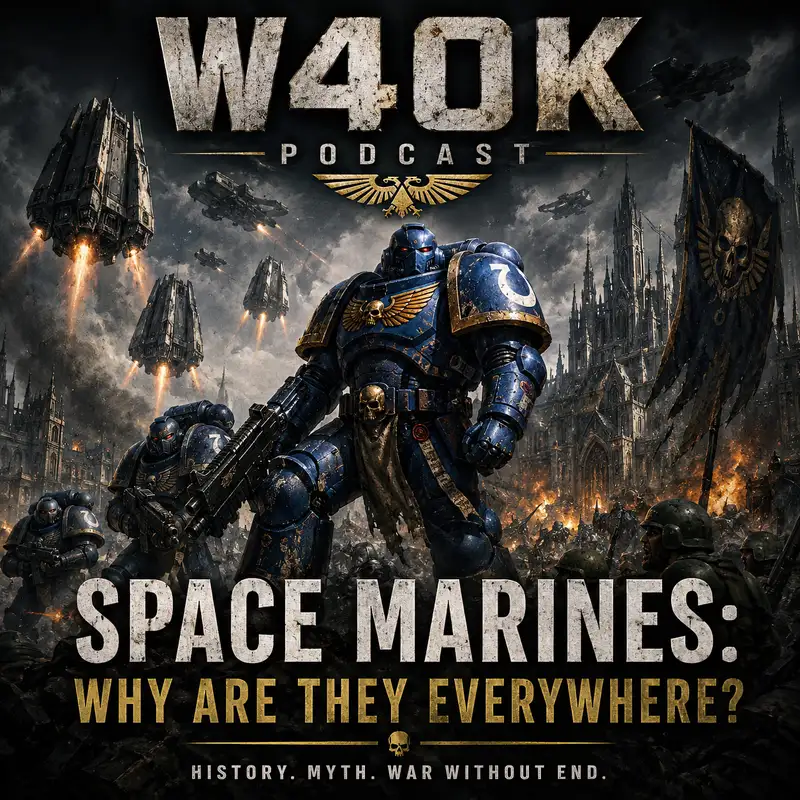
Space Marines: Why Are They Everywhere?
A rebellion can burn for years before a Space Marine appears. Regiments are raised, cities are shelled, supply lines collapse, and millions of ordinary soldiers learn the intimate geography of mud, rubble, and casualty reports. Then a strike cruiser arrives above the planet. Drop pods fall through the clouds. A few dozen armoured giants smash into the enemy headquarters, kill the leaders, destroy the weapons that mattered, and depart before most of the surviving population has seen them.
To the people below, the Space Marines were everywhere. They came from the sky, appeared at the decisive point, and became the image by which the entire war would be remembered. In truth, they may have spent only hours on the surface. The human armies had done nearly all the fighting. The Space Marines had simply arrived at the moment history chose to notice.
That contradiction explains much of their place in Warhammer forty thousand. Space Marines seem to be everywhere because the stories of the setting gather around catastrophes, and catastrophes are precisely where the Adeptus Astartes are meant to go. They are not common soldiers. They are rare, mobile concentrations of force, sent toward the battles where a small number of exceptional warriors might alter the fate of a world.
Their origin lies ten thousand years before the age in which most Warhammer forty thousand stories take place. The Emperor created the Legiones Astartes to conquer the galaxy during the Great Crusade. These first Space Marines were organised not into the comparatively small Chapters of the later Imperium, but into enormous Legions. Each Legion carried the genetic legacy of a Primarch, one of the Emperor’s gene-crafted sons, and each developed its own habits, loyalties, methods of war, and eventually its own dangerous sense of identity.
The Legions were built for expansion. They broke alien empires, forced isolated human civilisations into compliance, and drove the borders of the new Imperium outward at a pace that ordinary armies could rarely match. They could fight as massed formations, seize worlds, and continue from one campaign to the next with the confidence of men who had been told that history itself was marching beside them. This was efficient, so long as the commanders remained loyal.
They did not.
During the Horus Heresy, nine of the great Legions followed the Warmaster Horus into rebellion. The civil war almost destroyed the Imperium, mortally wounded the Emperor, and demonstrated the obvious hazard of placing tens of thousands of genetically enhanced warriors under the command of a single demigod. The Imperium is not always swift to learn from disaster, but the destruction of half its ruling military brotherhoods proved unusually persuasive.
After the Heresy, the loyal Legions were divided into Chapters. Roboute Guilliman, Primarch of the Ultramarines, set out the new structure in the Codex Astartes. A conventional Chapter would field roughly a thousand battle-brothers, organised so that no single commander possessed the power once held by a Legion master. The exact application varied, and some Chapters treated the Codex as sacred law while others regarded it as useful advice written by a relative they found tiresome. The political purpose, however, was clear. Never again should one warrior command a force large enough to tear the Imperium apart.
The division also scattered the Space Marines across the galaxy. The original loyal Legions became First Founding Chapters, while their remaining warriors formed successor Chapters with new names, heraldry, territories, and traditions. Later Foundings created still more. Some Chapters were established to guard dangerous regions. Some were raised for crusades. Some were assigned home worlds from which they could recruit and watch over surrounding space. Others remained fleet-based, carrying their fortress, armouries, relics, and grudges from one war zone to another.
Imperial records commonly speak of a thousand or more Chapters, though the true number has never been perfectly reliable. Chapters are destroyed, lost in the warp, declared renegade, rediscovered, rebuilt, or created by authorities whose records may not reach the same archive for centuries. Even the Administratum can struggle to count autonomous armies spread across a million worlds, especially when some of those armies are disinclined to answer letters.
Take the familiar approximation of a thousand Chapters, each with roughly a thousand Space Marines, and the total appears impressive. It produces something near a million warriors. Then place that number against the scale of the Imperium. Humanity occupies an immense and badly connected realm of worlds, stations, fleets, and fortress systems. Its population is beyond any trustworthy census. Its wars consume armies by the regiment and populations by the city. A million Space Marines, dispersed across that expanse, are not numerous. They are almost vanishingly rare.
Most Imperial citizens will never see one. Many soldiers of the Astra Militarum can serve entire careers without fighting beside them. A planetary governor may pray for their intervention and receive only silence, because the nearest Chapter is fighting three sectors away, because the message never arrived, or because the Chapter Master judged another disaster more important. Imperial distress calls are not answered by a fair system. They enter a dark ocean of competing obligations, uncertain communication, ancient oaths, political influence, and military necessity.
This is where Space Marine mobility becomes decisive. A Chapter possesses warships, landing craft, armouries, and the means to deploy directly from orbit. Its warriors can descend in drop pods, strike by gunship, teleport into prepared positions, or board an enemy vessel before a conventional army has finished unloading its first supply columns. A whole Chapter rarely needs to gather in one place. Companies, demi-companies, squads, and specialised strike forces can be sent to separate wars, allowing the Chapter’s colours to appear across a surprisingly wide region.
A Space Marine force is not designed to replace a mass army. It is designed to do what a mass army cannot do quickly. It can seize a spaceport before the defenders demolish it. It can board the flagship controlling an invasion. It can kill the warlord whose authority holds an enemy coalition together. It can break through a fortress gate, rescue a critical commander, destroy a planetary shield generator, or hold a narrow position long enough for millions of human troops to reorganise behind it.
This is warfare by leverage. The Space Marines seek the point where violence will have consequences larger than the number of warriors committing it. Sometimes that point is a command bunker. Sometimes it is a bridge, an orbital battery, a hive ship, a daemon, or a single enemy champion whose death will shatter an army’s confidence. The method is not subtle, but it is selective. A bolter is a remarkably direct answer to a strategic question.
The result is that Space Marines appear at the centre of important events even when they are absent from most of the war. A chronicler describes the storming of the citadel, not the six months spent moving fuel drums toward it. An Imperial monument depicts the armoured warrior raising a banner, not the labour battalions who repaired the road. The Astartes are built for the decisive image as much as for the decisive assault.
Imperial culture magnifies this effect. Space Marines are called the Angels of Death. They are presented as the Emperor’s chosen warriors, figures from sacred history walking into the present. Many citizens understand them through sermons, statues, devotional prints, and stories that have travelled farther than the warriors themselves. By the time a Space Marine reaches a battlefield, the people waiting there may have known his silhouette since childhood.
That mythology is not entirely false. A Space Marine is far stronger, faster, and more resilient than an unmodified human. His power armour turns him into a walking weapons platform. His training begins before adulthood and continues through decades or centuries of war. His implanted organs, gene-seed, indoctrination, and Chapter discipline make him capable of surviving conditions that would kill ordinary soldiers. When a squad of such warriors attacks with precision and surprise, witnesses can be forgiven for mistaking concentrated military engineering for divine intervention.
The mythology is also convenient. The Imperium survives through the labour and sacrifice of countless ordinary people, but ordinary sacrifice is difficult to carve into a single heroic statue. The Astra Militarum holds fronts that stretch across continents. The Imperial Navy protects supply routes and fights battles whose wreckage may circle dead stars for generations. Planetary defence forces resist invasions with whatever weapons their world can provide. Administratum clerks, ship crews, servitors, labourers, medics, and manufactorum workers keep the machinery of war moving. Their contribution is vast, anonymous, and seldom photogenic.
A Space Marine is the opposite. He has a name, a Chapter badge, a lineage, a relic weapon, and armour large enough to be seen from the back of a cathedral. He gives the Imperium a face for wars that would otherwise be remembered only as columns of numbers. The face is severe, heavily armoured, and often decorated with skulls, because subtle reassurance was never among the Imperium’s leading talents.
The Chapters themselves make the Space Marines seem even more numerous, because they are not interchangeable. The gene-seed lineage may connect them to the ancient Legions, but ten thousand years of separation have produced radically different warrior cultures. The Ultramarines value discipline, statecraft, and the broad teachings of the Codex Astartes. Their many successor Chapters carry that influence across wide regions of Imperial space.
The Blood Angels preserve ideals of beauty, nobility, and self-control while concealing the curses within their blood. The Space Wolves maintain the traditions of Fenris and organise themselves according to a culture that has never been overly troubled by Guilliman’s filing system. The Dark Angels carry the weight of being the First Legion while pursuing secrets that shape their loyalties and their wars. The White Scars prize speed and freedom. The Imperial Fists turn endurance into identity. The Salamanders retain a stronger connection to ordinary humanity than many of their cousins. The Black Templars have transformed one Chapter’s inheritance into a crusade without a scheduled conclusion.
These differences are not decorative. They determine how a Chapter chooses its wars, treats allies, interprets honour, recruits new warriors, and remembers failure. One Chapter may answer a distress call because of an oath sworn thousands of years earlier. Another may ignore the same call while pursuing a hidden enemy. One may fortify a world and stand until relieved. Another may abandon the world’s cities to strike directly at the invading fleet. Both can claim to be defending humanity. In the Imperium, agreement on the objective does not guarantee agreement on what should remain alive afterward.
This variety allows Space Marines to enter almost any kind of Warhammer forty thousand story without becoming exactly the same presence. They can be rescuers, conquerors, judges, allies, rivals, zealots, guardians, or executioners. They can inspire ordinary humans in one campaign and terrify them in the next. A Chapter may sincerely regard itself as humanity’s shield while treating individual humans as expendable material. Another may risk irreplaceable warriors to save civilians. The title Angel of Death contains both possibilities, and the Imperium rarely pauses to ask which word is more important.
Their autonomy makes them useful at moments when Imperial institutions fail. A Chapter Master does not normally wait for a planetary governor to approve an orbital assault. Space Marines carry their own chains of command, their own fleets, their own intelligence, and their own traditions of obligation. This independence allows them to react with a speed impossible for much of the Imperial bureaucracy. It also means they can pursue vendettas, misunderstand a situation, refuse cooperation, or decide that the local population is part of the problem.
They are defenders of the Imperium, but they are not merely employees of it. Many Chapters resemble sovereign warrior orders bound to the Emperor, to their gene-line, and to their own history more strongly than to any temporary official. Their loyalty may be genuine while their obedience remains negotiable. That tension places them naturally at the centre of political and military crises. A Space Marine arrival can solve a battle and begin an argument about who has authority to command the survivors.
The creation of new Space Marines also helps explain their continued presence. Chapters recruit aspirants from selected populations, often on harsh worlds where survival itself serves as an early examination. Those chosen undergo surgery, implantation, conditioning, and relentless training. The process is slow, dangerous, and dependent on preserved gene-seed. Many candidates fail. Some Chapters suffer from genetic flaws or damaged recruitment systems. Replacing a veteran can require years, which is inconvenient because killing one may require only a well-placed anti-tank weapon.
The Imperium therefore creates new Chapters in Foundings, using stored gene-seed and ancient authorisations to place fresh forces where they are needed. In the current age, the Primaris Space Marines developed by Belisarius Cawl reinforced battered Chapters and formed new ones during the Indomitus Crusade. Their arrival did not make the Astartes common, but it renewed the network at a moment when the Great Rift had divided the Imperium and multiplied the number of wars demanding intervention.
The opening of the Great Rift made the old Space Marine method even more important. Communication became less reliable. Travel grew more dangerous. Entire regions were cut off or isolated in darkness. Central control, never the Imperium’s strongest feature, weakened further. Autonomous Chapters with their own ships, supply systems, and inherited missions became anchors in a realm where orders from Terra might arrive late, distorted, or not at all.
Yet even reinforced Chapters cannot be everywhere. They lose worlds. They answer the wrong call. They arrive after the population has been consumed, corrupted, or enslaved. They win a fortress while the surrounding sector collapses. Their victories can be spectacular and still insufficient. This is essential to understanding them. Space Marines are powerful enough to change history, but too few to control it.
There is another reason their image keeps returning. The enemies of the Imperium include Space Marines as well. The Horus Heresy never truly ended. The Traitor Legions and later renegades continue to wage war as Chaos Space Marines, carrying the skills, weapons, and grievances of the old brotherhood into the present. When loyal and traitor Astartes meet, the battle is not simply between two elite forces. It is a continuation of the founding wound of the Imperium.
That ancient civil war gives almost every appearance of a Space Marine a shadow. The loyal Chapters exist in their current form because the Legions proved too dangerous to remain whole. Their rituals preserve memories of Primarchs who are dead, missing, returned, or transformed. Their gene-seed links living warriors to victories and betrayals ten thousand years old. Even a new recruit in freshly issued armour inherits a family history written largely in conquest, civil war, and unresolved guilt.
Outside the setting, this makes Space Marines an unusually effective doorway into Warhammer forty thousand. They are recognisably human, but no longer comfortably human. They are knights, monks, special forces, engineered weapons, and religious icons placed inside the same suit of armour. Their Chapters offer clear colours and identities, while their history opens into the Great Crusade, the Horus Heresy, the Imperium, Chaos, alien wars, and the present crisis of the galaxy.
They also embody the central contradiction of the setting. A Space Marine may perform an act of genuine courage in defence of people who live under a brutal regime. He may protect humanity without valuing human life in the way an ordinary person would understand it. He may be a hero, a weapon, and a warning at the same time. Few other figures express so much of Warhammer forty thousand merely by walking into a room, though the room will usually require a larger door afterward.
So why are Space Marines everywhere? They are not, at least not across the actual population and territory of the Imperium. They are rare enough to be mythical, few enough that most human beings will never meet one, and precious enough that every loss matters. They seem universal because they are dispersed among many independent Chapters, divided into small mobile forces, and sent toward the points where wars are most likely to turn.
They are also everywhere in memory. The Imperium places them on its monuments, in its sermons, and at the centre of its official victories. Its enemies remember them as sudden armoured violence descending from orbit. Its own citizens remember them as proof that the Emperor has not entirely abandoned them. The soldiers who held the line for months may know the truth was more complicated, but history has always preferred a clean symbol to an accurate supply ledger.
A Space Marine is therefore both rarer and more common than he appears. Rarer in the galaxy itself. More common at the moments chosen for legend. The drop pods fall, the fortress gate breaks, and the survivors look up at giants moving through smoke. For one hour on one dying world, it seems as though the Emperor’s angels are everywhere. Beyond that narrow circle of fire, a million other worlds are still waiting.