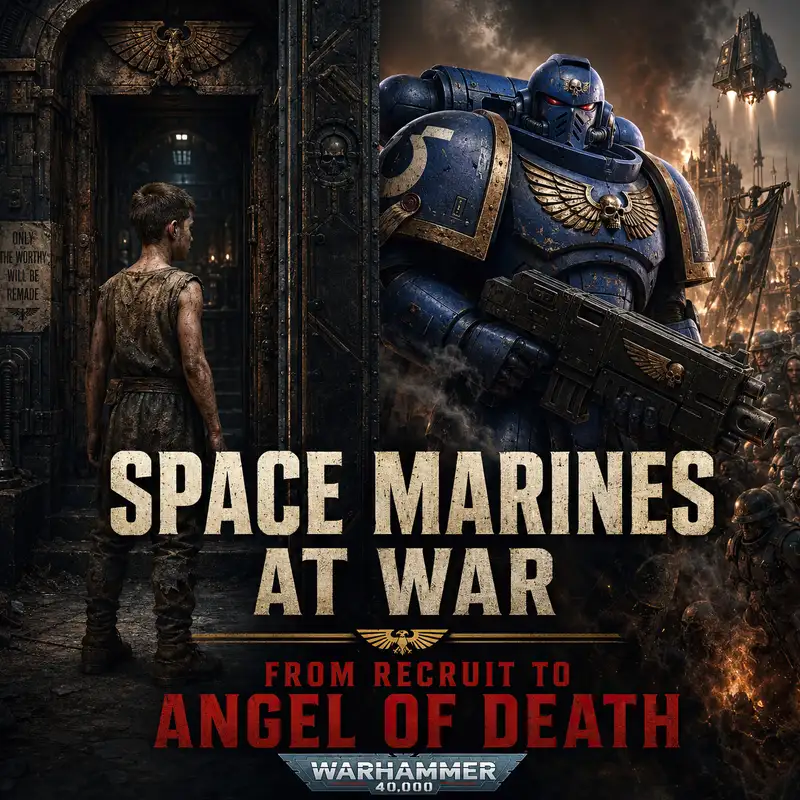
Space Marines at War: From Recruit to Angel of Death
The boy is still human when the doors close behind him.
He may have crossed a desert poisoned by radiation, survived a tribal war on an ice world, escaped the lower levels of a hive city, or distinguished himself in a culture where military service begins almost as soon as childhood ends. He may believe that being chosen is the reward for everything he has endured. It is not. Selection merely means that a Space Marine Chapter has decided his body, mind, and soul are worth risking on a process that may kill him, cripple him, or erase almost everything he once understood about himself.
Years later, another door will open. A giant in powered armour will walk through it, carrying a weapon built to break bodies apart from the inside. Human soldiers may kneel as he passes. Enemies who have never seen one of his kind may understand, in the final seconds of their lives, why the Imperium calls such warriors the Angels of Death.
The distance between those two doors is where a Space Marine is made.
Space Marines are not born. They are manufactured from human beings through a mixture of genetic engineering, surgery, chemical treatment, psychological conditioning, religious ritual, and military training. The science comes from the earliest days of the Imperium, when the Emperor created the original Legiones Astartes for the Great Crusade. Ritual came later, although in the Imperium it is difficult to tell where medicine ends and sacred mystery begins. An Apothecary may understand an implant perfectly while still treating the operation as an act of devotion.
Every Chapter recruits differently because every Chapter has spent thousands of years deciding what sort of warrior it believes the Emperor requires. Some draw aspirants from feral worlds where survival itself is a trial. Others recruit from hive gangs, warrior clans, feudal nobility, disciplined planetary institutions, or populations living under the shadow of a fortress monastery. The Space Wolves seek warriors from the tribes of Fenris. The Blood Angels test the youth of Baal and its moons. The Black Templars recruit as their crusade fleets move from war zone to war zone. Successor Chapters may follow traditions inherited from their founders or practices shaped by their own home worlds.
A Chapter is not simply looking for the largest boy with the sharpest knife. It seeks qualities that fit its culture. Endurance. Aggression. Self-control. Loyalty. Cunning. Faith. The ability to continue after fear, exhaustion, and pain have stripped away every polite reason to do so.
That does not mean the trials are fair. Fairness is not a major Imperial industry.
Aspirants may cross lethal terrain, hunt dangerous beasts, fight one another, resist interrogation, solve tactical problems, or endure ordeals whose meaning is known only to the Chapter. Some trials measure physical ability. Others test character. A few satisfy traditions so old that no one remembers why they began. The Chapter remembers only that they must continue.
Many candidates fail before implantation begins. Some die. Some are rejected. In certain Chapters, those who survive but cannot become Space Marines may serve the fortress monastery in other roles. The fortunate are those who are judged compatible with the Chapter’s gene-seed, because compatibility is not guaranteed. Courage cannot persuade the body to accept an organ it rejects.
Gene-seed is the biological inheritance of the primarchs, the engineered sons of the Emperor from whom the original Space Marine Legions were created. Every loyal Chapter traces its genetic lineage, directly or indirectly, to one of those primarchs. That inheritance shapes more than appearance. It can influence physiology, temperament, and the flaws that haunt a Chapter across generations.
The gene-seed of the Blood Angels carries the potential for the Red Thirst and the Black Rage. The Space Wolves bear the strange legacy of the Canis Helix. Some lineages are considered stable. Others have lost the ability to produce particular organs or display mutations that the wider Imperium views with suspicion. A Chapter may describe such differences as sacred gifts, burdens, or secrets. An Inquisitor may choose a less charitable word.
For most of the Imperium’s history, the creation of a Space Marine involved nineteen implanted organs. In the age of the Primaris Space Marines, the work of Archmagos Belisarius Cawl added further enhancements to the process. New recruits in many Chapters are now transformed as Primaris Marines, while veteran Space Marines created by the older method may attempt the dangerous transition known as crossing the Rubicon Primaris. The details have changed, but the principle remains the same. The human body is dismantled and rebuilt into a weapon.
The transformation takes years. Organs are implanted in a controlled sequence while hormones, drugs, diet, surgery, and training force the aspirant’s body to grow around them. A second heart provides redundancy and greater circulation. A third lung helps survival in poisoned atmospheres. Other implants strengthen bone, increase muscle, alter blood clotting, filter toxins, sharpen senses, regulate sleep, preserve the body during catastrophic injury, and permit the consumption of substances no sensible person would classify as food.
Some of the organs sound almost absurd until the battlefield explains them.
The Larraman’s organ helps seal wounds with extraordinary speed. The multi-lung can take over when normal breathing becomes impossible. The sus-an membrane can place a mortally injured warrior into suspended animation, allowing recovery or preservation under conditions that would finish an ordinary soldier. The omophagea can extract information through the consumption of biological material. The Betcher’s gland produces corrosive venom. No one should need to be told that a soldier capable of spitting acid has gone some distance beyond conventional infantry training.
The most important final implant is the black carapace. It grows beneath the skin and connects the Space Marine’s nervous system directly to his power armour. Without it, the armour would still be an immensely strong mechanical shell. With it, the suit becomes an extension of the wearer’s body. He does not operate it through levers and switches in the ordinary sense. He moves, and the armour moves with him.
The surgery leaves scars, interface ports, and a body transformed beyond the human frame. A Space Marine is taller, broader, denser, and stronger than any unmodified soldier. His organs are redundant, his senses sharpened, and his metabolism engineered for violence and survival. Yet this is only half the process.
The recruit must also learn to think like a Space Marine.
Hypno-indoctrination and chemical conditioning compress years of knowledge into the developing warrior. Weapons, tactics, languages, Chapter history, religious doctrine, threat recognition, and battlefield reflexes are driven into the mind. Training continues while the body changes. The aspirant learns to fight through pain, obey orders under impossible pressure, and treat circumstances that would break ordinary soldiers as problems requiring immediate solutions.
This is often described as removing fear. That is too simple.
Space Marines can experience fear, doubt, anger, grief, pride, and shame. Their stories would be considerably shorter if they could not. What conditioning does is change the relationship between emotion and action. Panic is suppressed. Hesitation is mastered. Fear becomes information. A Space Marine may know that the creature ahead of him can tear through his armour. He advances because the mission still requires someone to kill it.
The process does not produce identical personalities. Chapters are filled with rivalries, friendships, grudges, ambitions, and disagreements over doctrine. Some warriors remember their childhood clearly. Others retain only fragments. Some preserve concern for ordinary humans. Others become so distant that they can barely understand the people they are sworn to defend. The transformation narrows a life toward war, but it does not always erase the person who began it.
Before a neophyte is trusted with full power armour and the status of a battle-brother, he must prove himself in war. In many Chapters, this means service in the Scout Company. Scouts operate ahead of the main force, performing reconnaissance, infiltration, sabotage, target identification, and ambush. They learn how to survive without relying on the full protection of power armour. More importantly, they learn that a Space Marine’s greatest advantage is not merely strength. It is the ability to understand a battlefield before the enemy realizes there is a battle.
This stage also allows veteran sergeants to judge the neophyte under real pressure. Training chambers cannot reproduce the moment when a plan fails, the vox goes silent, and something large begins moving in the smoke.
Not every Chapter follows the same path. Space Wolves traditionally send their newest warriors into battle as Blood Claws, channeling aggression through close assault rather than quietly teaching patience from the shadows. Black Templar neophytes fight beside experienced Initiates in Crusader Squads, learning as squires in a living warrior tradition. These exceptions reveal something essential. There is no single Space Marine culture. There are hundreds of Chapters, and each believes its own way of making war has been tested by history.
When a neophyte is finally elevated, the moment is more than a promotion. He receives the armour, heraldry, weapons, and obligations of a full battle-brother. The suit may be ancient, its components repaired and sanctified across generations. Ceramite plates protect systems that support life, filter toxins, administer drugs, stabilize movement, enhance strength, provide targeting information, and link the warrior to his squad.
The armouring can be ceremonial. Chapter serfs and Tech-Priests fit each component while prayers, litanies, and oaths affirm what it represents. The ritual checks seals, honors relics, reinforces identity, and reminds the warrior that he carries equipment more valuable than entire settlements.
Then the Space Marine goes to war.
He does not usually go alone, whatever heroic art may suggest. The squad is the foundation of Space Marine combat. Battle-brothers share training, communications, doctrine, and trust built over decades or centuries. A sergeant can redirect fire, change formation, or order an assault with a few words or hand signals. Each warrior understands his role and the likely actions of the others. Their speed of coordination can appear almost telepathic to ordinary troops.
This is where the years of transformation become military power.
A Space Marine can fire accurately while advancing through debris, identify threats through smoke and darkness, absorb injuries that would incapacitate a human, and continue fighting while his armour feeds him combat stimulants and medical warnings. He can breach fortified positions and move with startling speed for something so large. Together, these abilities let a small force generate violence far beyond its numbers.
The bolter is well suited to that purpose. It is not simply a large rifle. Its mass-reactive ammunition penetrates a target before detonating, turning each hit into a compact internal explosion. Against lightly protected enemies, this is excessive. Space Marines regard excess as useful insurance.
The chainsword serves a different purpose. It turns close combat into an industrial process, its motorized teeth tearing through flesh, armour, and bone. It is brutal, loud, and terrifying. That psychological effect is not accidental. Space Marines are weapons of shock. They are meant to arrive suddenly, break the most dangerous point in an enemy force, and leave survivors wondering whether they faced soldiers or wrath made physical.
Their strategic value comes from mobility. A Chapter maintains warships, strike cruisers, rapid assault craft, armoured vehicles, aircraft, and support personnel so that its warriors can deploy without waiting for the vast machinery of the Imperial Guard. Drop Pods can hurl squads directly from orbit. Thunderhawks can deliver infantry and armour. Teleportation can place Terminators into the heart of a fortress or ship. A strike force may descend, destroy command nodes, seize a critical position, eliminate a warlord, and withdraw before a conventional army has finished assembling its transports.
This is why Space Marines should not be understood as a replacement for ordinary Imperial armies. They are too few. Even a Chapter at full strength cannot occupy an entire world, guard every supply route, or hold a continent against millions of enemies without support. The Astra Militarum wins wars through mass, artillery, logistics, and the willingness to remain in the field for years. Space Marines change wars by striking the places where a small number of exceptional warriors can have disproportionate effect.
A competent commander does not waste them on work that ordinary troops can perform. Naturally, the Imperium sometimes wastes them anyway. Ten thousand years of bureaucracy can defeat even excellent doctrine.
The ideal Space Marine attack is a controlled catastrophe. Orbital augurs identify the target. Scouts confirm its defenses. Ships strike from above. Assault craft descend. Squads hit communications, leadership, heavy weapons, and escape routes almost at once. By the time enemy commanders understand the pattern, the Space Marines are already inside the position they were supposed to defend.
Different Chapters pursue that result in different ways. The Imperial Fists favor disciplined defense, siegecraft, and the reduction of fortifications. The White Scars use speed and maneuver to keep the enemy off balance. The Raven Guard emphasize infiltration and carefully placed attacks. The Salamanders are known for endurance, close-range firepower, and a comparatively strong concern for civilian lives. The Blood Angels combine disciplined warfare with a dangerous hunger buried in their gene-seed. The Dark Angels carry layers of secrecy into everything they do. The Ultramarines are famous for flexible doctrine and structured command. The Space Wolves prefer an approach shaped by the hunting traditions of Fenris, which is more sophisticated than outsiders assume and generally louder than necessary.
These traditions affect recruitment because the Chapter is always recreating itself. The aspirant is not merely given stronger organs. He is taught a history, a set of heroes, a pattern of obedience, and an explanation of what honor means. Two Space Marines may share the same broad physiology yet interpret the same battlefield in very different ways because their Chapters remember different wars.
The result can inspire awe among Imperial citizens. Most humans will never see a Space Marine. They know them through sermons, statues, distorted records, and stories in which the Emperor’s angels descend at the moment of greatest need. When a squad appears, the reaction may be worship, relief, or terror. All three are reasonable.
The title Angel of Death is propaganda, but not empty propaganda. Heraldry, skulls, purity seals, glowing lenses, roaring weapons, and an amplified voice turn the warrior into a symbol before he fires. The Imperium understands that fear is ammunition. Space Marines understand it too.
Yet the symbol conceals limitations.
Space Marines can be killed. Heavy weapons can break their armour. Monsters can tear them apart. Psychic powers can attack the mind and soul in ways reinforced organs cannot prevent. A bad commander can squander them. Pride can blind them. Chapter traditions can preserve wisdom, but they can also preserve mistakes for thousands of years and decorate them with gold.
Every loss matters because a Chapter’s strength cannot be replaced quickly. The Apothecaries who move through the battle after the firing stops are not merely recovering the dead. They are protecting the future. Within each Space Marine are progenoid glands containing the genetic material needed to cultivate organs for later generations. When possible, those glands are harvested. A fallen battle-brother may therefore provide the gene-seed from which another aspirant will be transformed.
This gives Space Marine death a grim continuity. The warrior is an individual, but he is also part of a biological lineage stretching back to a primarch. His body carries the Chapter’s past and, if recovered, its future. The Apothecary kneeling beside a corpse is performing battlefield medicine, funerary duty, and strategic resource recovery at the same time. The Imperium has never seen a reason to separate functions that can be made equally solemn.
What, then, survives of the recruit who entered the fortress monastery?
There is no single answer. Some Chapters preserve names and memories. Others rename their warriors and bury the earlier life beneath ritual. The transformed Space Marine may remember family, hunger, cold, or the face of someone he failed to protect. He may retain loyalties to his home world. He may look upon ordinary humans as kin, dependents, subjects, or creatures so fragile that speaking with them requires effort.
He is no longer human in the ordinary sense, but neither is he a machine. His ability to choose remains, and that is why Space Marines can become heroes, tyrants, saints, rebels, or traitors. The same will that lets a warrior charge a daemon can convince him that his judgment outranks the laws he served. The Horus Heresy proved that engineered loyalty is not certainty. Later betrayals have repeated the point with admirable thoroughness.
A Space Marine becomes an Angel of Death not when the first organ is implanted, and not when the final plate of armour locks into place. He becomes one through the accumulation of changes that make war the organizing principle of his existence.
His body is redesigned to survive it. His mind is conditioned to function inside it. His Chapter gives it meaning. His squad turns individual strength into disciplined force. His ships carry that force to the exact point where it can break an enemy. His armour makes the result visible. His weapons make it final.
The recruit who entered the Chapter wanted to become stronger, serve the Emperor, escape his world, honor his clan, or survive one more trial. Whatever his reason, the process gives him something far larger and far narrower than the life he imagined. He may live for centuries. He may cross worlds whose names his people never knew. He may stand before horrors that would empty an ordinary mind of reason.
He will also spend that extended life moving from one war to another until age, violence, corruption, or duty finally claims him.
When that end comes, his brothers will recover what they can. His armour will be repaired. His deeds will be entered into the Chapter’s memory. His gene-seed may be carried back through the same doors that once closed behind him.
Somewhere, another human boy will be judged worthy of the risk.