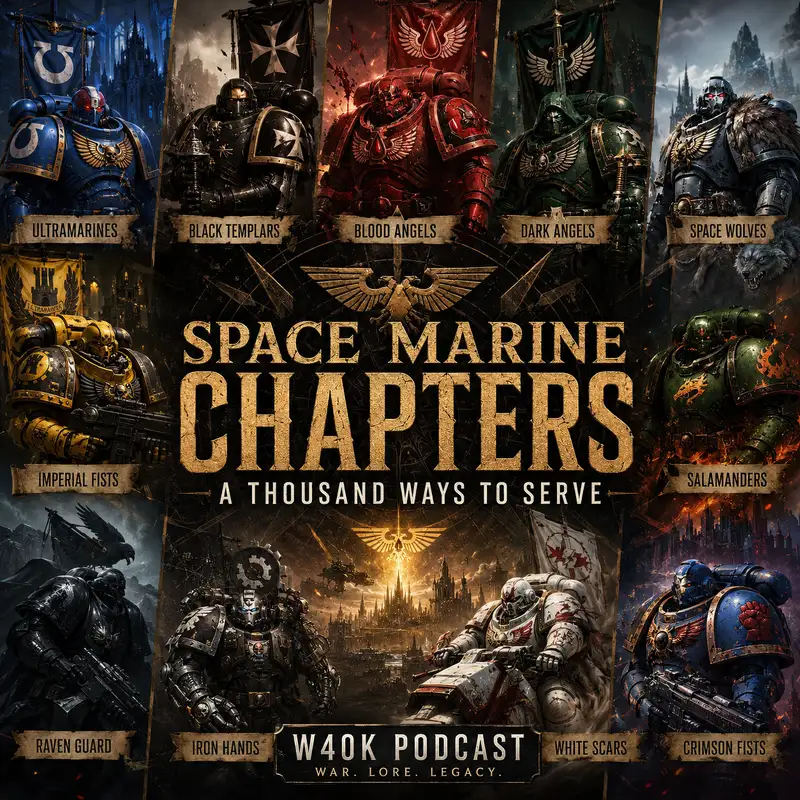
Space Marine Chapters: A Thousand Ways to Serve
The Imperium had survived the Horus Heresy, but survival did not feel much like victory. Terra was scarred. The Emperor was bound to the Golden Throne. Loyal armies stood amid the wreckage of a civil war in which the greatest weapons humanity had ever created had been turned against humanity itself. Among those weapons were the Space Marine Legions, vast brotherhoods commanded by primarchs and strong enough to conquer regions of the galaxy. Half had rebelled. The remaining half had helped stop them. That was precisely the problem.
Roboute Guilliman looked at the surviving Legions and saw both salvation and danger. No commander, however loyal, should again hold so many Space Marines beneath a single banner. The Imperium could not trust its future to the hope that the next great warlord would remain virtuous forever. Hope had already been tested. It had failed rather spectacularly.
Guilliman’s answer was the Codex Astartes and the division remembered as the Second Founding. The old loyalist Legions would be broken apart. In their place would stand smaller, independent Chapters, each nominally about one thousand battle-brothers. They would possess their own commanders, fleets, armouries, recruitment systems, traditions, and domains. No single Chapter could easily repeat the rebellion of a Legion. If one fell, the others could contain it.
This was not merely an administrative reform. It changed what a Space Marine was.
Before the Heresy, a Legionary belonged to an army that might include tens of thousands of warriors and campaign across entire sectors beneath its primarch. After the Second Founding, a Space Marine belonged to something smaller, more isolated, and more personal. His Chapter became his nation, his monastery, his military family, and his version of history. The Chapter told him which victories mattered, which defeats required vengeance, which dead must be remembered, and what service to the Emperor actually meant.
That last question has never received a single answer.
The Imperium is said to contain roughly a thousand Space Marine Chapters, though the number is not a reliable census. Chapters are destroyed, lost, founded, rediscovered, condemned, or simply omitted from records that have survived ten thousand years of war and clerical enthusiasm. Some exist on well-defended home worlds. Others live aboard fortress-monasteries and battle barges, moving from one war zone to another. Some are ancient enough to trace their identity directly to the Second Founding. Others were created centuries later, or during the great expansion of Primaris Space Marines in the Era Indomitus.
All of them are Adeptus Astartes. None of them are simply interchangeable.
Every ordinary Chapter descends genetically from a primarch through the gene-seed implanted into its warriors. That ancestry matters. It can influence physical traits, inherited flaws, temperament, and the rituals used to control what the gene-seed has made possible. Yet ancestry does not determine everything. A successor of the Ultramarines may carry the same broad genetic inheritance as its parent Chapter while possessing a culture that would make an Ultramarines officer pause, consult the Codex, and perhaps consult it again with greater concern.
Home worlds change Chapters. Recruitment changes them. Isolation changes them. The enemies they fight, the disasters they survive, and the leaders they choose all leave marks that can last for millennia.
A Chapter recruiting from a feudal world may turn the planet’s warrior aristocracy into a system of trials, oaths, and hereditary honour. A Chapter raised from a tribal death world may value endurance, hunting, and kinship. A fleet-based Chapter may think of itself less as the guardian of a place than as the bearer of an endless mission. Even when recruits are transformed through the same brutal surgery, chemical conditioning, hypno-indoctrination, and combat training, they are not emptied of culture. They are given a new culture powerful enough to replace nearly everything that came before.
The Codex Astartes was meant to provide a common foundation. In its best-known form, a Codex-compliant Chapter is divided into ten companies. The First Company contains veterans. Several battle companies form the main deployable striking force. Reserve companies provide specialized reinforcement, while the Tenth Company trains newer warriors and fields reconnaissance forces. A Chapter Master commands the whole, supported by captains, Chaplains, Librarians, Apothecaries, Techmarines, fleet officers, serfs, and ancient war machines whose maintenance records probably qualify as sacred literature.
Even this neat structure is neater on parchment than in war. Companies suffer casualties. Crusades require temporary formations. Specialists and vehicle crews complicate the famous figure of one thousand Marines. Some Chapters follow the Codex closely, some treat it as a flexible guide, and some regard its organizational passages as an interesting suggestion written by somebody else’s primarch.
That difference is often misunderstood. The Codex is not simply a book of rigid rules declaring where every warrior must stand. It is a vast body of strategic thought, doctrine, organization, logistics, and hard-earned lessons. Guilliman intended it to help smaller forces remain adaptable and self-sufficient. A wise commander could study its principles without becoming predictable. A foolish commander could quote it perfectly while losing the war. The Imperium has never lacked men capable of confusing obedience with understanding.
The Ultramarines became the great exemplars of the Codex tradition. They value discipline, combined arms warfare, clear chains of command, and the ability to govern as well as conquer. Their realm of Ultramar reflects that wider sense of duty. To the Ultramarines, military strength and ordered civilization are connected. A world defended today must still be able to function tomorrow.
Yet even the Ultramarines’ many successors demonstrate how quickly common ancestry can branch into different identities. Some preserve the parent Chapter’s measured discipline. Others adopt the customs of harsh recruiting worlds or develop rituals far removed from Macragge. The Mortifactors, for example, are descended from the Ultramarines but became shaped by the death-haunted culture of their home world. Their practices, trophies, and meditations on mortality hardly resemble the clean civic ideal most outsiders associate with Guilliman’s sons.
The gene-seed remained related. The meaning of service changed.
The descendants of the Imperial Fists make the contrast even sharper. The Imperial Fists are renowned for endurance, siegecraft, discipline, and a severe understanding of duty. They hold the line because the line must be held, even when every sensible part of the situation suggests that the line has become an elaborate method of dying in place.
From that same lineage came the Black Templars. They are fleet-based crusaders who reject much of the standard Codex structure, divide themselves into crusading forces, and wage an unending holy war across the stars. Where many Space Marines revere the Emperor as the supreme father and master of humanity without necessarily worshipping him as a god, the Black Templars embrace his divinity with absolute conviction. Their service is not merely military. It is a religious vow carried by chains, blades, relics, and a remarkable lack of interest in compromise.
The Crimson Fists, also descended from the Imperial Fists, developed another identity. Their history became defined by stubborn defense, devastating loss, and survival after near destruction. All three Chapters share the bloodline of Rogal Dorn. One represents the fortress. One represents the crusade. One represents the battered hand that closes around a weapon after almost everything else has been taken.
No genetic archive could explain those differences by itself.
The Blood Angels and their successors reveal the opposite problem. Culture may diverge, but blood can still bind Chapters together in ways that law cannot erase. The Blood Angels are noble, artistic, and self-controlled because they must be. Beneath that beauty lies the Red Thirst, a violent hunger carried in their gene-seed, and the Black Rage, in which afflicted warriors relive the final memories of their primarch Sanguinius as he faced Horus.
Their rituals are not decorative. Art, prayer, discipline, and ceremony help them master something terrible within themselves. Their nobility matters because it is chosen against a darker inheritance.
Successor Chapters experience that curse differently. The Flesh Tearers are notorious for standing closer to the edge, their battle fury more difficult to contain and their reputation stained by the deaths of those they were meant to protect. Other sons of Sanguinius struggle in their own ways, hiding weakness, seeking redemption, or trying to prove that they are more than the flaw inside their blood.
When the Tyranids descended upon Baal, many successor Chapters answered the Blood Angels’ call. They arrived in different colours, under different masters, carrying different customs and grudges. Yet the shared lineage of Sanguinius drew them together. For a moment, the scattered Chapters resembled the fragments of a Legion gathering around the memory of its father.
That is the central tension of the Chapter system. It was designed to destroy the political unity of the Legions, but it could not erase ancestry, memory, or loyalty.
The Dark Angels make that tension especially uncomfortable. Publicly, the Dark Angels and their successors are separate Chapters, each with its own heraldry and command. Privately, many of these descendants belong to the wider brotherhood known as the Unforgiven. Their inner circles share secrets concerning the Fallen, those members of the old First Legion who turned against their primarch during the destruction of Caliban. The hunt for the Fallen crosses Chapter boundaries and can override ordinary Imperial priorities.
From one perspective, this is loyalty to an ancient duty. From another, it is evidence that the First Legion was never divided as completely as Guilliman intended. The Dark Angels would strongly prefer that nobody investigate the distinction.
The Space Wolves present a more open refusal. Their organization follows the traditions of Fenris and the legacy of Leman Russ rather than the standard pattern of ten Codex companies. They fight in Great Companies led by Wolf Lords, preserve sagas as living history, and build their identity around packs, oaths, rivalry, and personal reputation. Their outward barbarism can mislead outsiders. The Space Wolves are not mindless berserkers. Their culture uses story and ritual to preserve judgment, loyalty, and collective memory.
They also demonstrate that noncompliance does not automatically mean disloyalty. The Imperium has endured partly because it often accepts results first and asks organizational questions later, particularly when the individuals producing those results are heavily armed and have been doing so for ten thousand years.
Other First Founding Chapters show how doctrine becomes philosophy.
The Salamanders come from Nocturne, a world of fire, unstable land, and close communal bonds. They are famed not merely for flame weapons and craftsmanship, but for maintaining a stronger connection to ordinary human life than many Chapters. Their warriors remember that the Imperium they defend is made of people, not just strategic assets. This does not make them gentle. It makes their violence purposeful.
The Iron Hands drew a very different conclusion from catastrophe. After the death of Ferrus Manus, weakness became the enemy they sought within themselves. Flesh was fragile. Emotion was suspect. Mechanical augmentation offered control, endurance, and distance from pain. Their clan structure, ties to the Mechanicus, and relentless self-modification turned grief into doctrine. They serve humanity partly by trying to remove the human weaknesses they believe caused their greatest failure. The tragedy is that the cure can resemble another form of injury.
The White Scars are often reduced by outsiders to speed and mounted warfare. They do value mobility, rapid attack, and the freedom to choose the moment of battle. Yet their traditions also include poetry, reflection, hunting, and the disciplined culture of Chogoris. Their laughter in battle is not proof of carelessness. It expresses a warrior ideal in which skill, freedom, and the acceptance of death exist together.
The Raven Guard favor stealth, infiltration, sabotage, and precise strikes against command structures. Their methods reflect the legacy of Corax and a history shaped by resistance against tyranny. Where another Chapter might answer oppression with a frontal assault, the Raven Guard may break the communications network, eliminate the overseers, arm the resistance, and vanish before the enemy understands that the war has begun.
All are Space Marines. All may carry bolters, wear power armour, descend from the Emperor’s primarchs, and answer the same desperate calls for aid. The similarities are real. So are the differences in what they notice when they arrive.
One Chapter sees a fortress that must not fall. Another sees civilians who must be evacuated. Another sees an enemy commander who can be removed with a single surgical strike. Another sees a stain upon its honour. Another sees evidence of an ancient secret and quietly changes the entire battle plan without explaining why.
This diversity is one of the Imperium’s military strengths. An enemy that learns how to fight one Chapter has not learned how to fight them all. A force prepared for the White Scars’ speed may find itself facing the patient defenses of the Imperial Fists. A commander expecting the formal methods of the Ultramarines may instead receive the night attacks and terror of a far harsher successor. The title Adeptus Astartes describes a category of weapon. A Chapter determines how that weapon thinks.
The diversity is also dangerous.
Chapters are unusually independent by Imperial standards. They may control recruitment worlds, maintain their own fleets, guard ancient treaties, and choose which requests for aid they can answer. They cooperate with Imperial commanders, but they are not ordinary regiments waiting for orders. A Chapter Master may deal with generals, admirals, inquisitors, planetary governors, and representatives of the Adeptus Mechanicus as a lord in his own right.
That autonomy allows decisive action. It also permits pride, secrecy, rivalry, and isolation to grow. Chapters have abandoned allies over old insults, pursued private objectives during wider campaigns, concealed mutations, and interpreted duty in ways that placed them dangerously close to rebellion. Some crossed that line.
The fall of a Chapter rarely begins with a formal announcement that treason has been selected. It may begin with a commander convinced that distant authorities are corrupt, a crusade that no longer accepts oversight, a desperate compromise made to preserve endangered brothers, or a secret defended so fiercely that loyalty to the Chapter replaces loyalty to the Imperium. The very independence designed to contain another Horus can produce smaller tragedies across the centuries.
The system works not because Chapters are incapable of betrayal, but because betrayal is fragmented. A renegade Chapter is a grave threat. A renegade Legion can tear the galaxy in half.
The return of Roboute Guilliman brought a final irony. The architect of the Chapter system awoke to find his design transformed by ten thousand years of interpretation. The Codex had become doctrine, tradition, scripture, and occasionally an excuse. The Imperium he meant to preserve had become a religious empire that treated ancient procedures with more reverence than understanding.
Guilliman did not abolish the Chapters. He reinforced them.
The creation and deployment of Primaris Space Marines brought new warriors into ancient brotherhoods and established new Chapters during the Ultima Founding. Existing Chapters received reinforcements drawn from their own genetic lineages. Entirely new forces entered the wars of the Era Indomitus with fresh armour, new organs, and training shaped by a different age.
This did not erase the old cultures. It created encounters between warriors who shared gene-seed but not memory. A Primaris Marine assigned to an ancient Chapter might know its recorded history while understanding none of its silences. He might bear the blood of Russ without having grown beneath the storms of Fenris, or the blood of Sanguinius without yet grasping how beauty and terror coexist in every ritual of Baal.
Some Chapters welcomed the reinforcements. Others distrusted them. Over time, the newcomers learned the traditions of their adopted brothers, while the old guard adapted to weapons and formations their ancestors had never known. The Chapter system survived by doing what it had always done. It changed while insisting that it had remained the same.
So why are there a thousand ways for a Space Marine to serve?
Because a Chapter is not merely a unit designation. It is a solution to an ancient political disaster that became a thousand separate civilizations of war. Gene-seed provides inheritance. The Codex provides a framework. Home worlds, commanders, losses, victories, beliefs, secrets, and enemies provide everything else.
The Chapter system prevents the Adeptus Astartes from becoming one unified power. It also ensures that no single definition of duty can govern them all. Their loyalty is shared, but it is filtered through stories told in fortress halls, carved into armour, sung beside funeral pyres, recorded in sealed archives, or whispered within circles where outsiders are never permitted to stand.
When an Imperial world sends a distress call into the dark, it does not know what answer will come. Blue-armoured strategists may arrive with a complete campaign plan. Black-clad crusaders may arrive seeking a holy war. Green-armoured guardians may stand between civilians and the fire. Pale hunters may already be inside the enemy command post. A fleet bearing an unfamiliar symbol may answer for reasons rooted in an oath sworn eight thousand years before anyone on that world was born.
The people below will call all of them the Emperor’s Angels.
The Angels themselves will know better. They are sons of different fathers, heirs to different wounds, and keepers of different truths. They serve the same Imperium, but each Chapter carries its own answer to what that service demands. Guilliman divided the Legions so that humanity would never again depend upon the loyalty of one immense brotherhood. In doing so, he created a thousand smaller brotherhoods, each certain that it remembers the proper way to stand between humanity and the dark.