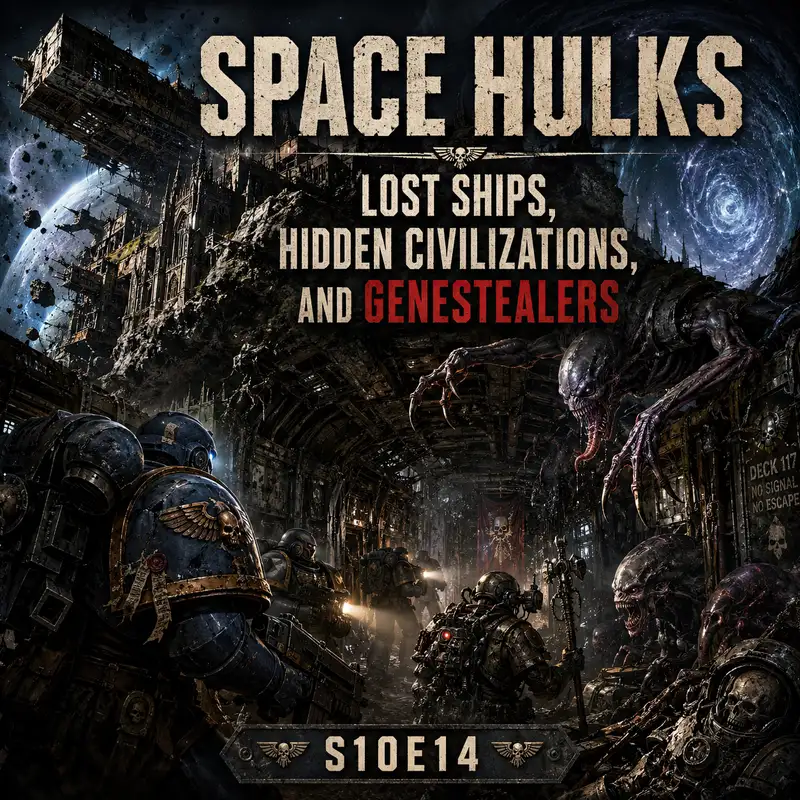
Space Hulks: Lost Ships, Hidden Civilizations, and Genestealers
The first warning is usually not a distress call. It is a mass reading where no mass should be, followed by the impossible silhouette of a vessel that appears to have been assembled by collision, gravity, and malice. A cruiser’s prow juts from an asteroid. An alien hull has been crushed through the flank of an Imperial transport. Cathedral towers rise from plates laid down before the Imperium existed. Then the auspex identifies a ship reported lost thousands of years ago, buried somewhere inside the wreck. At that moment, everyone on the bridge understands two things. The object may contain a fortune. It may also contain something that has been waiting for them.
A space hulk is not simply a very large derelict. It is a drifting accumulation of wrecked spacecraft, stations, asteroids, ice, and debris, fused into a single body by impacts and long exposure to the warp. Some are merely vast. Others approach the scale of moons. Their passages may connect vessels built by humans separated by ten thousand years, or by species that never met while either was alive. A hulk is therefore less like a ship and more like a moving archaeological layer, except the layers have been crushed together, the lights still flicker in places, and archaeology rarely tries to eat the excavation team.
Most hulks have no reliable course. They vanish into the immaterium and return to realspace according to currents no Navigator can confidently predict. One may appear at the edge of a system for a few days, drift toward a shipping lane, and disappear before a fleet can intercept it. Another may remain for months, shedding fragments and broadcasting signals from ships whose crews died before the Emperor’s Great Crusade. Time inside the warp does not behave properly. A vessel lost for centuries by the Imperial calendar may have experienced only years. Another may have endured generations. A hulk can carry the past into the present without asking whether either age is prepared for the meeting.
That unpredictability makes every appearance a military crisis. A space hulk may emerge on a collision course with a world, block a route needed by an Imperial crusade, or disgorge raiders into an undefended system. Orks have used hulks as wandering fortresses and transport vessels, accepting their uncertain destinations with a confidence available only to a species that considers navigation an optional refinement. Chaos warbands can establish bases inside them. Daemonic influence may seep through compartments whose protective fields failed long ago. Even an apparently empty hulk can damage a planet simply by falling on it, which is among the more honest threats found aboard.
The obvious response is destruction. Naval officers can calculate firing solutions. Space Marines can prepare torpedoes. Planetary governors can begin composing messages explaining why the burning object overhead is entirely under control. Yet the order to fire is often delayed, because a hulk is also a vault. Buried within it may be a warship believed lost with sacred relics aboard, an intact alien engine, a navigational archive, or fragments of a Standard Template Construct. To the Adeptus Mechanicus, even one recoverable design may justify casualties that would make a conventional commander reconsider the meaning of the word recoverable.
That is why boarding parties go in. The Imperial Navy wants intelligence and control of immediate hazards. The Mechanicus wants technology. The Inquisition wants whatever everyone else should not be allowed to find. Rogue Traders want salvage rights, preferably interpreted with creativity. Space Marine Chapters may seek lost gene-seed, honoured dead, weapons, or records tied to their own history. Xenos forces board for equally practical reasons. Aeldari may be recovering something that predates humanity’s presence in the region. Kroot may seek useful genetic material. Drukhari may be collecting prisoners. A space hulk attracts explorers because it can contain almost anything, and attracts predators for exactly the same reason.
The Death of Integrity showed how powerful that temptation can be. The Blood Drinkers and Novamarines prepared to destroy the Genestealer-infested hulk, only for the Adeptus Mechanicus to intervene and demand an expedition into its depths. At the centre lay the Spirit of Eternity, a human vessel from the Dark Age of Technology, guided by a true artificial intelligence and carrying knowledge beyond the Imperium’s diminished understanding. The explorers did not simply find an old machine. They encountered evidence that humanity had once crossed the stars with capabilities now regarded as miracle, heresy, or both, depending upon which priest had reached the control panel first.
The Mechanicus recovered only part of that prize, but even fragments of lost knowledge could alter careers, arm fleets, and reshape doctrine. This is the bargain at the heart of every hulk expedition. The danger is obvious before the first hatch opens. The value is not. A commander must decide how many lives to risk for a possibility hidden behind kilometres of wreckage. The decision becomes harder when the possibility is real. Once a single ancient reactor, intact data core, or lost battle standard is confirmed, withdrawal begins to feel like cowardice. The hulk does not need to lure its victims. Hope performs that function perfectly well.
Inside, ordinary naval thinking begins to fail. Deck plans are useful only until one ship’s corridor ends in the engine room of another vessel rotated ninety degrees. Gravity may pull toward the deck, the wall, or nowhere at all. Compartments can hold vacuum beside chambers filled with poisonous atmosphere. Bulkheads open into crushed transit shafts, flooded manufactorums, shrines built around machines no longer understood, and passages narrowed by centuries of accumulated debris. A route measured as fifty metres on an auspex may require hours of cutting, climbing, and sealing. The hulk is not a maze designed by an intelligence. That would be considerably easier.
Power is another uncertainty. Dead sections can awaken when a boarding team restores a local grid. Ancient doors may close without warning. Defence servitors can continue obeying orders issued by commanders reduced to dust. Reactor heat may keep one region habitable while irradiating the next. Machine spirits, damaged by isolation and contradictory commands, may respond to intruders with alarms, lockdowns, or weapons fire. Every attempt to make the environment safer can reveal the boarding party’s position. Light provides visibility, but it also announces movement. Restoring atmosphere makes breathing easier, and gives fire something to work with.
Commanders therefore favour small teams with clear objectives. Naval Breachers bring cutting tools, shotguns, void armour, and the practical education of people who know that every door might open into hard vacuum. Tech-priests carry scanners and rites for systems that may predate their entire creed. The Deathwatch brings specialists trained to identify alien threats before those threats become planetary emergencies. Space Marines provide strength, endurance, and armour suited to environments that would kill ordinary troops. None of this makes a hulk safe. It merely allows professionals to survive long enough to discover which danger has claimed it.
Not every presence aboard is an invading force. Some hulks contain populations that have lived within them for generations. Survivors from trapped vessels may gather around functioning life-support systems, then become isolated when the surrounding wreck shifts or returns to the warp. Their descendants inherit sealed decks as territories, maintenance rituals as religion, and garbled emergency instructions as law. Mutants, outcasts, human scavengers, xenos enclaves, and heretical congregations may all develop settlements. From outside, these are passengers. From within, they are nations measured in corridors, pressure doors, water tanks, and access to one dependable generator.
The Gallowdark made this possibility impossible to dismiss. Lost in the warp for more than four millennia, it returned as a moon-sized mass composed of thousands of ships and other debris. Its interior contained not only raiders and expeditionary forces, but established communities. Tribal gangs descended from ancient inhabitants controlled sections of the hulk. Settlements survived by scavenging machinery, guarding routes, trading supplies, and making agreements that could last until the next pressure failure. Ironshanty became a relative neutral ground inside a structure where peace was less a moral achievement than a shared preference not to rupture the walls.
Such societies may possess technologies they cannot reproduce and histories they cannot verify. A sealed vault might be remembered as the chamber of an angry god because the original warning sign was written in a forgotten language. A functioning air purifier can become the centre of political power. The family that knows how to replace its filters may rule more securely than a governor with a thousand soldiers. When the hulk enters the warp, generations can be shaped by nightmares, mutation, and strange shifts in time. To an Imperial boarding force, these people may appear degraded. To the people themselves, the armed giants cutting through their ancestral bulkhead are the incomprehensible invaders.
The Imperium rarely handles that ambiguity gently. A hidden population may be rescued, interrogated, quarantined, enslaved, or destroyed according to who finds it and what signs of corruption are present. An Inquisitor sees possible contamination. A tech-priest sees custodians who may know the route to a valuable system. A Space Marine commander sees civilians occupying a battlefield that may cease to exist without warning. Compassion is possible, but it competes with limited time and the knowledge that one infected survivor can doom a world. On a space hulk, mercy is not merely an ethical decision. It is also a containment procedure.
Many inhabitants are less ambiguous. Orks can thrive amid wreckage because the environment rewards scavenging, improvisation, and violence, three fields in which they require little additional instruction. Chaos followers use isolated chambers for worship and experimentation. Warp entities may manifest where reality has been weakened by repeated transitions through the immaterium. Ancient xenos organisms can remain sealed in cargo vaults or laboratories. Automated weapons may continue fighting wars whose participants vanished ages ago. A hulk is a meeting place for disasters that were never intended to cooperate, yet often manage a practical division of labour.
Then there are the Genestealers. Their association with space hulks is so strong because the environment suits nearly every part of their purpose. A purestrain Genestealer is fast, powerful, patient, and capable of surviving long periods in concealment. It can climb through ducts, cling to surfaces, move in darkness, and attack before a human nervous system has finished reporting the shape of the threat. It does not need a parade ground or a supply depot. It needs access, cover, and living hosts. A space hulk provides all three, along with transportation to destinations no conventional Tyranid vessel could predict.
Genestealers are Tyranid organisms, but they can operate far beyond the immediate control of a hive fleet. Their role is infiltration. A victim seized by a Genestealer may be implanted with alien genetic material and bound into a psychic family structure. That victim can return to society appearing alive, grateful, and perhaps ashamed of an encounter they no longer fully understand. The resulting bloodline forms a cult whose members protect the brood, infiltrate institutions, and prepare the world for eventual consumption. The process turns the normal bonds of family and loyalty into weapons. It is invasion carried through inheritance rather than orbital bombardment.
A hulk is an ideal delivery system for that invasion. Genestealers can remain dormant while the wreck drifts through the warp. When it emerges near an inhabited system, salvagers, naval crews, or military teams come aboard voluntarily. Some are killed. Others may be infected. Escape craft and returning ships then carry the brood’s influence to stations and planets. Alternatively, fragments of the hulk can break away and fall into shipping routes or onto worlds, releasing organisms that have survived sealed inside. The hulk therefore acts as both fortress and seed pod, moving Genestealers across distances without requiring them to control the journey.
This also explains why exterminating the visible brood is not enough. A boarding force can count bodies and still miss a creature sealed behind collapsed plating. It can cleanse one vessel while infected crewmen depart from another. It can recover survivors who sincerely believe they escaped untouched. The first sign of failure may appear decades later as an unusual labour movement, a new religious sect, or a pattern of families entering positions near a planet’s defences. By then, the original hulk may have vanished back into the warp, leaving investigators to argue over records that were incomplete before anyone began lying.
The close quarters make Genestealers especially dangerous to elite troops. A Space Marine can dominate an open battlefield with speed, firepower, and coordination. Inside a hulk, sight lines collapse to a few metres. Corners interrupt supporting fire. Metal walls confuse sensors. A creature can approach through maintenance shafts too narrow for an armoured warrior, then strike from above or behind. Genestealer claws can penetrate even Tactical Dreadnought armour at close range. The finest protection available to the Adeptus Astartes becomes a fortress with doors on every side, and the enemy has spent its existence learning where the doors are.
Terminator squads remain the preferred answer because the alternative is worse. Their armour is sealed, heavily protected, and able to carry weapons suited to stopping a rushing brood in a confined passage. Storm bolters can fill a corridor with fire. Heavy flamers can deny junctions and burn organisms hidden beyond direct sight. Power fists can tear open blocked routes or destroy machinery that must not survive. Teleportation can place a force close to its objective when the hulk’s structure permits a reliable lock. Yet Terminators are bulky. They cannot easily turn, retreat, or bring numbers to bear. Every junction becomes a small battle of geometry.
That geometry created the enduring nightmare of the Sin of Damnation. Six centuries before its appearance, the Blood Angels had suffered catastrophe during an assault on another hulk in the Secoris system. The Chapter was reduced to only fifty surviving Space Marines. When the Sin of Damnation emerged near Baal, carrying tens of thousands of Genestealers, the Blood Angels saw more than a tactical problem. They saw a chance to answer an old humiliation. Captain Michaelus Raphael led more than eighty veterans of the First Company into a structure designed by accident and occupied by an enemy perfectly adapted to it.
The assault was not a grand fleet engagement. It was a sequence of doors, junctions, signals, and seconds. Squads advanced through passages where one blocked weapon or one failed sensor could expose an entire formation. Genestealers rushed from darkness in numbers that made ammunition a measure of time. The Blood Angels had to maintain fields of fire, recover objectives, and keep moving before the hulk’s shifting conditions cut them off. Their armour allowed them to enter the killing ground. Discipline allowed them to survive it. The distinction matters, because courage without control merely delivers better-equipped bodies to the brood.
The Blood Angels ultimately purged the infestation and recovered an ancient relic, turning the operation into a victory over both the Genestealers and their own history. Yet the deeper lesson was not that Space Marines could master a hulk. It was that mastery required a rare combination of intelligence, preparation, sacrifice, and favourable circumstance. Another hulk might contain different architecture, a larger brood, corrupted systems, or a warp transition already beginning. The same plan could fail because a bulkhead opened three seconds late. Imperial records celebrate successful purges. The hulks containing failed expeditions keep their own records in armour, bones, and unanswered distress beacons.
Destroying a hulk from a distance remains the safest choice when destruction is possible. It is not always possible. The mass may be too large, the internal structure too resilient, or the object too close to a populated world. Bombardment can scatter contaminated fragments across an entire system. Valuable compartments may be shielded by kilometres of wreckage. A hulk about to return to the warp may offer only a narrow window for action. Commanders therefore face a brutal calculation. Board and risk bringing the danger home, or fire and risk losing knowledge, relics, survivors, and perhaps the only chance to alter its course.
This is why a space hulk cannot be understood as one kind of place. It is a tomb made from lost ships, but some of those ships are not dead. It is a ruin, but people may have built cultures inside it. It is a treasure vault whose locks are vacuum, radiation, madness, and living claws. It is a transport whose passengers do not choose the destination. To the Imperium, every hulk is simultaneously an archaeological site, a biohazard, a fortress, and an approaching deadline. The classification is untidy, but the object has shown little interest in administrative convenience.
The lost ships explain the hulk’s value. The hidden civilizations explain its depth. The Genestealers explain why curiosity so often becomes catastrophe. All three arise from the same condition. A space hulk preserves what the galaxy failed to destroy, then carries it into contact with the living. Ancient machines remain powered. Forgotten people endure behind sealed doors. Predators sleep through centuries until footsteps return to the corridor. When the next impossible silhouette emerges from the warp, the fleet will scan it, name it, and debate whether to open fire. Somewhere inside, history will already be awake.