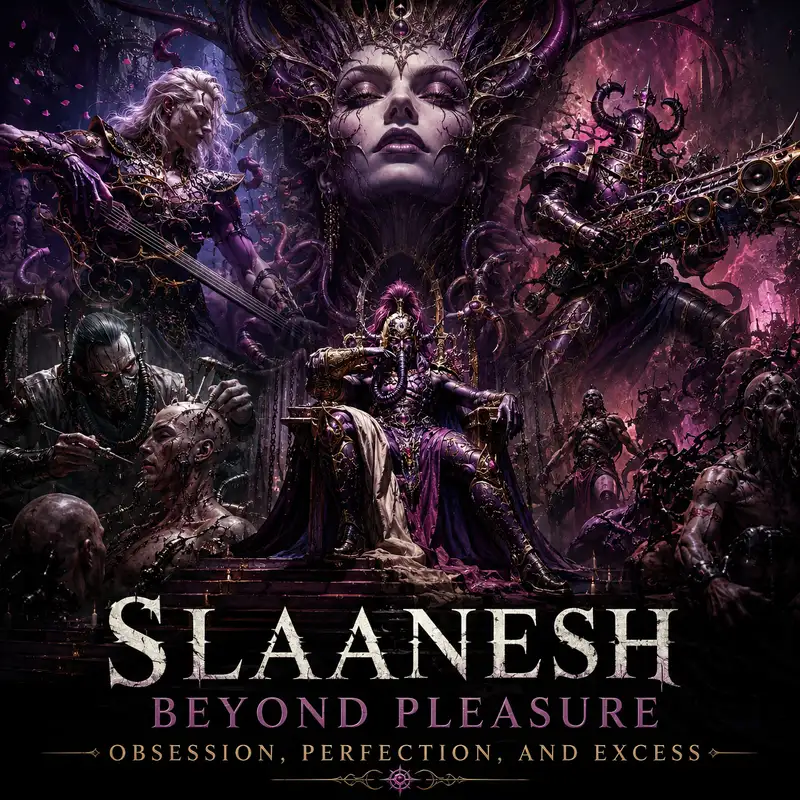
Slaanesh Beyond Pleasure: Obsession, Perfection, and Excess
The first note is beautiful. The second is better. By the hundredth, the walls are trembling, the audience is bleeding from the ears, and the musician is still dissatisfied. That is the road to Slaanesh. It may begin with pleasure, but pleasure is only the first door. Beyond it lie obsession, perfection, pride, hunger, sensation, and the quiet conviction that whatever was enough yesterday is intolerably dull today. Slaanesh is not merely the god of enjoying things. Slaanesh is the god of being unable to stop.
This is why the familiar title, the Prince of Pleasure, can be misleading. It suggests luxury, indulgence, and obvious temptation. Those are certainly part of the domain, but they are not its boundary. Slaanesh is the Chaos God of excess, and excess can attach itself to almost anything. Food, music, violence, beauty, speed, worship, pain, skill, status, knowledge, even discipline. The object changes. The pattern does not. A desire becomes a need. The need becomes an identity. The identity demands sacrifice. Eventually, the worshipper is no longer pursuing the thing they once loved. They are serving the appetite that replaced it.
The Warp gives form to emotion, thought, and psychic pressure. Across ages, the fears and passions of living beings gather there, not as tidy reflections but as vast predatory powers. Slaanesh was born from the psychic collapse of the ancient Aeldari civilisation. The Aeldari had achieved a degree of power and abundance almost impossible for humanity to imagine. Their machines answered needs that lesser species built empires to satisfy. Their enemies had largely been broken. Their lives were long, their senses keen, and their psychic presence brilliant. They had won the material struggle. Then they discovered that victory did not tell them what to want next.
Without ordinary limits, parts of Aeldari society turned inward. Art became more extreme. Experience became more elaborate. Private appetite became public culture. New sensations were pursued because familiar ones no longer reached deeply enough. Cruelty was not merely committed. It was refined. Entire cults formed around experiences that had once been forbidden, then tolerated, then celebrated, then found insufficient. Not every Aeldari followed this descent. Some fled aboard the vast craftworlds. Others withdrew to distant worlds or hidden paths. Enough remained, however, and enough psychic intensity accumulated, that the Warp finally answered.
The birth of Slaanesh was not a gentle awakening. It was a catastrophe that consumed most of the Aeldari empire, tore open the great wound in reality later known as the Eye of Terror, and claimed uncounted Aeldari souls in a single psychic disaster. Their civilisation did not merely fall because it had become decadent. It created the power that destroyed it. The god was both consequence and predator, born from their excess and immediately hungry for those who had fed it into being. That is why the Aeldari call Slaanesh She Who Thirsts. The thirst is not poetic decoration. It is the central fact.
Pleasure matters to Slaanesh because pleasure teaches the mind to return. Yet pain can serve just as well when pain becomes intense enough to dominate consciousness. Triumph can serve. Shame can serve. Admiration, envy, pride, humiliation, longing, and the desire to be seen can all become offerings. Slaanesh is interested less in whether an experience is pleasant than in whether it is consuming. A quiet cup of wine is not the problem. The problem begins when the drinker needs a rarer vintage, then a stronger one, then something no one else has tasted, then the knowledge that another person will never taste anything again.
Obsession is the narrowing of the world. At first, a person devotes themselves to a craft, a cause, or a skill. That devotion may be admirable. It may produce courage, discipline, beauty, or mastery. Gradually, everything outside the pursuit becomes an obstacle. Friends interrupt practice. Mercy compromises the result. Rest wastes time. Criticism becomes insult. Failure becomes unbearable, while success brings relief for only a moment. The obsession does not reward completion because completion would end the pursuit. It moves the standard forward and calls the distance improvement.
This is where Slaaneshi perfection differs from healthy excellence. Excellence accepts that a work can be finished, a battle can be won, and a limit can be real. Slaaneshi perfection cannot accept any of those things. A flaw is not a detail to correct. It is an accusation. A rival is not a colleague or opponent. The rival is evidence that the worshipper is not unique. Even an admirer can become intolerable, because admiration creates the fear that the next performance may disappoint. Perfection becomes less about the work and more about defending the self.
No force demonstrates this better than the Emperor’s Children. Before their betrayal, the Third Legion sought perfection in war, culture, discipline, and appearance. Their primarch, Fulgrim, wanted his sons to prove that excellence was not an ornament added to victory. It was the proper form of victory. They studied other cultures, cultivated art, polished their armour, refined their tactics, and held themselves to standards that could inspire genuine admiration. Their fall did not begin because they lacked virtues. It began because their virtues were tied too closely to pride.
Fulgrim could not merely achieve. He had to demonstrate that he had achieved more beautifully than anyone else. His Legion could not simply serve the Emperor. It had to embody the Emperor’s ideal more perfectly than every brother Legion. That distinction opened a fatal gap. Once perfection becomes proof of worth, any imperfection becomes proof of worthlessness. The Laer campaign widened that gap. The alien civilisation Fulgrim conquered had reshaped itself through extreme biological modification and worshipped Slaanesh without the Legion understanding the danger. The victory offered trophies, forbidden ideas, and the suggestion that even the Emperor’s genetic work could be improved.
Chief Apothecary Fabius Bile began altering the Legion’s warriors. At first, the changes could be presented as enhancement. Better reflexes. Sharper senses. Greater capability. The language of corruption often begins with efficiency. The question was not whether the Emperor’s Children were already extraordinary. The question was why they should accept extraordinary when something beyond it might be possible. Fulgrim also claimed the alien blade later known as the Blade of the Laer. The precise balance between the weapon’s influence, Fulgrim’s choices, and the corruption already growing around him has been told in different ways. None of those versions absolves the pride that made the temptation welcome.
By the time Fulgrim stood against his brother Ferrus Manus, perfection had become a prison. Ferrus was not merely an enemy commander. He was a witness to what Fulgrim had been, a brother whose judgment still mattered. Their confrontation ended with Ferrus dead by Fulgrim’s hand. The act was a military betrayal, a personal catastrophe, and a spiritual point of no return. Fulgrim’s path after that moment led toward daemonhood, but the essential corruption had already done its work. He had pursued the perfect self so relentlessly that there was almost no self left to save.
The Emperor’s Children followed the same road in a thousand different directions. Some pursued martial precision until battle became performance and enemies became props. Some surrendered to chemical and surgical alteration, demanding senses capable of reaching intensities ordinary flesh could not survive. Some transformed sound into a weapon and warfare into a concert of ruptured organs, shattered armour, and psychic overload. The Noise Marines are not simply warriors who enjoy loud music. They are the end point of sensory escalation. Their altered bodies require force where others perceive sound, and their weapons deliver experience with the approximate delicacy of a collapsing cathedral.
The horror lies in adaptation. A sensation that once overwhelmed becomes familiar. Familiarity feels like absence. The worshipper increases the dose, the risk, the speed, the volume, or the cruelty, not because the last experience failed, but because it succeeded and therefore changed the threshold. Slaanesh promises a summit and provides an escalator that only travels downward. Every new height of sensation makes ordinary existence seem greyer. The world loses colour unless it is being damaged.
Lucius the Eternal embodies another form of the same curse. He is a duellist of extraordinary skill whose identity depends upon proving that skill again and again. A worthy opponent offers excitement, but also danger. An unworthy opponent offers victory, but no satisfaction. Neither can provide peace. Slaanesh’s blessing makes the trap literal. Those who kill Lucius and feel satisfaction in the deed may become the vessel through which he returns. His defeated enemies join the horror of his armour, while his own defeats fail to teach humility because even death has been turned into applause.
Lucius therefore cannot complete his ambition. To become the greatest swordsman should require a final proof, but no proof can be final when the self needs constant confirmation. If he wins, he needs a better opponent. If he loses, the curse denies the meaning of defeat. He is preserved, celebrated, and imprisoned by the same desire. This is one of Slaanesh’s favourite forms of immortality. The worshipper receives endless opportunity to continue the pursuit and loses the ability to imagine anything beyond it.
Fabius Bile offers a different and more complicated example. He rejects the Chaos Gods as divine beings and regards many forms of worship with contempt. Yet his life is consumed by the attempt to create a superior form of humanity. His experiments are not casual cruelty. They are organised, purposeful, and sustained by an intellect that can explain every horror as necessary progress. Whether Bile would accept the comparison is beside the point. Slaanesh does not require a person to kneel before an altar in order for obsession, arrogance, and perfectionism to shape them. A denial can be sincere and still fail to provide freedom.
The daemons of Slaanesh reflect this mixture of invitation and threat. They are often graceful, swift, beautiful at a distance, and profoundly wrong when seen clearly. Their forms promise elegance while displaying predation. Their voices offer understanding while searching for the desire most useful to exploit. A servant of Khorne may confront a victim with obvious violence. A servant of Slaanesh is more likely to ask what the victim believes they deserve. The answer provides the handle.
The promise is effective because the gifts can be real. A devotee may become faster, more perceptive, more charismatic, or more deadly. A musician may hear patterns hidden from ordinary ears. A swordsman may move with impossible grace. A commander may read a battlefield with exquisite precision. Chaos does not always begin by lying about the immediate result. It lies about the price, the ownership, and the possibility of stopping. The gift changes the recipient, then the changed recipient needs the gift in order to feel whole. What first seemed like liberation becomes maintenance on a prison with very elaborate decoration.
That distinction matters. Pleasure itself is not corruption, any more than skill, beauty, ambition, or love is corruption. A shared meal does not belong to Slaanesh. Neither does a finished painting, a hard-won victory, or the satisfaction of work done well. The Dark Prince claims the moment when the experience becomes more important than the people involved, when appreciation becomes entitlement, and when the pursuit cannot accept a boundary. Slaanesh does not create every desire. Slaanesh teaches desire to consume its own object.
That temptation does not need to begin in a palace of luxury. It can begin in a barracks, workshop, chapel, laboratory, or command bunker. A soldier wants to make one perfect shot. A commander wants a victory so complete that no rival can question it. An artist wants to create something that will force an audience to feel exactly what the artist intends. A priest wants devotion without doubt. A surgeon wants a result beyond the limitations of the patient’s body. None of these desires is automatically corrupt. Slaanesh enters when the person decides that no cost matters as much as the result.
Even restraint can become excessive. A person may deny every comfort, punish every weakness, and turn discipline into a performance of superiority. The external appearance is the opposite of indulgence, but the inner pattern may be identical. The person is still consumed by sensation, control, pride, and the need to exceed every previous limit. Slaanesh is not defeated merely by choosing pain over pleasure or austerity over luxury. Martyrdom can become vanity. Purity can become obsession. The whip and the feast may stand at opposite ends of the room, but the Dark Prince owns the room.
This helps explain why Slaanesh overlaps with the other Chaos Gods without becoming identical to them. Khorne exalts rage, bloodshed, and direct violence. Slaanesh may exalt the elegance of the strike, the thrill of domination, or the perfect scream that follows it. Tzeentch feeds upon change, ambition, schemes, and the desire to transform what is. Slaanesh takes hold when ambition becomes fixation upon the experience of achievement or the perfection of the self. Nurgle offers surrender, endurance, and release from the pain of resistance. Slaanesh refuses release. It insists there must always be another sensation, another standard, another hunger.
This overlap makes Slaanesh dangerous even within the Great Game. Every champion of Chaos can become excessive in the service of another god. A warrior of Khorne can begin to care too much about the artistry of killing. A sorcerer of Tzeentch can become enthralled by the beauty of their own intellect. A follower of Nurgle can find pride in enduring what no one else can bear. Slaanesh threatens to turn devotion itself into self-adoration. The youngest of the great Chaos Gods feeds upon the moment when a servant stops asking whom they serve and begins admiring how magnificently they serve.
The surviving Aeldari understand this better than anyone. Craftworld society uses the Paths to direct intense minds into structured callings, then encourages the individual to leave one Path before it becomes the whole of the self. The system is not perfect. Some become trapped, unable to move beyond the identity they have mastered. Their fate shows how narrow the margin can be. The Aeldari do not survive by becoming passionless. They survive by giving passion boundaries, by recognising that mastery must sometimes be abandoned, and by treating the words enough and finished as instruments of spiritual defence.
Their soulstones provide protection after death, but their daily discipline is protection while alive. The Fall taught them that civilisation can be destroyed not only by scarcity, invasion, or political collapse, but by appetite unbound from consequence. The Aeldari tragedy is not that they experienced pleasure. It is that an entire culture lost the ability to place anything above experience, including its own survival. Their descendants carry that knowledge as ritual, fear, and memory.
Humanity is not protected by being poorer, harsher, or more repressed. The Imperium produces its own forms of excess with industrial enthusiasm. It builds monuments larger than cities, demands devotion beyond reason, turns punishment into ceremony, and treats sacrifice as proof of loyalty. Its nobles pursue rare experiences while workers die before seeing daylight. Its warriors may become obsessed with honour, purity, vengeance, or the perfect execution of doctrine. The Imperium condemns Slaanesh, often correctly, while cultivating countless desires that Slaanesh can sharpen into hooks.
This is the deeper reason Slaanesh cannot be reduced to a catalogue of forbidden pleasures. Such a catalogue would be comforting. It would allow people to identify the dangerous activities, forbid them, and declare themselves safe. Slaanesh is more intimate than that. The danger lies in the relationship between a person and desire. Can the artist release the work? Can the warrior accept an imperfect victory? Can the lover recognise another person rather than treating them as an experience? Can the believer tolerate doubt? Can the leader hear criticism without needing to destroy the critic?
The first temptation is rarely, destroy everything you value. It is, prove how much you value this. Work longer. Fight harder. Feel more deeply. Remove the distraction. Silence the doubter. Correct the flaw. Do it once more, but better. The steps may look like dedication. That is why the path is difficult to see from inside. By the time the sacrifices become obvious, the worshipper has often redefined sacrifice as evidence of commitment.
Slaanesh beyond pleasure is the power of appetite without completion. Obsession provides the tunnel. Perfection places a light at the end that moves whenever the worshipper approaches. Excess keeps the feet moving long after everything worth reaching has been passed. Pleasure may open the door, but pride holds it, fear locks it, and hunger removes the memory that there was ever another room.
The first note was beautiful because silence existed around it. The final note is louder than war, but the musician can no longer hear it. There is no audience left, no music left, and no pleasure left. There is only the need for one more note.