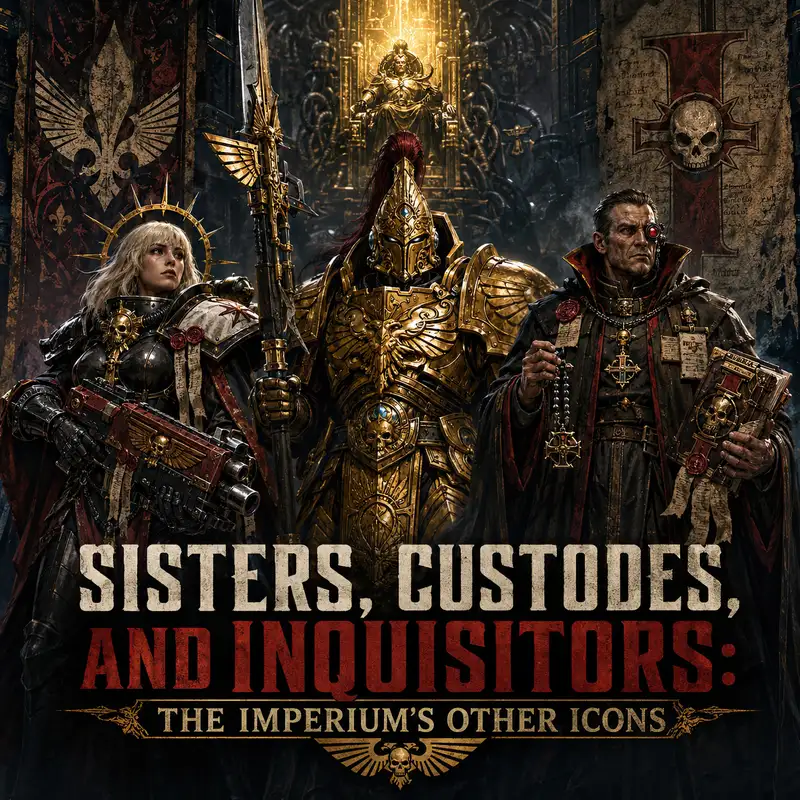
Sisters, Custodes, and Inquisitors: The Imperium’s Other Icons
The most important conversation in the history of the Sisters of Battle was never recorded. Alicia Dominica entered the inner sanctum of the Imperial Palace as the loyal bodyguard of a tyrant. She emerged carrying a new certainty, walked into the tyrant’s throne room, and cut off his head.
The man she killed was Goge Vandire, master of the Administratum, Ecclesiarch of the Imperial faith, and ruler of the Imperium in all but name. His reign had become an age of executions, purges, and private terror. He claimed to speak for the Emperor, and made disobedience a brief and unhealthy occupation.
His most devoted protectors were the Brides of the Emperor, an order of warrior women whom he had deceived into believing that his authority was sacred. When rebellion finally reached Terra, even armies could not easily break their loyalty. A Custodian of the Emperor offered another path. He led Alicia Dominica and five of her companions through the Imperial Palace and into the presence of the Golden Throne.
No surviving account tells us what they saw or whether the Emperor communicated with them. That silence matters. The Sisters of Battle would become one of the galaxy’s most religious forces, yet their defining revelation remains hidden. Dominica returned, denounced Vandire, and ended his reign with one stroke.
That moment brings together two of the Imperium’s most recognisable institutions. The future Adepta Sororitas found its purpose through faith. The Adeptus Custodes carried the authority of direct access to the Emperor. The Inquisition, watching from the shadows of Imperial history, would embody a third kind of power: the right to question anyone who claimed to be loyal.
They are sometimes treated as supporting characters beside Space Marines, the Astra Militarum, and the great war machines of the Imperium. Yet the Sisters, Custodes, and Inquisitors reveal what Imperial power looks like when it is not measured by army size. One represents belief. One represents proximity to the throne. One represents suspicion armed with legal authority.
They also disagree, often profoundly, about what the Emperor is.
To the Adepta Sororitas, he is the God-Emperor, divine protector and final judge of humanity. To the Custodes, he is their creator, master, and the person they were made to guard. Most Custodians do not need the theology of the Ecclesiarchy. They stood beside the Emperor before the church raised its cathedrals. To the Inquisition, the Emperor is also a source of mandate. His name is stamped onto warrants, whispered during interrogations, and invoked when entire governments are ordered aside.
Three servants can kneel before the same throne and see three different kinds of authority.
The women commonly called the Sisters of Battle belong to the Adepta Sororitas. The distinction is useful. The Sisters of Battle are its Orders Militant, armoured warriors with bolters, flamers, and a notable institutional enthusiasm for cleansing fire. The wider sisterhood also includes healers, scholars, diplomats, and advisers whose influence reaches far beyond the battlefield.
Most are recruited from the Schola Progenium, which raises the orphaned children of servants who died in the Emperor’s service. Its pupils may become commissars, elite soldiers, priests, administrators, or Sisters. The process produces disciplined servants of the state, though it suggests that the Imperium’s most reliable renewable resource is bereavement.
A Battle Sister remains human. She is not transformed into a posthuman warrior as a Space Marine is. Her strength comes from relentless training, exceptional equipment, collective discipline, and absolute conviction. Power armour gives her protection and strength beyond ordinary infantry, but the person inside can still bleed, tire, doubt, and die.
That mortality is essential to the faction. Space Marines are distant angels to most Imperial citizens. Battle Sisters look more recognisably human. They march through cities, defend shrines, escort relics, protect pilgrims, and fight in wars whose meaning is explained through sermons and symbols. When they stand on a wall beside ordinary soldiers, they are not proof that humanity can escape its weakness. They are proof that the Imperium expects humanity to fight through it.
Their modern form emerged from the ruins of Vandire’s Reign of Blood. After his fall, the church was forbidden from maintaining men under arms. The restriction was intended to prevent another Ecclesiarch from commanding a private military empire. The Adepta Sororitas survived as the Ecclesiarchy’s closely aligned martial power, thanks to a legal distinction so literal that it could only flourish inside the Imperium.
That origin explains why the Sisters are more complicated than the phrase warrior nuns suggests. They are the armed expression of a civilisation in which faith, government, history, and war have fused together. Their ceremonies are not decoration added to military life. They define why that life exists.
Different Orders cultivate endurance, aggression, sacrifice, or silent discipline. Their heraldry, saints, and traditions distinguish them, but all are shaped by the Imperial Creed. They believe humanity survives beneath the Emperor’s protection and that betrayal is not merely a crime. It is a wound in the structure of existence.
This belief can produce extraordinary courage. Sisters hold positions after a sensible commander would withdraw. They advance through fire while singing hymns and carry the remains of saints into battle because memory itself is a weapon. A relic may turn panic into resolve and make exhausted soldiers believe that retreat would shame generations not yet born.
In Warhammer forty thousand, faith is not always confined to morale. The Adepta Sororitas are associated with acts that appear miraculous. Warriors survive wounds that should kill them. Flames turn aside. A doomed charge reaches its target. Saints appear amid battle, and Saint Celestine has returned from death to fight again.
No comfortable explanation covers every such event. Some may be shaped by the warp or the psychic weight of mass belief. Some may truly be the Emperor’s intervention. Imperial witnesses rarely debate the distinction while the miracle is killing their enemies.
The price of this faith is severe. The Sororitas praise martyrdom and can turn guilt into a weapon. Disgraced Sisters may join the Repentia, seeking absolution in battles they are not expected to survive. The institution can be compassionate toward the faithful and merciless toward anyone judged corrupt. A Hospitaller may save one wounded soldier while another Sister burns the infected neighbour.
That is not hypocrisy from their point of view. It is consistency. The body may be healed because it serves the Emperor. The heretic may be destroyed for the same reason.
The Sisters therefore embody both the strength and danger of conviction. They can inspire whole populations to resist invasion. They can also turn suspicion into a sacred obligation. They are heroes in many Imperial stories, but they are heroes of the Imperium, not visitors from a kinder moral universe.
The Adeptus Custodes stand at the opposite end of Imperial experience. A Sister is trained within a great order. A Custodian is fashioned individually through processes so rare and secret that even senior Imperial authorities understand little about them. The transformation begins in extreme youth and reshapes body, mind, and spirit.
Calling them golden Space Marines is convenient, and wrong. Space Marines are produced through gene-seed, implanted organs, psycho-conditioning, and the inherited traditions of their Chapters. Custodians are not descendants of primarchs. Each is a singular work of gene-alchemy and artifice, made according to knowledge associated directly with the Emperor.
They existed before the Great Crusade and stood beside him during the creation of the Imperium. They were bodyguards, certainly, but also companions, advisers, emissaries, and executioners. Their purpose was not merely to stop an assassin at the final doorway. It was to understand danger before it reached that doorway.
That is why Custodians study politics, history, strategy, philosophy, and the cultures of the Imperium. Their weapons are individually crafted, but so are their minds. They are expected to interpret intent, detect manipulation, and act without the ordinary limitations of a military chain of command. A Custodian is a warrior, but one designed for the court as much as the battlefield.
Their golden armour is made from auramite, and their guardian spears combine blade and firearm. Yet the person matters more than the equipment. A small group can perform tasks requiring far larger conventional forces. This does not make them invincible. It makes every loss almost impossible to replace.
During the Horus Heresy, the Custodes suffered terribly in the hidden war beneath the Imperial Palace. The Emperor’s attempt to secure a human route through the webway had failed, and daemons flooded into the breach. Custodians and the Sisters of Silence fought for years in a battle most of the Imperium never knew existed. The conflict consumed lives, machines, and possibilities that could not be restored.
Then came the Siege of Terra and the final confrontation with Horus. The Custodes were created to protect the Emperor, and the Emperor was mortally wounded. No later victory could erase that fact. Their greatest identity was permanently joined to their greatest failure.
For ten thousand years, they kept watch over the Imperial Palace and Golden Throne. They did not simply stand very still in impressive corridors. Their vigil included intelligence gathering, counter-infiltration, hidden missions, and the Blood Games, exercises that tested the Palace’s defences through attempted penetration.
The point was ruthless and sensible. A defence that never fails during training is usually a defence whose trainers have become polite.
The Custodes also maintained networks beyond the Palace. Those who could no longer meet the order’s exacting standards might surrender their armour and become Eyes of the Emperor, gathering information across the Imperium. Their service did not end. It merely became quieter.
After the opening of the Great Rift and the return of Roboute Guilliman, the Custodes began operating more openly beyond Terra. Shield hosts carried the Emperor’s authority into a galaxy splitting apart. The change did not turn them into another crusading army. Their focus remained the security of the throne, but the definition of that security expanded. A threat no longer had to stand at the Palace gates to be treated as immediate.
They often fight beside the Sisters of Silence, the psychic blanks who served as the Emperor’s witch hunters. These are not the Sisters of Battle. The similar names have probably caused several unfortunate briefing-room errors, though the distinction becomes clear once every psyker nearby begins screaming.
Together, the Custodes and Sisters of Silence are known as the Talons of the Emperor. One provides unmatched physical and intellectual mastery. The other carries a null presence that disrupts psychic power and harms daemonic beings. Their partnership reflects the Emperor’s original design more directly than almost any institution still functioning.
This is why the Custodes are both glorious and tragic. They remember an Emperor who walked, spoke, planned, and commanded. Around them, the Imperium worships a god enthroned in suffering. The Custodes protect that religion because it protects the realm, but they also stand as living evidence that the religion is not the whole story.
They are not guardians of the Imperium in the broad sentimental sense. They guard the Emperor. Those aims often overlap. They do not have to overlap forever.
The Inquisition lives inside that uncertainty.
Its origins lie in the catastrophe of the Horus Heresy, when betrayal proved that armies, primarchs, officials, and trusted friends could all become weapons of the enemy. The Imperium needed servants who could investigate threats hidden behind uniforms, noble titles, sealed archives, and declarations of loyalty. It created an institution whose first assumption was that appearances were worthless.
The Inquisition is not a tidy organisation with one director and a sensible headquarters directory. It is a web of Inquisitors, conclaves, Ordos, agents, archives, alliances, rivalries, and private wars. Its members share a broad mission but argue over methods, theology, risk, and the meaning of victory.
The three largest branches are the Ordos Majoris. The Ordo Hereticus hunts internal corruption, rogue psykers, cults, mutants, and threats to the Imperial faith. The Ordo Xenos investigates alien influence and invasion. The Ordo Malleus confronts daemons and the forces of Chaos. Many smaller Ordos pursue narrower dangers, because the Imperium has never encountered a nightmare without eventually establishing an office for it.
An Inquisitor carries a rosette as the symbol of near-boundless authority. In theory, that authority can requisition troops, redirect ships, question governors, open forbidden archives, and command cooperation from almost any Imperial servant. In practice, power depends on reputation, allies, evidence, and the willingness of armed people to accept the rosette before somebody begins shooting.
The Inquisition is personal in a way most Imperial institutions are not. One Inquisitor may quietly unravel a cult with a handful of investigators. Another may arrive with soldiers, assassins, sanctioned psykers, naval assets, and enough paperwork to make a planetary government wish the daemons had won.
Their retinues reflect their missions. An Inquisitor may employ savants, interrogators, soldiers, criminals, priests, medics, blanks, or even alien specialists. Such groups can resemble a court, a detective agency, a special operations unit, and a deeply unhealthy family at once.
The Ordo Hereticus often works with the Adepta Sororitas. The Ordo Malleus is closely associated with the Grey Knights. The Ordo Xenos can call upon the Deathwatch. These relationships give Inquisitors access to some of the Imperium’s most specialised warriors, but they do not make every operation a battlefield deployment. Most victories begin with a name found in the wrong ledger, a confession that does not fit, or a shipment whose destination officially does not exist.
That quiet work explains why the Inquisition is necessary. Genestealer cults can infest a society for generations. Chaos corruption may begin with a harmless-seeming book or a promise whispered into a desperate mind. A governor can appear loyal while preparing to sell a system to an alien power.
The danger is real. So is the damage caused by hunting it.
Inquisitors commonly divide themselves into broad camps called Puritans and Radicals. Puritans reject the tools of the enemy and insist that corruption must be destroyed without compromise. Radicals argue that alien technology, forbidden knowledge, bound daemons, or controlled heresy may be used against greater threats. The path from one position to the other is often paved with emergencies.
A Radical rarely begins by announcing an intention to become a monster. The first forbidden act saves lives. The second prevents catastrophe. The third is concealed because colleagues would not understand. By the time the daemon is chained in the basement, the original ethics have become a historical document.
Puritans are not automatically safer. Certainty can destroy the innocent as efficiently as corruption. An Inquisitor who sees compromise everywhere may burn loyal servants, collapse governments, and create the rebellion being investigated. The Inquisition’s bleakest feature is not that its members lack principles. It is that many possess principles strong enough to justify almost anything.
This includes Exterminatus, the destruction of life on a world judged beyond saving or too dangerous to surrender. It is not the standard response to an overdue library book. It is an extreme measure, and those who invoke it may face scrutiny. Yet some threats truly can spread from one world to consume thousands.
The result is an institution that may save humanity by committing acts from which humanity should need saving.
The Sisters, Custodes, and Inquisitors can cooperate, but none fits comfortably beneath the others. An Inquisitor may requisition a Sororitas force, especially when hunting heresy. The Sisters may obey while judging the Inquisitor’s faith and methods. A Custodian may work beside an Inquisitor when their goals align, but the Custodes answer to the Emperor’s purpose, not to the ordinary hierarchy of Imperial authority.
An Inquisitorial rosette opens almost every door in the Imperium. The door to the Golden Throne remains a more complicated matter.
Imagine a world where a hidden cult has reached the governor’s household. The Inquisitor asks who has been compromised and how far the infection has spread. The Sisters ask which shrines, communities, and souls can still be defended, and which must be purged. The Custodes become involved only if the danger touches Terra, the Emperor, or some strategic design invisible to local commanders.
Each institution may fight the same enemy, but each is fighting a different war.
That is why these three have become icons. The Adepta Sororitas make belief visible. Their armour, hymns, relics, and sacrifices turn the Imperial Creed into a force that can march through fire. The Custodes make the Emperor’s lost presence visible. They are living weapons from the age when he still walked among his servants. The Inquisition makes fear visible. Its rosette represents the knowledge that any face, office, or institution may conceal the next catastrophe.
Their contradictions are just as important as their strengths.
The Sisters worship a divine Emperor who once tried to build an Imperium without religion. The Custodes preserve the memory of his intentions, yet could not prevent the disaster that trapped him upon the throne. The Inquisition defends humanity by granting individuals the power to distrust, manipulate, and destroy human societies.
None is an accidental flaw added to an otherwise sensible regime. Each is a logical response to the Imperium’s history. Faith holds together a civilisation too large and wounded to survive by reason alone. The Custodes protect the one being whose continued existence anchors that civilisation. The Inquisition searches for enemies that conventional armies cannot see until it is too late.
The horror is that the logic works often enough to endure.
A Sister stands in a burning cathedral and sings because belief must outlast the fire. A Custodian watches beside a silent throne because one failure ten thousand years ago can never be allowed to happen again. An Inquisitor closes a case file and condemns a city because uncertainty has become more frightening than guilt.
Three servants. One Emperor. No shared understanding of what service truly requires.
That contradiction is not a weakness in the image of the Imperium. It is the image of the Imperium.