Seers, Spirit Stones, and the Infinity Circuit
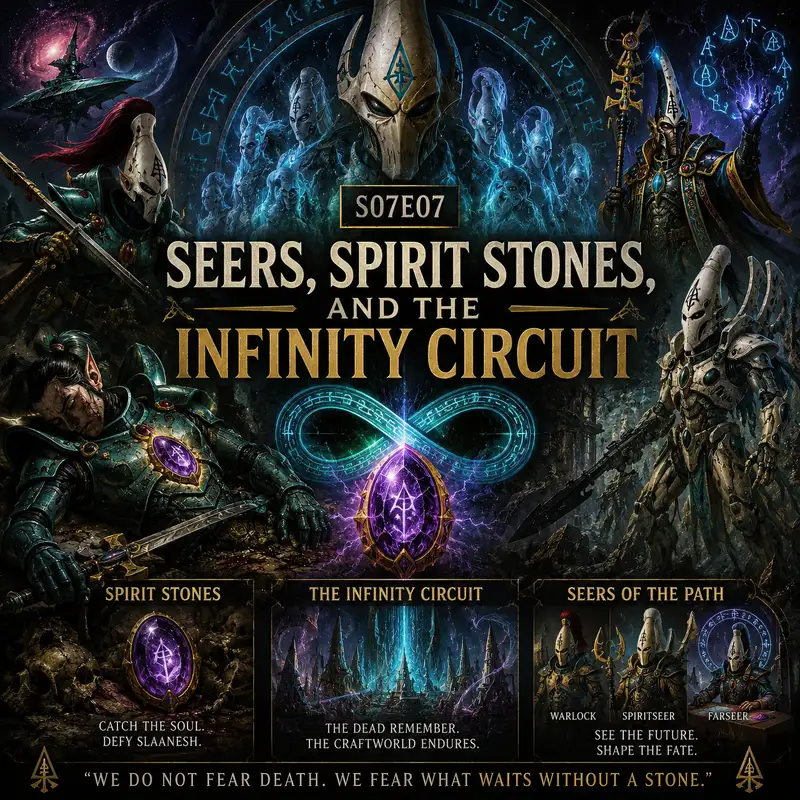
An Aeldari warrior falls in a corridor of living bone, and the most important object on the battlefield is not the weapon still locked in her hand. It is the small gem fixed against her armour. Before the enemy reaches the body, another Aeldari risks everything to recover it. The dead can no longer be saved, at least not in the ordinary sense, but the soul may still be rescued. Leave the stone behind, allow it to crack, or fail to reach it before corruption takes hold, and death becomes something far worse than an ending. For the craftworld Aeldari, this is the truth beneath every ceremony, every prophecy, and every carefully controlled life. Their civilisation is built not merely to survive war, but to prevent their souls from becoming the property of a god that hates and hungers for them.
That god is Slaanesh, born from the catastrophe that destroyed the ancient Aeldari empire. The Fall did more than shatter worlds and turn the heart of their civilisation into the Eye of Terror. It changed what death meant for every Aeldari who remained. Their souls are unusually bright within the warp, rich with the same psychic intensity that once allowed their species to achieve wonders. After the birth of Slaanesh, that brightness became a beacon. An unprotected Aeldari soul passing into the warp does not simply dissolve into some distant mystery. It is drawn toward She Who Thirsts. The craftworlders therefore live beneath a sentence that can be delayed, diverted, and resisted, but never safely ignored. Humanity fears death because life ends. The Aeldari fear death because consciousness may continue in the custody of its worst possible captor.
The first defence is the spirit stone, sometimes called a waystone before it holds a soul, and remembered in Aeldari myth as one of the Tears of Isha. These gems are not decorative badges or symbols of rank. They are psychoreactive vessels worn close to the body so that, at the instant of death, the departing soul can be caught before Slaanesh claims it. The stone does not make its bearer immortal. It does not heal mortal wounds, reverse time, or produce a cheerful second life in a convenient crystal apartment. It preserves what would otherwise be lost. That distinction matters. A spirit stone is less a promise that death has been defeated than an emergency refuge carried against a disaster known to be inevitable.
Even obtaining these stones reveals the scale of the Aeldari predicament. Many are recovered from the Crone Worlds, the ruined domains of the old empire now swallowed by the region of space where reality and the warp bleed together. Expeditions to retrieve them may pass through places haunted by daemons, corrupted memories, and the remains of a civilisation destroyed by its own excess. The craftworlders must return to the scene of their species' greatest crime to gather the means by which their children can die safely. It is a grim inheritance, and an efficiently circular one. The Aeldari are rarely permitted a tragedy without also receiving an administrative requirement.
When an Aeldari dies and the stone performs its purpose, the soul remains contained, conscious in ways that living minds can only imperfectly understand. The stone must then be recovered. On a craftworld, that may happen amid ritual and mourning. On a battlefield, it may require a raid beneath enemy fire, a desperate search through wreckage, or a choice between saving the living and retrieving the dead. The Aeldari do not regard such recovery as sentiment alone. A lost stone represents a person exposed to Slaanesh, and perhaps knowledge, memory, and identity that can never be replaced. This helps explain actions that outsiders mistake for arrogance or irrational obsession. A human commander may see a gem. The Aeldari see a captive waiting to be taken. Recovery can therefore become a sacred duty and a military objective at the same time. A squad may withdraw from a position yet return for the stones of those left behind, because abandoning the ground is a tactical loss while abandoning the dead carries consequences without end.
Once returned to the craftworld, the spirit stone can be joined to the Infinity Circuit. The name sounds mechanical, but the reality is closer to a nervous system, ancestral sanctuary, archive, and communal mind woven through the craftworld's wraithbone structure. Wraithbone is psychically shaped material, and the Infinity Circuit runs through it as a vast network of soul energy. The dead do not sit in rows like records in an Imperial data vault. Their memories, personalities, impressions, and accumulated wisdom become part of a greater psychic whole. Each craftworld is therefore inhabited by more than its visible population. Beneath its gardens, chambers, shrines, and avenues, generations of the dead remain present within the vessel itself.
This does not mean the Infinity Circuit is a simple paradise. Accounts of Aeldari death describe a condition that is communal, dreamlike, and distant from ordinary physical experience. Individual souls can retain identity, yet they also participate in a larger consciousness. Time and sensation no longer behave as they did in life. The dead may advise the living, respond to seers, or lend their strength to the craftworld, but they are not merely elderly citizens answering messages from another room. The separation between person and community becomes less certain. For a species that experiences emotion with extraordinary intensity, even its refuge after death requires discipline. Safety has been achieved, but not simplicity.
The Circuit is also part of the craftworld's living function. Its gathered souls provide psychic strength, continuity, and guidance. They preserve memories that might otherwise vanish as the population dwindles. They connect the present craftworld to eras before its current leaders were born. In human terms, imagine if a city contained not only its archives and monuments, but the actual minds of its ancestors, woven into its foundations and able to influence its future. Then imagine that the city was also a starship, a nation, a temple, and the last surviving fragment of a murdered civilisation. The Infinity Circuit is all of these things at once. Damage to it is therefore not merely structural failure. It is cultural mutilation on a scale few other peoples could understand.
The living cannot safely approach such a system through raw psychic force alone. The Aeldari are naturally psychic, but that gift is precisely what makes unrestrained contact with the warp so dangerous. Their answer is the Path, a sequence of disciplined ways of life designed to focus the mind and restrain the appetites that once destroyed their empire. The Path of the Seer is among the longest and most perilous. Those who walk it learn to shape psychic power through ritual, symbols, runes, meditation, and exacting control. A seer is not simply an Aeldari born with unusual talent. The talent is common. The discipline required to use it without becoming a doorway for something hungry is the rare achievement.
Different seers apply that discipline in different ways. Warlocks are seers who have previously walked the Path of the Warrior. Their understanding of battle allows them to turn psychic power toward protection, destruction, concealment, and command. They accompany warhosts, advise leaders, and fight with witchblades or singing spears whose effectiveness comes as much from psychic mastery as physical form. Their role reflects a characteristically Aeldari belief that experience should be specialised almost to the point of obsession. A human army might issue a staff officer a sidearm. The craftworlds may issue a former warrior a weapon that responds to thought and ask them to bend probability while under fire.
Spiritseers face a quieter and often more unsettling duty. They tend the relationship between the living and the dead, guide souls within the Infinity Circuit, and call particular spirits forth when the craftworld has need of them. Their work demands empathy as well as power. The dead do not always perceive the material world clearly, and entering a wraith construct can be disorienting. A Spiritseer must provide direction, awaken memory, and help an ancestral soul act within a body that has no living senses. They are part priest, part guide, part battlefield controller, though none of those human terms fully captures the intimacy of asking a dead relative to stand up and fight again.
Farseers carry another burden. They examine the possible futures of their people, casting runes and reading the branching skeins of fate. The popular image is of a prophet who sees what will happen. The more accurate picture is of a strategist confronting an enormous field of possibilities, each altered by choice, chance, hostile psychic power, and the very act of observation. A Farseer may perceive that one path leads toward catastrophe, another toward survival, and a thousand more vanish into uncertainty. The runes help protect and focus the mind, allowing the seer to test possibilities without plunging unshielded into the warp. Even then, prophecy is not certainty. The future resists being treated as a timetable.
This is why Aeldari intervention can appear incomprehensible to outsiders. A craftworld may attack an apparently minor target, rescue an individual who seems unimportant, abandon a world it once defended, or manipulate two enemies into destroying one another. The immediate action may be only a small adjustment to a chain of events expected to unfold decades or centuries later. From the Farseer's perspective, sacrificing a hundred lives now might prevent the death of millions in a future war. From the perspective of the hundred selected for sacrifice, the elegance of the calculation may be less persuasive. Foresight gives the Aeldari extraordinary strategic reach, but it does not free them from moral cost. It merely allows them to see more of the bill before it arrives.
Nor are Farseers infallible. The skeins can be obscured. Other psykers interfere. Chaos deceives. Necrons employ powers and technologies that do not always sit comfortably within Aeldari expectations. Tyranid hive fleets cast a psychic shadow. Human decisions remain notoriously difficult to model, perhaps because humanity possesses vast numbers, violent impulses, and a command structure capable of misplacing an entire war in triplicate. More seriously, a seer can become attached to a preferred outcome, misread a warning, or create the disaster they hoped to avoid. The Aeldari know this. Their reverence for seers is therefore mixed with the knowledge that every vision is an interpretation made under pressure.
Those who become lost upon the Path of the Seer are known as Farseers. To be lost on a Path is not simply to become highly skilled. It means the discipline has consumed the rest of the self so thoroughly that leaving it is no longer possible. An Aspect Warrior lost on the Path of the Warrior becomes an Exarch, permanently bound to a shrine and martial identity. A Farseer is similarly bound to vision, responsibility, and psychic practice. Their lives may stretch across immense spans of time, but the end of that journey can be strangely literal. Ancient Farseers may gradually crystallise, their bodies becoming psychoreactive forms within domes of crystal seers, until they are joined fully to the craftworld and its Infinity Circuit.
The image is beautiful from a distance. A silent chamber holds translucent figures who were once the greatest guides of their people. Light moves through them. Their thoughts remain connected to the ancestral network, and living seers may seek their wisdom. Yet the process also reveals the cost of Aeldari survival. The Farseer spends life trying to preserve the craftworld, then becomes part of the craftworld in substance as well as spirit. There is no clean retirement from seeing too much. The final promotion is to become architecture.
The most controversial use of the Infinity Circuit comes when its souls are drawn back into war. Spirit stones can be placed within wraithbone bodies such as Wraithguard, Wraithblades, and Wraithlords. These constructs are not artificial intelligences pretending to be the dead. They are animated by actual Aeldari souls called from the Circuit and housed within forms built for battle. Larger constructs demand spirits of particular strength, and Spiritseers help the awakened dead understand the physical world around them. To enemies, a wraith host looks like an army of graceful machines. To the craftworld, it is a column of ancestors disturbed from refuge because the living have run out of better choices.
A soul inside a wraith construct experiences reality imperfectly, often as though moving through a dream. The living world may seem dim, distant, or unreal. This is one reason Spiritseers remain close, providing psychic clarity and purpose. It is also why the decision to awaken the dead is treated with unease. Craftworld culture honours its ancestors, and honour does not naturally include fitting them with heavy weapons and sending them through artillery fire. Necessity changes the discussion. When extinction approaches, the dead are sometimes the only reserves left. The Aeldari have mastered many forms of warfare, but few are as revealing as the moment a society begins mobilising its own afterlife.
Craftworld Iyanden provides the most famous example. Once among the greatest of the craftworlds, Iyanden suffered catastrophic losses when Hive Fleet Kraken attacked. Its warriors fought with courage and extraordinary skill, but the Tyranids brought a scale of hunger that could not be answered by elegance alone. Vast numbers of Iyanden's living population died. The craftworld survived, yet survival left it hollowed. In the wars that followed, Iyanden increasingly relied upon wraith constructs and Spiritseers, sending its dead to defend the diminished remnant of the living. The bright colours of its hosts do not soften the fact that many of its soldiers are funerary vessels carrying people who have already paid for the craftworld once.
Iyanden demonstrates both the strength and the danger of the system. Without spirit stones and the Infinity Circuit, its losses would have been even more final, and its later defence might have become impossible. Because the dead endured, the craftworld retained warriors, heroes, memory, and a means of resistance. Yet every wraith construct risked a soul that had already escaped Slaanesh. If its stone were shattered and could not be recovered, the refuge would fail. The same system that preserved Iyanden also gave desperation a way to spend the dead twice. This is not hypocrisy. It is the terrible arithmetic of a people whose population cannot be replaced at the rate their enemies destroy it.
The Infinity Circuit itself is therefore a strategic vulnerability as well as a sanctuary. A craftworld's living core contains generations of souls. If enemies corrupt, rupture, or destroy that network, the loss reaches backward through history as well as forward into the future. The danger helps explain the ferocity with which craftworlders defend their vessels and spirit stones. They are not protecting territory in the ordinary sense. A craftworld is homeland, population, archive, graveyard, and afterlife compressed into a single moving structure. An attack upon it threatens citizens who have not yet died and ancestors who have not entirely departed. Very few fortresses carry such a crowded definition of civilian casualties.
Other Aeldari cultures answer the same spiritual disaster differently. Exodite communities bind their dead into world spirits rooted through their planets. Harlequins trust in the protection of Cegorach, though the fate of Solitaires is more dangerous. The Drukhari avoid spirit stones as a normal practice and sustain themselves through the suffering of others, delaying the slow drain of Slaanesh by methods that make craftworld austerity seem almost sociable. The Ynnari place hope in Ynnead, the emerging god of the dead, and challenge older assumptions about how Aeldari souls must be protected. These differences are not minor religious preferences. They are competing survival strategies formed beneath the same divine predator.
For the craftworld Aeldari, seers, spirit stones, and the Infinity Circuit are not three separate curiosities. They form one continuous answer to extinction. Seers search the future for routes that keep the living alive. Spirit stones catch those who cannot be saved. The Infinity Circuit shelters the dead, preserves the memory of the craftworld, and, when disaster leaves no alternative, returns ancestral souls to the battlefield. Each part supports the others. Remove the seers, and the craftworld moves blindly. Remove the stones, and every death feeds Slaanesh. Remove the Circuit, and rescue has nowhere to lead.
The price is a civilisation in which no death is entirely private and no future is allowed to remain merely possible. The living walk disciplined Paths because uncontrolled desire once destroyed their empire. Their seers carry choices that may condemn strangers for outcomes those strangers will never see. Their dead rest inside the walls, advise their descendants, power the vessel, and sometimes march again beneath weapons fire. A craftworld crosses the void with gardens, shrines, armies, and cities upon its back, but its greatest population travels unseen within the bone beneath their feet. The Aeldari have not conquered death. They have built a fortress around the soul, and every generation can hear the enemy waiting outside.