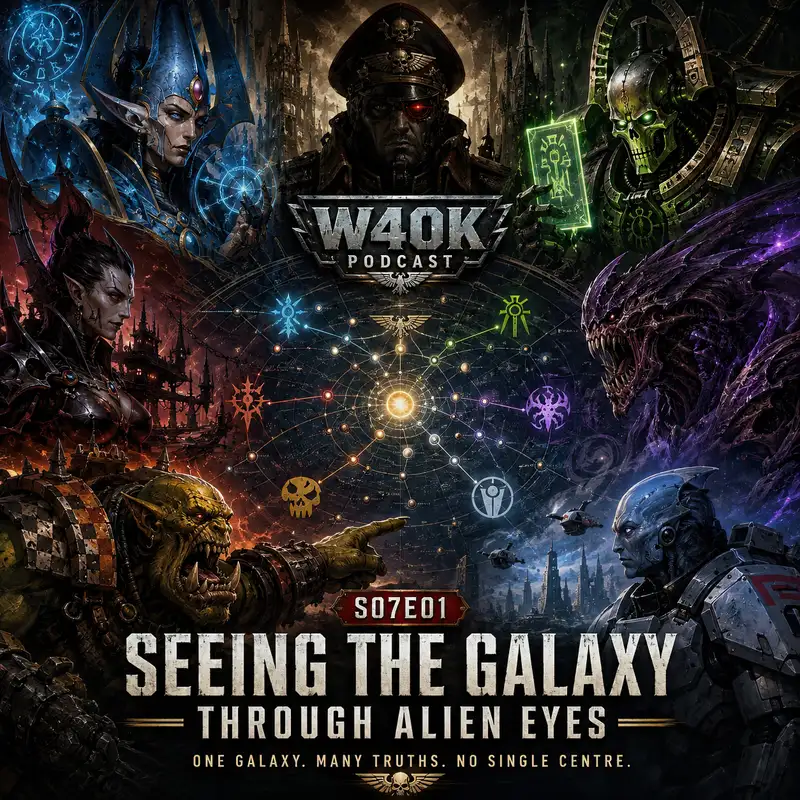
Seeing the Galaxy Through Alien Eyes
A map of the galaxy is never neutral. An Imperial chart marks shrine worlds, fortress systems, shipping lanes, and regions citizens are advised not to study. The same space appears entirely different to those the Imperium calls alien. An Aeldari seer may see possible futures crossing the graves of an ancient empire. A Necron ruler may see an ancestral estate infested by creatures who arrived yesterday and began building cathedrals on the furniture. An Ork may see directions in which a loud war has not yet occurred. A T’au commander may see populations awaiting alliance or correction. The Tyranid Hive Mind may not see worlds at all, but concentrations of biomass, resistance, and psychic signal. The stars remain where they are. What changes is the meaning laid upon them. To see the galaxy through alien eyes is not merely to change sides. It is to discover that humanity was never standing at the centre.
Most accounts of the forty-first and forty-second millennia reach us through human language and Imperial institutions. That matters. The Imperium does not describe the unknown with scholarly detachment. It classifies, condemns, weaponises, and occasionally loses the paperwork. Its word for alien, xenos, collapses uncounted species and civilisations into a single category of threat. For an Imperial commander, this is practical. A creature approaching the defence line with a weapon rarely pauses to explain its philosophy. For history, however, the category conceals as much as it reveals. The Aeldari and the Orks do not understand existence in the same way. The Necrons and the T’au do not share a political project. Even members of one species may disagree so violently that humanity becomes a secondary concern. Seeing through alien eyes begins with a simple correction. Alien does not mean united, and it certainly does not mean simple.
Understanding is not approval. Explaining why a Drukhari raider inflicts suffering does not excuse it. Recognising the logic of a Necron dynasty does not make the people disintegrated by its legions less dead. Perspective identifies what a faction believes it is doing, what it fears, and what it cannot see. Humans often assume their motives are universal. They expect enemies to want territory, resources, security, prestige, or revenge in familiar proportions. Sometimes that works. At other times, the enemy is defending a future that has not happened, reclaiming a kingdom lost before humanity evolved, searching for the perfect battle, or reducing a continent to organic compounds. Diplomacy becomes difficult when one side wants a border agreement and the other regards borders as a temporary symptom of edible life.
The craftworld Aeldari offer the clearest step away from human assumptions because they are recognisably emotional, political, artistic, and afraid, yet experience all four intensely. They descend from a civilisation that once dominated much of the galaxy and destroyed itself in a catastrophe that birthed Slaanesh. Their survivors do not remember a fallen golden age only through books. They travel aboard immense craftworlds carrying fragments of that civilisation, its dead, and the knowledge that the same spiritual predator waits for every unprotected Aeldari soul. A spirit stone is not decoration. It is a defence against a fate worse than death. The infinity circuit is not simply an archive. It is a community of the dead and one of the structures that allows the living to continue. An Imperial boarding action against a craftworld is not merely an attack on a ship. It is an invasion of a homeland, a sanctuary, and an inhabited tomb.
Their long lives and powerful emotions help explain the discipline of the Paths. A craftworld Aeldari may devote years to an art or martial calling, then leave before it becomes an obsession from which there is no return. Humans may interpret this as cold ritualism. From the Aeldari viewpoint, it is controlled survival. Their ancestors proved that unrestrained appetite could become a god. Restraint is not prudishness when excess has teeth. This also changes how they perceive time. A human officer may plan for the next campaign season. A Farseer studies branching possibilities, searching for the thread that prevents catastrophe decades or centuries later. Such foresight is neither perfect nor comfortable. Possible futures shift when observed, and rival seers may reach different conclusions. The result is a civilisation that can appear secretive because it acts upon dangers no human has seen and cannot fully explain without changing the future it hopes to preserve.
This is where Aeldari morality becomes most difficult for humanity. A Farseer may accept the destruction of an Imperial settlement if doing so saves a craftworld or prevents greater disaster. To the victims, the calculation is monstrous. To a population facing extinction and the consumption of its souls, the arithmetic may seem unavoidable. Aeldari arrogance is real, but not merely vanity. They remember when humanity’s ancestors were primitive, and they can sense dimensions of reality most humans encounter only as nightmares. Yet memory and sensitivity do not make them infallible. Pride helped destroy their first empire and continues to distort their choices. Through Aeldari eyes, humans can resemble gifted children playing with weapons beside a fuel dump. Through human eyes, the Aeldari resemble strangers who refuse to explain why they moved the fuel dump under someone else’s house. Both impressions contain enough truth to keep the guns loaded.
The Drukhari reveal how differently one species can answer the same doom. They also descend from the ancient Aeldari, but survive within Commorragh by embracing predation rather than restraint. Slaanesh’s claim upon them has not vanished. Their souls slowly wither, and the suffering of others replenishes what is drained away. Cruelty becomes more than entertainment, though it remains that as well. Pain is sustenance, currency, status, art, and political power. Realspace raids supply captives, resources, prestige, and continued existence. None of this softens what the Drukhari do. It makes the horror more complete. Their society has built survival around the industrial production of agony, then rewarded those who perform it with imagination. Through Drukhari eyes, compassion is vulnerability and trust is an elaborate method of assassination. Their civilisation persists because everyone understands the rules, especially that rules are temporary when a rival can profit by breaking them.
Orks do not look upon this moral complexity with much patience. To an Ork, conflict is not the tragic failure of politics. It is one reason politics exists. Ork society organises itself through strength, aggression, reputation, and leaders capable of gathering larger mobs. A great Waaagh is more than an army on campaign. It is a cultural, biological, and psychic convergence in which violence gives Orks purpose and momentum. Humans facing an Ork invasion see farms burned, cities shattered, and populations butchered. The Orks see movement, opportunity, noise, competition, and something worth hitting. This does not make them cheerful innocents. Their enjoyment of war is catastrophic for everyone else. It does mean deterrence works differently. Threatening an Ork with a larger battle may produce enthusiasm rather than caution. The diplomatic message has been received. It has simply been mistaken for an invitation.
Their technology is another trap for human interpretation. Ork machines look crude, use scavenged parts, and are maintained by methods that would cause an Adeptus Mechanicus priest to develop new liturgies of distress. Yet crude does not mean imaginary. Meks possess instinctive technical knowledge, and Ork devices have real mechanisms. Tales that belief alone makes any Ork contraption function are an exaggeration. An empty box does not become a cannon because enough Boyz shout at it. The more interesting truth is that Ork engineering, religion, society, and warfare are tangled together. A vehicle is transportation, status, a weapon, and an argument about who has the best vehicle. Through Ork eyes, the galaxy is not a collection of stable states. It is a field of challenges arranged by size, loudness, and the likelihood of fighting back.
Necrons see an entirely different galaxy because their past is deeper than almost everyone else’s. Long before humanity crossed the void, the mortal Necrontyr entered a bargain that transformed them into living metal. Biotransference granted endurance at terrible cost. The star gods consumed what made the Necrontyr alive, while rank determined how much personality survived. The dynasties later turned against those gods, shattered them, and entered a sleep measured in millions of years. When Necron nobles awaken, they do not necessarily believe they are invading foreign worlds. They believe they are returning to their domains. Human cities above tomb complexes are unauthorised construction by short-lived squatters. The resulting eviction process is efficient and weak on appeals. What humanity calls ancient ruins may be dormant infrastructure. What an Imperial governor calls his hereditary planet may still appear in a Necron archive under a title older than the human species.
The tragedy is that the Necrons who return are not exactly those who slept. Memory has eroded. Minds have fractured. Some nobles remain brilliant, proud, and capable of honour, curiosity, or eccentric restraint. Others are consumed by obsession, madness, or the Destroyer curse. Their warriors may retain little individuality. Necron perception therefore has a strange double quality. They possess the scale of ancient monarchs, but their recollections can be unreliable. They claim continuity with a lost civilisation while inhabiting bodies that prove its destruction. A Phaeron may speak of restoring a rightful dynasty, yet the subjects who gave that dynasty meaning are now ranks of near-silent machines. Through Necron eyes, humanity is young, noisy, and temporary. Through the eyes they no longer possess, the galaxy may be a reminder of everything immortality failed to save.
The T’au look forward rather than backward. Their empire is young by galactic standards, technologically confident, and organised around the Greater Good. Its castes divide social functions, its Ethereals provide direction, and expansion often begins with diplomacy, trade, and promised membership in something larger. This can make the T’au seem reasonable beside powers that open negotiations with orbital bombardment. The comparison is not demanding. The T’au incorporate allied species and can offer material conditions better than those on many Imperial worlds. Through their eyes, the Imperium is a vast tragedy: technologically powerful, politically decayed, fanatically violent, and unable to imagine cooperation without submission to an emperor they regard as dead. Human worlds are not always enemies to annihilate. They can be partners, converts, auxiliaries, or citizens waiting to be persuaded that their suffering is neither sacred nor necessary.
The T’au viewpoint has blind spots. The Greater Good is presented as universal, but its meaning is defined within a hierarchy led by Ethereals. Peaceful inclusion remains inclusion on T’au terms, and resistance can be answered by precise, overwhelming force. Confidence in rational planning has been tested by a galaxy shaped by the Warp, daemons, ancient hatreds, and enemies for whom mutual benefit means nothing. The T’au are not wholly ignorant of these dangers, but their civilisation developed without the same depth of trauma carried by older powers. This gives them a quality rare in the setting: institutional optimism. It also gives them the confidence of a young power discovering that every ancient monster left a separate minefield and none supplied a map. Through T’au eyes, the future can still be organised. The unsettling question is who may organise it, and what happens to those who decline.
The Tyranids take us to the edge of what perspective can mean. A Termagant has eyes, nerves, and reactions, but it is not an independent citizen of a Tyranid state. Tyranid organisms are specialised components of biological systems directed through the synaptic will of the Hive Mind. Hive fleets cross the intergalactic void, adapt bioforms, overwhelm resistance, and strip worlds of biomass. The Shadow in the Warp smothers psychic communication and fills sensitive minds with pressure, terror, and the presence of something too large to address as a creature. Whether the Hive Mind experiences thought in any form comparable to a person remains uncertain. Its actions reveal intelligence, adaptation, memory, and strategic purpose, but not a motive safely translated into hunger. Hunger is the closest human word. It may be no more complete than describing the Imperium as an animal that wants stone because it builds fortresses.
To see as the Hive Mind sees may be impossible. A city could register as nutrients, heat, defensive fire, and resistance. An army could be a problem solved through adaptation rather than hatred. A heroic last stand might have no emotional meaning beyond the cost required to consume it. This absence of shared meaning is part of the terror. Orks can be baited. Necron nobles can sometimes be bargained with. T’au commanders can negotiate. Aeldari can cooperate when futures align. The Tyranids offer no political body to persuade and no stable desire diplomacy can satisfy. Even apparent individuality among advanced organisms serves the wider swarm. The galaxy, through this many-bodied awareness, may not be territory to rule. It may be a living process to enter, dismantle, absorb, and reproduce. The defenders call that extinction. The swarm may have no need to call it anything.
Imagine one contested world viewed by these powers at the same moment. The Imperium sees a sacred possession whose loss would dishonour the dead. A craftworld seer sees a junction where one evacuation prevents catastrophe. A Drukhari Archon sees captives, leverage, and a chance to embarrass a rival. An Ork Warboss sees a fortress sturdy enough for a memorable afternoon. A Necron Overlord sees trespass upon a domain recorded before human language. A T’au commander sees a population that might be detached from Imperial rule. The Hive Mind detects biomass behind defensive concentrations. The physical planet is the same, but there is no shared war. Several wars occupy the same ground, each with different stakes, histories, and definitions of victory. Peace is difficult not only because the factions hate one another, but because they disagree about what the world is.
Alien perspective also changes how the Imperium appears. Seen from within, a Space Marine can be a guardian, saint, or embodiment of humanity’s last defence. Seen by a T’au Fire Warrior, he is a modified shock trooper serving a regime that worships sacrifice. Seen by an Aeldari, he may be a narrow weapon created by a species with immense psychic potential and little patience. Seen by a Necron noble, he is a durable barbarian. Seen by an Ork, he is promising. Seen by the Hive Mind, he is resistant biomass carrying useful genetic information. None of these views is complete. Neither is the Imperial one. The Space Marine is heroic in some circumstances, terrifying in others, and always the product of a civilisation that turns children into weapons because its wars have outlived every humane alternative it remembers.
The same principle applies to every faction. Aeldari foresight does not make the Aeldari wise in all things. Ork joy does not make Ork violence harmless. Necron antiquity does not make every claim just. T’au cooperation does not erase coercion. Tyranid otherness does not make resistance meaningless. Drukhari necessity does not excuse chosen cruelty. Taking alien motives seriously should sharpen moral judgement rather than dissolve it. It reveals where choice exists and where biology, history, metaphysics, or institutions have narrowed it. These societies are compelling because some part can be understood while another resists translation. We recognise the Aeldari fear of extinction, then recoil from the lives they may sacrifice. We recognise T’au hope, then notice the hand guiding it. We recognise Necron grief, then hear the gauss weapons fire.
Language keeps reminding us that translation is incomplete. Words such as dynasty, caste, craftworld, hive, and Waaagh give human listeners a bridge, but every bridge leaves something behind. Imperial reports are distorted by censorship, fear, theology, and the difficulty of questioning an alien survivor without first shooting them. Alien accounts carry their own propaganda. A Necron chronicle may turn defeat into an administrative inconvenience. An Aeldari warning may omit the part where Aeldari intervention created the danger. A T’au communiqué may describe conquest as compliance with the Greater Good. Ork testimony is often direct, though rarely useful for casualty accounting. The setting offers no clean viewpoint waiting to correct all others. It offers competing memories, self-serving histories, genuine revelations, and gaps large enough to hide fleets.
Seeing the galaxy through alien eyes changes more than our opinion of aliens. It changes the setting’s shape. Humanity becomes one civilisation among many, neither the first to rule the stars nor guaranteed to be the last. The Imperium’s wars stop looking like a single defence of the natural order and become collisions between incompatible orders, each carrying ruins. The Aeldari fight beneath the shadow of a god born from their failure. The Necrons awaken inside a bargain that destroyed their souls. The T’au advance because they still believe history can be directed. The Orks thrive because history is best measured by the quality of the fighting. The Tyranids approach from beyond the galaxy with no obligation to make sense in human terms. The Drukhari endure by ensuring someone else pays the price.
The galaxy does not look kinder from the other side. Often it looks worse. What changes is the assumption that every war is about humanity, every ruin awaits human discovery, and every alien is a variation of the same enemy. Through alien eyes, an Imperial crusade may be an infestation, a prophecy, a source of recruits, a feast, or a welcome challenge. A human victory may be irrelevant to a plan measured in centuries. A human defeat may save lives no human commander will know existed. The galaxy is not one story seen from several angles. It is several realities forced to occupy the same stars. Their borders overlap. Their memories contradict. Their futures cannot all survive. Somewhere, one sun burns above an Imperial shrine, an Aeldari grave, a Necron claim, an Ork destination, a T’au objective, and a Tyranid feeding ground. The light is the same. The universe beneath it is not.