Sebastian Yarrick: The Man the Orks Feared
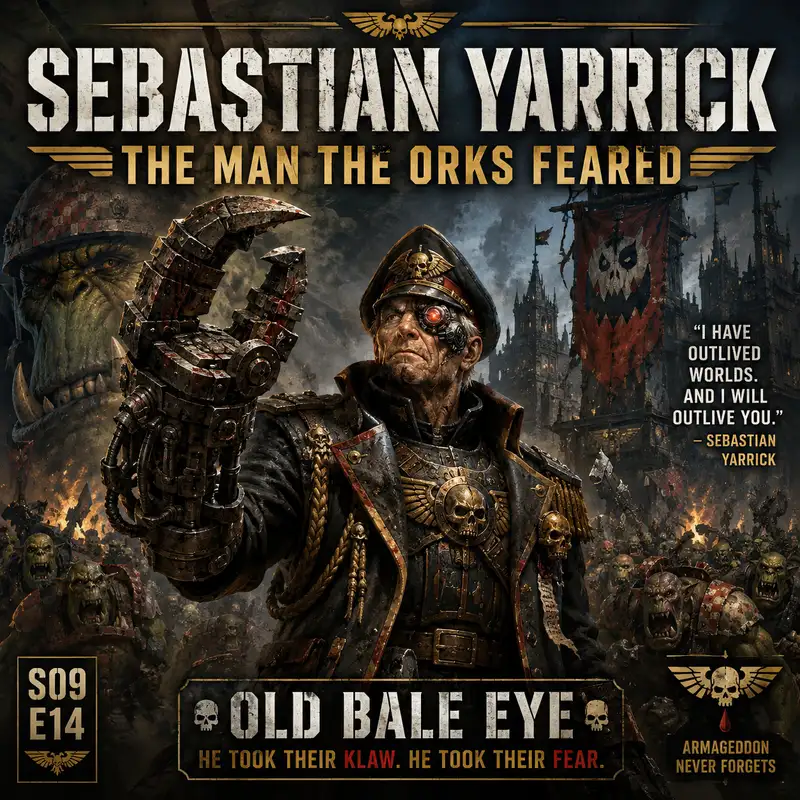
At Hades Hive, the Orks watched an elderly human lose an arm and become more dangerous. Warboss Ugulhard drove his power klaw through Sebastian Yarrick’s right arm and tore it away. The sensible result should have been shock, collapse, and death beneath green boots. Instead, the commissar stayed upright long enough to kill the Warboss with his chainsword. He pulled the klaw from the corpse and raised it. The humans saw proof that the line could still hold. The Orks saw something worse. They saw an enemy who had taken an Ork’s strength, survived the taking, and made the weapon his own.
That moment explains much of Yarrick’s legend, but not all of it. He was never the strongest warrior on Armageddon. He was not a Space Marine, a living saint, or a demigod in ancient armour. He was an old human with a uniform, a sharp mind, and an unreasonable refusal to remain dead. What made him frightening was that he understood the Orks well enough to fight them on two battlefields at once. One was made of trenches, artillery, and burning hive cities. The other existed inside Ork imagination. Yarrick learned that a reputation could be fortified like a wall, armed like a gun, and aimed at the enemy.
Orks do not experience fear in quite the way humans expect. They are not mindless, and they are not fearless. They retreat, panic, turn on weak leaders, and avoid things that promise death without a proper fight. They also admire violence, endurance, audacity, and spectacle. An enemy who merely survives is irritating. One who survives dramatically becomes interesting. One who keeps returning, kills bosses, speaks their language, and carries trophies from their dead begins to look less like prey and more like an omen. Among Orks, fear and admiration can occupy the same space. Yarrick understood that space better than most Imperial commanders understood their own maps.
Later accounts describe Yarrick as knowing the Orks long before Armageddon made him famous. Born Sebastian Vaarden, he was orphaned during an Ork invasion and took the name of the grandfather who had raised him. The surviving stories say the boy endured alone for years before Imperial forces found him. He was taken into the Schola Progenium, which turns the children of Imperial servants into instruments of the state. It is a system built to replace family with duty. In Yarrick’s case, it produced a man whose hatred of the Orks was personal, but whose methods against them were rarely blinded by hatred.
A commissar is usually imagined behind Imperial soldiers with a bolt pistol and a narrow interpretation of acceptable morale. That image is not entirely unfair. Commissars enforce loyalty, punish cowardice, and preserve obedience in armies assembled from a million worlds. Yarrick could be ruthless, and he served one of the harshest institutions in the Imperium. Yet his authority did not rest only on execution. He studied the cultures around him. He learned the Ork language from a captive and paid attention to the logic beneath their apparent chaos. He watched how they followed strength, how stories spread through a mob, and how belief could turn one fighter into the center of an army.
By the time the great Ork invasion reached Armageddon, Yarrick was already near retirement. He had served through many campaigns and was helping raise a regiment when reports of the approaching enemy arrived. The planetary ruler, Overlord Herman von Strab, believed Armageddon needed no outside aid. Yarrick examined the evidence and disagreed. The invader was not an ordinary Warboss. Ghazghkull Mag Uruk Thraka was disciplined by Ork standards, strategically patient, and capable of holding an enormous horde together. Yarrick ordered a call for assistance. Von Strab sent him away to Hades Hive. The Imperial reward for accurate analysis was, as often happens, reassignment to the disaster.
Von Strab’s confidence lasted longer than his defensive plans. Ghazghkull’s armies smashed through one position after another, while refugees and broken units streamed toward the surviving hives. At Hades, Yarrick inherited a fortress filling with the defeated. He lacked trained soldiers, weapons, and time. He did have walls, industry, desperate civilians, retreating troops, criminal gangs, and maintenance crews. Yarrick turned everything available into resistance. Blast portals were sealed. Defensive lines were rebuilt. Soldiers from shattered formations were reorganized rather than discarded. The population was armed. Even underhive criminals were brought into agreements, because extinction has a way of simplifying negotiations.
Yarrick appeared wherever the defence was weakest. He inspected barriers, planned counterattacks, spoke to soldiers, and stayed close enough to the fighting that no one could mistake his orders for advice from a distant bunker. Accounts of Hades Hive say he did not need to execute a single defender for cowardice during the siege. That reveals the source of his command. The soldiers did not stand merely because they feared the commissar behind them. They stood because the old man was beside them, bleeding in the same smoke, and because he made resistance feel possible. Yarrick frightened Orks partly because he first taught humans not to fear them.
His defence was not built on speeches alone. Yarrick used raids to keep the besiegers uncertain and drew Orks into mined approaches and killing grounds. When Ghazghkull sent aircraft and Blood Axe kommandos against the upper hive, Yarrick improvised. Conventional artillery fired into the crowded attack formations, while armed maintenance crews entered ducts and service passages to hunt infiltrators. It was not elegant, but elegance has limited value when Orks are descending through the ventilation system. The assault failed. More importantly, Ghazghkull learned that Hades would not behave as expected. Every clever blow met an answer, and every answer seemed to carry Yarrick’s name.
Ghazghkull’s frustration became personal. Hades was only one battlefield in a planetary war, yet the Warboss poured increasing attention into breaking it. This was a strategic gift to the Imperium. Every mob, aircraft, gun, and boss committed there was not advancing elsewhere. Yarrick had turned himself into bait, and Ghazghkull was too proud to stop biting. Ork accounts treated the commissar as a destined rival, an enemy whose defeat would prove the victor’s greatness. That status did not make Yarrick safe. It made him the focus of an army that considered prolonged violence a form of celebration.
Then came Ugulhard and the severed arm. Yarrick killed a massive Ork Warboss after suffering a wound that should have ended the fight. When he displayed the captured klaw, the defenders surged forward and the Orks recoiled. Later, the weapon was fitted to Yarrick’s body as a replacement for the arm it had removed. His damaged eye became a weaponized bionic implant. The transformation was deliberate. Yarrick did not hide his injuries or restore a normal human appearance. He turned each wound into visible evidence that attacking him only made him more like the monsters he fought.
To the Orks, he became Old Bale Eye, the old enemy with the deadly stare. Yarrick encouraged the image because he knew superstition was part of Ork warfare. He wore the power klaw openly. He let the bionic eye burn. He stood where he could be seen. None of this would have mattered without victories behind it. A costume does not frighten an Ork for long if the wearer dies at the first charge. Yarrick’s symbols condensed remembered events. The klaw meant a dead Warboss. The eye meant survival. The old body meant that time itself had apparently failed to finish the job.
The siege continued for months. Ghazghkull eventually joined the fighting, and Hades Hive was largely ruined. Yarrick could not save every district, soldier, or civilian. He was nearly killed during the final struggle and evacuated with the surviving defenders. Relief forces broke the siege, and the wider counteroffensive drove the Orks from the world. The Imperium called Yarrick the Saviour of Armageddon, but the title can obscure what he achieved. He did not win alone. He denied Ghazghkull a quick victory, consumed the enemy’s attention, preserved resistance, and gave other forces time to recover. In military terms, he made one hive too expensive to ignore and too stubborn to conquer.
That is another reason the Orks feared him. Yarrick did not need to be undefeated. He needed every defeat to become troublesome. Hades was devastated, but the siege helped cost Ghazghkull the campaign. Yarrick was maimed, but the maiming produced the claw and the eye. He was nearly killed, but his survival enlarged the story. Against most enemies, the Orks measured progress in ground taken and bodies crushed. Against Yarrick, even success fed the legend opposing them. He had made suffering operationally useful, a very Imperial talent, though rarely practiced with such personal commitment.
After the Second War, retirement again presented itself. Yarrick treated it as a suggestion from someone who had misunderstood the situation. Ghazghkull was alive, and Yarrick believed another invasion inevitable. He launched expeditions to hunt the Warboss across nearby systems. On Golgotha, he led Imperial armour from a Baneblade super-heavy tank called the Fortress of Arrogance. The name suited both vehicle and campaign. Yarrick intended to destroy Ghazghkull before he returned in greater strength. Instead, the Imperial force was crushed. The Fortress was disabled, Yarrick was captured, and the hunter became a prisoner aboard the enemy’s space hulk.
Captivity should have ended the legend. Yarrick was tortured, worked beside human slaves, and stripped of the armies that had made him powerful. He answered by organizing revolt. The uprising failed, but Yarrick remained defiant inside the Warboss’s domain. Then Ghazghkull did something that reveals their strange bond. He released Yarrick, provided a way home, and sent him back to Armageddon. Good enemies were difficult to find, and Ghazghkull wanted his favored opponent present when the next war began. It was not mercy. It was an Ork invitation, written in humiliation and anticipation.
Ghazghkull’s decision was respect, but also obsession. Yarrick had become part of the Warboss’s understanding of himself. A great Ork leader requires a great war, and a great war improves when a worthy enemy stands opposite. By releasing Yarrick, Ghazghkull admitted that killing him in a cell would diminish the coming victory. The commissar’s continued existence had value within Ork culture. That is a peculiar kind of fear. Ghazghkull did not cower before Yarrick, but he treated him as a force that had to be faced properly. The old human had become too important to dispose of casually.
When the Third War for Armageddon began, Yarrick returned before the main invasion and received supreme command. His first great decision showed that legend had not replaced judgment. Ghazghkull was certain to strike Hades Hive, where his earlier defeat had become inseparable from Yarrick’s name. Many commanders would have defended the ruins for honor. Yarrick evacuated them. He knew the hive could not survive another assault and suspected Ghazghkull might destroy it from orbit. That is what happened. The Warboss obliterated Hades with asteroids, only to discover that his grand gesture had killed a city Yarrick had already abandoned.
The choice was cold, but not careless. Yarrick refused to confuse a symbol with the people who had created it. Hades mattered because its defenders had held, not because every broken wall possessed sacred military value. By moving the troops, he denied Ghazghkull both massacre and strategic reward. Yarrick understood the story the enemy wanted to tell and removed the ending. The Orks could destroy the place of their humiliation, but not reverse what had happened there. A dead hive remained a monument to the fact that Ghazghkull had once spent months trying to break an old commissar and failed.
The Third War became an immense struggle involving Guard regiments, Titans, aircraft, naval forces, Space Marines, and defenders from across Armageddon. Yarrick did not command every battle, nor could any leader control a conflict of that scale. His importance lay in coordination and confidence. He knew Ghazghkull was neither stupid nor random. He could warn commanders when apparent chaos concealed a plan and persuade exhausted soldiers that the Orks had been stopped before. From the rebuilt Fortress of Arrogance, he served as commander and signal. Wherever the black tank and raised klaw appeared, Imperial troops knew the old man had not conceded the field.
The war settled into attrition. For the Imperium, that meant appalling losses and a world reduced to permanent battle. For Ghazghkull, it meant no decisive triumph. Eventually, the Warboss departed to pursue a wider vision of conquest. Yarrick did not consider that victory enough. He joined High Marshal Helbrecht and the Black Templars in pursuit. They cornered Ghazghkull’s flagship in the Haunted Gulf, but the Ork escaped through the Warp. Once again, the contest ended without resolution. Once again, Yarrick continued the chase. Retirement was now less a stage of life than an administrative rumor.
Their rivalry reveals the scale of Yarrick’s achievement. Ghazghkull was a warlord, prophet, conqueror, and living center of the greatest Ork movement of his age. Yarrick was physically fragile by comparison, held together by surgery, machinery, and determination. In a direct contest of strength, there was no contest. Yet war is not strength alone. Yarrick forced Ghazghkull to acknowledge him as an equal participant in the story. The Ork could crush his body, overrun his armies, and ruin his cities, but could not make him insignificant. Yarrick’s real weapon was the refusal to become small in the enemy’s mind.
On Icaria, that refusal nearly killed him for good. Yarrick’s forces caught Ghazghkull amid another vast Ork plan as the planet broke beneath unleashed energies. Yarrick led a strike force into the enemy position and confronted the Warboss. His power klaw wounded Ghazghkull, but the Ork seized him, crushed bones, and struck him down with a headbutt. Ghazghkull raised an armored boot over the fallen commissar, then stopped and withdrew as the world collapsed. A Space Wolves priest recovered what remained of Yarrick. Imperial forces reported him dead, and the Bell of Lost Souls tolled on Terra.
For a time, the Imperium accepted Sebastian Yarrick’s death. Stories multiplied, as they do when institutions possess poor information and excellent ceremonial facilities. Some called him a martyr. Others claimed stranger fates. The reality was more characteristic. Yarrick survived, though barely. His skull was reconstructed and his broken body supported by a cybernetic armature. His remaining years became a negotiation between advanced medicine and stubbornness. When Armageddon faced another Ork assault, he returned. Older, paler, and more damaged than before, Old Bale Eye came back to the world that had made him a legend.
The return completes the pattern. Yarrick’s reputation was never based on invulnerability. He was wounded too often for that. It was based on conversion. Pain became authority. Loss became iconography. Defeat became warning. Captivity became another story of resistance. Even a death notice became preparation for return. The Orks feared him because normal victories settled nothing. Killing his soldiers did not make them forget him. Breaking his body did not stop him commanding. Destroying Hades did not erase Hades. Capturing him did not make him obedient. Announcing his death did not guarantee the useful administrative detail of his remaining dead.
There is a harder truth beneath the legend. Yarrick understood the Orks because part of him shared their fixation. He devoted his remaining life to Ghazghkull, pursuing the Warboss when another commander might have accepted honors and withdrawn. Their hatred gave each purpose. Ghazghkull wanted the greatest possible war. Yarrick wanted to prevent it, yet became defined by the chase. This does not make them morally equivalent. One sought conquest and slaughter, while the other defended human worlds. It means Yarrick’s strength carried a cost. To become the enemy the Orks feared, he allowed the war against them to consume nearly everything else he might have been.
Sebastian Yarrick frightened the Orks because he refused to fight only as an Imperial officer. He learned their language, studied their instincts, recognized spectacle, and built a weapon from the stories they told about him. His claw was not merely a tool. His eye was not merely an implant. His age was not merely frailty. Together they formed an argument the Orks understood: this human had faced their best, taken their blows, stolen their strength, and returned for more. He mastered fear, first in his soldiers, then in his enemies, and finally in the legend that moved between them.
Across the ash wastes of Armageddon, an Ork mob can hear engines, artillery, and the promise of battle without hesitation. Then a black command vehicle appears through the smoke. An old figure rises above it, too thin for the weapon fixed to his arm, one eye burning like a coal in a dead face. The Orks know he can be wounded. They have wounded him. They know he can be beaten. They have beaten him. What they do not know is how to make any of it permanent. That uncertainty is where their fear lives, and it has a name. Old Bale Eye is still standing.