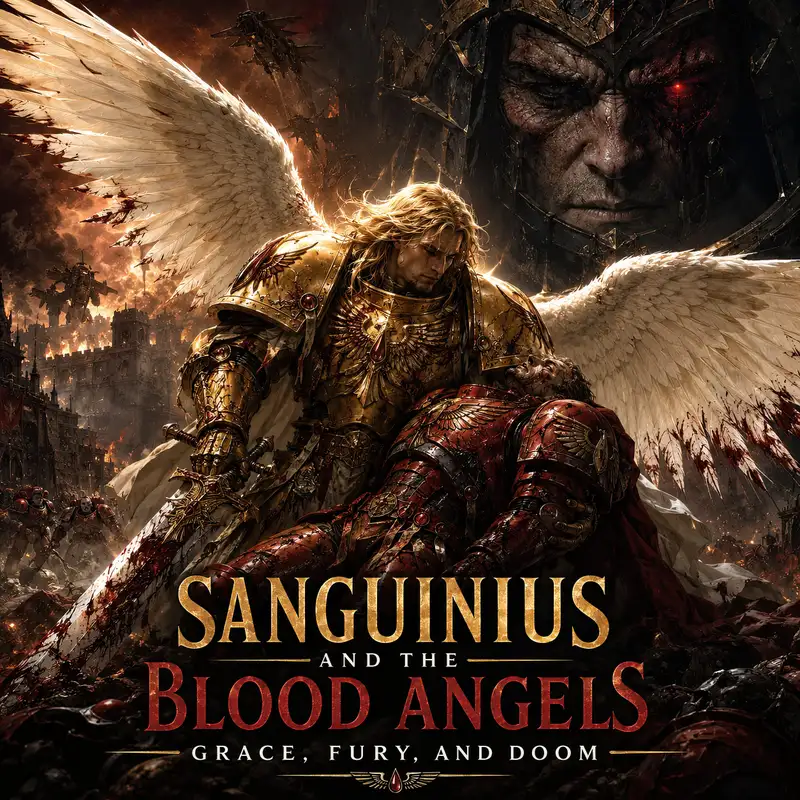
Sanguinius and the Blood Angels: Grace, Fury, and Doom
By the time Sanguinius reached Horus aboard the Vengeful Spirit, he had already seen his own death many times. He knew the chamber. He knew the shape of the betrayal waiting inside it. He knew that the brother he had once loved had become something vast, cruel, and almost impossible to kill. None of this stopped him. The angel entered anyway. That choice is the key to Sanguinius, because his story is not really about beauty, wings, or even battlefield glory. It is about a being born with every reason to believe he was cursed, who spent his life proving that doom does not excuse surrender. The Blood Angels inherited that contradiction. They are among the most graceful of the Space Marines, and among the most dangerous. They create art, speak of nobility, and descend into battle like figures from a religious vision. Beneath all of it waits a hunger they may never fully control.
The Ninth Legion did not begin as angels. Before Sanguinius was found, they were known by names such as the Revenant Legion and the Eaters of the Dead. These were not affectionate nicknames. The Legion had been used during the wars of Unification and the early expansion from Terra as a brutal force of endurance. Its warriors could survive appalling losses, recruit from populations that other Legions rejected, and rebuild themselves with unsettling speed. Their gene-seed could transform damaged, irradiated human stock into powerful warriors. Their enhanced biology also allowed them to consume the flesh of the dead and absorb fragments of memory. In practical military terms, this helped preserve experience when officers were killed. In cultural terms, it produced a Legion that could replace its commanders by eating them. Even by the standards of the early Imperium, this made formal dinners difficult.
The Legion’s savagery was not random. It was an adaptation to the missions it was given and to the expectations placed upon it. The Ninth was often sent where casualties would be extreme and restraint was unlikely to survive first contact. Its warriors developed rituals around blood, death, and continuity because those things defined their existence. They were effective, loyal, and deeply feared. They were also beginning to show signs of the flaw that would later be called the Red Thirst. In battle, some Legionaries became consumed by a craving for blood and a rage that overwhelmed judgment. The Imperium tolerated many defects, provided they remained useful and discreet. The Ninth had reason to worry about the second requirement. Then its primarch was found on Baal Secundus, and a Legion that had survived by becoming monstrous encountered a leader who looked like an angel.
Baal was not a gentle world awaiting rescue. Its moons had been poisoned by ancient war. Radiation, mutation, scarcity, and tribal violence shaped every life upon them. Sanguinius was discovered among the people known as the Blood, who found a child with wings in a landscape where mutation usually meant danger. Accounts of his earliest years carry the weight of legend, but the central truth is clear. He grew among people who had almost nothing, and he became their protector. He learned what beauty meant in a place where survival was ugly. He also learned that mutation did not automatically make someone evil, a lesson the wider Imperium was not famous for encouraging. His wings made him extraordinary, but they also marked him as something that could have been feared, hunted, or destroyed. The grace associated with Sanguinius was therefore never innocence. It was a decision made in full knowledge of cruelty.
When the Emperor came to Baal, Sanguinius recognised him and accepted his place in the Great Crusade, but not without concern for the people who had raised him. He secured a promise that Baal would be spared the kind of cleansing the Imperium often applied to populations it found inconvenient. That bargain reveals much about him. Sanguinius did not reject the Emperor’s vision, nor did he stand outside the violence of the Crusade. He became one of its greatest commanders. Yet he retained a loyalty to the forgotten and damaged people of his home. He understood the Imperium as both promise and threat. When he met the Ninth Legion, he did not simply give them a new name. He offered them a new idea of what they could be. The Revenants would become the Blood Angels, and the change would reach far deeper than armour, heraldry, or ceremony.
Sanguinius imposed discipline, but discipline alone could not remake the Legion. He encouraged his sons to pursue art, music, poetry, craftsmanship, and the study of human achievement. The purpose was not decoration. A Legionary who could shape stone, illuminate a manuscript, or understand beauty was being trained to see himself as more than an instrument of appetite. The Blood Angels became famous for physical elegance and refined culture because refinement was part of their defence against degeneration. Their transformation also had a literal dimension. Recruits drawn from the wasted tribes of Baal could emerge from implantation and long confinement in sarcophagi remade into striking, powerful warriors. The contrast became part of the Legion’s identity. From poisoned deserts came figures of almost impossible beauty. From a history of cannibal survival came a culture obsessed with self-command. The angelic appearance was real, but it was also armour.
That armour was necessary because the Red Thirst never vanished. Sanguinius understood that the flaw existed within his gene-line, and he feared what the Emperor might do if it became fully known. Two Legions had already been erased from Imperial history. Their primarchs were gone, their records suppressed, and the surviving brothers had learned that even the Emperor’s sons were not beyond judgment. Sanguinius had no certainty that the Ninth would be forgiven. He therefore concealed the worst of the flaw and tried to master it through culture, loyalty, and example. This secrecy was not simple vanity. He feared for his sons, and perhaps also feared what their condition suggested about him. If the Legion’s hunger came from its primarch, then every loss of control was a reflection of something hidden behind his own perfect face.
The Blood Angels’ battlefield style expressed the same tension. They were not merely berserkers dressed in gold. They favoured rapid assaults, close combat, aerial deployment, and decisive concentration of force. Their aggression was shaped into doctrine. Sanguinius himself was a commander of exceptional speed and presence, able to move across a battlefield in ways no ordinary general could imitate. His wings were not symbolic when enemy lines were below him. He could appear at the point of crisis, strike with overwhelming violence, and turn panic into momentum. His Legion learned to make fury precise. This is one reason their grace should not be mistaken for softness. The Blood Angels were beautiful in the way a sword can be beautiful. The craftsmanship matters. So does the edge.
Among the primarchs, Sanguinius inspired unusual affection. He possessed charisma without the cold distance of the Lion, the theatrical pride of Fulgrim, or the crushing certainty of Horus after his elevation. His brothers trusted him because he could be magnificent without always making magnificence feel like an accusation. Horus loved him, and Sanguinius loved Horus in return. That relationship gave the coming betrayal its personal force. The Horus Heresy was not only a civil war between military blocs. It was a family collapse conducted with fleets, armies, and daemons. Sanguinius did not face an abstract traitor. He faced the brother who had once seemed most capable of uniting them all. Horus, in turn, understood that Sanguinius represented a rival kind of greatness, one based less on command than on devotion freely given.
The trap was laid in the Signus Cluster. The Blood Angels were sent into a region supposedly threatened by a grave enemy, but the campaign had been shaped to exploit their deepest weakness. Worlds had been ruined, populations tormented, and the entire theatre prepared as a ritual weapon. The powers of Chaos did not merely want the Ninth destroyed. They wanted it corrupted. The daemon Ka’Bandha and the forces gathered around Signus sought to awaken the Red Thirst on a scale the Legion could not contain. If Sanguinius could be broken, his sons might fall with him. Khorne did not need them to become subtle philosophers. It needed them to accept that rage was their true nature and that resistance had always been hypocrisy.
The assault worked, at least at first. Blood Angels lost themselves to fury. Sanguinius was confronted not only by daemonic power but by the spectacle of his sons becoming exactly what he had feared. Ka’Bandha wounded and humiliated him, using the slaughter of Legionaries to deepen the psychic shock. The Legion approached collapse. Yet Signus did not end with surrender. Sanguinius rose, fought back, and rejected the claim that bloodlust made allegiance to Khorne inevitable. The Apothecary Meros made the decisive sacrifice. He accepted the burden intended for his primarch and became the creature remembered as the Red Angel. His fate was terrible, but it denied Chaos the victory it had designed. The Blood Angels escaped Signus damaged, ashamed, and still loyal.
Signus matters because it tested the central argument of the Legion’s existence. The Red Thirst was real. It was not Imperial slander, a minor medical inconvenience, or a poetic metaphor. The Blood Angels could become monsters. Chaos looked at that fact and declared the case closed. Sanguinius answered that a tendency is not a destiny. His sons were responsible for what they did with the hunger, even if they had never chosen to possess it. This did not cure them, and it did not remove the need for secrecy. It gave their struggle moral weight. Virtue is easy when temptation is absent. The Blood Angels’ nobility matters because it is maintained beside the locked door, not because the room behind it is empty.
The Heresy then forced Sanguinius into a role stranger than any battlefield command. Cut off from Terra by the Ruinstorm, Roboute Guilliman feared that the Emperor had fallen and created Imperium Secundus as a contingency. Sanguinius was placed upon its throne, with Guilliman as regent and the Lion as protector. The arrangement was politically logical and emotionally disastrous. Sanguinius possessed the legitimacy neither brother could claim without appearing to seize power, but he had no desire to replace the Emperor. He became a symbol of unity inside an empire built on incomplete information. Once evidence showed that Terra still stood, Imperium Secundus was abandoned. The episode left all three primarchs with questions that would outlive the war. It also placed Sanguinius, briefly, inside the exact image others had always projected onto him: the perfect ruler. He knew better than most how misleading a perfect image could be.
As the loyalists fought through the Ruinstorm and sought a path toward Terra, Sanguinius’s visions of his death became more insistent. Foresight in the hands of a primarch was not a convenient map of the future. It was a field of possible outcomes, symbols, traps, and self-fulfilling choices. Sanguinius came to believe that he would die at Horus’s hands. He also believed that avoiding that fate might permit something worse. The important point is not that he became passive before prophecy. He continued to choose. He went to Terra because the defence required him. He accepted that knowledge of doom did not remove duty. A soldier who knows an assault is likely to fail may still have reasons to lead it. Sanguinius carried that logic to its most terrible conclusion.
During the Siege of Terra, the angel became what the defenders needed him to be. He moved between walls, command posts, and killing grounds as both general and symbol. By then the defenders were not fighting for a clean victory. They were buying time with people, ammunition, fortifications, and pieces of the Palace that had stood for ages. Sanguinius understood morale as a military resource. His presence could steady troops who had seen Titans, traitor Astartes, and daemons turn ordinary fear into something almost rational. He did not make the battlefield less hopeless. He made hopelessness temporarily irrelevant. That distinction kept men and women at their posts long after good sense had packed its belongings and left.
At the Eternity Gate, Sanguinius faced Angron. The contrast could hardly have been sharper. Both were winged figures by then, but Angron’s wings were the mark of daemonhood, and his body had become an engine for endless rage. Sanguinius was exhausted, wounded, and still mortal enough to die. Their duel was not a contest between calm and anger. Sanguinius possessed anger in abundance. It was a contest between fury commanded and fury enthroned. He met Angron’s violence directly, endured it, and finally tore the Butcher’s Nails from the daemon primarch’s skull. Angron was banished, not permanently destroyed, because Chaos is generous with returns and less attentive to customer complaints. The gate held. Sanguinius survived, but the victory consumed strength he would soon need elsewhere.
When the Emperor prepared to board the Vengeful Spirit, Sanguinius went with him. The teleport assault scattered the loyalist force through Horus’s corrupted flagship. Sanguinius reached Horus before the Emperor did. Here the military situation and the family tragedy became inseparable. Horus had been transformed by the power of Chaos, but traces of the brother he had been made the confrontation more painful, not less. Sanguinius could not accept him, and Horus could not allow Sanguinius to remain what he was. The angel’s continued loyalty disproved the traitors’ claim that corruption was inevitable. His very existence was an accusation.
Sanguinius fought despite knowing the likely end. He was not strong enough to defeat Horus in that state, and courage did not alter the imbalance. Horus killed him with overwhelming brutality. Later tradition surrounded the moment with claims that Sanguinius created an opening the Emperor would exploit, or that his sacrifice weakened Horus in some decisive way. The surviving accounts do not make every detail simple. What remains certain is the refusal. Sanguinius did not kneel, did not join the rebellion, and did not preserve himself by abandoning the cause he had chosen. His death was not valuable because death itself is noble. The Imperium has always had more than enough graves. It was valuable because Horus could offer him no future worth surviving for.
The death did not remain aboard the Vengeful Spirit. It passed through the Blood Angels as a psychic wound. The Black Rage was born from the final agony of their primarch and the bond carried through his gene-seed. Those who fall to it do not merely become angry. They lose the present and experience fragments of Sanguinius’s last battle as if they are living it themselves. Comrades become figures from the Siege. Enemies become Horus. The warrior’s own identity is submerged beneath inherited memory and pain. This is distinct from the Red Thirst, though the two curses can feed one another. The Red Thirst is the hunger within the Blood Angels. The Black Rage is the echo of the moment their father died.
In the centuries that followed, the Legion was divided into Chapters, but the inheritance remained. Blood Angels and many of their successors built rituals, institutions, and offices around managing the flaw. Chaplains guide those claimed by the Black Rage into the Death Company, where their final madness can be directed against the enemy. Sanguinary Priests preserve the physical and spiritual traditions of the bloodline. Artists, warriors, and commanders continue the pursuit of beauty that Sanguinius encouraged. Some successors hold the curse with dignity. Others stand much closer to the edge. The Flesh Tearers, for example, have often embodied the fear that fury may consume everything else. Yet even the most troubled descendants remain measured against the same impossible standard.
That standard is sometimes misunderstood. Sanguinius was not great because he was free of darkness. He was great because he recognised it. His grace was not the absence of violence, but violence placed under judgment. His fury was not a betrayal of his nobility, but the force his nobility had to govern. His doom was not proof that resistance failed. Horus killed him, but could not make him agree that corruption was truth. Every Blood Angel who creates something beautiful, restrains the Red Thirst, or enters battle while hearing a dead primarch’s final memories is repeating part of that refusal.
This is why grace, fury, and doom belong together. Remove the fury and the grace becomes decoration. Remove the doom and the courage becomes effortless. Remove the grace and the Blood Angels become exactly what Chaos claimed they were. Sanguinius could not save himself, and he could not free his sons from the curse carried in their blood. He gave them something more difficult than a cure. He gave them a standard by which to resist. Across ten thousand years, beneath gilded armour and funeral-black markings, the Blood Angels continue to live inside the choice he made aboard the Vengeful Spirit: not whether the darkness is present, but whether it will be obeyed.