Rogue Traders: Licensed to Cross the Unknown
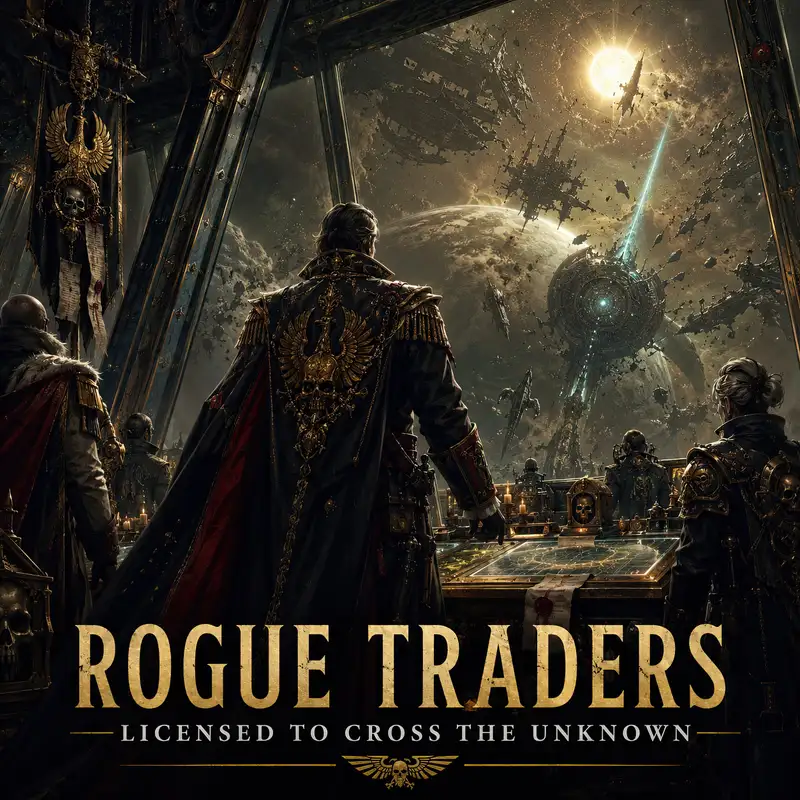
At the edge of an uncharted system, an Imperial voidship slows beneath a dead sun. Its augurs have found a world where no world should be, surrounded by wreckage older than the Imperium and transmitting a signal in a language no one aboard can identify. A naval captain might mark the coordinates, withdraw, and send a report into the patient machinery of Imperial command. A planetary governor would have no authority to be there at all. An inquisitor might see a threat before seeing anything else. The figure standing on this ship’s bridge has another option. They may land. They may bargain. They may claim the world, loot the wreckage, destroy the transmitter, or return with an army. The decision can be made before the signal reaches the next star. That is the power of a Rogue Trader.
The name is misleading in exactly the way the Imperium enjoys. A Rogue Trader is not necessarily a rogue, and trade is only part of the profession. Rogue Traders are explorers, privateers, diplomats, conquerors, merchants, colonisers, intelligence gatherers, and occasionally the first human face an unknown civilisation sees. They operate where maps become guesses and Imperial authority becomes a matter of how many guns have arrived with the paperwork. Their defining possession is a Warrant of Trade, a sacred charter granting freedoms that would be unthinkable for almost any other Imperial subject. The central contradiction is obvious. Why would the most controlling human regime imaginable give one person permission to cross its borders, negotiate with aliens, command private armies, and make decisions that may shape entire regions of space? The answer is that the Imperium has no practical alternative.
The Imperium is vast, but vastness is not the same as control. Between inhabited systems lie distances that can swallow fleets, messages, and generations. Warp travel is dangerous, astropathic communication is uncertain, and the bureaucracies of Terra can take decades to notice that a frontier has moved. The Adeptus Administratum can record a conquered world once the forms arrive. It is less effective at deciding what to do when the world has not yet been discovered, its inhabitants do not recognise the Emperor, and the only navigable route to it may vanish with the next warp storm. Frontier decisions must be made locally, quickly, and by someone authorised to accept enormous risk. The Warrant of Trade is the Imperium’s solution. It replaces close supervision with a mandate, a bloodline, and a very long list of consequences.
A Warrant is not a common licence stamped by a bored clerk before lunch. Each is a specific legal instrument defining the rights, obligations, territories, and privileges of its bearer. Many are ancient. Some dynasties trace their authority back to the Great Crusade, when the expanding Imperium needed trusted agents to move ahead of its armies and locate worlds worth conquering, contacting, or avoiding. Later Warrants have been granted by the highest powers of the Imperium in the Emperor’s name. The oldest are treated almost as relics, strengthened by the fact that few living officials would dare declare an Imperial decree of such age invalid. In a civilisation that worships precedent, an order ten thousand years old is not obsolete. It has merely had time to become holy.
Most Warrants are hereditary, which turns a commission into a dynasty. The right to explore passes through families whose histories may include triumphs, bankruptcies, massacres, marriages of convenience, disputed heirs, and enough concealed relatives to keep several assassins professionally engaged. A Rogue Trader may inherit not only a document, but voidships, colonies, debts, enemies, contracts with Navigator Houses, obligations to the Adeptus Mechanicus, and grudges preserved with greater care than the family archives. The individual at the head of the dynasty may be brilliant, reckless, pious, cynical, or all four before breakfast. What matters is that the Warrant survives them. A Rogue Trader is therefore both a person and an institution, the temporary bearer of a power designed to outlive ordinary governments.
The title also creates rank. A recognised Rogue Trader can stand among the highest strata of Imperial society and negotiate with planetary rulers, military commanders, senior priests, and other great servants of the Throne. That does not mean every demand will be obeyed. The Imperium contains many authorities that consider themselves final, and several of them have warships. Within established Imperial space, a Rogue Trader must navigate local law, ancient privilege, rival jurisdictions, and the suspicions of anyone who sees excessive independence as the first symptom of treason. Beyond the frontier, the Warrant becomes far more powerful. There may be no governor, no sector command, and no court of appeal. In that emptiness, the Rogue Trader does not merely represent Imperial authority. For practical purposes, the Rogue Trader defines what Imperial authority will mean.
That authority can include the right to explore unknown regions, chart warp routes, establish colonies, claim resources, make war, and open relations with human or alien powers. The exact permissions vary, because Warrants are not identical. Their common purpose is expansion. A Rogue Trader is expected to return with something the Imperium can use. That something may be a habitable world, a stable passage through the warp, a source of rare minerals, an intact fragment of ancient technology, intelligence about an emerging enemy, or proof that a region should be marked with a warning and left to someone more heavily armoured. Glory is welcome. Profit is essential. The unknown consumes ships, crews, and fortunes at an alarming rate, and devotion alone has never paid for replacement plasma coils.
Profit in this world is larger than currency. A successful dynasty measures wealth in vessels, mining rights, military retainers, monopolies, political favours, and worlds whose populations may never see their distant master. Discover a stable route between isolated systems, and the dynasty may collect revenue for generations. Recover a functioning piece of archeotech, and the Adeptus Mechanicus may offer almost anything for access, followed by several theological arguments over who owned it first. Establish a colony, and the Rogue Trader may become its first ruler. Lose the flagship in the warp, and the family’s creditors will demonstrate a touching commitment to continuity of government.
The flagship is more than transportation. It is a moving palace, fortress, marketplace, archive, and city. Many Imperial voidships carry populations numbering in the thousands or far more, including families whose ancestors served on the same decks. A Rogue Trader’s vessel may contain audience chambers hung with trophies, reliquaries holding copies or portions of the Warrant, armouries large enough to equip an invasion force, and cargo vaults filled with objects that would cause an inquisitor to reach for a seal and a pistol in whichever order seemed faster. Its guns are part of the dynasty’s legal argument. A Warrant without a ship is a magnificent claim. A Warrant backed by macrocannon batteries is policy.
No Rogue Trader crosses the unknown alone. The popular image is a flamboyant noble on the bridge with a pistol and an entirely justified opinion of their own importance. The reality is a web of specialists and dependants. A seneschal manages accounts, contracts, intelligence, and the delicate task of telling an absolute master that the treasury is empty. A Navigator guides the vessel through the warp, using a mutation tolerated because civilisation would collapse without it. Astropaths carry messages across impossible distances. Tech-priests preserve engines whose workings are understood through a mixture of expertise, ritual, and fear. Voidsmen defend the decks. Pilots, soldiers, priests, savants, medicae, labourers, and household officers turn personal authority into practical power. The Rogue Trader commands the expedition, but the expedition is a small civilisation.
Those relationships place limits on freedom. A Warrant may grant sweeping legal rights, but it cannot compel a Navigator House to forget an insult, make a damaged warp engine repair itself, or persuade a starving crew that honour is nutritious. Rogue Traders survive through alliances, contracts, patronage, and reputation. They borrow troops, hire mercenaries, secure Mechanicus support, bargain with governors, and call in favours owed to ancestors dead for centuries. Their independence is real, but it rests upon cooperation with institutions that have their own agendas. A Rogue Trader who treats every ally as a servant may eventually discover that the frontier is an inconvenient place to become unpopular.
The most controversial freedom concerns contact with aliens. Imperial doctrine teaches that the alien is dangerous, corrupting, and fundamentally opposed to human survival. Often, the evidence is distressingly supportive. Yet the first human ship to encounter an unknown species cannot always wait for an Ordo Xenos conclave to decide whether conversation is permissible. Rogue Traders may negotiate, exchange goods, employ intermediaries, gather intelligence, or form temporary alliances when their Warrant and circumstances allow it. Some include sanctioned aliens or other highly unusual companions in their retinues. This does not make them enlightened citizens of a tolerant age. It makes them authorised to use methods that would condemn ordinary subjects, provided those methods serve the Imperium and do not become open betrayal.
That distinction is broad enough to be useful and narrow enough to be dangerous. A xenos weapon carried as a trophy may demonstrate victory. The same weapon studied too eagerly may suggest corruption. A trade agreement may secure a strategic resource. The same agreement may enrich an enemy. An alien guide may save a fleet from annihilation, then become evidence at a trial conducted by someone who was not present and has never liked the defendant. Rogue Traders live inside this ambiguity. Their Warrant protects them from many ordinary prohibitions, but it is not a charm against the Inquisition, the Ecclesiarchy, rival dynasties, or bad judgement. The frontier grants distance from oversight. It does not grant distance from consequences.
First contact with isolated human worlds can be equally complicated. Some worlds beyond Imperial control are descendants of ancient human settlements, separated since the Dark Age of Technology or the Age of Strife. They may possess unfamiliar governments, religions, technologies, or memories of humanity’s past. To the people living there, the arrival of a Rogue Trader can look like rescue, invasion, revelation, or a heavily armed commercial proposal with very small print. The Trader must decide whether to negotiate, intimidate, infiltrate, convert, or conquer. If the world is judged suitable, it may be claimed in the Emperor’s name and drawn toward compliance. The first flag planted on an unknown shore is therefore not merely an explorer’s achievement. It is the opening act of annexation.
This is where the romantic image of the fearless pioneer meets the colder logic of empire. Rogue Traders expand human knowledge, but they also expand Imperial reach. Their charts guide merchant convoys, missionaries, colonists, battlefleets, and tax officials. Their discoveries can reconnect lost populations and open lifelines between isolated systems. They can also expose worlds to exploitation, religious coercion, and war. A Rogue Trader may sincerely believe that incorporation into the Imperium is humanity’s only defence against the horrors beyond. In many regions, that belief is not difficult to understand. The problem is that the protection arrives with tithe schedules, political submission, and a remarkably limited opportunity to decline.
Some Rogue Traders behave like disciplined servants of a larger cause. Others behave like kings who have remembered to carry authorisation. Many move between those roles according to circumstance. Their careers reward audacity. Caution preserves ships, but discovery builds dynasties. A captain who returns from every expedition with the vessel intact and the holds empty may be considered reliable by the crew and disappointing by everyone who financed the voyage. This creates a culture in which risk becomes status. The greatest prizes lie beyond established routes, inside alien ruins, across unstable passages, or in regions from which earlier expeditions failed to return. The fact that no one has successfully claimed something is often interpreted as evidence that the claim remains available.
The dangers are not confined to battle. The warp can alter time, twist perception, and deliver a ship centuries late or not at all. Unknown systems may contain hostile species, dormant machines, predatory phenomena, or human societies skilled at killing visitors. Ruins may hold technology that the Mechanicus considers sacred, forbidden, or both. A profitable cargo can carry infection, corruption, or a passenger no manifest records. Rival dynasties may sabotage routes, bribe officers, falsify claims, or arrive after the fighting to insist their ancestors discovered the region first. The frontier is full of wonders. It is also full of reasons the previous owners stopped answering messages.
The Rogue Trader’s freedom therefore produces a particular kind of character. They must be able to command like an admiral, bargain like a merchant, judge like a governor, and improvise like a criminal while insisting that everything remains entirely legal. Some cultivate theatrical splendour because reputation can end a dispute before weapons are drawn. Others lead from the front, sharing danger with their retinues and proving that noble rank has not softened them. Elucia Vhane, scion of an ancient mercantile dynasty, embodies the active explorer who seeks to surpass the achievements of her ancestors rather than merely inherit them. Janus Draik, drawn toward the Blackstone Fortress by glory and the promise of ancient secrets, shows how quickly ambition can become obsession when the prize is large enough.
These figures also reveal that a Rogue Trader’s household is often stranger than any formal Imperial organisation. Their crews can include specialists whose beliefs, origins, and methods would never coexist comfortably in a regiment or ministry. Necessity makes room for eccentricity. A frontier expedition may need a death cultist, a xenos expert, a sanctioned mutant, an archaeologist, a missionary, and a gunner willing to fire into a structure everyone else wishes to study. The Rogue Trader holds this collection together through loyalty, payment, charisma, fear, or the shared knowledge that returning home empty-handed would be worse. It is not a modern fellowship of equals. It is a feudal court under pressure, sealed inside a warship and thrown through hell between assignments.
The Warrant itself is often protected as the heart of the dynasty. Lose a cargo, and the house suffers. Lose a ship, and the house may recover. Lose the legal proof that turns private violence into Imperial service, and every rival has an opportunity. A disputed inheritance may split fleets and colonies between claimants, each insisting that the Emperor’s ancient will clearly favours them. Because the office carries so much power, family politics can become regional warfare. The Imperium created hereditary frontier lords to avoid supervising every expedition. It then inherited hereditary frontier disputes, which was perhaps the most predictable result available.
Their relationship with the wider Imperium remains deliberately uneasy. Administrators value new taxable worlds but dislike incomplete records. The Navy values charts and intelligence but may resent private fleets crossing its jurisdictions. The Mechanicus covets discoveries while questioning whether the discoverer understood what should not have been touched. Missionaries see new souls. Governors see competitors. Inquisitors see useful agents, possible witnesses, and future case files. A successful Rogue Trader becomes powerful enough to attract alliances and scrutiny in equal measure. The Warrant opens doors, but every institution beyond them wonders how that freedom can be directed.
This does not make Rogue Traders secret opponents of the Imperium. Most are products of its hierarchy and benefit enormously from its survival. Their wealth depends on Imperial markets, their legitimacy on Imperial law, and their identity on service to the Emperor, however creatively that service is interpreted. Even the most independent dynasty is not building a separate liberal civilisation beyond the stars. It is extending a feudal, religious, militarised order by methods that the central government cannot closely control. The Rogue Trader’s freedom is not freedom from empire. It is freedom on behalf of empire.
That is why the title survives every contradiction. They are called Rogue Traders because they move beyond normal boundaries while carrying authority with them. They are licensed to enter places where law has not yet arrived and decide what the law will eventually say happened. They can negotiate with beings the Imperium condemns, then summon Imperial force against them. They can discover a world as an explorer, claim it as a conqueror, govern it as a monarch, and invoice it as a merchant. None of those roles cancels the others. Together, they form one of the Imperium’s most effective and dangerous instruments.
The unknown changes the person who crosses it, and the Imperium knows this. Distance encourages independence. Wealth builds private power. Alien contact complicates certainty. Secrets accumulate in sealed vaults. A dynasty that spends centuries beyond ordinary oversight may return with new routes and priceless relics, or with loyalties no tribunal fully understands. The Warrant accepts that risk because refusing it would mean surrendering the frontier to enemies, rivals, and silence. The Imperium would rather empower a potentially troublesome servant than admit there are places its hand cannot reach.
A Rogue Trader is therefore not simply an adventurer with unusual privileges. The office is a bargain between a rigid civilisation and an uncontrollable galaxy. The Imperium gives one dynasty room to act, profit, and rule. In return, that dynasty carries the Emperor’s claim into darkness where no administrator can follow and no reinforcement may arrive. The Warrant does not make its bearer wise. It does not make the unknown safe. It does not guarantee that first contact will become diplomacy, conquest, or catastrophe. It guarantees only that someone has been authorised to choose.
Somewhere beyond the last reliable chart, a voidship enters a system whose name has not yet been written in any Imperial archive. On its bridge, beneath armourglass and candle smoke, rests a document older than nations, guarded more carefully than many planets. Ahead lies wealth, death, discovery, or all three in an inconvenient order. Behind lies an empire waiting to call the outcome destiny. The Rogue Trader gives the command to proceed, and for that moment, the edge of humanity moves with the ship.