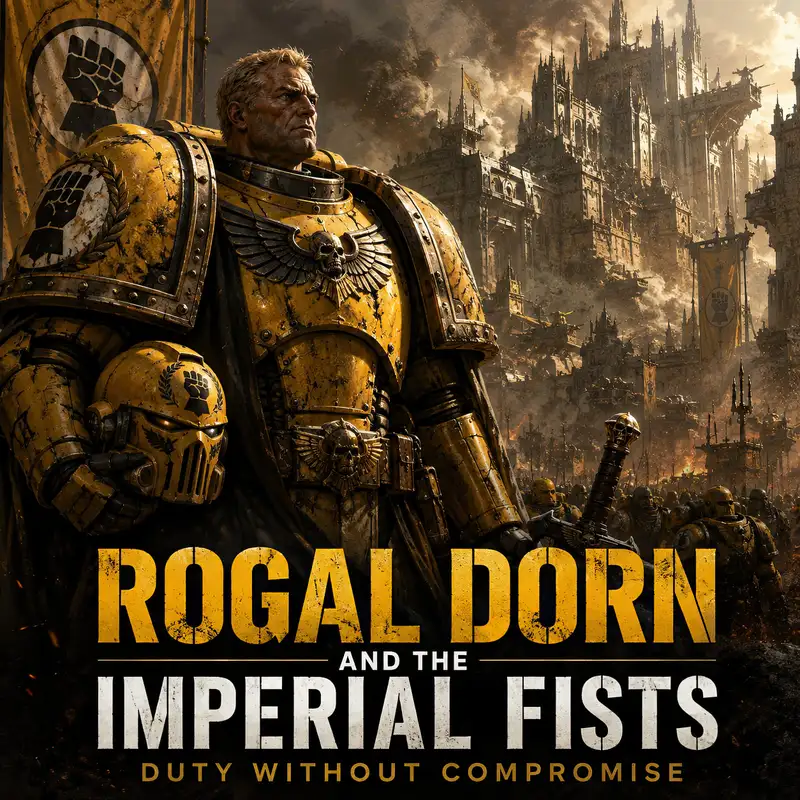
Rogal Dorn and the Imperial Fists: Duty Without Compromise
The first great victory in Rogal Dorn’s defence of Terra was the destruction of the Imperial Palace. Towers raised to celebrate human unity were cut down to clear fields of fire. Gardens became killing grounds. Galleries were sealed behind armour and stone. The work offended artists, courtiers, and anyone who had assumed that the Emperor’s home was too sacred to be altered. Dorn understood the objection. He simply did not permit it to matter. The Palace had to survive an attack by Horus, and beauty could not be allowed to weaken a wall. That decision contains almost everything admirable and dangerous about Rogal Dorn. He did not lack feeling. He believed feeling must yield to duty.
Dorn is often reduced to the simplest possible description. He built fortresses. His sons wore yellow armour. They stood on walls and refused to move. All of that is true, but it is not enough. A fortress is not merely a collection of guns and battlements. It is an argument about what must be protected, what may be sacrificed, and how long the defender is willing to suffer. Rogal Dorn’s answer was usually uncompromising. The objective came first. Personal desire came later, if circumstances had been kind enough to leave any time for it. They rarely were.
Like his brothers, Dorn was scattered across the galaxy before the Great Crusade began. He came to Inwit, a cold and difficult world at the heart of a small interstellar realm. The surviving accounts describe a society shaped by scarcity, discipline, and the practical demands of survival. Dorn was raised by its ruling house and eventually became the master of the Inwit cluster. He did not emerge from isolation as a wandering warrior or local warlord. He arrived before the Emperor already commanding worlds, fleets, and the vast star fortress called Phalanx. He had learned that authority was not a performance. It was the obligation to make systems function when failure meant death.
The bond between Dorn and his adopted family appears to have mattered to him throughout his life. Later tradition remembers that he kept the cloak of the man he called grandfather, sleeping with it even after he had become a primarch and commander of a Legion. The detail is valuable because Dorn’s reputation can make him seem almost mechanical. He was not. He formed attachments, admired courage, and grieved deeply. He simply distrusted emotion when it tried to overrule responsibility. The warmth was there. It was protected behind so much armour that even his brothers sometimes concluded there was nothing inside.
When the Emperor found him, Dorn accepted the larger purpose of the Great Crusade and transferred his loyalty without theatrical resistance. He offered Phalanx to his father and took command of the Seventh Legion, the Imperial Fists. Their name would become inseparable from siegecraft, but their military character was broader than static defence. They excelled in void warfare, boarding actions, disciplined assaults, and the seizure of positions that other forces considered impossible. They did not build walls because they were afraid to advance. They built walls because every conquest had to be secured, every supply route protected, and every victory made durable.
That distinction explains the Legion’s temperament. The Imperial Fists believed that war was won through preparation, endurance, and control. A strongpoint forced the enemy to attack where the defender wanted. A fleet formation could become a moving fortress. A boarding force could create a defended foothold inside an enemy ship, then expand it deck by deck. Even an individual warrior could become a wall by refusing to surrender a corridor, gate, or breach. Their doctrine was not simply to withstand punishment. It was to turn suffering into time, and time into victory.
Dorn demanded honesty from his sons because a false report could destroy an army. He demanded obedience because a perfect plan became useless if every commander treated orders as optional suggestions. He also demanded mastery of pain. Among the Imperial Fists, controlled suffering became a means of examination and discipline. In later ages, the Chapter’s pain glove would make this practice notorious. The idea was not that pain made a warrior noble. Pain stripped away distraction. It forced the warrior to confront weakness without excuse. As with much in Dorn’s legacy, a useful discipline always stood uncomfortably close to self-punishment.
The Imperial Fists were not without pride. They simply expressed it in a manner that sounded suspiciously like a construction report. Dorn knew the value of his Legion and did not pretend otherwise. He could be blunt when tact might have preserved a relationship, and several of his brothers discovered that his honesty was easier to admire at a distance. Konrad Curze responded to Dorn’s condemnation with violence. Alpharius treated his certainty as a weakness to be exploited. Perturabo turned professional rivalry into a hatred that would consume worlds.
The conflict with Perturabo was especially bitter because the two primarchs understood many of the same military truths. Both could calculate the strength of a wall, the endurance of a garrison, and the cost of an assault. Both commanded Legions capable of reducing cities to rubble. Yet they interpreted duty differently. Perturabo believed his sacrifices were ignored and his genius used without gratitude. Dorn accepted burden as proof that he had been trusted. Perturabo wanted recognition for doing the impossible. Dorn regarded the impossible as the assignment. This did not make Dorn kinder, and it did not make Perturabo’s resentment harmless. It made reconciliation increasingly unlikely.
During the Great Crusade, Dorn’s campaigns showed that his method could be aggressive, adaptable, and brutally effective. He consolidated conquests instead of leaving unstable victories behind. When ordered into regions beyond reliable Imperial navigation and communication, he continued because the mission required it. The Imperial Fists could prosecute a campaign in isolation, establish order, and leave behind fortifications intended to outlast the fleet that built them. Their victories were not always glamorous. A properly secured supply network seldom inspires poetry. It does, however, keep the ammunition arriving, which soldiers often find more useful.
After the triumph at Ullanor, the Emperor recalled Dorn and the Imperial Fists to Terra. Horus became Warmaster and carried the Great Crusade onward. Dorn became the Emperor’s Praetorian. The appointment was both an honour and a warning. The Emperor was withdrawing from direct command to pursue a secret work beneath the Palace. Someone had to protect Terra, the Solar System, and the political heart of the Imperium. Dorn received the task because the Emperor believed he would do it without distraction, ambition, or complaint. For Dorn, there could have been no greater expression of trust.
Then Nathaniel Garro brought word that Horus had betrayed the Emperor.
Dorn’s first response was not serene acceptance. The accusation violated everything he believed about loyalty, command, and the structure of the Imperium. Horus was not merely another general. He was the Warmaster, chosen by the Emperor and loved by his brothers. To claim that he had turned traitor sounded like an attack upon reason itself. Dorn’s anger nearly destroyed the messenger before evidence forced him to confront the truth. That moment is important. Dorn was not immune to denial. His strength was that, once the facts became undeniable, he did not preserve his pride by rejecting them. He accepted the unbearable and began to work.
The Heresy transformed every virtue of the Imperial Fists into a burden. Their loyalty fixed them at the centre of the war. Their reputation for reliability ensured that impossible tasks found their way to them. Fleets were dispatched, garrisons reinforced, and the Solar defences rebuilt while the scale of the rebellion remained uncertain. At Phall, an Imperial Fists fleet under Alexis Polux fought the Iron Warriors and came close to turning an ambush into a remarkable victory. Then orders arrived recalling the force. Polux obeyed, abandoning the opportunity. Duty preserved the wider strategy, but it also surrendered a triumph that was within reach.
Sigismund presented Dorn with a more personal crisis. The First Captain was among the finest warriors of the age and one of the most devoted sons of the Legion. Yet he accepted a warning rooted in faith and chose not to take command of a distant expedition, believing he had to remain near Terra for the war to come. Dorn saw the decision as a failure of obedience disguised as destiny. He rejected Sigismund with a severity that wounded them both. Sigismund’s judgement would prove useful, but Dorn could not excuse the way he had reached it. A commander who rewards disobedience whenever events later justify it will soon have an army composed entirely of prophets.
The Alpha Legion tested a different part of Dorn’s method. Alpharius did not simply attack the walls of the Solar System. He attacked information, identity, and confidence. Infiltrators turned preparation against the defenders. Plans that appeared secure concealed weaknesses placed there by the enemy. Dorn responded by recognizing that defence could not remain passive. He used Phalanx and the movement of the Solar fleet to counter the assault at Pluto, then faced Alpharius directly. Their duel ended with Dorn killing his brother. The victory protected Terra, but it offered no satisfaction. Dorn had proven that his wall could strike back. He had also crossed another line from which the Imperium could never return.
As Horus approached, Dorn remade the Solar System into layers of resistance. Orbital platforms, minefields, fleet stations, planetary bastions, and the Palace itself formed a defence in depth. None of these measures was expected to be invincible. Their purpose was to delay, divide, and bleed the attackers. This is the practical heart of fortification. A wall need not survive forever. It must survive long enough for something else to happen. Reinforcements may arrive. An enemy may exhaust its reserves. A counterattack may become possible. On Terra, the hoped-for event was the arrival of loyal armies before Horus could reach the Emperor.
The Solar War proved that preparation could be defeated. Treachery, sorcery, and overwhelming force opened paths through defences that had consumed years of labour. Horus reached Terra, and the siege began. Dorn now commanded a battlefield extending from the void above the system to corridors beneath the Palace. He had to judge where to commit the Legions, where to spend mortal armies, and which positions could no longer be saved. Every decision had a human cost. The arithmetic of defence is merciless. A gate held for another hour might require ten thousand soldiers who would never leave it.
Dorn’s relationships with Sanguinius and Jaghatai Khan reveal that he was capable of cooperation, but not ease. Sanguinius understood morale in ways Dorn did not naturally express. The Khan valued movement and independent action, often pressing for attacks beyond the walls. Dorn feared wasting irreplaceable strength, yet he also knew that a purely static defence would allow the enemy to dictate everything. Their arguments were not a contest between wisdom and foolishness. They were disagreements over which risk was least fatal. Dorn’s role required him to hear them, decide, and remain when his brothers rode out to seek victories of their own.
At Saturnine, Dorn demonstrated that the master of defence was also a hunter. He identified a weakness in the Palace works and understood that the traitors might discover it. Rather than merely repair the flaw, he turned it into a trap. Elite Sons of Horus entered beneath the walls expecting a decisive breakthrough and found loyalist kill teams waiting in the dark. Above ground, Dorn confronted Fulgrim and drove the attack back. The victory was real, but it was not free. Loyal warriors died in numbers the defenders could not easily replace. In a siege, even success arrives carrying an invoice.
The Palace continued to shrink. Outer lines fell. Titans walked through ruins that had once represented the future of humanity. Daemons entered the battle as the barrier maintained by the Emperor weakened. Perturabo’s ordered war of calculation gave way to the nightmare logic of Chaos. Dorn had prepared to fight armies. He now faced a conflict in which distance, time, and causality themselves became unreliable. The defender who trusted measurement was forced to command a battlefield that no longer agreed to remain measurable.
Horus understood that Dorn’s strongest fortress was not the Palace. It was the structure inside his mind. When the final confrontation began aboard the Vengeful Spirit, Dorn was separated from the Emperor and trapped within a wasteland shaped to erode certainty. There, rage offered a terrible form of simplicity. If duty had brought only betrayal, failure, and endless slaughter, then perhaps nothing remained except violence. Dorn endured, but endurance did not mean he passed through untouched. The man who had made himself a wall discovered that a wall can crack inward where no one else can see.
By the time Dorn reached the centre of Horus’s flagship, Sanguinius was dead and the Emperor had been mortally wounded. Dorn had spent years preparing Terra so that this outcome would not occur. He had obeyed, calculated, sacrificed, and held. He had done almost everything that could reasonably have been demanded of him. It was not enough to preserve the Imperium that had existed before the war. His duty now was to carry his broken father from the bridge and help place him upon the Golden Throne. The Praetorian saved the Emperor’s life in the narrowest possible sense. He could not save the Emperor’s dream.
That failure, though not truly his alone, changed Dorn. In the first years after the siege, grief hardened into vengeance. He called for the traitors to be scoured from the galaxy and drove the surviving loyalists after them. The Great Crusade had once expanded a vision of human unity. The Scouring pursued enemies through the ashes of that vision. Dorn continued because duty still demanded action, but the purpose had darkened. He was no longer fortifying a future. He was hunting those who had destroyed it.
Roboute Guilliman’s Codex Astartes created another confrontation. Guilliman wanted the surviving Legions divided into smaller Chapters so that no single commander could again wield the power Horus had possessed. Dorn initially resisted. To him, the Imperial Fists were not merely an administrative formation. They were an instrument forged for a continuing war, and breaking that instrument while traitors still lived appeared dangerously premature. The dispute threatened violence between loyalists. Dorn eventually accepted division, not because he suddenly admired the proposal, but because preserving unity required him to yield. Compromise, in this case, became the higher duty.
The Second Founding revealed the different qualities that had always existed within the Seventh Legion. The Imperial Fists continued the central tradition of discipline and defence. Sigismund led the Black Templars into an eternal crusade, turning loyalty into relentless attack and faith. Alexis Polux became the father of the Crimson Fists, carrying forward resilience, practical command, and the ability to adapt under pressure. These Chapters were not departures from Dorn so much as fragments of him. The fortress, the sword, and the commander had been separated because the Imperium no longer trusted them in one hand.
The Iron Cage remains the darkest symbol of Dorn’s postwar grief. Accounts differ in detail and emphasis, but the essential shape is clear. Perturabo prepared a killing ground, and Dorn led the Imperial Fists into it. The battle became a contest of endurance so severe that victory and punishment were difficult to distinguish. Dorn may have intended to break Perturabo, to temper his Legion for the new order, or to scour away the guilt of surviving Terra. Those motives are not mutually exclusive. The Imperial Fists escaped destruction, but the episode showed what happened when their refusal to yield ceased to serve a clear objective. Endurance had become an end in itself.
Dorn eventually disappeared during a battle against the forces of Chaos. The surviving tradition holds that only one of his hands was recovered. His ultimate fate remains uncertain, as primarchs have a discouraging habit of making death less final than ordinary people would prefer. For the Imperial Fists, uncertainty changed little. They preserved his relics, his teachings, and the conviction that Terra must never stand undefended. Phalanx endured. Successor Chapters carried his bloodline across the Imperium. The wall outlived the architect.
In the forty-first and forty-second millennia, the sons of Dorn are still known for stubborn defence, siegecraft, disciplined marksmanship, and an alarming willingness to solve personal doubt through controlled agony. Their greatest strength remains reliability. When a position absolutely must be held, the Imperial Fists are among the forces the Imperium sends. Their danger remains the same as their primarch’s. Duty can become pride. Endurance can become refusal to reconsider. A warrior may continue paying a price long after the objective no longer justifies it, simply because stopping feels too much like weakness.
Rogal Dorn was not the primarch without emotion. He was the primarch who believed emotion did not release him from obligation. That belief allowed him to tear down the Emperor’s Palace in order to save it. It allowed him to accept Horus’s betrayal, command the defence of Terra, endure losses that would have broken a less disciplined mind, and carry the Emperor from the ruins of the final battle. It also made forgiveness difficult, grief private, and self-punishment dangerously respectable.
Duty without compromise saved humanity, but it could not preserve everything humanity had hoped to become. The walls fell. The Emperor was broken. The Legion was divided. Dorn himself vanished into war. Yet Horus did not reach an undefended throne, and Chaos did not win the quick victory it required. Rogal Dorn did not build a fortress that could never fall. He built one that fell late enough for humanity to endure.