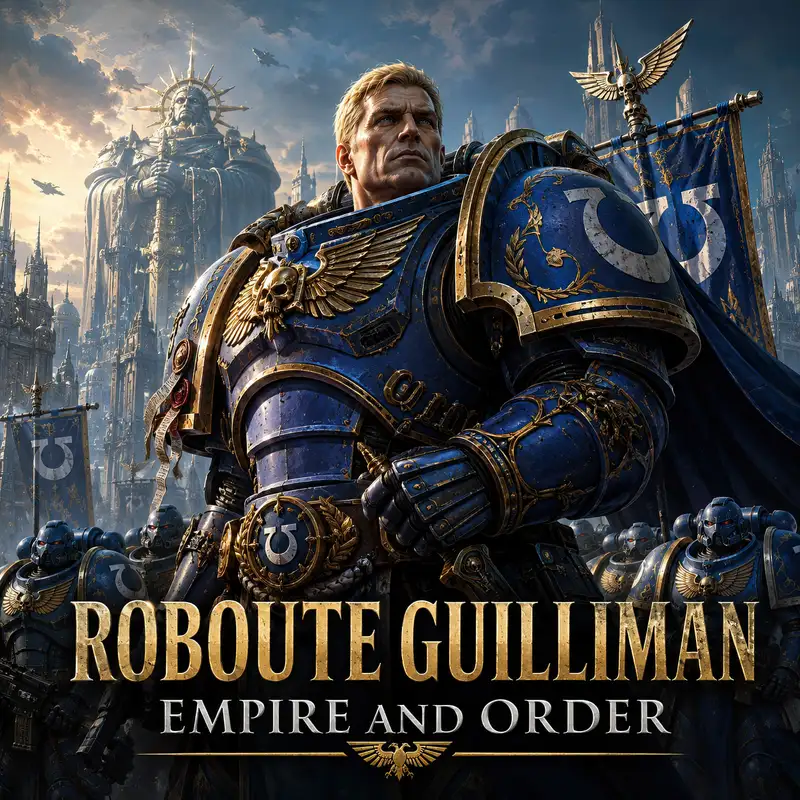
Roboute Guilliman and the Ultramarines: Empire and Order
Roboute Guilliman awoke to find that humanity had preserved almost everything except the future he had tried to build. His statues stood in cathedrals. His words had become sacred law. His father was worshipped as a god, and the empire they had created in the name of reason had spent ten thousand years sinking into ritual, fear, and decay. For Guilliman, this tragedy of faith and history was also a management problem of offensive proportions. The galaxy was split, its armies exhausted, and its institutions skilled at explaining why nothing could be repaired. The greatest organiser of his age had returned. Unfortunately, his age was dead.
That contradiction defines Guilliman and the Ultramarines. They are disciplined, balanced, and devoted to doctrine, but their real obsession is more ambitious. They believe victory should create something that endures. A conquered world must be governed. An army must be supplied. A commander must prepare others to command after him. War is an instrument used to preserve, extend, or rebuild civilisation. Guilliman did not merely want to win battles for the Emperor. He wanted to turn conquest into durable human order.
He learned that instinct on Macragge, the world that raised him. Like the other primarchs, Guilliman had been scattered across the galaxy as an infant. His capsule came to rest on a planet of fortified cities, martial tradition, and old political institutions. He was adopted by Konor Guilliman, one of Macragge’s ruling consuls, and raised within a culture that treated public duty as an obligation. Konor gave him a model of legitimate government, in which authority served the commonwealth rather than the powerful.
Guilliman matured with the unnatural speed of his kind. He mastered war, law, logistics, and diplomacy while most children were still learning which end of a ceremonial sword faced the enemy. Yet Macragge did not surrender itself to him peacefully. While Guilliman campaigned against the tribes of Illyrium, political enemies moved against Konor. Aristocrats who resented reform and feared the loss of privilege drove the rebellion. Guilliman returned to a capital in crisis and a foster father mortally wounded by treachery.
The lesson was permanent. Corruption could kill a state from within as surely as an invading army could destroy it from without. Guilliman crushed the rebellion, assumed control of Macragge, and reorganised the world. His reforms improved military readiness, trade, infrastructure, and government. He did not abolish hierarchy. He made hierarchy answerable to purpose. Macragge became prosperous, disciplined, and capable of projecting power. By the time the Emperor reached it, Guilliman had already begun creating an interstellar realm.
The Emperor did not find a lost son waiting among ruins. He found a ruler at work. Macragge was productive, defended, and connected to neighbouring systems. Guilliman had done on a small scale what the Great Crusade claimed it would do for humanity. When the Emperor gave him command of the Thirteenth Legion, Guilliman received the means to expand his political philosophy across the stars.
Under Guilliman, the Legion that became the Ultramarines developed an unusually complete method of conquest. They fought with immense force, but they also planned for the morning after. Conquered worlds were not simply left beneath smoking banners and contradictory orders. The Ultramarines established defences, restored production, organised trade, trained local authorities, and connected each system to the wider Imperium. This was not kindness in the modern sense. Compliance remained compliance, and refusal could end beneath orbital fire. Yet Guilliman understood that terror alone produces brittle empires. A self-sustaining world is less likely to require reconquest every generation.
The result was a self-reinforcing machine. Stable worlds supplied ships, arms, recruits, and taxes. Those resources supported expansion, and new conquests joined the network. The Ultramarines became one of the Great Crusade’s greatest forces because every part of war supported every other part. Logistics served strategy. Strategy served politics. Politics created new logistics. It was empire as a military system, and military power as an instrument of empire.
That logic shaped them in battle. Other Legions built identities around particular forms of warfare. The Imperial Fists mastered fortification. The White Scars excelled at speed and manoeuvre. The World Eaters solved tactical problems by applying violence until the problem became difficult to identify. The Ultramarines cultivated breadth. Their officers studied changing conditions, tested assumptions, and sought practical answers. They valued combined arms, dependable reserves, and plans that could change when reality declined to cooperate.
Describing them as rigid therefore misses the original point. Guilliman did not teach his sons to obey a page when the page was wrong. Doctrine was stored experience. It prevented commanders from rediscovering reconnaissance by losing an entire company. Yet doctrine was supposed to support judgement, not replace it. The best Ultramarine understood why the rules existed and when circumstances demanded another answer.
Their discipline carried a moral claim. Guilliman wanted officers who could govern, negotiate, build, and preserve. A Space Marine might spend his life in war, but the purpose of that war was supposed to be human survival. The worlds of Ultramar were not merely recruiting grounds. They were the foundation of the Legion’s identity. The blue-armoured warriors saw themselves as guardians of a functioning commonwealth, not wandering conquerors with a particularly impressive filing system.
The flaw in this vision was the flaw in almost every enlightened empire. Guilliman believed competent rule could justify enormous authority. He trusted systems because he was exceptionally good at designing them, and hierarchy because he expected it to be filled by people trained for duty. He could recognise corruption, but not always how intimidating his own certainty could be. To a mind built for interstellar law and logistics, disagreement could look very much like a calculation awaiting correction.
The destruction of Monarchia revealed the danger. The city had been raised by the Word Bearers as a monument to worship of the Emperor. The Emperor rejected that worship and ordered the Ultramarines to destroy the city, evacuate its population, and witness Lorgar’s public humiliation. Guilliman obeyed. He appears to have taken no pleasure in the task, but restraint did not make it merciful. To Lorgar, the Ultramarines became the cold, favoured sons used to demonstrate his failure.
Monarchia was not the sole cause of the Word Bearers’ fall, and Lorgar remained responsible for the path he chose. The humiliation drove the wound deeper. Guilliman had carried out an order intended to restore ideological discipline. Instead, it helped push a brother toward secret rebellion. Order imposed without understanding had produced obedience on the surface and hatred beneath it. Guilliman made a city an example. Lorgar spent years preparing an answer.
That answer came at Calth. The Ultramarines gathered there expecting a joint campaign with the Word Bearers. Horus had already turned against the Emperor, and the deployment placed one of the largest loyal Legions far from Terra. The Word Bearers attacked without warning, turning orbital traffic, planetary infrastructure, and trust between Legions into weapons. Ships collided. Defence networks failed. The system’s star was poisoned by the catastrophe. The assault aimed to cripple the organised heart of Ultramar.
For a force built upon coordination, the opening was devastating. Communications broke down. Command structures were isolated. Units received deceptive information. Guilliman himself was cast into the void during fighting around his flagship and survived circumstances that would have converted a normal human into a brief lesson in vacuum exposure. When he returned to the battle, he was furious. The controlled statesman had discovered that betrayal could reach beneath doctrine and touch something more primitive.
Calth also showed why the Ultramarines were difficult to destroy. Their structure did not depend entirely upon one voice. Officers assessed what they could see, formed local plans, and rebuilt connections. Once the betrayal was understood, the Legion adapted with frightening speed. Guilliman turned shock into organised resistance. The Word Bearers inflicted terrible damage, but failed to annihilate their enemy.
The wider attack on Ultramar was worse. Lorgar and Angron carried the Shadow Crusade across Guilliman’s realm while warp storms isolated the eastern galaxy. Worlds that embodied his belief in stable order were burned, corrupted, or drowned in violence. The Ruinstorm cut Ultramar away from Terra, and reliable news became almost impossible. Guilliman faced the question every ruler fears. What should be preserved when the centre may already be gone?
His answer was Imperium Secundus. Guilliman did not declare himself Emperor. Sanguinius became its symbolic ruler, Lion El’Jonson its protector, and Guilliman its architect and administrator. To its defenders, this was galactic contingency planning. If Terra had fallen, someone had to preserve loyal humanity, military power, and lawful continuity. To its critics, it looked like empire building at the precise moment the true Imperium needed every available ship.
Both readings have force. Guilliman acted with incomplete information inside a storm created to divide the loyalists. He also defaulted to the solution he trusted most. Faced with uncertainty, he built a government. Faced with possible civilisational collapse, he drafted continuity arrangements. Somewhere in the ruins, one imagines an Administratum clerk feeling a sudden and inexplicable sense of pride.
Imperium Secundus was not proof that Guilliman secretly wanted Horus’s throne. His refusal to crown himself argues against that simple accusation. It showed his belief that civilisation could be reconstructed through legitimate offices and shared purpose. It also exposed his temptation to treat political legitimacy as something competent people could assemble if they arranged the correct pieces. Humanity has never been entirely cooperative with diagrams.
When evidence showed that Terra still stood, the secondary empire was abandoned. Guilliman, Sanguinius, and the Lion turned their strength toward the Throneworld. Sanguinius reached Terra. Guilliman’s relief force fought through barriers and traitor resistance, but did not arrive before the final confrontation between Horus and the Emperor. The Emperor survived only as the ruined being placed upon the Golden Throne, and Sanguinius died aboard the Vengeful Spirit. Guilliman arrived with power to alter the war, but after its defining moment.
That absence became part of his burden. He had not abandoned the Imperium, and the routes to Terra had been closed by powers beyond ordinary strategy. Even so, Guilliman was the primarch who planned contingencies and prided himself on placing force where it was needed. At humanity’s greatest crisis, he was not there soon enough. No explanation could make that feel like victory.
After the Heresy, his instinct for order became essential. The Imperium was shattered. Traitor forces fled toward the Eye of Terror. Loyal armies wanted vengeance while worlds, shipyards, supply lines, and governments collapsed. Guilliman pushed for consolidation as well as pursuit. Terra had to be secured. Mars and Luna had to be reclaimed. The machinery of survival had to function before a long war of retribution. It was not the most emotionally satisfying strategy. That was one reason it was necessary.
His most consequential reform divided the surviving Space Marine Legions into smaller Chapters. Horus had shown what could happen when a primarch controlled a vast, self-contained military empire. Guilliman intended to make another rebellion harder by dispersing power. The old Legions would become independent forces of roughly a thousand battle-brothers. Each could wage war, but none could easily threaten the entire Imperium alone.
The proposal was bitterly controversial. Some loyalists saw the breaking of their Legions as punishment after they had bled to defend humanity. Rogal Dorn resisted before accepting the new order. Guilliman’s own Ultramarines were divided into many successor Chapters, surrendering the concentrated strength that had made them so powerful. Guilliman was not merely limiting his brothers. He applied the same principle to his own sons and reduced the direct military power of Ultramar.
The Codex Astartes supported this structure. It addressed organisation, command, training, strategy, and an immense range of battlefield problems. Over time it became the defining text of the Ultramarines and many successors. Yet the later image of the Codex as a sacred book of mandatory answers obscures its intention. Guilliman had written a framework to preserve knowledge and encourage sound decisions. Ten thousand years of reverence gradually turned guidance into ritual. The Imperium could transform even adaptability into a tradition that must never be adapted.
The Ultramarines endured without their father. Guilliman was mortally wounded by the daemon primarch Fulgrim at Thessala and placed in stasis on Macragge. His body hung at the edge of death while pilgrims crossed the stars to gaze upon him. The rational statesman became a holy relic. His sons continued to defend Ultramar, and their successor Chapters spread his gene-line and doctrine across the Imperium. In one sense, his system worked. The institutions survived the man, while preserving his form and slowly losing his argument.
Ultramar remained exceptional by Imperial standards. Its worlds were generally better administered, defended, and connected than much of the Imperium. Citizens still lived beneath authoritarian rule and military obligation. Ultramar was not a liberal paradise misplaced in the forty-first millennium. It was a disciplined imperial realm. Yet in a civilisation where populations could disappear into bureaucratic error, competent sanitation and a governor who knew local food requirements approached the miraculous.
When Guilliman returned, the contrast was unbearable. Belisarius Cawl and Aeldari allies restored him during the crisis surrounding the fall of Cadia and the opening of the Great Rift. He awoke amid invasion, defeated the threat, and confronted ten thousand years of decline. The Imperial Truth had given way to the Imperial Creed. Technology was preserved through rites that often outlived understanding. Government had become an alliance of ancient institutions protecting privilege while humanity burned.
Guilliman could not simply reject this Imperium. He could not abolish its faith and rebuild its government while enemy fleets crossed the Great Rift. He travelled to Terra, stood before the Emperor, and emerged as Lord Commander and Imperial Regent. Whatever passed between them did not restore the certainty of the Great Crusade. Guilliman came away with authority, purpose, and a colder understanding of the being on the Golden Throne.
He launched the Indomitus Crusade because movement was survival. Fleets were gathered, armies reorganised, and Primaris Space Marines sent to reinforce exhausted Chapters. Guilliman again applied the method of Ultramar on a galactic scale. Establish routes. Relieve strongpoints. Restore command. Deliver reinforcements. Reconnect isolated regions. The crusade could not heal the Imperium, but it might keep the patient alive while the physicians argued over incense.
He also ordered the restoration of the Five Hundred Worlds. Tetrarchs and successor Chapters received responsibility for regions of Ultramar, extending defence beyond the Ultramarines alone. Ultramar was a strategic reserve, a model of governance, and proof that dysfunction was not inevitable. It was also unmistakably Guilliman’s empire, which ensured accusations of empire building would never entirely disappear.
The Plague Wars made the symbolism explicit. Mortarion and the Death Guard attacked Ultramar with disease, corruption, and despair. Nurgle teaches victims to accept decay as natural and resistance as pointless. Guilliman opposed it with armies, medicine, supply, quarantine, fortification, and refusal. Order fought entropy. Neither side was subtle, but subtlety is a limited resource when daemon armies are poisoning the landscape.
Guilliman’s greatest strength is his ability to make power coherent. He can take fleets, laws, worlds, officers, factories, and competing institutions and force them toward one strategic purpose. The Ultramarines embody that gift. They are dangerous not because they are always the finest at every form of war, but because they understand how different forms of war fit together. They build commanders and turn isolated victories into campaigns. They do not merely take ground. They try to make the ground part of a lasting order.
Their danger is the shadow of that strength. Systems can become more important than the people they were meant to protect. Doctrine can become identity. Competence can become a claim to permanent authority. A ruler who can save society may decide society must accept his design. Guilliman is more self-aware than many of his brothers, but he is still a primarch, created to conquer for an Emperor who offered unity at the point of a gun.
He is therefore neither the dull administrator of easy jokes nor the flawless statesman his admirers imagine. He is a warlord who wants war to end in civilisation, and a rationalist commanding an empire that worships him against his wishes. He wrote rules to prevent another Horus, then returned to find those rules treated as holy. He built institutions so humanity would not depend on heroes, then became the hero upon whom the Imperium increasingly depends.
The Ultramarines are his answer to chaos in both senses of the word. Against confusion, they bring plans. Against fragmentation, hierarchy. Against destruction, the stubborn belief that something should be built afterward. Ultramar matters not because it is large, but because it demonstrates Guilliman’s central conviction. Survival must be organised, or it will be temporary.
Roboute Guilliman now stands beneath monuments raised by generations that misunderstood him, commanding an Imperium he would never have chosen to create. He cannot restore the age he lost or abandon what replaced it. So he does what he has always done. He counts the ships, appoints commanders, repairs the roads between stars, and tries to make tomorrow possible. His tragedy is not that the Imperium forgot his laws. It remembered the laws, sanctified them, and forgot why he wrote them.