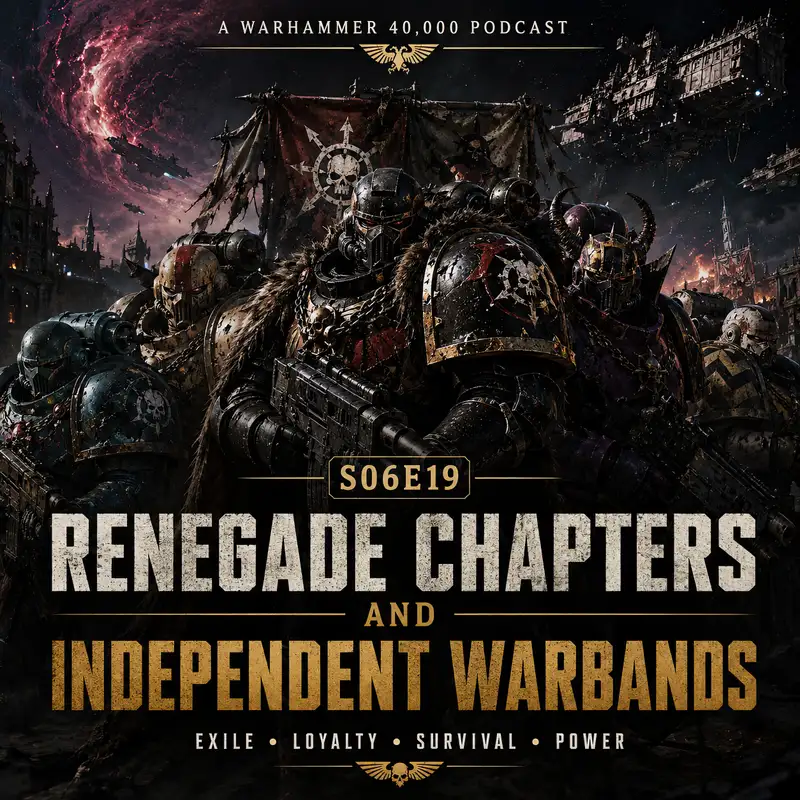
Renegade Chapters and Independent Warbands
The distress call says the attackers are Space Marines. That should narrow the possibilities. It does not. The warriors cutting through the airlocks wear power armour in half-erased colours, old Chapter badges scored away. They move with the discipline of the Adeptus Astartes, use Imperial battle-cant, and know exactly where a warship keeps its fuel, ammunition, and gene-stock. Some curse the Emperor. Some still pray to him. All of them kill his servants. To the frightened crew behind the next sealed hatch, the distinction is academic. To the warriors outside, it may be the only distinction that matters. A renegade Space Marine is not always a worshipper of Chaos, and a condemned Chapter does not always believe it has betrayed humanity. That is what makes renegades so dangerous. They do not merely reject an order. They carry an alternative version of loyalty, armed with bolters, warships, and centuries of grievance.
In Imperial language, renegade, traitor, and Chaos Space Marine are often used as though they mean the same thing. They do not. A traitor has turned against the Imperium. A servant of Chaos has submitted to the powers of the warp. A renegade is defined first by separation. He has rejected Imperial authority, been cast out by it, or placed himself beyond its reach. Those paths often meet, but begin apart. Some renegades become champions of the Dark Gods. Some use Chaos as a weapon while insisting they remain its masters, which is a confidence the warp has always found charming. Others despise Chaos and still raid Imperial worlds because exile has left them no other source of supplies. The Imperium rarely has patience for these distinctions. Once a Chapter is declared beyond forgiveness, its motives become a matter for interrogators and historians. Its position on the targeting display remains pleasantly uncomplicated.
The possibility of rebellion is built into the way a Space Marine Chapter is made. A Chapter is not simply an infantry regiment with unusually large soldiers. It is a mobile warrior society. It possesses strike cruisers, armouries, recruitment rights, gene-seed vaults, serfs, priests, surgeons, navigators, and traditions older than many sectors. Its battle-brothers honour the Emperor, but their daily loyalty is directed toward their Chapter, its gene-line, and the commanders who embody its history. Many Chapters rule home worlds or maintain domains where Imperial officials appear rarely and ask permission before entering. This autonomy is necessary. Space Marines must act across impossible distances. Yet when a Chapter Master decides Terra is wrong, he does not disobey alone. He may take a fleet, a fortress, and generations of conditioned warriors with him. The Imperium created the Chapters to prevent another rebellion of Legion scale. It did not eliminate rebellion. It divided the risk into smaller, heavily armed pieces.
Most Chapters do not wake one morning and announce that they have become villains. The break usually begins with a dispute that can still be described as duty. An Inquisitor demands access to a forbidden vault. The Adeptus Mechanicus claims a relic the Chapter considers sacred. Administrators redirect forces away from a war the Chapter believes must be won. A tithe is withheld because local resources are needed for defence. A commander refuses an order because obeying would abandon allies, disgrace the Chapter, or expose a secret. At first, both sides expect the other to retreat. Then honour becomes involved, which has ended more negotiations than artillery. Censure leads to resistance. Resistance requires secrecy. Secrecy makes every accusation look plausible. Soon the Chapter is firing on Imperial forces while insisting that it defends the Emperor’s true purpose against corrupt servants. That argument may contain some truth. The trouble is that a bolter round remains indifferent to constitutional nuance.
The most famous warning is the Badab War. Before he became Huron Blackheart, Lugft Huron was Chapter Master of the Astral Claws and master of a strategic domain near the Maelstrom. The region was a wound in realspace, a haven for raiders and warp-born threats. Huron believed the Maelstrom could be contained, perhaps even pacified, if he possessed enough ships, warriors, and authority. That ambition was not absurd. The Imperium routinely demands impossible victories and then acts suspicious when a commander asks for the means to achieve one. Huron strengthened local defences, drew worlds and military forces into his control, and treated distant Imperial institutions as obstacles to the mission. Gradually, defence of the region became ownership of the region. The Astral Claws ceased to behave like one Chapter among many and began to behave like the central power of a private empire. Huron still spoke the language of service. His actions increasingly spoke the language of sovereignty.
The crisis deepened through withheld obligations, disputed authority, concealed military strength, and the conviction that compromise would be humiliation. Other Space Marine Chapters became involved through old oaths, local alliances, and incomplete information. The Mantis Warriors, Lamenters, and Executioners did not enter for identical reasons, nor did every warrior understand how far Huron had travelled from lawful defiance. That matters. The Badab War was not a clean contest between obvious heroes and warriors already chanting to daemons. It was a civil war in which heraldry, reputation, and sworn brotherhood could pull a Chapter onto the wrong side before the full shape of the rebellion was visible. Imperial forces answered with Chapters of their own. Space Marines hunted Space Marines across void lanes and fortress worlds, each side claiming duty, each loss making retreat harder. Once blood had been shed between Chapters, admitting error required more courage than continuing the war. Courage was available. Humility was in shorter supply.
As fighting escalated, Huron’s grievance became inseparable from his desire to rule. The Astral Claws used increasingly ruthless methods and fought not merely to preserve a defensive mandate, but to defeat the Imperium’s right to judge them. Badab became the centre of a secessionist stronghold. The war ground down fleets, worlds, and Chapters until the rebels were broken. Yet the aftermath showed that the Imperium could distinguish degrees of guilt when it wished. Some Chapters that had sided with Huron were punished, stripped of privileges, and sent on long penitent crusades rather than exterminated. Their rebellion was grave, but not identical to surrender to Chaos. Huron received no such path. Badly wounded during the fall of his domain, he escaped into the Maelstrom with the surviving Astral Claws. The Chapter that had claimed to defend Imperial space vanished into the region it once guarded. It returned under a new name.
The Red Corsairs were not simply the Astral Claws with darker paint. Exile changed the purpose of the force. Huron built a confederation of renegades, pirates, mutants, human soldiers, and Space Marines drawn from many bloodlines. A warrior who abandoned his Chapter could enter the Maelstrom with nothing but armour, skill, and hatred, then earn a place through violence. Old heraldry became a memory or a trophy. Shared gene-seed mattered less than loyalty to the Tyrant of Badab, and that loyalty was maintained through success, fear, reward, and Huron’s ability to survive challenges from ambitious subordinates. The Red Corsairs raid because plunder sustains them, but plunder is also their political language. A commander who brings back ships, weapons, slaves, and recruits proves he deserves followers. One who fails becomes vulnerable. The structure is flexible, energetic, and permanently close to murder. It is a system well suited to people who considered Imperial administration excessively restrictive.
That transformation explains the difference between a renegade Chapter and an independent warband. A Chapter claims continuity. It has a name, a lineage, a fortress or fleet, rituals of succession, and a story explaining why rebellion preserves its honour. A warband is usually more personal. It may form around a captain, sorcerer, champion, or exile whose authority depends on victory. Its warriors can come from one shattered Chapter, several Chapters, a Traitor Legion, or no stable brotherhood at all. Some warbands are disciplined formations. Others are raiding companies held together by shared need and mutual suspicion. They split after defeat, merge under a stronger lord, or change names when a new commander kills the old one. The Imperium prefers fixed categories and permanent records. Warbands change insignia, commanders, and loyalties faster than those records can be approved. Somewhere, an Administratum clerk is still waiting for the proper form. The warband has already stolen his planet’s orbital guns.
Survival outside the Imperium turns ideology into logistics. Power armour requires maintenance. Bolters require ammunition. Ships require fuel, replacement parts, trained crews, and navigators willing or compelled to enter hostile warp routes. Apothecaries need viable gene-seed and suitable recruits. Techmarines need access to machinery that was never designed to be repaired forever with battlefield scrap and optimism. A renegade force can begin with full magazines and proud declarations of independence. Decades later, it may be boarding merchant vessels for reactor components, bargaining with hereteks, or stripping armour from the dead. Even a warband that rejects Chaos must trade with criminals, attack isolated worlds, or cooperate with powers it once hunted. Every compromise can be described as temporary. Temporary arrangements have a habit of lasting until no one remembers the original boundary. Independence is expensive, and the galaxy does not offer a respectable supply contract to forces marked for annihilation.
Recruitment creates an even harder problem. Loyal Chapters draw aspirants through protected traditions and maintain gene-seed under strict ritual. Renegades lose the laboratories, oversight, and stable populations that make those systems possible. Some continue recruiting from hidden domains. Others seize candidates during raids, bargain for gene-stock, or absorb Space Marines who deserted from elsewhere. The result is not automatically a horde of undisciplined killers. Many retain exacting standards because survival depends on quality. Yet brotherhood changes when the force contains warriors who once belonged to enemies, rivals, or unknown gene-lines. Loyalty shifts from ancestry toward immediate bonds, shared crimes, and the authority of the warlord. A recruit may not be asked whether he believes the old cause. He may be asked whether he can hold an airlock and whether anyone is likely to avenge his previous captain. It is a brutal form of meritocracy, with a severe performance review.
Chaos enters this world less like a sudden conversion and more like an environment. Renegades travel where Imperial fleets cannot easily pursue them. Those refuges are often warp storms, daemon-haunted systems, lawless border regions, and territories ruled by powers that demand a price. A warband may accept a sorcerer because he can guide a ship through the immaterium. It may carry a cursed weapon because the weapon kills loyalists. It may invoke a god’s name to secure allies while claiming the words mean nothing. Some newly turned renegades still fight with doctrines learned in loyal service and care little for divine favour. They want freedom, vengeance, wealth, or command. Chaos does not require them to begin as theologians. It can work through appetite, repetition, and necessity. The warrior who swears he will use corruption without being used by it is not unique. He is simply early in a very well documented process.
The Soul Drinkers reveal how uncertain that process can become. Their break with the Imperium began in a conflict over a relic and widened through betrayal, manipulation, and violence. Declared excommunicate, they believed that Imperial institutions had abandoned the Emperor’s true purpose. Under Sarpedon, they continued to fight enemies of humanity while opposing the authorities that hunted them. They were also marked by mutation and touched by the schemes of Chaos. Some wanted to prove they remained loyal in a deeper sense. Others were tempted to embrace the power already within their ranks. Their story refuses the comforting idea that intention decides purity. A warrior can sincerely hate Chaos and still carry its mark. He can defend human lives while killing Imperial servants. He can speak of freedom while following a leader whose choices have placed the brotherhood beyond appeal. The Soul Drinkers were not easily reduced to loyalists, traitors, or victims. The Imperium reduced them anyway.
From Terra’s perspective, such ambiguity is intolerable for practical reasons. The Adeptus Astartes are symbols as much as weapons. Their authority depends on the belief that their loyalty is absolute. A renegade who still venerates the Emperor presents a more dangerous example than a horned killer screaming praise to Khorne. The obvious monster confirms Imperial teaching. The disciplined exile asks whether obedience to the Imperium and loyalty to humanity are always the same thing. That question cannot be allowed to circulate among soldiers, governors, or other Chapters. Records are sealed. Names are erased. Survivors are hunted. The response may look excessive, but the Imperium understands the political threat clearly. A rebellious Chapter possesses not only military power, but a story that might justify rebellion. Empires can endure pirates. They become nervous around precedents.
The Ashen Claws offer one of the oldest examples of Astartes independence. Their origins lie in the Raven Guard before and during the Horus Heresy, among warriors sent far from their Primarch and embittered by exile. When the Imperium split, they did not simply join Horus. They fought and raided according to their own interests, rejecting both loyal submission and the Warmaster’s claim. Over millennia they survived in the Ghoul Stars as a piratical power with their own domain. They were predatory and no friends of the Imperium, yet they despised the servants of Chaos. Their survival proves that renegade does not always mean immediate worship of the Dark Gods. It also proves how difficult independence becomes. Isolation weakened them. Gene-seed and resources became strategic concerns. Survival required raids, bargains, and occasional cooperation with forces whose values they did not share. They escaped Imperial command, but not dependence.
For individual Space Marines, the road into a warband can be smaller than a Chapter-wide rebellion. A squad may be abandoned after a failed campaign. A captain may refuse a suicidal order and be condemned before he can explain. Survivors may return from the warp to find their Chapter destroyed, their oaths disputed, or centuries passed. Others are plainly guilty. They murder superiors, steal ships, or flee judgment. Once separated from their parent Chapter, even an innocent warrior faces a brutal choice. Surrender may mean execution or interrogation without end. Flight requires supplies. Seeking other exiles provides protection, but associates him with their crimes. The first raid may keep the ship alive. The second is easier. By the tenth, the warrior has a new badge and an explanation for why the victims deserved it. A warband grows from many such explanations, none quite matching, all pointing their bolters in the same direction.
Command within these forces is rarely secure. Loyal Chapters possess offices, councils, traditions, and recognised succession, even when their politics are fierce. A warband leader must prove himself repeatedly. He may rely on personal champions, sorcerers, veteran captains, mortal fleet officers, or hostage relationships between rival factions. Victory brings recruits. Defeat invites challenge. This can make warbands tactically daring because their leaders need visible success, but strategically unstable because patience looks too much like weakness. Huron Blackheart’s achievement is not merely that he survived Badab. It is that he turned defeat into authority and maintained a force large enough to attract warriors from across the galaxy. The Red Corsairs offer something the old Traitor Legions often cannot: a future not entirely chained to a ten-thousand-year-old grievance. For a newly exiled Space Marine, that can be powerfully seductive. He does not have to inherit another Legion’s ancient failure. He can participate in a newer one.
The Imperium’s treatment of renegades is both military policy and damage control. Some rebels can be offered surrender, penance, or a narrow road back if their conduct leaves room for it. Badab showed that Chapters misled by obligation or honour might be punished without being erased. Yet mercy is never guaranteed, and the deciding authorities may be distant, divided, or dead before evidence arrives. Other Chapters are condemned because their methods are too dangerous even when their stated purpose remains loyal. A force that uses forbidden relics, conceals mutation, attacks Imperial agents, or builds an independent domain may insist necessity justifies every act. The Imperium has heard this argument before. So has Chaos. Imperial suspicion can create the rebellion it fears, while leniency can let genuine corruption spread. No reliable test separates principled defiance from the opening stage of damnation. In the forty-first millennium, uncertainty is usually resolved with fleet assets.
Renegade Chapters and independent warbands matter because they expose the machinery beneath Space Marine loyalty. The Adeptus Astartes are conditioned, indoctrinated, and bound by ritual, but they are not mindless. They interpret orders. They remember insults. They form loyalties to commanders and brothers. They can decide that the Imperium has betrayed its own ideals, or that those ideals were always restraints placed upon superior beings. The first conclusion can lead to tragedy. The second leads quickly to conquest. Between them lies a field of pride, necessity, fear, and self-deception. Chaos waits at its edge, but it does not create every grievance. Often it merely offers the grievance a weapon, a harbour, and an audience.
So what is a renegade Space Marine? Not simply a loyalist with the wrong paint, and not always a Chaos worshipper awaiting his first set of horns. He is a warrior whose chain of loyalty has broken and been tied to something else: a Chapter Master, a private kingdom, a warlord, a cause, a grudge, or the brothers beside him. A renegade Chapter can preserve discipline, faith, and even a desire to protect humanity. An independent warband can reject the Dark Gods and still become predatory because predation is how it survives. The longer exile lasts, the harder it becomes to separate principle from habit and necessity from appetite. The old badge may be scraped from the shoulder plate, but its outline remains in the metal. That faint shape is the truth of the renegade. He can leave the Imperium behind. He cannot leave behind what the Imperium made him.