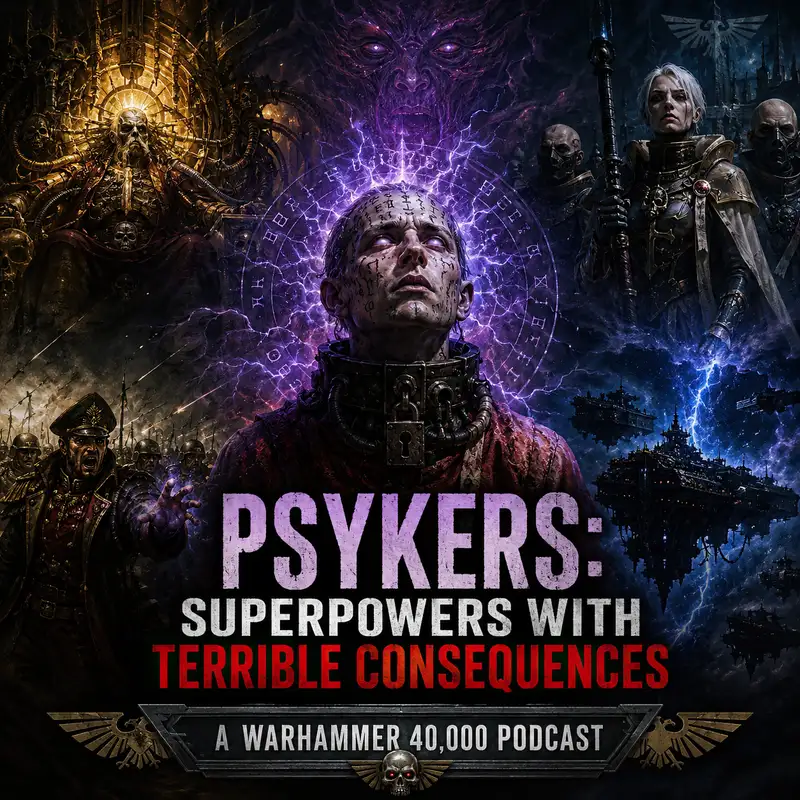
Psykers: Superpowers With Terrible Consequences
The first sign may be a voice that no one else can hear. Then comes the dream that predicts an accident, the cup that moves without being touched, or the burst of heat that leaves a room scorched and a frightened family staring at one of its own. In another universe, this might be the beginning of a heroic origin story. In the Imperium of Man, it is more likely to end with chains, interrogation, and a place aboard a black-hulled prison ship.
A person with such abilities is called a psyker. The word covers an enormous range. One psyker may catch fragments of another person’s thoughts. Another may glimpse possible futures. A stronger mind might hurl a soldier across a chamber, ignite flesh with a gesture, crush metal, conceal itself behind illusion, or tear open a path through the barriers of reality. The most powerful can influence battles, populations, and worlds.
That sounds like a superpower. It is not entirely wrong. It is simply missing the part where the power source is a dimension shaped by emotion, haunted by predators, and fundamentally hostile to ordinary sanity.
Psykers do not create their abilities from nothing. Their minds and souls have an unusual connection to the Warp, also called the Immaterium. The Warp is the parallel realm through which ships cross interstellar distances and astropathic messages travel. It is also the realm of Chaos, daemons, and the accumulated psychic pressure of sentient life. Anger, fear, hope, obsession, despair, and desire leave impressions there. Given enough intensity, those impressions become currents, storms, and things with intentions of their own.
An ordinary human soul is present in the Warp, but faint. A psyker burns more brightly. That brightness allows the psyker to draw energy from the Immaterium and impose a thought upon reality. It also makes the psyker easier to notice.
This is the central problem. Every act of psychic power is a connection. The psyker reaches into the Warp, but something in the Warp may reach back.
The danger is not limited to deliberate use. A trained psyker learns concentration, ritual, mental barriers, and methods of control. An untrained psyker may open that connection while asleep, terrified, enraged, or confused. The first manifestation can therefore be both accidental and catastrophic. A nightmare may become a shared hallucination. Panic may turn into telekinetic violence. A desperate wish for help may be answered by an intelligence that considers human suffering a form of conversation.
The Imperium has many names for what follows. Psychic backlash. Warp breach. Possession. Mutation. Madness. The terminology depends on which department writes the report and which department later burns it. The result is much the same. People die, reality behaves badly, and the surviving officials become extremely interested in finding someone to blame.
A psyker who loses control might injure only themselves. Blood vessels rupture. Memories collapse. The body burns from within. A mind can be overwhelmed by impressions it was never built to contain. At greater extremes, the psyker becomes a doorway through which daemonic influence enters the material universe. What begins as one frightened person can end as a cult, an outbreak of possession, or a breach requiring military containment.
The Imperium’s fear of witches is therefore not based entirely on superstition. That is important, because the Imperium has enough superstition already and needs no assistance producing more. Rogue psykers really can destroy communities. They really can attract daemons. They really can be manipulated by powers they do not understand.
The cruelty begins when a genuine danger becomes an excuse to treat every psyker as guilty before anything has happened.
Most Imperial citizens are taught to fear mutation and psychic ability. A child showing signs may be hidden by a family, surrendered to local authorities, murdered by a mob, or denounced by a neighbour hoping to prove unusual enthusiasm for civic duty. Planetary governments are expected to identify psykers and hold them for collection. The requirement forms part of the great system of tithes through which the Imperium extracts soldiers, food, material, and human lives from its worlds.
Eventually, the Black Ships arrive.
These vessels belong to the machinery of the Adeptus Astra Telepathica and the League of Black Ships. Their task is to gather psykers from across the Imperium and carry them toward Terra. The ships are designed as prisons, with wards, restraints, guarded compartments, and personnel trained to deal with captives who may be able to read minds or kill without touching anyone.
The Sisters of Silence are especially suited to this duty. They are blanks, sometimes called nulls or pariahs. Where a psyker has a powerful presence in the Warp, a blank has an absence that others can feel. Their proximity disrupts psychic power and produces instinctive discomfort in ordinary people. Psykers may experience their presence as agony, suffocation, or a terrifying emptiness.
This makes the Sisters effective hunters and gaolers. It does not make them popular company. The Imperium values many of its servants most highly when those servants make everyone nearby feel physically ill.
For the captives, the voyage can be a slow movement through fear, silence, and uncertainty. Some know the stories. Others have only rumours. They have been taken from families, worlds, and lives that may never have been kind to them, but were at least familiar. They are now cargo in a system that has already decided their ability belongs to the state.
Those who reach the centres of Imperial assessment are tested and classified. The process seeks to answer several questions. How powerful is this psyker? How stable? How trainable? How useful? How likely are they to become a threat? Imperial institutions do not always agree on the answers, and their methods are rarely gentle.
Some are too unstable to survive. Some are destroyed because they cannot be controlled. Some are consumed in the hidden necessities that sustain the Imperium’s psychic infrastructure. Some are selected for the great choirs associated with the Astronomican, the beacon that helps Navigators guide vessels through the Warp. Others are taken to support the Golden Throne and the Emperor’s continued existence. The exact workings of these systems are secret, sacred, and poorly understood even by many who serve them. What is not secret is the cost. The Imperium feeds human psychic lives into the mechanisms at its heart because without those mechanisms, its million worlds would become even more isolated than they already are.
Those judged useful and capable of control may become sanctioned psykers. Sanctioning means that Imperial authorities have tested, trained, marked, and authorised them. It does not mean they are safe. It means the danger has been inspected, documented, and assigned a supervisor.
Sanctioned psykers serve in many roles. Some join the Astra Militarum as battle psykers, using foretelling, mental force, or destructive power in support of ordinary soldiers. They may shield a unit from hostile witchcraft, sense an approaching threat, or turn an enemy position into a demonstration of why officers prefer artillery that does not whisper back.
Some become Astropaths. These psykers form the Imperium’s long-distance communication network. They send messages through the Warp as dreams, emotions, symbols, and compressed impressions, which other Astropaths receive and interpret. The process is neither clean nor perfectly reliable. An astropathic message may arrive distorted, delayed, fragmented, or wrapped in imagery that requires trained interpretation.
Yet without Astropaths, Imperial government would collapse into disconnected islands. Fleets could not coordinate across vast distances. Warnings of invasion might travel no faster than a ship. Orders from Terra could arrive generations too late. The Imperium distrusts psykers, hunts psykers, imprisons psykers, and depends upon psykers every hour of its existence.
Astropaths undergo the ritual of soul-binding, a direct psychic communion with the Emperor intended to strengthen them against the Warp. The experience is overwhelming and often leaves them physically blind, though their psychic senses may remain formidable. Even after this protection, their work is dangerous. They spend their lives touching the same realm from which the Imperium tells ordinary citizens to recoil.
Space Marine psykers follow another path. They become Librarians, warriors whose psychic talents are shaped by a Chapter’s traditions and discipline. A Librarian is still a Space Marine, with all the training, physical transformation, and indoctrination that implies. Added to that is the ability to wield the Warp in battle, perceive hidden threats, ward allies, or strike an enemy with force no conventional weapon can quite reproduce.
Their armour may bear wards. Their weapons may be designed to channel psychic force. Their minds are trained with extraordinary severity. Even so, other Space Marines may regard them with unease. The history of the Imperium provides excellent reasons. The Thousand Sons Legion was renowned for psychic mastery before its fall to Chaos, and the debate over Legion psykers helped produce the Council of Nikaea during the Great Crusade. The Emperor forbade the Legions from maintaining their Librarius departments, though the crisis of the Horus Heresy soon proved that daemonic enemies did not feel obliged to respect the ruling.
The lesson was not that psychic power could simply be abandoned. It was that the Imperium could neither trust it nor survive without it.
The Emperor himself is the greatest expression of this contradiction. Imperial doctrine presents him as divine, yet his power is profoundly psychic. He guides the Astronomican. He endures upon the Golden Throne. His servants invoke his protection against the Warp while sacrificing psykers to sustain the systems connected to him. The Imperium condemns the witch and worships a being whose psychic might holds the species together.
There are, of course, distinctions the Imperium insists are very important. A loyal sanctioned psyker is not a witch. A Space Marine Librarian is not a witch. An Inquisitor using psychic abilities in the Emperor’s service is certainly not a witch, especially if the Inquisitor is present to hear the suggestion. The word usually means an unauthorised psyker, an enemy psyker, or anyone whose continued existence has become administratively inconvenient.
The distinction is not entirely dishonest. Training, restraint, loyalty, and supervision matter. A disciplined mind is less vulnerable than an untrained one. Protective wards matter. Knowledge matters. The company of specialists capable of killing the psyker at the first sign of possession matters quite a lot.
Still, no procedure removes the fundamental risk. Psychic power is dangerous because the Warp is dangerous. A psyker may be loyal, brave, and careful, yet remain exposed to forces that can exploit exhaustion, grief, pride, curiosity, or desperation. Chaos rarely needs to begin with an offer of obvious evil. It can begin with a solution.
A voice promises enough power to save a squad. A vision suggests a way to prevent a disaster. A presence offers knowledge that a trained psyker has been forbidden to seek. The first concession may seem noble. The second becomes easier. By the time the price is clear, the psyker may believe that only greater power can repair the damage caused by using power in the first place.
This is where psykers and sorcerers overlap, but they are not identical. A psyker possesses an innate psychic connection. Sorcery is the deliberate use of rituals, symbols, pacts, forbidden knowledge, and Warp manipulation. A psyker may become a sorcerer. A sorcerer may combine natural ability with learned practices. Chaos encourages both, because rules are more useful when they can be broken in several different ways.
The Thousand Sons embody the attraction and ruin of psychic mastery. Their culture valued knowledge, control, and the refinement of mental power. Their tragedy was not that they were ignorant of the Warp. It was that knowledge encouraged confidence, confidence encouraged risk, and the powers watching them were more patient than they understood. Their descendants remain among the galaxy’s most formidable sorcerers, but the price of their path is written across a Legion of dust-filled armour and servants bound to Tzeentch, the Chaos God of change, ambition, and manipulation.
Humanity is not alone in producing psykers. The Aeldari are a profoundly psychic species. Their Farseers read possible futures, their Warlocks turn psychic discipline toward war, and much of their technology responds to psychic craftsmanship. They understand the Warp with a sophistication humans rarely match.
That does not make them safe. The Aeldari know better than most what uncontrolled desire and psychic excess can create. The birth of Slaanesh destroyed their ancient civilisation and condemned their species to live beneath the attention of a god that hungers for their souls. Their methods therefore emphasise discipline, runes, carefully limited paths, and layers of protection. An Aeldari Farseer may appear serene because panic would be unhelpful, not because the future has become simple.
Orks approach the matter differently, as they approach most matters. Weirdboyz channel the psychic energy generated by masses of Orks. In battle they may unleash green lightning, crush minds, or hurl entire mobs across space through uncontrolled psychic force. The more Orks gather, the greater the pressure can become.
This is uncomfortable for the Weirdboy and entertaining for nearby Orks, especially when the result happens to someone else. A Weirdboy is as likely to be treated as a dangerous piece of equipment as a respected mystic. The Orks have, in their way, achieved a clear understanding of psychic warfare. Point the unstable thing toward the enemy and accept that the definition of enemy may broaden unexpectedly.
The Tyranids present another form of psychic power. Their fleets are bound together by the Hive Mind through a vast synaptic network. Powerful organisms act as nodes, directing lesser creatures and exerting mental force. Ahead of a hive fleet spreads the Shadow in the Warp, a crushing psychic phenomenon that disrupts communication, fills minds with terror, and makes psychic action more difficult.
For an Imperial world, the Shadow can be the first sign that help is no longer coming. Astropathic voices fade. Nightmares spread. The defenders feel an intelligence approaching that is not hateful in any human sense. It is simply hungry, coordinated, and immense.
Even among species, then, psychic power reflects culture and biology. Humans fear and regulate it. Aeldari discipline it through traditions born from catastrophe. Orks vent it through collective violence. Tyranids embody it as part of a distributed alien mind. Chaos cultivates it as temptation, weapon, religion, and trap.
The power itself can look miraculous. A psyker can see what is hidden, speak across stars, or kill with thought alone. Yet the consequences are never merely personal. The existence of psykers shapes law, warfare, travel, religion, and government. It explains why the Imperium maintains the Black Ships. It explains why the Sisters of Silence are feared and needed. It explains why commanders keep sanctioned psykers close while soldiers make protective signs behind their backs.
It also explains part of the Imperium’s moral architecture. The state does not simply protect people from dangerous psykers. It claims ownership of psychic humanity. A person born with the wrong kind of soul becomes a resource to be collected, tested, trained, consumed, or destroyed. The system is brutal because the danger is real, and the danger is useful because it allows the system to justify brutality.
There is no easy humane solution waiting just beyond Imperial ignorance. Leaving untrained psykers alone can lead to catastrophe. Killing every psyker would cripple interstellar communication, navigation, military defence, and the institutions sustaining Terra. Training them requires knowledge that can itself be dangerous. Trusting them completely is reckless. Treating them all as monsters creates fear, secrecy, and desperate people who become easier prey for Chaos.
The Imperium chooses control, sacrifice, and terror because those are the tools it understands best. Sometimes those tools prevent disaster. Sometimes they manufacture it.
Since the opening of the Great Rift, the barrier between reality and the Warp has been wounded across the galaxy. Psychic manifestations have grown more widespread, old certainties have weakened, and humanity appears to be moving toward a more psychic future. Imperial authorities call it an age of witches with the same mixture of dread and bureaucratic determination they apply to most approaching disasters.
That future might represent evolution. It might represent extinction. In Warhammer forty thousand, the distinction is often decided by who survives the first manifestation.
So psykers do possess superpowers. They can move objects with thought, read minds, foresee danger, command flame, and send messages through a realm beyond space. Yet every one of those abilities carries a second meaning. Telepathy invites intrusion. Foresight can become obsession. Power can become pride. Communication exposes the mind to the dark between worlds. A weapon drawn from the Warp is also a signal sent into it.
A psyker is not merely a person who can do the impossible. A psyker is a point where the impossible can enter.
That is why they are feared, chained, trained, worshipped, sacrificed, and sent to war. They are among the Imperium’s most valuable servants and among its most dangerous vulnerabilities. Without them, humanity’s empire would go blind and silent. Through them, the things in the darkness are always listening.