Propaganda, Censorship, Art, and Entertainment
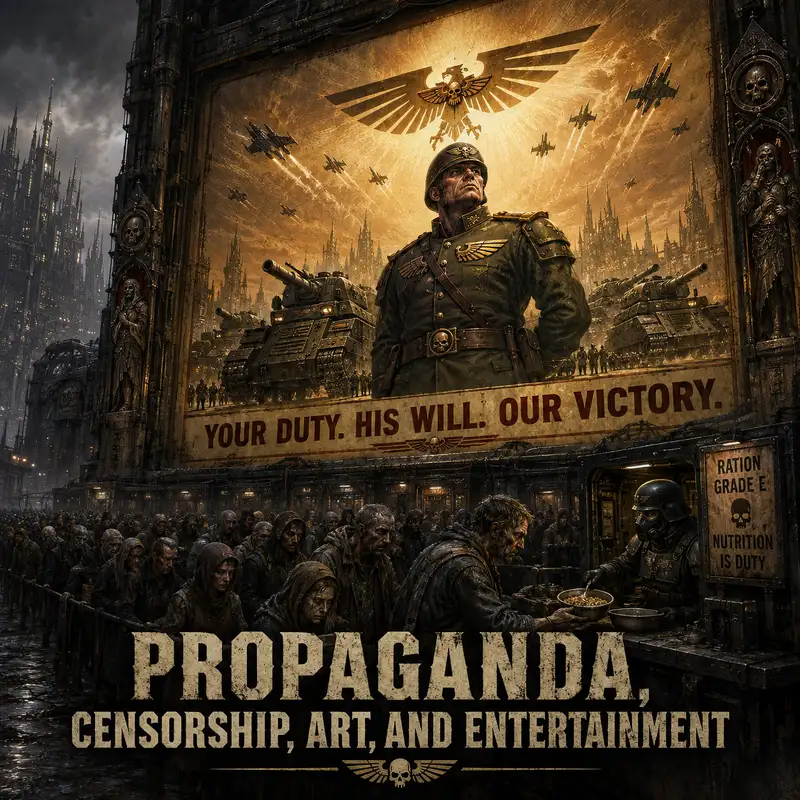
Above a ration line in a hive city, a mural shows an Imperial Guardsman standing beneath a golden sky. His uniform is clean. His jaw is firm. Behind him, tanks advance in perfect order while aircraft carve the sign of the aquila through the clouds. Beneath the image, a simple message promises that duty brings victory. Below it, several thousand exhausted workers wait for food made from ingredients they have learned not to ask about. Most have never seen an open sky. None of them believes that war looks like the mural. They still understand what it means.
That is what Imperial propaganda is designed to accomplish. It does not need to convince every citizen that the picture is literally true. It needs to provide the approved language through which truth may be discussed. Courage looks like the soldier. Loyalty looks like the aquila. Sacrifice looks clean, purposeful, and properly supervised. Defeat, confusion, fear, and administrative error are left outside the frame. This is not because the Imperium has forgotten those things. It has entire departments devoted to producing them.
The question is not whether Imperial culture contains propaganda. The question is whether anything remains outside it.
The Imperium of Man could not survive on force alone. Its armies are vast, its prisons are numerous, and its methods of execution have benefited from ten thousand years of institutional enthusiasm. Yet even the Imperium cannot place an enforcer behind every citizen. It must persuade people to work, obey, reproduce, endure, and die for a civilization most of them will never understand. Propaganda supplies the story that makes those demands appear necessary. Censorship removes competing stories. Art gives the approved story emotional power. Entertainment makes life inside it bearable.
There is no single Imperial ministry controlling every image, sermon, song, and performance across the galaxy. The Imperium is too large, too slow, and too divided for that. The Ecclesiarchy guards doctrine and public faith. The Administratum classifies records and decides which version of an event enters the official archive. The Inquisition suppresses knowledge judged dangerous to humanity. The Adeptus Mechanicus protects technical mysteries with the tenderness of a dragon sitting on a library. Planetary governors censor threats to their own rule. Noble houses, guilds, military commanders, and local priesthoods all shape what their people are allowed to know.
The result is not one perfectly coordinated propaganda system. It is a thousand overlapping systems, often contradicting one another while insisting upon absolute certainty. A saint revered on one world may be almost unknown on the next. A battle celebrated as a decisive victory in one sector may appear elsewhere as a regrettable strategic withdrawal, or may not officially have happened at all. An Imperial citizen does not receive a complete explanation of the galaxy. He receives the explanation required by his location, occupation, and social rank.
Across those differences, a few symbols remain astonishingly durable. The Emperor is humanity’s divine protector. The Imperium is surrounded by enemies. Obedience is survival. Doubt invites ruin. The mutant represents corruption, the heretic represents betrayal, and the alien represents an existence fundamentally opposed to mankind. These ideas appear in sermons, banners, statues, military oaths, school lessons, devotional cards, public executions, triumphal processions, and the architecture of the cities themselves. The message is repeated so often that it no longer feels like a message. It becomes the shape of ordinary reality.
Imperial architecture may be the most effective propaganda of all. A cathedral does not argue that the individual is small and the Emperor is vast. It demonstrates the point in stone. A courthouse lined with statues of blindfolded martyrs does not need to explain that justice requires suffering. A governor’s palace rising above the polluted clouds makes a political statement visible from several hundred levels below. Monumental scale turns hierarchy into landscape. Even a person who cannot read can understand a fortress, a shrine, or a row of traitors displayed above the gate.
The Imperium inherited this instinct from a far more hopeful age. During the Great Crusade, remembrancers accompanied expeditionary fleets to record humanity’s reunion beneath the Emperor. They were poets, historians, sculptors, writers, and imagists. Their task was not merely to document conquest. They were supposed to give it meaning. The Crusade presented itself as rational, progressive, and liberating. The remembrancers would preserve that achievement for the future.
They discovered that history was less cooperative. The fleets they joined contained brilliance, courage, arrogance, cruelty, and growing political tension. Compliance could mean genuine liberation from a monstrous regime. It could also mean the destruction of a human culture that refused to accept the Emperor’s authority. The remembrancers saw warriors treated as demigods by populations officially instructed that there were no gods. They recorded triumphs while sensing the contradictions beneath them. When the Horus Heresy began, some became witnesses to truths the later Imperium would transform into scripture, legend, or silence.
The fate of the remembrancers reveals the central problem of art in the Imperium. The state wants artists because artists can turn power into memory. It fears them because memory is difficult to control once given human form. A statistic can be revised. A report can be sealed. A painting of a terrified survivor may remain persuasive long after the official casualty figure has been corrected to a more encouraging number. Art can serve authority, but it can also preserve the detail authority hoped everyone would forget.
Censorship is often imagined as a bonfire, and the Imperium certainly has bonfires. More commonly, control is quieter. A name is removed from a memorial. A verse disappears from a hymn. A pict is cropped so the retreating troops are no longer visible. A witness signs a statement he cannot read. A library remains open, but the catalogue sends every troublesome request to a room whose key was lost three governors ago. These methods are less dramatic than execution and often more effective. A forbidden book creates curiosity. A book that no one can prove ever existed creates only doubt.
Patronage also shapes what artists dare to create. Noble families commission portraits that turn inheritance into destiny. Governors sponsor triumphal works that place themselves near saints and military heroes, usually at a respectful distance but within excellent lighting. The Ecclesiarchy rewards artists who make doctrine emotionally clear. The Mechanicus preserves ancient designs while treating innovation as a theological negotiation conducted under armed supervision. An artist can gain wealth, protection, and influence by serving power. She can also discover that the patron who requested fearless honesty was using the phrase decoratively.
After the Heresy, the Imperium did not abandon art. It covered itself in it. Cathedrals, reliquaries, icons, illuminated manuscripts, devotional murals, death masks, victory arches, regimental standards, and colossal statues became part of the machinery of rule. The dominant style was not restrained. Restraint had enjoyed its opportunity and was found insufficiently intimidating. Imperial art became monumental, sacred, crowded with symbols, and obsessed with martyrdom. Human bones were not hidden from view. They were framed, polished, named, and placed where they could improve morale.
Much of this work is propaganda, but that does not make it emotionally false to the people who create it. A sculptor carving the face of a saint may be fulfilling a political commission, practicing a sacred vocation, and mourning a dead child at the same time. A regiment’s banner may repeat an approved heroic narrative while carrying the names of actual soldiers who died beneath it. A pilgrim may weep before a relic whose history is uncertain because the grief that brought her there is real. The Imperium manipulates devotion, but it did not invent the human need for devotion.
Nor is all Imperial art produced for palaces and cathedrals. Ordinary people carve household icons from scrap, paint protective marks above doors, decorate tools, embroider unit badges, preserve local songs, and build small shrines to the dead. Gangs develop colours, symbols, tattoos, and legends. Workers create jokes about overseers. Soldiers rewrite marching songs with verses their commissars would not appreciate. Families pass down stories that exist nowhere in the official archive. These acts may appear insignificant beside a monument that dominates a hive’s skyline, which is one reason they occasionally survive.
Local culture persists because the Imperium usually demands loyalty rather than uniformity. A world must pay its tithe, worship the Emperor in an acceptable form, obey Imperial law, and avoid forbidden practices. Beyond that, customs may vary enormously. One planet may honour the Emperor as a sun lord. Another may imagine him as a warrior ancestor, a distant king, or a judge seated among the stars. The Ecclesiarchy often absorbs such traditions rather than destroying them, provided the theology can be adjusted without excessive paperwork or gunfire.
This flexibility gives Imperial life more cultural variety than its public monuments suggest. A feudal world may preserve heroic recitations and seasonal festivals. A hive world may produce cheap pict serials, devotional broadcasts, tavern music, gambling contests, and arena fights. A civilized world may support theatres, orchestras, galleries, sporting events, and fashionable literature. A shrine world may turn religious processions into spectacles involving choirs, costumes, relics, incense, and crowds large enough to create their own weather. A voidship may have mess-hall songs, card games, drinking customs, and ceremonies older than the vessel’s current captain.
Class determines which version of culture a person can enter. The wealthy may attend private concerts, masked balls, formal duels, hunting expeditions, or elaborate banquets beneath artificial skies. Their entertainments display wealth because wealth is most enjoyable when witnesses are present. In the lower hive, leisure is cheaper and less safe. Drinking dens, gambling halls, fighting pits, music houses, illicit picts, and gang celebrations offer temporary escape. On worlds such as Necromunda, bored nobles may descend into lethal hunting grounds in advanced armour and call it sport. The people being hunted tend to use a different term.
Military life produces its own entertainment because soldiers remain human even when the Departmento Munitorum would prefer a simpler supply category. Guardsmen gamble, drink, sing, complain, tell stories, write letters, collect souvenirs, and exaggerate their previous battles. They read sanctioned material when ordered and unsanctioned material when available. Official handbooks assure them that the enemy is cowardly, badly equipped, and certain to collapse before disciplined Imperial fire. The enemy frequently neglects to read the same handbook.
Such publications are funny from a safe distance, but their purpose is serious. A frightened soldier needs a usable picture of the enemy. The truth may be too complicated, too horrifying, or too damaging to morale. The primer reduces alien monstrosities and daemonic threats to simple instructions. Aim here. Recite this prayer. Trust your officers. Do not ask why the previous regiment vanished. The information may be inaccurate, but it creates action where complete knowledge might create paralysis.
Individuals can become propaganda in the same way. Commissar Ciaphas Cain is remembered publicly as an almost impossibly fearless hero. The private accounts associated with him present a more anxious, self-protective, and complicated man. The irony is that the heroic image is not entirely false. Cain repeatedly performs genuinely brave acts, often while trying very hard to avoid situations requiring bravery. Imperial propaganda removes the fear and uncertainty, leaving a cleaner figure who can be printed on posters. In doing so, it also removes the part that makes his courage recognizably human.
Censorship begins where the approved image becomes threatened, but Imperial censorship is not only the concealment of embarrassment. In this setting, some knowledge is genuinely dangerous. The symbols of Chaos may carry influence beyond their intellectual meaning. Forbidden texts can attract attention from powers that should not be encouraged. Knowledge of daemons, psychic phenomena, alien technology, or secret military operations may endanger entire populations. A society facing supernatural corruption has reasons to restrict information that would sound absurd in a safer universe.
That danger gives censors a powerful justification, and power rarely limits itself to the original emergency. The same machinery that destroys a corrupting grimoire can destroy an inconvenient history. The same official who suppresses the location of a xenos relic can suppress evidence of a governor’s crimes. Records disappear because they are hazardous, shameful, politically awkward, wrongly classified, or simply placed in the care of an office that no longer exists. Sometimes the Imperium lies. Sometimes it forgets. From the citizen’s point of view, the distinction is largely ceremonial.
The Inquisition represents the most feared form of information control, but it is not a single mind. Different inquisitors disagree about what humanity can safely know. Some believe ignorance is a shield. Others believe ignorance leaves mankind unable to recognize its enemies. One may quarantine a witness, another may recruit her, and a third may decide that the cleanest archive is an empty room. Their choices reflect a real dilemma. Every revealed secret can prepare someone for danger, and every revealed secret can spread the danger further.
The cost of secrecy is institutional amnesia. Worlds face threats encountered elsewhere centuries before, but the relevant records are sealed, lost, or written in a classification system no living clerk understands. Commanders repeat failed strategies because the earlier failure was removed from the official history. Citizens are told that the enemy is weak, then punished for collapsing when the enemy proves otherwise. The Imperium protects itself from dangerous knowledge by making useful knowledge dangerous to possess.
Entertainment helps close the gap between official reality and lived experience. It offers rest, but it also teaches people how to feel. A martyr play turns obedience into tragedy and tragedy into inspiration. A military pict drama makes sacrifice exciting. A public execution becomes a moral lesson with refreshments nearby. A feast day honors a saint, redistributes a little food, displays the governor’s generosity, and gathers the population where priests and security forces can observe it. In the Imperium, even a holiday may have several departments attached.
Yet entertainment cannot be reduced entirely to control. People laugh at jokes the authorities did not write. They cheer performers for reasons no censor predicted. They interpret approved stories through their own experience. A ballad about a victorious regiment may become a lament for the district from which that regiment never returned. A saint’s festival may preserve an older local custom beneath Imperial names. A tavern tale may turn an official hero into a fool, then turn the fool back into a hero because the storyteller likes him better that way.
This is why culture remains unpredictable even under extreme repression. Propaganda gives people symbols, but it cannot dictate every use of them. A worker may wear an aquila because she believes, because refusal is dangerous, because her mother gave it to her, or because the metal token can be traded for food. A soldier may repeat a slogan sincerely in battle and mock it in the barracks that night. Contradiction is not a failure of Imperial culture. It is how people survive inside it.
The Imperium is not alone in controlling narrative. The T’au Empire presents the Greater Good through disciplined diplomacy, advanced communications, and carefully managed public information. Its leaders understand that optimism can govern as effectively as terror, especially when unpleasant facts are edited before broadcast. The continued public presence of the dead Ethereal Aun’Va through artificial projection is an especially elegant solution to the political inconvenience of mortality. The Imperium would admire the principle, though probably object to the efficiency.
Revolutionary movements also create propaganda. Genestealer cults present themselves as liberators, workers, kin, and heralds of a coming ascension. Their imagery draws power from genuine injustice within Imperial society. They promise dignity to people treated as replaceable machinery. The promise is monstrous, but it succeeds because it speaks to wounds the official culture refuses to acknowledge. Propaganda is strongest when it attaches a lie to a truth everyone can already feel.
Chaos works in a more intimate fashion. Its art, music, symbols, and stories do not merely demand obedience. They offer revelation, sensation, belonging, vengeance, perfection, or freedom from limits. A censored song may be only a song, or it may be the first thread of a corruption that ends with a city screaming in one voice. The authorities are therefore correct that culture can become a weapon. They are less willing to admit that their own cruelty often places the weapon in waiting hands.
Propaganda, censorship, art, and entertainment are not separate parts of Imperial life. They are a continuous struggle over memory. Who is allowed to name the dead. Which defeats become victories. Which horrors become secrets. Which songs become hymns. Which stories are preserved, and which are burned so thoroughly that later generations can only guess at the shape of the missing page.
The Imperium paints the wall, the priest explains it, the censor removes the names, and the crowd is instructed when to cheer. Somewhere beneath the mural, a worker hums an old song in a language no official remembers. The mural tells him how humanity expects him to die. The song reminds him that he once belonged to the living.