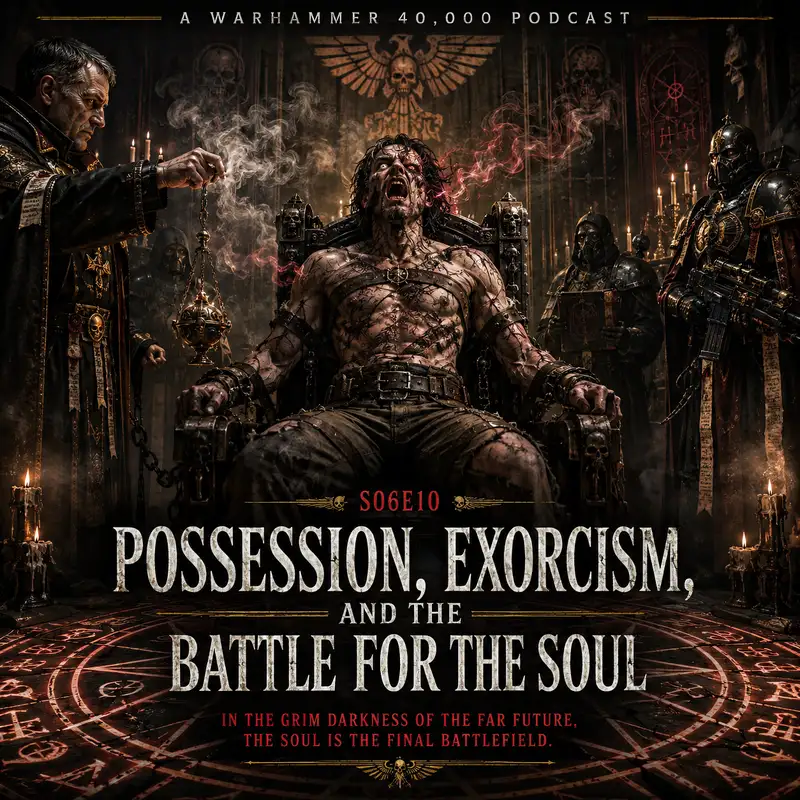
Possession, Exorcism, and the Battle for the Soul
The prisoner is strapped to a chair beneath a chapel that does not appear on any official plan. Iron manacles hold the wrists. Hexagrammic wards cover the floor. Incense hangs in the air, thick enough to taste, while an interrogator asks the prisoner to state his name. The first answer comes in a frightened human voice. The second comes from the same mouth, but it knows the interrogator’s childhood. Somewhere behind the words, the original man may still be listening. That is the decision everyone in the chamber must make. Is there a soul left to save, or only a daemon wearing its memories? In the Imperium, hesitation can doom a city. Certainty can murder an innocent. Exorcism begins in that narrow space between the two.
Daemonic possession in Warhammer forty thousand is not merely a monster climbing into a body and taking the controls. A mortal soul has a presence in the Warp, and a daemon is a creature of that realm. When the two are forced together, invited together, or entangled through sorcery, the result is a conflict between identities that do not obey ordinary physical boundaries. The body becomes an anchor in realspace. The soul becomes contested ground. The daemon gains senses, flesh, and access to a world that normally rejects it. The host may gain strength, speed, knowledge, or psychic power, though the usual price is that every gift makes it harder to determine where the mortal ends and the intruder begins.
There is no single road into possession. A cultist may invite a daemon through ritual, believing that service will be rewarded. A Chaos Space Marine may submit to a Master of Possession and treat the process as an ascent beyond mortal limits. A psyker may suffer a momentary breach while reaching into the Warp. A victim may be weakened by torture, despair, illness, or prolonged exposure to a corrupted place. An artefact can provide the connection. A bargain can provide consent, at least in the technical sense preferred by entities that regard desperation as a valid negotiating position. Sometimes the host opens the door. Sometimes someone else opens it for them. Sometimes the door was never visible until something began knocking from the inside.
Not every servant of Chaos is possessed. Corruption can alter belief without placing a separate entity inside the body. Mutation may arise from exposure to warp energy or the favour of a god. Psychic domination can compel a victim without merging two souls. A daemon prince is a mortal transformed into a creature of the Warp, not simply a person carrying a passenger. These distinctions matter because exorcism cannot cure an ideology, reverse every mutation, or force someone to regret a willing betrayal. The Imperium often ignores such precision and applies fire until the categories stop arguing. For anyone trying to save a host, however, identifying the actual condition is the beginning of the battle.
Psykers face the greatest danger because their minds already reach into the Warp. Their power makes them useful, but it also makes them bright. Training, sanctioning, wards, discipline, and ritual exist partly to prevent that brightness from becoming an invitation. When control fails, the consequences may extend far beyond one body. A possessed psyker can become a breach through which other entities push into reality. This is why Imperial authorities respond to suspected possession with such severity. They are not only afraid of what the victim may do. They are afraid that the victim has become a doorway, and that something on the other side has noticed the handle.
The first stages may be almost impossible to separate from ordinary fear, guilt, ambition, or anger. The victim hears a voice that offers advice. Then the advice begins arriving before the question. Dreams become instructions. Missing time appears. Familiar memories return with details that are subtly wrong. The daemon may threaten, but seduction is often more efficient. It can promise revenge without consequences, courage without fear, knowledge without study, or relief without healing. Most dangerously, it can use the host’s own memories and desires. A stranger can be rejected. A thought that sounds like your own is harder to fight. By the time the body changes, the more important invasion may already have happened.
Among the servants of Chaos, possession can be treated not as contamination but as communion. The Possessed of the Traitor Legions allow daemons to entwine with their souls and reshape their bodies. Armour splits around new limbs. Bone becomes weaponry. Flesh learns forms that biology never approved. Yet the transformation is not always a simple replacement of the warrior by the daemon. In some cases, both personalities remain active. They may struggle, bargain, cooperate, or fuse. Chaos calls this transcendence because calling it a prolonged internal siege would damage recruitment. The power is real. So is the loss of privacy, control, and any reliable distinction between desire and compulsion.
Argel Tal of the Word Bearers offers one of the clearest examples. During the Great Crusade, he and the warriors who became the Gal Vorbak entered the Eye of Terror and were changed by what they encountered there. Argel Tal became bonded with the warp entity Raum. Their relationship was not the crude puppetry of a dead body. It was a fusion of human soul and daemonic power, capable of shifting between the familiar form of a legionary and something far more terrible. Argel Tal could speak, choose, remember, and remain recognisably himself, but Raum was present within those choices. The result was powerful precisely because it preserved enough of the man to make the union useful.
That is the seductive argument for possession. If the host still thinks, still remembers comrades, and still acts with purpose, then perhaps nothing essential has been lost. Argel Tal could regard Raum as a companion rather than a jailer. He could believe that he had seen the truth of the universe and accepted it honestly. Yet companionship with a daemon is never an equal arrangement. The daemon does not need the host to remain whole. It needs the host to remain functional. The mortal may interpret cooperation as control while every successful transformation makes separation less imaginable. Possession does not always erase the self in one dramatic moment. Sometimes it teaches the self to defend the cage.
The World Eaters known as the Eightbound make the struggle even more literal. Each carries not one daemon of Khorne, but eight, locked in ceaseless conflict within a single transhuman body. Their strength comes from surviving an ordeal that should destroy identity altogether. Some become Exalted Eightbound, described as warriors whose spirit has emerged triumphant and become one with the daemons sharing their form. That sounds like victory until the terms are examined. The daemons have not been expelled. The old warrior has not returned untouched. What has triumphed is a new unity built from violence, will, and eight hostile presences. In Chaos, winning the battle for your soul may mean becoming the battlefield permanently.
A daemonhost is a different obscenity. Instead of welcoming possession as a blessing, a sorcerer or radical Inquisitor binds a daemon into a mortal vessel and attempts to imprison it there. The host’s flesh may be carved with runes, wrapped in chains, pierced with seals, and enclosed by wards designed to limit the entity’s power. The purpose is control. A bound daemon can be questioned, transported, threatened, or turned against another enemy. The mortal body becomes both cell and ammunition. Whether the original soul survives depends on the ritual, the daemon, and the intentions of the binder. Those intentions are rarely improved by the fact that someone was willing to build a prison out of another person.
The daemonhost Cherubael shows why such arrangements corrupt even those who believe they are acting for the Imperium. Cherubael was bound by the fallen Inquisitor Quixos and later rebound by Gregor Eisenhorn. Eisenhorn’s use of the daemonhost helped him confront threats that conventional authority could not defeat, but it also marked his descent into radical methods and estranged him from former allies. Cherubael served as weapon, tempter, and patient conspirator. The practical argument was always available. The enemy was worse. The need was urgent. The tool could be controlled. Daemons are fond of arguments that end with their continued presence. They can wait longer than an Inquisitor can remain certain.
Exorcism attempts to reverse the union without simply destroying the vessel. That distinction matters. Killing a possessed body may banish the daemon back to the Warp, especially if its hold on reality depends upon the host. It may also kill the person one hoped to save. Exorcism seeks separation. The host must be preserved while the connection is broken, the daemon is expelled, and the breach is sealed. This is much harder than shooting the problem, which explains why the Imperium usually keeps several people nearby who remain professionally committed to the simpler option.
An exorcism is fought on three fronts. The body must be contained because possession can produce impossible strength, mutation, psychic violence, or sudden transformation. The mind must be defended because the daemon will attack memory, shame, fear, and identity. The metaphysical bond must be severed through wards, ritual, psychic force, faith, knowledge, or some combination of them. Failure on any front can ruin the others. A broken circle can release the daemon. A panicked assistant can give it emotional purchase. A host who accepts one final promise can reopen what the exorcist has nearly closed. The room is a fortress, but its weakest wall may be a private thought.
True names can provide leverage because a daemon’s name is not merely a convenient label. It is bound to the entity’s nature and identity. The Ordo Malleus and the Grey Knights preserve forbidden lore because knowing what a daemon truly is can make banishment possible. A true name is not a universal command word, and speaking one is not safe. The knowledge itself may be corrupting, incomplete, or designed to lure the user into error. Still, correctly identifying the intruder can strip away its disguises and give ritual power a precise target. It is easier to force an enemy from a fortress when you know which enemy is actually inside.
Faith can also become a weapon, though not as a mechanical substitute for courage. In the forty-first millennium, belief has weight in the Warp. Litanies, relics, sacred symbols, and the authority of the Emperor may strengthen resistance or wound a daemon’s hold, especially when carried by genuine conviction. Empty repetition is less dependable. A terrified priest can pronounce every word correctly and still provide the daemon with a banquet of fear. A battered soldier who clings to one sincere refusal may prove harder to break. Ritual creates structure. Faith supplies force. Neither guarantees success, and the Imperium has responded to that uncertainty by producing very large books of approved prayers.
Psychic power can confront the possessing entity directly, but this is like fighting a fire by opening a fuel line and hoping to aim carefully. A trained psyker may enter the victim’s mind, reinforce the host’s identity, or drive the daemon toward prepared wards. The same contact gives the daemon another consciousness to attack. Blanks and null fields can weaken warp activity and make manifestation harder, but their presence may also torment ordinary psykers and disrupt delicate ritual work. Every method has a cost. Exorcism in this setting is not a clean contest between holy words and an obvious monster. It is a hazardous operation conducted with tools that may injure the patient, the surgeon, and the building.
The most extraordinary Imperial answer to possession is the Exorcists Chapter of Space Marines. Their initiates deliberately undergo daemonic possession and then attempt to banish the intruder through will, ritual, and carefully guarded methods. Those who survive emerge with souls described as tattered and unusually resistant to daemonic influence. The Chapter uses the enemy as an inoculation against the enemy. It is an approach of breathtaking courage, calculated cruelty, and very Imperial administrative logic. If exposure to damnation produces better daemon hunters, the obvious concern is not whether the process should exist, but whether enough candidates can be supplied.
The failures reveal the price. Those who cannot complete the ordeal may become the Broken Ones, living prisons connected to the Chapter’s secret possession trials. They are not an unfortunate footnote. They are the evidence required to understand the system. The successful Exorcist is not proof that possession is controllable in the ordinary sense. He is the rare survivor of a process designed around casualties. His resistance comes from having fought an enemy inside the most private territory possible and driven it out. Even then, the language of tattered souls matters. Exorcism has saved him, but it has not restored the untouched person who entered the chamber.
This raises the uncomfortable question at the centre of every successful exorcism. What counts as saving the host? If the daemon is gone but memories are missing, has the person returned? If the body remains mutated, is the victory complete? If the survivor can no longer feel ordinary emotion, sleep without wards, or enter a chapel without hearing an echo, is the soul free or merely unoccupied? Imperial institutions prefer clear categories. Pure or tainted. Loyal or condemned. Human or daemon. Possession destroys those boundaries, and exorcism rarely rebuilds them neatly. A survivor may be innocent, dangerous, traumatised, useful, and spiritually scarred at the same time. The Imperium is not famous for managing that amount of nuance before breakfast.
Duration matters. So does consent. A daemon that has only begun to whisper may be easier to reject than one that has worn the body for years. A victim taken by force may retain a stronger boundary between self and intruder than a willing host who has repeatedly surrendered control. Yet willing possession is not always fully willing. Cults recruit through deception. Sorcerers conceal the terms. Desperate people agree to survive one more night. Chaos treats every compromised choice as eternal consent. Exorcism must therefore fight not only the daemon’s power, but the host’s belief that the bargain cannot be undone. The first victory may be persuading the victim that the voice is not destiny.
There is no reliable Imperial procedure that guarantees recovery. Some hosts resist long enough for aid to reach them. Some help the exorcist from within by holding onto a name, a memory, a duty, or a person they refuse to betray. Some are freed only as their bodies fail. Some die before the daemon leaves. Some appear cured and later reveal that the entity merely learned patience. Others survive and become uniquely capable enemies of the Warp. The surviving records do not offer a comfortable percentage, and any institution that claimed one would probably have obtained it through methods best left sealed. The outcome depends on the daemon, the host, the depth of the bond, and the price others are willing to pay.
The Grey Knights, the Ordo Malleus, faithful priests, sanctioned psykers, and secretive specialists all bring different weapons to the same war. The Grey Knights excel at identifying and banishing daemonic entities. Inquisitors gather knowledge and make decisions that ordinary law cannot contain. Priests give language and form to resistance. Psykers can fight where bullets cannot reach. None of them can make the risk disappear. Banishment is not necessarily destruction, because a daemon expelled into the Warp may return when conditions allow. Exorcism may save one soul while leaving the enemy alive. Execution may prevent return through that body while conceding that the soul was beyond rescue. Every option is a victory measured against a worse failure.
That is why possession is more frightening than mutation or physical corruption alone. It attacks the idea that a person owns their own thoughts. The daemon does not merely seize muscle and bone. It interprets memory. It speaks in the voice of desire. It turns virtues into entry points. Loyalty becomes fear of failure. Curiosity becomes obsession. Courage becomes pride. Love becomes the willingness to accept any price. The strongest host is not always the one with the least emotion, but the one who can recognise an emotion without surrendering authority to it. The battle for the soul is fought through identity, and identity is difficult to defend when the enemy has read every page of the archive.
Can a possessed soul be saved? Warhammer forty thousand answers yes, but never easily, never safely, and rarely without lasting damage. Exorcism can drive out the daemon. Will can matter. Faith can matter. Knowledge can matter. Other people can enter the fight and help the host reclaim the right to speak with one voice. Yet success does not erase the occupation. The survivor carries proof that the self can be invaded, divided, bargained over, and nearly lost. In the sealed chamber beneath the chapel, the prisoner finally states his name, and this time only one voice answers. The guns remain trained on him. That is the final cruelty of possession. The soul may win its freedom, but everyone who witnessed the battle knows the door was once open.