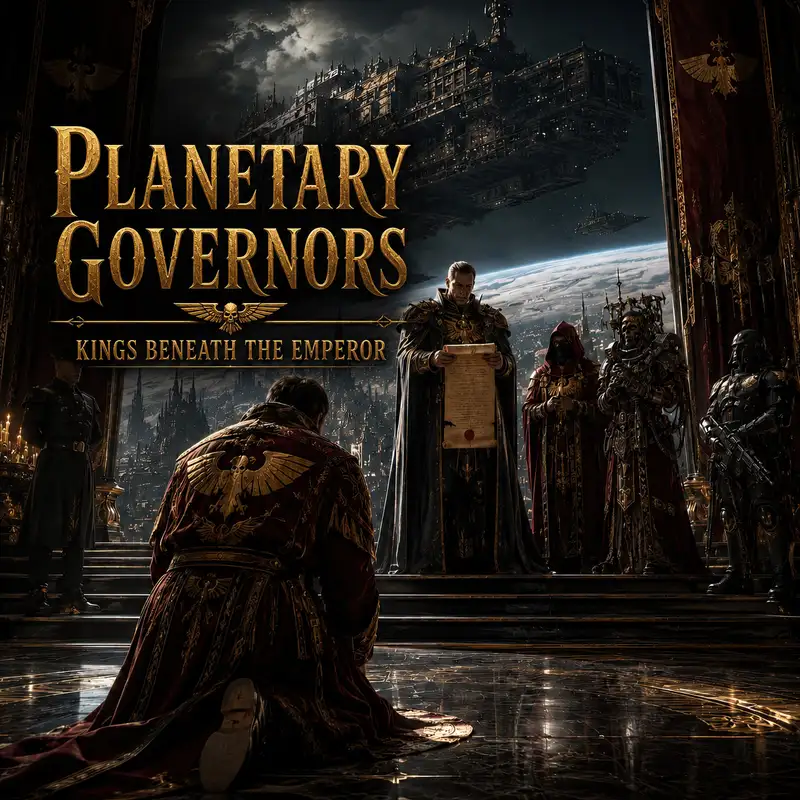
Planetary Governors: Kings Beneath the Emperor
A warship appears above the planet without warning. It may be the first vessel from Terra’s wider Imperium seen in a generation. Its hull eclipses the stars, its guns can erase cities, and its officers carry documents older than the governor’s dynasty. Below, a ruler who commands armies, judges, factories, and the lives of billions leaves a throne room built to make visitors feel small. Before the emissaries of the Emperor, that ruler kneels. The gesture may last only a few minutes. Its meaning governs the entire world.
That is the central contradiction of the planetary governor. On the surface, such a figure can resemble a king, a dictator, a high priest, an elected chancellor, a hereditary prince, or the chair of a ruling council. To the Imperium, the local title is less important than the function. Someone must be responsible for the planet. Someone must keep the population obedient, the factories operating, the soldiers trained, the psykers contained, and the tithe moving upward toward authorities so distant that many citizens doubt they are entirely human. That person is often called the Imperial Commander or planetary governor. The office grants immense freedom. It also ensures that every failure has a name attached to it.
The Imperium rules an enormous and badly connected realm. Its worlds are separated not merely by distance, but by the hazards of the warp. Messages can arrive late, distorted, or not at all. Reinforcements may respond to a plea for help decades after the people who sent it have died. A centralized government capable of directing every harvest, criminal trial, succession dispute, and military deployment on every planet would be impossible even for a rational civilization. The Imperium is not a rational civilization. It therefore solves the problem in the oldest imperial manner available. It delegates authority, demands tribute, and punishes disappointment.
A planetary governor receives broad control over administration, development, law, and defence. The details vary wildly. One world may be ruled by a noble house whose genealogy fills vaults beneath the palace. Another may be controlled by merchant families, military officers, industrial guilds, tribal chiefs, or an ecclesiastical hierarchy. A governor might inherit the office, seize it, purchase it, win it through ritual combat, or emerge from a political process that still uses the word election with a straight face. Imperial authorities usually care less about the ceremony of selection than about the result. The world must remain loyal. Its obligations must be met. Its ruler must be identifiable when they are not.
For the ordinary citizen, the governor may be the highest power that can be imagined in practical terms. The Emperor is divine, distant, and represented through icons, sermons, and institutions. The governor controls the doors that open today. Local law may regulate occupation, marriage, residence, worship, travel, inheritance, clothing, speech, and access to food. It may be enforced by uniformed constables, household troops, hive enforcers, clan warriors, or masked officials who arrive at night and leave the paperwork until morning. The governor can reward cities, destroy families, redirect rivers, close manufactoria, and send entire generations into military service. Terra is the source of legitimacy. The palace is where legitimacy becomes an order.
The governor’s first great obligation is the Imperial tithe. A world may owe grain, ore, manufactured weapons, chemicals, vehicles, rare biological products, or human beings. The assessment is supposed to reflect planetary capacity. In practice, it reflects capacity as understood by the Administratum, whose information may be incomplete, ancient, or filed beneath a report concerning a different planet with a similar name. The governor must extract the required amount from the population and deliver it on schedule. A productive world that misses its tithe can attract more dangerous attention than a miserable world that meets a smaller one. The Imperium does not reward suffering. It records compliance.
The second obligation is manpower. Planetary Defence Forces remain under local authority and exist to resist invasion, rebellion, piracy, and disaster. They vary from disciplined armies with armour and orbital batteries to badly equipped militias whose principal tactical doctrine is confidence. When the Imperium requires regiments for the Astra Militarum, the governor must provide them. Those troops leave the world’s direct control and may never return. The levy therefore removes trained soldiers precisely when a prudent ruler would prefer to keep them. Substandard offerings can be treated as fraud or treason. The governor must give the Imperium good troops while retaining enough good troops to survive without them.
The governor must also police the boundary between acceptable humanity and what Imperial authorities define as dangerous deviation. Unsanctioned psykers must be identified, confined, and surrendered through the machinery of the Adeptus Astra Telepathica and the Black Ships. Mutation must be monitored according to Imperial standards that are severe, unevenly applied, and rarely compassionate. Heresy, sedition, and xenos influence must be suppressed. The governor is expected to preserve the Imperial Creed, though local forms of worship can differ dramatically. On one world, the Emperor may be revered as a sun god. On another, as the first ancestor, the lord of storms, or the immortal general watching from the stars. The symbols can change. The direction of obedience cannot.
Defence is the obligation that turns a jeweled throne into a command post. The governor must maintain ground forces, fortifications, intelligence networks, emergency stores, and whatever orbital protection the world can support. A planetary defence force is not normally expected to defeat every threat the galaxy can produce. Very little can. It is expected to hold, report, delay, and preserve vital assets until greater Imperial strength arrives. That sounds reasonable until the astropathic message fails, the warp route closes, and the promised fleet becomes a theological concept. At that point, the governor possesses full authority over a dying world and no authority over the ships that might save it.
Meeting these obligations requires more than issuing commands. A governor must manage a web of interests that may be older and stronger than the current regime. Noble houses control land and patronage. Guilds control production. The Ecclesiarchy controls pulpits and public legitimacy. The Adeptus Mechanicus may control machines that no local official understands or is permitted to touch. Chartist captains and merchant combines connect the planet to outside markets. Astropaths connect it, unreliably, to outside knowledge. The governor stands at the center of this web, but the center is not the same as command. Power often consists of deciding which rival receives permission to damage another.
Necromunda offers one of the clearest examples. For millennia, House Helmawr stood at the summit of the hive world’s feudal order. The ruling house did not personally administer every factory line, settlement, noble feud, and underhive gang. That would be impossible. It governed the powers that governed everyone else. Great houses competed for wealth and status. Merchant interests moved goods. Enforcers maintained the accepted hierarchy. Violence below the spires was constant, but so long as it did not interrupt production or threaten the ruling order, it could be treated as part of the planet’s normal metabolism. Necromunda was not peaceful. It was productive.
Lord Gerontius Helmawr personified that arrangement. To Necromunda, he represented Imperial authority. To the Imperium, he represented Necromunda. That dual role is the essence of the office. He could permit rival houses to exhaust one another, reward loyalty, manipulate succession, and preserve his dynasty through methods that would make an ordinary criminal appear insufficiently ambitious. Yet the Imperium did not require him to produce justice in any humane sense. It required stability, loyalty, and output. His throne was secure because the planet’s obligations were secure.
The moment those obligations became uncertain, the nature of his power changed. In the turmoil following the Great Rift, struggles within Necromunda’s ruling order disrupted control of Hive Primus and threatened the planetary tithe. The response from outside was not a polite inquiry into local constitutional arrangements. An ultimatum arrived. Restore control and eliminate the usurping power, or face consequences imposed by forces beyond the governor’s command. Thousands of years of dynastic legitimacy mattered. The tithe mattered more. The Imperium can tolerate cruelty, rivalry, and inherited privilege with considerable patience. It becomes much less philosophical when shipments stop.
This is why a planetary governor is not truly sovereign. Around the palace stand other Imperial institutions whose loyalty does not belong to the local throne. The Adeptus Arbites enforce the Lex Imperialis, the body of Imperial law concerned with the Emperor’s rule, the authority of the Adeptus Terra, the payment of tithes, and crimes that threaten the wider Imperium. Local enforcers may arrest thieves, break strikes, or settle neighborhood violence. The Arbites watch for treason, rebellion, and failure at the top. Their fortified precinct is both courthouse and warning. A governor may command millions of local police and still have no lawful authority over the judges observing from across the avenue.
The Ecclesiarchy can sanctify a regime, but it can also turn public faith against it. The Administratum can revise an assessment, investigate missing quotas, or discover that a world has been misclassified for several centuries and correct the matter with devastating efficiency. The Inquisition can override almost any local authority when it judges the survival or purity of the Imperium to be at stake. The Adeptus Mechanicus guards its privileges and sacred technology. The Imperial Navy controls the great ships that cross between stars. A visiting Space Marine commander may possess neither interest in local protocol nor patience for it. The governor rules the planet, but never rules all the powers upon it.
The governor’s survival depends on reading this landscape. Competence includes knowing when to resist and when to kneel. A ruler who treats every Imperial visitor as a subordinate will not remain ruler for long. One who yields too easily may appear weak to local rivals. The most successful governors present obedience upward and command downward. They send the correct gifts, maintain relationships with sector officials, keep astropathic channels open, and ensure that reports describe both loyalty and indispensable service. A palace is a center of government, but it is also a stage on which the governor must continually perform usefulness.
The office can produce genuine competence. A capable governor may spend a lifetime balancing food supply, industrial output, defence, factional rivalry, disease, climate, and Imperial demands. Such rulers rarely receive much attention because a functioning world is not an emergency. Their achievements appear as uneventful columns in a ledger. The tithe arrived. The levy assembled. The rebellion ended before it required off-world troops. The orbital station remained operational. In a civilization addicted to martyrdom, preventing catastrophe is an oddly thankless form of service.
The office can also protect spectacular incompetence. Hereditary systems can place authority in the hands of someone trained to inherit power rather than use it. Court politics reward loyalty, flattery, and the useful disappearance of better candidates. Distance from Terra allows errors to continue for years. Fear prevents subordinates from reporting bad news. A governor surrounded by people who insist the situation is under control will eventually believe them, especially when the governor has ordered that conclusion in advance.
Herman von Strab, Overlord of Armageddon during the Second War for Armageddon, demonstrates how dangerous that combination can become. Warnings gathered around his world. A vast Ork threat approached. Von Strab refused to understand the scale of the danger and resisted calls for outside assistance. He believed Armageddon’s forces could manage the invasion under his direction. His decisions wasted troops, weakened the defence, and allowed personal vanity to shape strategy while cities fought for survival. The title of overlord gave him the power to make disastrous choices at planetary scale. It did not give those choices wisdom.
When outside forces finally arrived in strength, von Strab’s sovereignty evaporated. Commander Dante of the Blood Angels assumed control of the Imperial war effort, and the governor was placed under guard. This was not a constitutional transfer negotiated between equals. It was the practical judgment of the Imperium under invasion. The person responsible for defending the world had failed, so others took command. Von Strab escaped, and later returned as a traitor during another war, but his earlier removal already revealed the truth of the office. A governor may be king while the world functions. When the world becomes a battlefield of wider importance, higher powers may step over the throne without slowing down.
Yet it would be too simple to portray governors as pampered tyrants waiting to be exposed. Many rule under demands no humane system would impose. A tithe may leave a population hungry. A military levy may strip away the best defenders. A mutation purge may destroy communities already damaged by industrial poison. Reporting weakness may invite intervention as dangerous as the original threat. Concealing weakness may allow the threat to grow. A governor who protects the population by withholding resources from the Imperium risks being branded a traitor. A governor who delivers every quota may preserve the planet’s official standing while ruining the people who make the quotas possible.
This is where local oppression and Imperial pressure become difficult to separate. Governors often enrich themselves, protect their dynasties, and crush rivals because they desire power. They also do so because the Imperial system rewards control and punishes disorder. A ruler who allows open opposition risks rebellion. Rebellion interrupts production. Interrupted production threatens the tithe. A small protest can therefore be interpreted through a chain of consequences that ends with a punitive fleet in orbit. The governor’s police do not need to believe every dissenter is a heretic. They need only believe that Terra might eventually ask why the dissent was permitted.
The ordinary population experiences this system from below. Most citizens will never see an Imperial official from off-world. They know the governor through tax collectors, recruiting officers, sermons, work quotas, ration cards, and portraits staring down from public buildings. They may love the ruler, fear the ruler, or regard the ruler as simply another permanent feature of the landscape. On isolated worlds, a governor’s family can become the only imaginable connection to the Emperor. Loyalty to the dynasty and loyalty to the Imperium may merge until questioning one appears to threaten the other.
That arrangement gives governors a dangerous political weapon. They can present personal enemies as enemies of the Emperor. They can describe succession disputes as tests of faith. They can turn private wars into public crusades and claim that every sacrifice protects humanity. Imperial ideology provides immense legitimacy to those who speak in its name. It also provides the vocabulary by which those rulers can be condemned. A rival need not prove that the governor is unpopular. It is far more effective to prove that the governor is wasteful, disloyal, impure, or incapable of meeting the tithe.
Succession is therefore one of the office’s most vulnerable moments. A stable dynasty may prepare heirs, arrange alliances, and secure recognition before the previous ruler dies. A less fortunate transition can divide the palace, the military, the noble houses, and the priesthood. The Imperium may support the lawful heir, the strongest claimant, the most loyal claimant, or simply the claimant most likely to restore production before the next collection vessel arrives. Ancient rights carry weight. So do loaded guns and complete shipping manifests.
Rebellion against a governor does not always begin as rebellion against the Imperium. It may begin as a local coup, a workers’ rising, a noble feud, a religious dispute, or a military response to obvious incompetence. The wider Imperium then faces a practical question. Is the new regime loyal, useful, and capable of meeting obligations, or has the disturbance opened the world to secession, heresy, or xenos influence? Unfortunately, Imperial answers may be based on delayed reports, partisan testimony, and orders issued before the facts were known. A victorious rebel can discover that the punitive expedition launched against the old crisis has finally arrived and is not interested in revised paperwork.
The title king beneath the Emperor is therefore accurate, but only if both halves are understood. The governor is a king because local authority can be nearly absolute. The governor is beneath the Emperor because that authority is delegated, conditional, and surrounded by institutions able to end it. The office exists to translate distant Imperial demands into planetary reality. It turns theology into law, law into quotas, quotas into labour, and labour into ships departing for wars the workers will never see.
The most revealing moment in a governor’s reign is not a coronation. It is the arrival of something from beyond the world. A tithe fleet. A Black Ship. An Arbites judge. An inquisitor’s seal. A distress call from a neighboring system demanding regiments. Each arrival tests the bargain upon which the throne rests. Has the ruler preserved the world for the Imperium, or merely preserved the throne for the ruler?
A planetary governor can command continents and still live in fear of a clerk’s assessment. That is not a contradiction accidentally produced by the Imperium. It is the arrangement working as intended. Terra does not need to govern every street when it can make one ruler responsible for all of them. It does not need to understand every local problem when failure itself can be treated as evidence of guilt. The governor receives a crown, an army, and the freedom to rule. In return, the Imperium receives a world without having to administer it.
So the governors are kings, but their crowns are borrowed. They may pass them to children, defend them with armies, and surround them with ceremonies older than nations. They may be loved, feared, competent, monstrous, or all four in the course of a long reign. None of that changes the final condition. The tithe must arrive. The faith must hold. The world must remain useful. When those things fail, the stars above the palace begin to disappear behind the hulls of ships, and the ruler who seemed answerable to no one remembers exactly whose throne stands above every throne