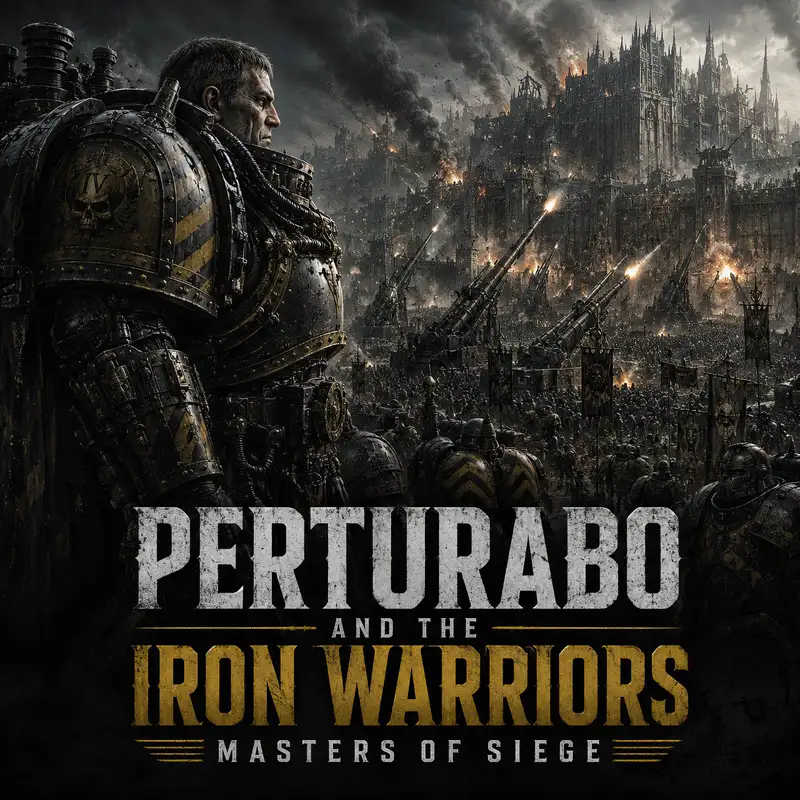
Perturabo and the Iron Warriors: Masters of Siege
At the height of the Siege of Terra, Perturabo looked upon the Imperial Palace and saw neither holiness nor history. He saw load-bearing walls, fire lanes, supply routes, weak foundations, and a problem that could be solved with enough guns, enough time, and enough dead men. Around him, the armies of Horus shouted prayers, gave themselves to daemons, and dreamed of killing the Emperor. Perturabo did something colder. He calculated. That was why the Iron Warriors were feared. Not because they loved sieges, and not because they possessed some secret artillery unknown to their brothers. They were masters of siege because their primarch had taught them to see war as engineering, suffering as material, and victory as the moment when an enemy’s structure finally failed.
That mastery came at a price. The Iron Warriors could reduce a fortress to rubble, but they gradually treated everything as though it were a fortress. A rebellious world became a wall to be broken. A rival became an obstacle to be undermined. A son became a resource to be spent. Even loyalty became a calculation. Perturabo’s tragedy was not that the Imperium failed to recognise his talents. It often did. His tragedy was that recognition never arrived in the form he needed, and each disappointment became further evidence that he was being used. He wanted to be known as a builder of wonders. He made himself indispensable as a breaker of worlds.
The Fourth Legion had been prepared for him long before he was found. During the early Great Crusade, its warriors earned a reputation for difficult assaults, stubborn garrison duties, and campaigns in which success was measured less by glory than by whether the guns were still firing at dawn. Other Legions might spearhead a brilliant advance and receive the triumph. The Fourth would be left behind to clear the fortress, secure the supply route, and hold the conquered ground. It was necessary work. It was also exhausting, anonymous, and expensive in lives. The Legion learned to endure without applause, which is a useful military virtue until endurance becomes the only thing a commander values.
Perturabo grew up on Olympia, a mountainous world divided among rival city-states and ruled through suspicion, ambition, and carefully maintained power. He was taken in by Dammekos, the ruler of Lochos, who recognised the strange child’s extraordinary intelligence and quickly found uses for it. Perturabo understood mechanisms almost by instinct. He could study a machine and grasp its purpose. He could look at a fortress and see how it might be improved, or how it might be destroyed. He designed engines, buildings, weapons, and works of art with the same ruthless clarity. Yet he never became comfortable among the people who praised him. He suspected admiration of being manipulation, and on Olympia that suspicion was not entirely foolish.
The young primarch wanted to create. Beneath the iron discipline and the contempt, there was a genuine desire to build cities, theatres, monuments, and devices whose beauty would outlast war. He possessed the imagination of an architect and the temperament of a besieged commander. That combination was disastrous. Perturabo rarely explained what he wanted, because asking for affection or recognition would have exposed a need he despised in himself. Instead, he waited for others to understand. When they failed, as people generally do when expected to read the mind of an armoured demigod, he stored the disappointment like ammunition.
When the Emperor found him, Perturabo was given command of the Fourth Legion and a place in the Great Crusade. He did not greet his sons with warmth. He reviewed their record and judged it inadequate. His answer was decimation, the ancient punishment in which one warrior in ten was killed by his own comrades. It was an act of calculated terror. Perturabo believed that shame and blood would burn weakness from the Legion. The survivors learned the lesson. Failure would not merely bring defeat. It would make them complicit in the punishment of their brothers. The Legion became harder, more disciplined, and more afraid of disappointing its father.
This is where the Iron Warriors’ reputation begins to take its familiar shape. A siege is not simply a prolonged gunfight against a wall. It is a contest of systems. The attacker must isolate the fortress, cut its communications, map its weapons, suppress its artillery, move ammunition forward, protect engineers, dig approaches, open breaches, and prepare assault troops to enter a place where every doorway has been designed to kill them. The defender needs food, water, power, morale, replacement parts, and confidence that relief is coming. Perturabo understood all of this. He did not merely ask how thick a wall was. He asked what supported it, who supplied it, and how long its defenders could continue believing it would hold.
Under his command, the Iron Warriors became experts in the entire machinery of reduction. They used artillery not as decoration, but as a method. They measured ranges, adjusted fire, studied patterns of collapse, and kept firing after a less patient commander might have declared the target destroyed. They dug trenches and tunnels. They built redoubts, killing grounds, and fortified camps. They used armoured vehicles and siege engines to exploit breaches, then reinforced captured ground before the enemy could respond. Their plans were rarely elegant in the heroic sense. They were elegant in the way a well-designed execution device is elegant. Every component had a purpose, and the intended result was not in doubt.
The Legion’s willingness to accept losses made it especially dangerous. Iron Warriors did not assume that every warrior could be saved, or even that every formation was meant to survive. Some units fixed the enemy in place. Others drew fire. Others entered the breach because someone had to discover where the hidden guns were. This was not unique in the Great Crusade, but Perturabo turned it into doctrine. He treated casualties as a cost to be forecast. That could produce victory where a more sentimental commander would hesitate. It could also conceal waste, because a commander who prides himself on accepting the necessary price may eventually stop asking whether the price is necessary.
Their strength was not limited to attack. The best destroyers of fortresses usually understand how to build them. The Iron Warriors could create layered defences, overlapping fields of fire, reserve positions, traps, bunkers, and underground works with remarkable speed. They knew where an attacker would place guns because they had placed those guns themselves. They understood the psychology of a breach, the way defenders rushed to close it and attackers crowded toward it. A fortress built by the Iron Warriors was not merely a wall. It was an argument, arranged in concrete and steel, explaining why every choice available to the enemy was wrong.
This brought Perturabo into inevitable comparison with Rogal Dorn and the Imperial Fists. Dorn was another master of fortification, but the two primarchs approached war through different moral languages. Dorn saw endurance as duty. He built to preserve, to hold, and to provide a stable point around which others could rally. Perturabo saw structures as problems of force, geometry, and will. He could build magnificently, but he was drawn to the moment when a design revealed its weakness. Their rivalry was not simply a dispute over who understood walls better. It was a struggle over what endurance meant. To Dorn, endurance proved loyalty. To Perturabo, endurance proved that suffering had not yet been sufficient.
The Imperium repeatedly assigned the Iron Warriors to campaigns suited to their abilities. They were sent against entrenched enemies, rebellious citadels, and worlds that refused to yield. They garrisoned distant victories while other Legions moved on. Perturabo took these assignments as proof that the Emperor valued his usefulness but not his person. There was some truth in the grievance. The Fourth Legion was often given brutal work with little ceremony. Yet Perturabo also helped create the pattern. He rarely refused a burden. He rarely admitted that it wounded him. He performed the impossible, then hated those who concluded that the impossible was simply what he did.
His sons absorbed that resentment. They saw themselves as the Legion that did the real work while others collected honours. Their iron armour, hazard markings, heavy guns, and practical brutality became the outward signs of a deeper belief. They would not ask to be admired. They would demonstrate that admiration was irrelevant. Iron within, iron without, became more than a declaration of strength. It was a refusal to acknowledge vulnerability. The problem with refusing vulnerability is that it does not remove pain. It only makes pain harder to discuss and easier to weaponise.
Perturabo’s relationship with his warriors reflected the same contradiction. He demanded excellence and could recognise technical brilliance, but he did not offer affection freely. He trusted machines because machines did not misunderstand, flatter, hesitate, or disappoint. He surrounded himself with mechanisms, calculations, and eventually robotic bodyguards. His Legion followed the example. Flesh was unreliable. Emotion was weakness. Compassion interfered with the schedule. This philosophy produced formidable soldiers. It also produced commanders who could look at thousands of dead and see only whether the timetable had slipped.
The breaking point came on Olympia. The world rebelled against Imperial rule and against the demands placed upon it, including the continuing burden of supplying warriors for Perturabo’s Legion. He returned not as the gifted son who had once dreamed of improving the world, but as a conqueror determined to punish betrayal. The suppression was savage. Cities were destroyed. Populations were slaughtered. Perturabo’s foster sister, Calliphone, confronted him with an accusation more dangerous than any weapon. She told him, in effect, that he had chosen the role of martyr, accepted every burden in silence, and then blamed others for failing to rescue him from it. He killed her. A fortress can be taken by force. An honest judgment is harder to silence.
After Olympia, Perturabo believed he had crossed a line the Emperor would never forgive. Horus understood exactly how to use that fear. By then, the Warmaster had turned against the Emperor and was drawing brother after brother into rebellion. Horus did not need Perturabo to love Chaos. He needed him to feel condemned, unappreciated, and indispensable. He offered the Iron Warriors a war in which their bitterness could be called justice and their worst act could be hidden inside a greater treason. Perturabo joined the rebellion less as a worshipper than as a man convinced there was nowhere else to go.
The Iron Warriors helped spring the trap at Isstvan the Fifth, where loyalist Legions were shattered in a massacre planned by supposed allies. From there, Perturabo became one of the rebellion’s most useful commanders. He could conduct campaigns, manage logistics, break strongholds, and impose order on forces that increasingly had little interest in discipline. He was not infallible. The Heresy repeatedly exposed the limits of perfect plans, particularly when enemies acted with courage, deception, or simple unpredictability. Yet Horus had few brothers capable of turning a galactic civil war into a sequence of solvable military problems.
The wider rebellion also revealed Perturabo’s uneasy relationship with Chaos. He was willing to use warp-tainted weapons, daemon engines, and corrupted allies when they served a purpose. He was far less comfortable with surrendering control. To him, a daemon was useful if it could be chained inside a machine and pointed at a wall. A daemon that demanded worship, symbolism, or ecstatic self-destruction was an inefficient colleague. This did not make Perturabo innocent of corruption. It showed only that he preferred damnation with specifications, maintenance schedules, and clearly assigned fields of fire.
When the traitor armies reached Terra, the great rivalry became real. Rogal Dorn had spent years preparing the Imperial Palace and the wider Solar System for attack. The Palace was not a single building. It was a continent-spanning complex of walls, bastions, subterranean routes, gun positions, shielded structures, and defensive zones. Behind it stood the Emperor, the centre of the Imperium and the object of Horus’s rebellion. Perturabo was given the task he had always wanted and perhaps always feared. He would test himself against Dorn before the eyes of the galaxy.
He approached the Siege of Terra as a campaign of layers. The attackers had to establish their forces, secure landing zones, capture ports, move guns forward, and reduce the outer defences before the inner works could be assaulted. Every advance created a new supply problem. Every breach exposed the troops entering it. Every hour favoured the possibility that loyalist reinforcements might arrive. Perturabo coordinated Legions whose primarchs were becoming less like generals and more like natural disasters. Angron could be unleashed, but not easily directed. Fulgrim had interests of his own. Magnus and Mortarion brought powers that did not fit neatly on any staff map. Horus had assembled gods, monsters, and armies. Perturabo was expected to make them keep appointments.
For a time, he did. The bombardments continued. Walls fell. Spaceports changed hands. The traitors pushed deeper toward the heart of the Palace. Perturabo’s calculations gave shape to the violence, and the Iron Warriors paid in blood to maintain the advance. Yet the Siege was becoming something other than a military operation. The Warp pressed closer. Time, distance, and causality began to fray. Horus increasingly treated the struggle as a ritual confrontation with the Emperor rather than a problem of fortifications and logistics. Perturabo had spent his life demanding that war obey reason. At Terra, reason was being consumed by the very rebellion he had joined.
Eventually, command of the assault shifted, and Perturabo withdrew the Iron Warriors from Terra before the final confrontation. The decision can be read as pride, disgust, calculation, or all three. He had broken much of the road to the Palace, but he would not remain merely to watch his work become part of someone else’s mystical drama. His departure weakened the traitor war effort, though by then the Siege had passed beyond anything like normal strategy. Perturabo had wanted the greatest test of siegecraft in human history. He discovered that Horus wanted an apocalypse.
The failure at Terra did not end the rivalry with Dorn. During the Great Scouring, when loyalist forces drove the traitors back, Perturabo constructed a fortress on Sebastus the Fourth as a deliberate challenge. The place became known as the Iron Cage. Dorn led the Imperial Fists into it, seeking to punish the Iron Warriors and perhaps to purge his own Legion’s shame through sacrifice. Perturabo had designed the battlefield for exactly that response. The Imperial Fists advanced into interlocking fortifications, traps, and killing zones where courage could not substitute for position. The battle became a grinding contest of pride, with both Legions proving how much pain they could endure.
The Ultramarines eventually intervened, allowing the surviving Imperial Fists to escape. Perturabo claimed the victory he had wanted, and the captured gene-seed of fallen Imperial Fists became part of the offering associated with his elevation to daemonhood. It was a bitter triumph. He had demonstrated that he could trap Dorn, bleed the Imperial Fists, and build a fortress that punished every predictable virtue of his rival. Yet even this did not resolve the old wound. Proving that another man could suffer did not prove that Perturabo had been loved, understood, or wronged.
After the Heresy, the Iron Warriors carried their methods into the Eye of Terror and beyond. From the fortress world of Medrengard, their wars became darker versions of the campaigns they had always fought. They built citadels, enslaved populations, created daemon engines, and reduced enemy worlds through artillery, siegecraft, and deliberate terror. Their warbands often compete with one another, each lord constructing fortresses and weapons as declarations of superiority. The Legion that once resented being used for thankless labour became an empire of masters forcing others to perform it.
Yet the Iron Warriors were never entirely defined by treason. Loyalist sons such as Barabas Dantioch showed that the Legion’s discipline, ingenuity, and endurance could serve purposes other than bitterness. Dantioch endured disgrace, resisted his traitor brothers, and used the same practical intelligence associated with the Fourth Legion in defence of others. His example matters because it prevents an easy excuse. The Legion’s culture made its fall more likely, but it did not make the fall inevitable. Perturabo shaped his sons, and many chose to follow him. Others looked at the same iron and decided it could support rather than crush.
So why were Perturabo and the Iron Warriors masters of siege? Because they understood that fortresses are not symbols. They are systems made from material, labour, fear, supply, and belief. Break enough of those elements in the right order, and even the greatest wall will fall. Their genius was patience guided by mathematics, engineering joined to violence, and a willingness to continue after other armies had spent their courage. Their failure was applying the same method to everything, including themselves.
Perturabo could identify the weak point in any defence except the one he built around his own pride. He could calculate the cost of a breach, but not the cost of teaching his sons that suffering was proof of worth. He wanted the galaxy to recognise that he was more than a destroyer, yet every grievance drove him to another act of destruction. The Iron Warriors became masters of siege because their primarch taught them how every structure could be broken. In the end, the structure they served longest was the prison he had built inside himself.