Perpetuals: The People Who Refuse to Stay Dead
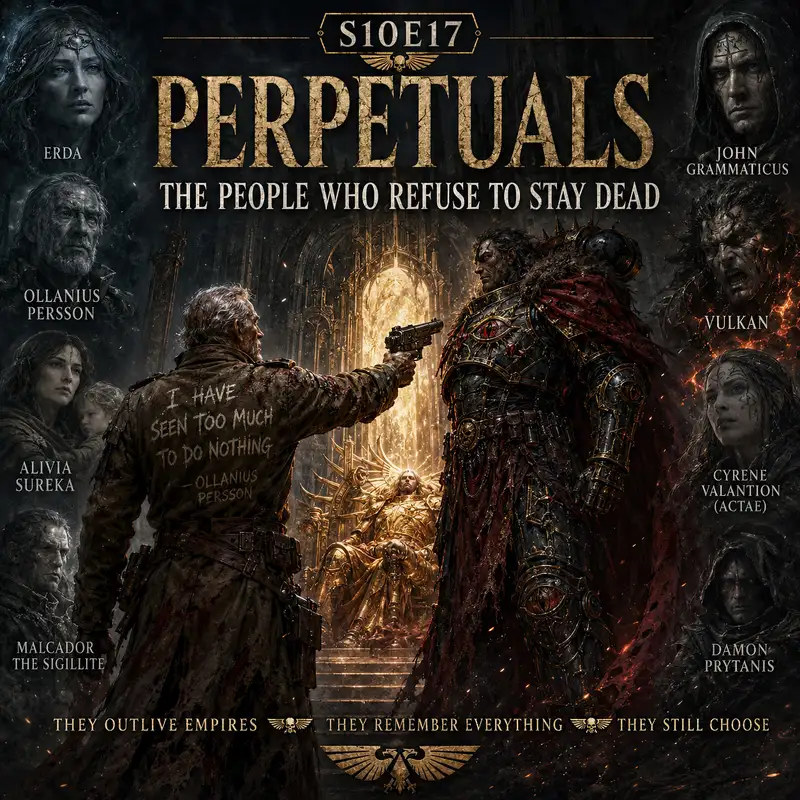
Horus Lupercal had already broken angels, armies, and most of the laws that normally keep reality behaving itself. The Emperor lay at his feet, apparently beaten. Then two human figures appeared in the court of the Vengeful Spirit. One spoke a word powerful enough to stagger the Warmaster. The other ran to the fallen Emperor, pressed a small blade into his hand, and turned to face Horus with a lasgun. His name was Ollanius Persson. He had walked through tens of thousands of years, survived wars that had become myths, and died more than once. He fired anyway. Horus erased him in an instant.
That final act is the best place to begin, because it contains the central contradiction of the Perpetuals. They are the people who return from death, yet their most important stories are about the moments when survival stops being the point. They can outlive nations, religions, and entire versions of human civilisation. They can watch history repeat its mistakes with the weary confidence of someone who has seen the original paperwork. Yet none of that makes them wise, united, or safe. Immortality gives them time. It does not tell them what to do with it.
A Perpetual is a human, or a human-derived being, whose life does not end in the normal way. Some do not age. Some can regenerate after wounds that would leave an ordinary person as a regrettable stain. Decapitation, dismemberment, incineration, and even near-total bodily destruction may only delay the return. Their abilities are not identical, and the surviving accounts do not offer a neat biological manual. Some are powerful psykers. Some possess unusual mental gifts. Others appear extraordinary mainly because death keeps discovering that its paperwork was filed incorrectly.
That does not mean a Perpetual cannot suffer. Death still hurts. Loss remains permanent even when the body is not. Friends age, children die, cities vanish, languages become archaeology, and memories accumulate until identity itself becomes difficult to carry. A Perpetual may survive the destruction of a world and still lose everything that made life on that world meaningful. Their gift is therefore less like invulnerability and more like compulsory continuation. The body returns. The grief is under no such obligation.
Even their origins remain uncertain. Erda, one of the oldest and most powerful among them, believed Perpetuals were a natural step in human evolution. She called them a higher form of humanity and expected more to appear as the species developed. That was her interpretation, not a laboratory conclusion accepted by everyone involved. Other Perpetuals were created deliberately. Alien science, psychic intervention, and the Emperor's own designs could manufacture versions of the condition. The category describes a result more reliably than it explains a cause.
The greatest of them was the being who became the Emperor of Mankind. Long before golden armour, Custodian guards, or an empire of a million worlds, he moved through human history under different names and identities. He believed humanity was evolving toward a dangerous psychic future. Left unguided, the species might awaken into the Warp and be devoured by it. His answer was intervention on a civilisational scale. He sought other immortals who could understand the length of the problem and help him shape the solution.
For a time, some of them did. They advised rulers, fought wars, preserved knowledge, and tried to push humanity toward futures they considered survivable. This was not a secret council calmly agreeing on the next forty thousand years. It was a gathering of powerful individuals with unlimited time and sharply limited patience for one another. They disagreed over methods, authority, risk, and whether humanity should be guided at all. A committee of immortals sounds efficient until one remembers that nobody has any reason to end the meeting.
Ollanius Persson was among the Emperor's oldest companions. By his own reckoning, Oll was older than the man who would become Master of Mankind. In ancient Terra, he served as the Emperor's Warmaster, commanding armies before that title belonged to Horus. Their partnership broke during a campaign against a cult building a great tower covered in Enuncia, a language whose words could alter reality. Oll wanted the tower and its knowledge destroyed. The Emperor wanted the knowledge preserved for possible use against future enemies.
Both positions had logic behind them. Dangerous knowledge can become a weapon against something worse. It can also become the thing that destroys you while waiting for that worse thing to arrive. Oll believed no one should possess such power, including his friend. He stabbed the Emperor, spoke the words that brought the tower down, and left. It was an early version of the argument that would define the Emperor's entire project. He saw knowledge as something to master. Oll saw some doors and concluded that the responsible act was to brick them shut.
Afterward, Oll tried repeatedly to become ordinary. He fought as a soldier across ages, carrying memories of battles that later humanity would half remember as history or legend. By the thirty-first millennium, he had become a farmer on Calth and a quiet follower of an ancient faith. He even served again as a common soldier before retiring. The Imperial Army calculated his land grant from his recorded service and rounded down. There are forces in the galaxy more persistent than immortality, and military administration is one of them.
Erda stayed beside the Emperor much longer. She was a gifted geneticist as well as a Perpetual, and her genetic material was used with the Emperor's in the creation of the primarchs. In that sense, she regarded herself as their mother. According to her account, the primarch project also answered the loss of the Emperor's old immortal allies. If naturally born Perpetuals would not follow him, he would create mighty, long-lived leaders shaped for his purpose. Erda eventually decided that purpose would condemn her sons to become instruments of conquest.
She claimed responsibility for opening the Warp vortex that scattered the infant primarchs across the galaxy. Her intention, as she described it, was to save them from the future the Emperor had designed. Whether Chaos manipulated that decision, exploited it, or shared responsibility remains contested within the story. What is certain is that the scattering helped create the conditions for the Horus Heresy. Erda tried to protect her children from one destiny and delivered them into twenty very different worlds, several of which had child-rearing policies best described as hostile.
During the Siege of Terra, Erebus found Erda in exile and offered her a place beside Chaos. She refused. He unleashed daemonic powers against her, and she destroyed them at terrible cost. Exhausted and wounded, she was finally killed with an athame blade. Her end demonstrates the first hard rule of Perpetual existence. Returning from ordinary death does not make permanent death impossible. Certain weapons, psychic forces, and deliberate sacrifices can consume or sever whatever allows the return. The immortal can be killed. It simply takes specialised effort, which the galaxy provides with depressing enthusiasm.
Alivia Sureka offers a different picture of what endless life could become. She had accompanied the Emperor to Molech in the distant past and remained there as guardian of the Warp gate he had used. By the time Horus came for that gate, Alivia had built something resembling a family. She had a husband, adopted daughters, and reasons to care about a single household rather than the destiny of the species. Her immortality did not place her above ordinary human attachments. It made those attachments more precious because she knew exactly how temporary they were.
Alivia survived the fall of Molech and reached Terra. During the Siege, Magnus the Red appeared within the Imperial Palace and struck down Malcador. Alivia herself was blasted apart, regenerated, and found the Sigillite's ruined body. She then gave her own immortal life force to restore him. This time she did not return. She died thinking of her family, spending eternity as if it were a finite resource. It was not a failure of her Perpetual nature. It was a decision about what another life was worth.
Malcador was also counted by Erda among the old immortals who remained with the Emperor. His endurance was prodigious, but even he had limits. After Alivia restored him, he later took the Emperor's place upon the Golden Throne so the Master of Mankind could confront Horus. The machinery and psychic burden consumed him. When the Emperor was returned to the Throne, Malcador had almost nothing left to give. His death is another warning against treating Perpetuals as characters with unlimited extra lives. Some forces do not merely kill the body. They spend the person.
Not every Perpetual was born that way. John Grammaticus had been made immortal by the alien Cabal, a coalition that believed it could see the broad paths of the future. John was a gifted psyker and agent, used to influence the Alpha Legion and help steer the Horus Heresy toward the outcome the Cabal preferred. Their calculation was appalling but coherent. If Horus won, humanity might destroy itself quickly and starve Chaos of its greatest source of power. If the Emperor won, humanity would decay slowly and feed Chaos for millennia.
John helped carry that choice to the Alpha Legion, then recoiled from what he had done. He tried to kill himself by leaving a spacecraft without the usual courtesy of an airlock cycle. Perpetuality returned him to duty. That episode captures the uglier side of manufactured immortality. John had not been granted freedom from death. He had been made too useful to escape his employers. The Cabal could send him into impossible missions, lose him, recover him, and issue another set of instructions. Immortality had become a contract with no retirement clause.
His path changed around the Fulgurite, a weapon formed from matter struck by the Emperor's psychic lightning. It carried enough of that power to threaten a Perpetual permanently. John was ordered to use it in a plot against Vulkan, but at the decisive moment he rejected the Cabal's design. Rather than finish the primarch, he used the Fulgurite in a way that restored Vulkan's sanity and surrendered his own Perpetual state. John became mortal again. For someone who had once tried desperately to die, mortality became not an escape, but a responsibility he had chosen.
Vulkan is the clearest and most violent demonstration of Perpetual regeneration. The primarch of the Salamanders survived the massacre at Isstvan Five, only to become the prisoner of Konrad Curze. Curze killed him repeatedly, searching for a method that would work and for proof that Vulkan could be broken. Vulkan was cut apart, burned, cast into the void, and subjected to cruelties that would have ended any normal captive. Each time, he returned. Curze discovered that an immortal prisoner offers excellent opportunities for experimentation and absolutely no improvement in the researcher's mood.
The horror of those scenes is not simply that Vulkan cannot die. It is that resurrection does not protect his mind from trauma. He returns carrying the memory of every death and the knowledge that Curze can begin again. Yet Vulkan's identity remains rooted in compassion, duty, and his connection to ordinary people. His immortality matters because it is tested against someone who believes cruelty reveals the truth. Curze tries to prove that beneath enough pain, Vulkan is just another monster. Vulkan's survival is moral before it is biological.
Vulkan later returned during the War of the Beast, more than a thousand years after the Heresy, and again died and regenerated in battle. He eventually vanished in the destruction of a vast Ork war machine while fighting the Beast. The surviving record does not settle whether that event ended him permanently. His nature makes survival possible, not guaranteed, and it certainly does not guarantee a prompt return at a strategically convenient location. The Imperium has spent ten thousand years learning that missing primarchs are not a dependable reserve formation.
Cyrene Valantion shows how strange artificial Perpetuality can become. Once the revered Blessed Lady of the Word Bearers, she was killed, restored through the designs of Erebus, and eventually became the psyker called Actae. During the final collapse of the Siege, she was buried beneath wreckage and died again and again as her body regenerated inside the trap. Her mind also became entangled with that of another woman, Katerina Moriana. Here immortality does not preserve a clean, untouched identity. The body returns, but the person returning may carry new wounds, memories, loyalties, and names.
By the final hours of the Heresy, the Perpetuals had not guided humanity to safety. Their grand designs had fractured. The Emperor's plan produced conquest, rebellion, and a throne that would become a life-support machine for an empire. Erda's intervention helped scatter the primarchs. The Cabal's farseeing encouraged treachery. Damon Prytanis, another immortal agent, died to a weapon made for ending his kind. Alivia sacrificed herself. Malcador was consumed. Vulkan endured but vanished. Their long view did not free them from error. It merely allowed some mistakes to gather interest for thousands of years.
Oll wanted no part of that responsibility. On Calth, he had chosen fields, neighbours, faith, and a life small enough to understand. Then the Word Bearers attacked. The world split open, the Warp flooded through its wounds, and Oll led a handful of survivors away using an athame blade to cut paths through space and time. Their journey crossed ruined ages and impossible places. He did not return because he believed himself destined to rule. He returned because he had seen enough of history to recognise the shape of its ending.
At Terra, Oll finally reached the Emperor at the moment his oldest friend was drawing in enough Warp power to defeat Horus and becoming something far worse in the process. The power threatened to turn him into the Dark King, a new god born from humanity's ruin. Oll did what he had done at the ancient tower. He opposed the Emperor in order to save him from his own solution. He reminded him of human limits, human trust, and the possibility that victory purchased with absolute corruption was not victory at all. This time, the Emperor listened and cast the power aside.
That choice left the Emperor weaker when he faced Horus, but still himself. Later, Oll and John were brought into Lupercal's court at the moment of defeat. John used Enuncia to buy a few seconds. Oll placed the restored athame in the Emperor's hand and ordered John to leave. Then the oldest soldier in human history turned toward the Warmaster. His lasgun could not harm the thing Horus had become. Oll knew that. He fired because the weapon was not the point. The point was that Horus would have to pass through one human being who had decided the Emperor was not his to take.
Horus destroyed him, and no return followed. The blade Oll delivered became the means by which the Emperor finally killed his fallen son. In later Imperial memory, the complicated truth collapsed into the legend of Ollanius Pius, the ordinary Guardsman who stood between Horus and the Emperor. The legend lost ages of betrayal, friendship, time travel, and immortal politics. It preserved the essential fact. At the decisive moment, someone who could have spent eternity avoiding the war chose to stand his ground.
That is what defines the Perpetuals. They are not wise because they are old, and they are not good because they survive. Immortality magnifies whatever is already present. It can turn conviction into tyranny, service into manipulation, caution into paralysis, and guilt into a prison without walls. It can also give someone endless opportunities to choose differently. John surrendered immortality. Alivia spent hers. Vulkan endured without accepting Curze's view of him. Oll returned to a friend he had once abandoned and saved him twice, first from godhood and then from defeat.
The Emperor remains the final unresolved Perpetual. He sits between life and death upon the Golden Throne, sustained because the Imperium cannot safely discover what would happen if he were allowed to die. Perhaps his nature could restore him. Perhaps the Throne, the Warp breach beneath Terra, and ten thousand years of psychic damage have made that impossible. The surviving lore does not provide a reliable answer, and no one in the Imperium possesses both the knowledge and the courage to perform the experiment.
Perpetuals do not truly refuse to stay dead. Their bodies return because something in nature, science, or the Warp insists upon continuation. The meaningful refusal is different. Again and again, the best of them refuse to let endless life excuse endless control. Ollanius Persson lived longer than empires and died as a soldier with an ineffective rifle. In a universe obsessed with gods, bloodlines, and immortal rulers, his final act reduced eternity to one human decision. He stood where he was needed, and this time, he did not come back.