Orks: The Galaxy’s Happiest Warmongers
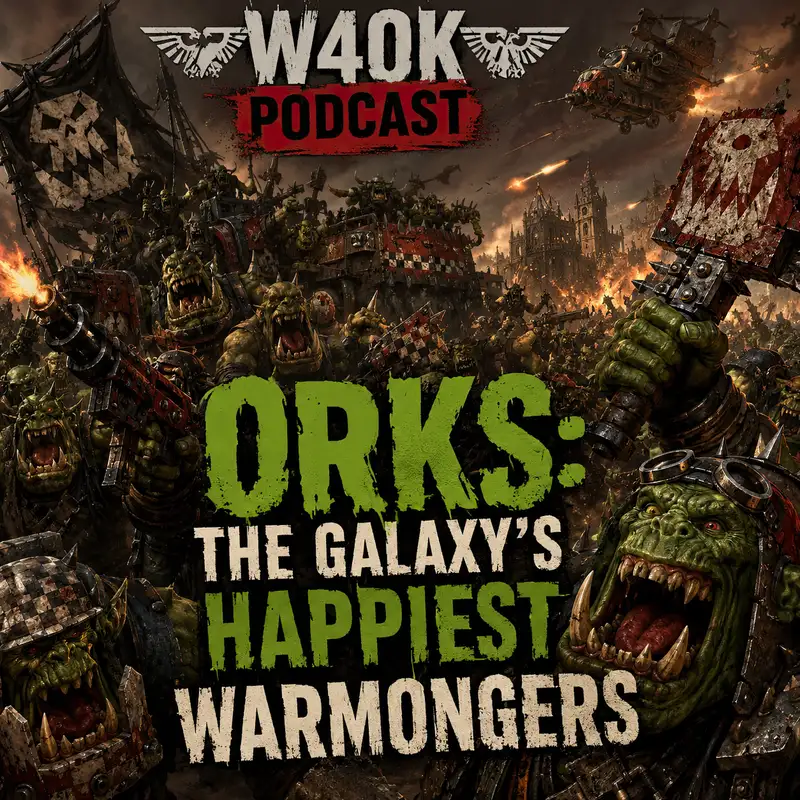
The first warning is not the gunfire. It is the laughter. Across the walls of a burning hive city, human defenders hear it rolling through the smoke, louder than engines and almost as loud as artillery. Green figures surge over wreckage, firing weapons that look as though they were assembled during an argument in a scrapyard. Some are wounded. Several are on fire. None appear discouraged. To the people holding the wall, this is the end of their world. To the Orks climbing toward them, it is an excellent day.
That is the terrible contradiction at the center of the Orks. Warhammer forty thousand is filled with species trapped by grief, duty, hunger, faith, or ancient mistakes. The Orks seem almost free. They are not searching for peace. They are not trying to restore a lost golden age. They do not expect history to vindicate them. They want a louder gun, a faster vehicle, a stronger enemy, and enough surviving friends to argue over who won. In a galaxy where there is only war, the Orks may be the only major people who regard the situation as broadly satisfactory.
Calling them happy does not make them harmless. Orks conquer, enslave, torture, loot, and destroy with very little concern for the suffering they cause. Their amusement is often somebody else’s catastrophe. A human settlement overrun by Orks does not experience a cheerful cultural misunderstanding. It experiences massacre, forced labor, and the demolition of anything that might be converted into a weapon. The humour surrounding Orks comes from their point of view, not from the consequences. They are funny in the way an avalanche wearing a stolen officer’s hat might be funny, provided it is moving away from you.
Their strange contentment begins with what they are. The oldest surviving accounts connect the Orks to the Krork, a warrior species created in the remote past, probably by the beings remembered as the Old Ones. The precise history is uncertain, because the events belong to the War in Heaven, an age so distant that even immortal witnesses disagree about it. What matters is the design. The ancestors of the Orks were not a civilisation that happened to become militarised. They appear to have been made for survival and conflict from the beginning.
An Ork is part animal, part fungus, and part biological weapons system. Orks do not build families or raise children. They spread spores throughout their lives and release even more when they die. Given time, those spores produce an entire Orkoid ecology. Fungi appear first, followed by squigs, snotlings, Gretchin, and eventually full-grown Orks. The sequence can vary, and Imperial xenobiologists do not understand every detail, but the result is brutally practical. Food, labor, livestock, and warriors emerge from the same self-sustaining biological network.
This means an Ork invasion does not end when the last visible warrior falls. Spores remain in soil, ruins, ventilation systems, and wilderness. Years later, fresh bands may crawl out of places that were supposedly cleansed. Imperial authorities have learned that reclaiming an Ork-infested world can require repeated purges, controlled burns, and constant patrols. Even then, confidence is dangerous. The Orks do not merely occupy territory. They take root in it.
Their bodies are equally suited to their purpose. Orks are immensely tough, resistant to pain, and capable of surviving injuries that would kill most humans. They grow larger and stronger through conflict, especially when they win. This growth is not only physical. Size carries social authority. A large Ork is assumed to be dangerous, and because dangerous Orks tend to settle disputes by striking nearby objects or people, the assumption usually proves sound.
Their medicine follows the same practical philosophy. Painboyz cut, stitch, replace, and occasionally improve whatever has been damaged, often using tools that would make an Imperial field surgeon request immediate reassignment. Ork physiology allows procedures that should be fatal to succeed with alarming frequency. A lost limb may become an excuse for a metal replacement. A wound may become a story, provided the patient survives the doctor. Pain matters to Orks, but it rarely carries the same emotional finality it does for humans. Injury is another contest, and scars are evidence that the contest failed to finish the job.
Ork society therefore has a simple foundation. The biggest Ork leads until a bigger Ork defeats him. A powerful leader becomes a Nob. The strongest and most successful becomes a Warboss. Beneath them are the ordinary Boyz, then the smaller Gretchin and snotlings who perform much of the unpleasant labor and receive very little gratitude for it. The system is cruel, unstable, and remarkably easy to understand. Ork political theory can generally be demonstrated with one fist and a witness.
Simple does not mean mindless. Orks can plan ambushes, negotiate, deceive rivals, retreat from losing battles, and return with more guns. Some are cunning strategists. Others are gifted engineers, surgeons, pilots, or psykers. Their intelligence is specialised around the needs of Ork society, and much of the necessary knowledge appears to be instinctive. An Ork does not attend an academy to become a Mekboy. At some point, he begins to understand engines, weapons, force fields, and machinery with a confidence entirely unsupported by formal education.
Mekboy technology is one of the most misunderstood parts of Ork lore. Their machines are crude, loud, unsafe, and often assembled from stolen components, but they are not imaginary. Ork guns fire because they contain working mechanisms. Ork spacecraft cross the void because Mekboyz can build engines and life-support systems, although Ork standards for life support are refreshingly modest. The psychic influence surrounding a large Ork population may make their devices work better than they otherwise should, but belief alone does not turn an empty metal box into a cannon.
Ork weapons also express what they value. Accuracy is useful, but noise, rate of fire, and visible destruction have their own importance. The Ork word dakka describes gunfire and the beloved quantity of it, a quantity that is never finally sufficient. Vehicles are decorated with trophies, glyphs, armor plates, and whatever seemed impressive when the Mekboy found it. Their machines are not merely tools. They are declarations of status and personality, built by a culture in which subtlety is respected mainly when it helps someone get close enough to stop being subtle.
The same caution applies to Ork beliefs about color. Red vehicles are considered faster. Blue is associated with luck. Yellow suggests wealth and spectacular explosions. These ideas are woven into Ork culture, and the collective psychic field may reinforce them in subtle ways. The surviving evidence does not support the popular notion that any absurd claim becomes true merely because enough Orks shout about it. Their reality is flexible around the edges, not completely unemployed.
That collective psychic presence is central to understanding them. Every Ork contributes to a background field often called the power of the Waaagh. The word can mean a battle cry, the psychic energy generated by Orks, or a vast migration of warbands under a dominant leader. These meanings overlap because, to an Ork, belief, community, and war are not separate subjects. As more Orks gather, the field strengthens. Weirdboyz channel dangerous surges of power. Mekboyz receive more ambitious inspiration. Bosses grow in authority, and the horde begins to act with a unity that no council could have produced.
A Waaagh is therefore more than an army. It is a self-organising storm. A successful Warboss wins battles, which attracts more Orks. More Orks create greater psychic momentum, which supports larger machines, bolder plans, and still greater victories. Ships are built or stolen. Asteroids are hollowed out. Gargants rise from scrap fields like walking idols. Entire worlds are stripped to feed the advance. The process continues until the Warboss is defeated, the enemy disappears, or the horde fragments under the weight of its own arguments.
Those arguments are frequent because Orks do not require an external enemy in order to fight. When no suitable opponent is available, they fight one another. This prevents peace from becoming a serious problem. A defeated Ork may run if the alternative is pointless death, but retreat is usually a pause rather than a philosophical change. He can return with friends, a better weapon, or a story explaining why the previous battle did not count. Orks are not fearless. They simply recover from fear with impressive speed when another opportunity for violence appears.
Their gods reflect the same worldview. Gork is commonly described as brutal but cunning, while Mork is cunning but brutal. Or perhaps it is the other way around. Orks have debated the distinction for ages, often through methods that leave very little written scholarship. The ambiguity is important. Ork religion does not ask them to overcome their nature. It declares their nature sacred. Strength, trickery, endurance, noise, and victory are not merely useful qualities. They are evidence that the universe works as it should.
The Ork clans give that shared culture different forms. Goffs value direct violence and consider themselves the hardest fighters. Evil Sunz adore speed, engines, and the possibility of reaching the enemy before anyone else. Bad Moons are wealthy because their teeth grow faster, which matters because Orks use teeth as currency. Deathskulls are enthusiastic looters who see unattended property as a confession of weakness. Snakebites favor older ways, hardy beasts, and a suspicion of excessive technology. Blood Axes imitate the tactics of other species, use camouflage, and sometimes trade with humans, behavior many Orks regard as dangerously sophisticated.
These clans are not separate nations. Members of several clans may fight within the same Waaagh, each convinced that its own habits represent proper Ork behavior. Their rivalries create friction, but they also give Ork armies a wide range of abilities. A horde may contain disciplined Goff mobs, racing Evil Sunz vehicles, Blood Axe commandos, Deathskull scavengers, and Bad Moon gun batteries. The result looks chaotic from the outside because it is chaotic. It is also an adaptable military society that can replace losses, absorb captured technology, and turn almost any environment into a workshop.
Even the Ork economy serves conflict. Their teeth, usually called teef, grow back after being lost and decay after removal. Currency is therefore renewable, difficult to preserve indefinitely, and most readily acquired by punching someone in the mouth. Bad Moons enjoy a natural advantage because their teef grow especially quickly, allowing them to purchase the finest weapons and most excessive decoration. Economic inequality still exists, but inflation occasionally arrives with a pair of pliers.
Gretchin do much of the work that allows this economy to function. They carry ammunition, repair equipment, cook fungus, tend squigs, clear mines, and endure the moods of larger Orks. Some become clever, wealthy, or influential by Gretchin standards, but Ork society is built on their exploitation. This matters because the cheerful image of Orks can hide the ugliness of their world. Their freedom belongs mainly to those strong enough to take it. The smaller creatures beneath them live by obedience, deception, and knowing when to leave the room.
Orks also possess a kind of cultural honesty that makes them seem strangely uncomplicated beside other powers. The Imperium describes conquest as duty, sacrifice, or divine necessity. Chaos promises liberation while fastening chains around the soul. The T’au speak of collective purpose. The Aeldari fight beneath the burden of survival and memory. Orks rarely pretend that their wars are for anyone’s benefit but their own. They attack because fighting is enjoyable, because victory brings status, and because a powerful enemy offers the chance to prove who is strongest.
That honesty should not be confused with innocence. An Ork does not need hatred to destroy a city. He may not despise the people inside it at all. They are simply in the way, and if they resist effectively, they become more interesting. This is one reason Orks can form intense rivalries with particular enemies. They respect durability, aggression, and the willingness to return for another battle. From an Ork perspective, a worthy opponent is almost a collaborator, helping to produce the greatest possible war without receiving any say in the arrangement.
Ghazghkull Mag Uruk Thraka embodies this idea on a galactic scale. He rose from an unremarkable beginning after a severe head wound and the intervention of the infamous Mad Dok Grotsnik. Ghazghkull came to believe that Gork and Mork had chosen him as their prophet. Whether his visions were divine, psychic, or the result of trauma matters less than what followed. He united warbands, defeated rivals, and developed a purpose larger than ordinary conquest. He would gather the greatest Waaagh the age had seen.
Armageddon became the defining battlefield of that ambition. Ghazghkull’s invasion brought him into conflict with the Imperium and with Commissar Sebastian Yarrick, a human commander who understood Orks better than most Imperial officers did. Yarrick recognised that they were neither a mindless mob nor a problem that would vanish after one victory. Ghazghkull, in turn, came to value Yarrick as a worthy enemy. Their rivalry gave both sides a symbol. To the Imperium, Yarrick was the old soldier who would not yield. To the Orks, he was proof that humans could occasionally provide a proper fight.
For Ghazghkull, this was not a contradiction. Destroying every enemy immediately would end the entertainment. A great enemy gives meaning to a great Warboss. Armageddon became more than a strategic target. It became a place where Ork identity could be performed at its grandest scale, with endless armies, colossal machines, and opponents stubborn enough to keep the war alive. The planet’s suffering was almost beyond measure. Ghazghkull saw confirmation that his gods favored him.
The most dangerous mistake is to assume that Ork enthusiasm makes them unserious. When scattered, they can look like pirates, raiders, or feuding gangs. When united, they become one of the galaxy’s great existential threats. Imperial history contains periods when Ork empires reached extraordinary levels of organisation and technology. During the conflict remembered as the War of the Beast, Orks threatened the heart of the Imperium with attack moons, advanced weapons, and a leadership structure far beyond what human commanders expected from them.
Such episodes suggest that the Orks of the present may be diminished descendants of something even more formidable. The ancient Krork were created for wars fought by powers beyond modern understanding. Ork society may contain buried capacities that emerge only when population, conflict, and psychic momentum reach the necessary scale. A Mekboy’s sudden inspiration, a Warboss’s growth, and a Waaagh’s expanding organisation may all be fragments of an old design trying to rebuild itself.
This possibility changes the meaning of their apparent disorder. What looks like incompetence may be a system optimised for rapid expansion rather than comfort. Orks do not need stable schools because knowledge emerges where it is required. They do not need a formal industrial base because Mekboyz turn ruins into factories. They do not need recruitment offices because battle attracts them. They do not need elaborate political institutions because physical dominance produces immediate authority. The arrangement is brutal and wasteful, but the galaxy provides so much raw material that efficiency is almost impolite.
It also explains why conventional victory over Orks is so difficult. Defeat a warband, and survivors scatter to join another. Kill them, and spores remain. Offer weak resistance, and the Orks overrun the position. Offer strong resistance, and word spreads that a better fight is available. The defender’s success can become an advertisement. Imperial commanders facing Orks must win decisively, cleanse thoroughly, and avoid creating the kind of heroic rivalry that attracts half the sector. This is a demanding set of requirements, especially for an Imperium whose preferred response is often to build a larger monument to the previous failure.
The Orks are happy because almost every part of their existence points in the same direction. Their bodies reward fighting. Their society rewards strength. Their economy rewards aggression. Their gods celebrate brutality and cunning. Their technology becomes more ambitious as their numbers grow. Their psychic presence turns collective excitement into real power. Even death helps seed the next generation. Where other species experience a division between what they want and what the universe demands, the Orks experience alignment.
There is tragedy in that alignment, though not usually for the Orks. Their victims lose worlds, families, histories, and futures to creatures who may remember the invasion as a particularly enjoyable season. The Orks’ lack of malice can make them more disturbing, not less. Hatred might be negotiated with, redirected, or exhausted. Joy renews itself. Every explosion, every challenge, and every stubborn defender confirms that life is proceeding correctly.
That is why the Orks are more than comic relief, and why their laughter belongs in the darkest parts of the setting. They reveal what endless war would look like to a species perfectly adapted to it. The Imperium survives war. Chaos feeds upon it. The Tyranids consume through it. The Necrons awaken into it. The Orks live for it, and the galaxy has given them more than they could ever have asked for. The walls are burning, the guns are firing, and somewhere in the smoke, the happiest creatures in the galaxy are coming closer.