Orks at War: Clans, Meks, Speed, and the Waaagh!
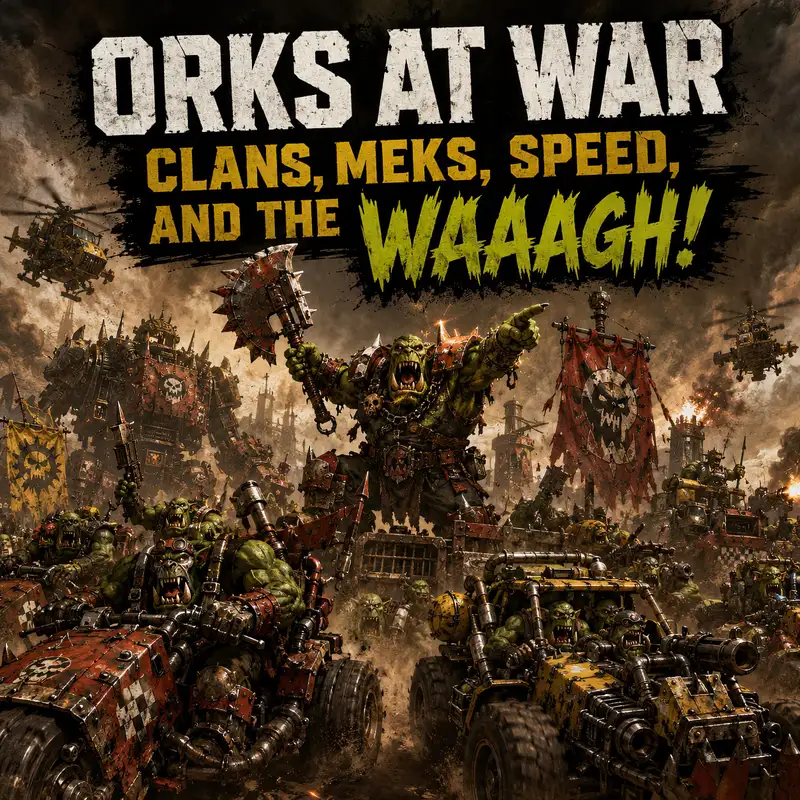
The first warning is usually noise. Not gunfire, and not the disciplined thunder of an artillery preparation, but engines. Hundreds of them. Some cough black smoke. Some scream like wounded animals. Some appear to be held together by welded plates, chains, and a level of optimism that would be criminal in any properly regulated motor pool. Then the horizon turns green, the engines surge forward, and the defenders discover that the apparent disorder has direction.
Warbikes race ahead, throwing up curtains of dust. Buggies probe the flanks. Trukks packed with shouting warriors drive straight at the strongest point in the line. Looted guns fire from positions no sane engineer would have selected. Behind them come walkers, battlewagons, great stomping machines, and infantry mobs that seem to multiply whenever the smoke clears. There may be no printed operation order. There may not even be a map that everyone agrees is the right way up. Yet the attack develops with speed, weight, and a brutal sense of purpose.
That contradiction is the heart of Ork warfare. Orks look like an army assembled from wreckage, appetite, and bad decisions. They are also one of the most successful warrior species in the galaxy. Their clans argue, their leaders fight each other, their machines explode, and their plans often begin with the instruction to go toward the loudest battle. None of this prevents them from conquering worlds. Much of it helps.
Ork society is not random. It is self-organising. Its institutions are crude, violent, and remarkably well matched to what Orks are. Clan identity creates different military instincts. Meks turn debris into weapons. Speed Freeks convert excitement into operational tempo. A powerful Warboss gives the whole mass direction. The Waaagh then transforms countless local urges for battle into something approaching a galactic migration.
An Ork army is easier to understand if it is not imagined as a conventional state military. It is closer to a travelling ecosystem built for war. Orks reproduce through spores. Wherever large numbers of them live, fight, and die, the ground may eventually produce more than Orks alone. Grots, squigs, and the other parts of Ork life emerge with them, creating labour, food, livestock, ammunition handlers, and test subjects. Ork society carries the beginnings of its supporting institutions inside itself.
This is why removing an Ork invasion is so difficult. Defeating the visible army may only be the first stage. The battlefield, ruins, and wilderness can remain seeded with the next generation. Years after victory has been declared, isolated settlements may begin reporting missing livestock, crude traps, or green shapes beyond the perimeter lights. The official campaign may be over. The practical problem has merely become less convenient to brief.
Within this ecosystem, size and strength create authority. Orks grow larger and tougher as they survive conflict. The biggest fighters become Nobz. The most dominant may rise as a Warboss. Challenges are frequent, and political disagreement is often resolved at close range. This looks unstable because it is unstable, but it also produces a hierarchy that every Ork understands immediately. The boss is the boss because he can prove it.
A Warboss identifies an enemy, promises loot and battle, and gives rival mobs a reason to move in roughly the same direction. If victories follow, his reputation grows. More Orks gather. Meks arrive because large wars require large machines. Freebooterz and wandering mobs attach themselves to the host. Nobz who might otherwise challenge him decide there will be time for that later.
This is not loyalty in the human sense. It is confidence expressed through momentum. An Ork follows a successful boss because the boss leads him to better fights. Failure weakens that bond. A stalled invasion, a humiliating defeat, or a convincingly delivered blow to the head can fracture the structure. Rival leaders begin testing their chances. Mobs peel away. What appeared to be one army becomes several furious armies, sometimes with the enemy temporarily relegated to second place.
The clan system sits inside this hierarchy, but clans are not the same as tribes or armies. A tribe commonly contains Orks from several clans under one Warboss. Clan identity is broader. It is a cultural instinct, a set of preferences, symbols, habits, and ideas about the proper way to be an Ork. The six great clans appear across countless worlds, and their rivalries persist even when they fight beneath the same banner.
The Goffs represent the most direct answer to any military question. They value size, toughness, discipline by Ork standards, and the honourable simplicity of hitting the enemy very hard. Their black colours and stark checks suit their outlook. They do not object to guns or vehicles, but these are generally understood as methods for reaching the decisive moment when someone can be struck with a heavy object. Goff mobs often provide the hard centre of a Waaagh, and many of the greatest Warbosses have risen from their ranks.
The Evil Sunz believe that a good battle should arrive quickly. They are closely associated with vehicles, roaring engines, and the conviction that red machines go faster. Their mobs contain many Speed Freeks, Orks for whom motion is not merely useful but emotionally necessary. An Evil Sun who is not driving, riding, flying, or repairing something fast may be planning to steal something that is. In battle, they race ahead, outflank slower formations, and occasionally discover the enemy command post by crashing through it.
The Bad Moons are wealthy because their teeth grow faster than those of other Orks, and teeth are the standard Ork currency. Wealth buys the best weapons, the loudest guns, elaborate armour, and the services of talented Meks. Bad Moons favour yellow and display their prosperity without embarrassment. They understand that money cannot buy happiness, but it can buy a larger gun, which is usually close enough.
The Deathskulls are looters, scavengers, and practical opportunists. They paint themselves and their equipment blue for luck, then improve the odds further by stealing anything not securely attached. If it is securely attached, they may interpret that as a technical challenge. Deathskulls strip battlefields, dismantle wrecks, and return enemy technology to combat in altered form. Every destroyed vehicle becomes raw material. Every abandoned position becomes a supply depot.
The Blood Axes possess the unsettling Ork habit of studying other species. They use camouflage, infiltration, discipline, feigned retreats, and organised tactics more readily than most clans. They may trade with outsiders or serve as mercenaries when it suits them. Other Orks consider this suspicious, particularly the camouflage, because hiding from the enemy can seem uncomfortably close to avoiding a fight. The Blood Axes would reply that they are merely arranging to hit the enemy from a more amusing direction.
The Snakebites hold to older ways. They prize toughness, tradition, hunting, and close relationships with the dangerous beasts of Ork culture. They often prefer squigs and living mounts where another clan might choose an engine. This does not mean every Snakebite rejects all technology. They are simply less impressed by novelty and more willing to trust methods that have survived generations of use. Their warriors can appear primitive beside a Mek-heavy warband, right up to the moment an enormous war beast crashes through an armoured position.
These tendencies are not rigid job descriptions. Goffs can ride bikes. Evil Sunz can fight on foot. Blood Axes can charge directly, and Bad Moons can run out of money with impressive speed. The clans create recurring specialities without requiring a central bureaucracy to assign them. A large Waaagh draws together mobs that naturally favour assault, mobility, firepower, scavenging, infiltration, and endurance. The result is combined arms assembled through culture rather than staff planning.
If the enemy fortifies a road, the Goffs want to break it. The Evil Sunz want to go around it. The Blood Axes want to infiltrate it. The Bad Moons want to bombard it. The Deathskulls want to know whether the fortifications can be removed intact. The Snakebites may release something large and hungry into the minefield. There is no guarantee that these efforts will be coordinated. There is also no guarantee that the defenders can survive all of them.
Behind this variety stand the Meks. An Ork Mek is not merely a mechanic who learned a trade. Meks possess an instinctive technical understanding that emerges as part of Ork society. They can examine wreckage and see the beginnings of an engine, a weapon, a walker, or a teleportation device. Their designs are crude by the standards of the Adeptus Mechanicus, but crude is not the same as ineffective. A weapon does not need to be elegant if it fires a shell the size of a man through the correct wall.
Meks build shootas, power fields, warbikes, buggies, trukks, battlewagons, aircraft, walkers, and towering war machines. As a Waaagh grows, its technology grows with it. Small camps produce repaired weapons and improvised vehicles. Great concentrations of Orks produce factories, launch sites, Gargants, and devices capable of moving armies across distances that should require sober engineering and extensive safety review. Orks generally provide neither. They compensate with numbers, intuition, and a willingness to stand well back during the first test.
Their machines reveal something important about Ork logistics. Orks absorb the battlefield. Wrecked Imperial armour becomes plating. Captured guns become Ork guns after sufficient cutting, welding, and disagreement. Fuel, ammunition, and raw materials are seized locally. Grots perform much of the unpleasant labour. Meks keep the system moving, often by replacing careful maintenance with aggressive intervention.
The common claim that Ork technology works only because Orks believe it works is too simple. Orks generate a collective psychic field, and their expectations may reinforce the performance of their machines. Red vehicles really do seem to gain an advantage in Ork hands. Yet a trukk still has an engine. A shoota still has moving parts and ammunition. A Mek still knows how to make machinery function, even if he cannot explain the principles in terms an Imperial engineer would recognise. Belief may smooth the rough edges. It does not turn an empty box into a battle tank.
Dismissing Ork technology as magical nonsense leads to dangerous conclusions. Their devices may be unreliable, but they are built by specialists whose knowledge is real. Their weapons may look improvised, but the improvisation is supported by an inherited technical culture. An officer who assumes the enemy cannot repair a bridge, breach a void shield, or build heavy artillery may soon receive a practical correction, usually at high velocity.
Meks also compete. One builds a larger engine, so another adds more guns. A third decides the machine needs legs. A fourth concludes that the real problem is insufficient teleportation. The process is not efficient, but it is inventive. Success brings status, materials, and customers. Failure brings an explosion and a vacancy in the workshop.
Speed gives that technology its most aggressive expression. Speed Freeks appear across Ork society, though the Evil Sunz contain them in especially large numbers. They ride warbikes, drive buggies, pilot aircraft, and modify engines beyond any reasonable tolerance. Their obsession is often treated as comedy because it is loud, reckless, and prone to ending in pieces. On the battlefield, it is a serious military capability.
Fast Ork formations seize ground before defenders are ready. They screen the slower horde, raid supply lines, find weak points, and force the enemy to react. Warbikes can turn an open flank into a crisis. Trukks deliver infantry before artillery has completed its firing plan. Deffkoptas and aircraft extend the threat above the battlefield. None of this requires every driver to understand operational art. It requires thousands of drivers to want desperately to be first.
Speed also preserves momentum. Ork warfare thrives on advance. A moving Waaagh attracts followers and offers constant opportunities for combat and loot. A static Waaagh begins to argue with itself. Fast formations carry the excitement outward, discovering new enemies before the old ones become boring. The Speed Freeks are not merely scouts or cavalry. They are the nervous system of an expanding war.
Then comes the Waaagh itself. The word can mean a battle cry, the psychic force generated by Orks, or the vast campaign that forms when a great leader gathers enough of them. All three meanings are connected. Orks are individually aggressive, but in large numbers their aggression becomes contagious. The presence of the mob intensifies emotion, confidence, and psychic energy. Weirdboyz channel that power, sometimes with spectacular results and personal inconvenience.
A Waaagh begins when a Warboss becomes powerful enough to make his ambitions larger than one tribe. Victories spread his reputation. Other bosses submit, cooperate, or are removed. Mobs arrive from nearby worlds. Meks build ships and engines. The gathering moves toward an enemy because movement and battle are what keep it together.
This is strategy, but not strategy as the Imperium teaches it. A Waaagh may not be driven by a carefully written political objective. Its purpose is expansion through war. The Warboss chooses a target worthy of his followers and keeps producing victories. Success creates the resources and prestige required for greater success. It is a military snowball made of muscle, scrap metal, fungal spores, and enthusiasm.
The greatest example in the current age is Ghazghkull Mag Uruk Thraka, prophet of Gork and Mork and the most famous living Ork warlord. Ghazghkull did not abolish clan rivalries. He gave them a larger battlefield. Under his leadership, forces from the great clans retained their identities while contributing to a war vast enough to satisfy them all. His invasions of Armageddon demonstrated that Orks could mass fleets, coordinate planetary assaults, sustain prolonged campaigns, and return after failure with greater strength.
Armageddon was exactly the kind of target a great Waaagh required. It was industrial, heavily defended, and filled with enemies who could fight back. The world offered factories to seize, vehicles to loot, cities to storm, and defenders capable of becoming respected rivals. Goff strength, Evil Sun speed, Bad Moon firepower, Deathskull scavenging, Blood Axe cunning, and Snakebite ferocity all found a place within the greater war.
The defenders learned that the Orks’ appetite for battle did not prevent planning. It created the demand for planning. Ghazghkull could direct attacks, select objectives, manipulate rivals, and use the promise of future violence to hold an enormous coalition together. His forces remained noisy, competitive, and prone to local excess. Yet their diversity made them difficult to predict, and their momentum made every delay dangerous.
They also learned that killing Orks is not the same as defeating Ork warfare. A destroyed assault leaves wreckage for Meks and Deathskulls. A prolonged defence offers the Goffs the fight they wanted. A rapid retreat gives the Evil Sunz a race. A complex plan gives the Blood Axes something to imitate. A battlefield filled with dangerous wildlife may merely make the Snakebites feel at home. Even resistance can feed the culture attacking you.
Ork warfare does have weaknesses. Its unity is personal. Remove the dominant Warboss and the coalition may split. Deny it victories and internal rivalry grows. Destroy workshops, fuel stores, and captured materials, and even Meks face limits. Force Orks into prolonged inactivity and their attention may turn inward. Skilled commanders exploit these tensions, separating mobs, provoking premature attacks, and ensuring rival bosses receive just enough reason to blame one another.
Those weaknesses should not be confused with stupidity. Orks learn through imitation, instinct, competition, and survival. A tactic that succeeds spreads. A machine that wins battles attracts copies. A boss who chooses good targets gains followers. Their civilisation conducts selection at terrifying speed because the failures are usually killed in public.
The two Ork gods reflect the same principle. Gork and Mork embody brutality and cunning in different proportions. The distinction is debated with religious intensity and practical violence, but the pairing reveals how Orks understand war. Strength without deception is incomplete. Deception without the final blow is merely delay. The best Ork victory is both brutal and cunning, preferably while the enemy is still arguing about which came first.
That is why Orks are so dangerous at war. They do not overcome their disorder by becoming disciplined in the human sense. They turn rivalry into specialisation, appetite into momentum, wreckage into industry, and mass emotion into psychic force. Their clans give the horde different ways to fight. Their Meks ensure that every conquered machine can return with more armour and worse exhaust. Their Speed Freeks keep the front moving faster than caution. Their Warbosses convert victory into authority. The Waaagh binds it all together for as long as the battles continue.
From a distance, the result still looks absurd. The colours clash. The engines should not run. The chain of command is a sequence of increasingly large threats. The supply system begins with theft and ends with someone discovering that the ammunition depot has wheels now. Then the guns open fire, the flanks collapse, and the absurdity becomes a matter for historians.
An Ork invasion is not a broken version of a proper army. It is a functioning expression of Ork civilisation. It carries its economy, hierarchy, religion, technology, and reproductive future into battle because, for Orks, those things were never separate from battle. The clans give the Waaagh shape. The Meks give it reach. Speed makes the recklessness arrive before the defence is ready.
And when the Waaagh passes, the battlefield does not become silent. Somewhere beneath the wreckage, spores settle into the soil. Somewhere in the ruins, a grot finds a tool. Somewhere beyond the smoke, a Mek looks at a burned-out engine and decides it could be faster. The war has moved on, but the machinery of the next one is already beginning to grow.