Ork Society: Clans, Castes, and the Meaning of Strength
When an Ork Warboss dies, there is no sealed order of succession waiting in a vault. There is no hereditary heir, no council with lawful authority, and usually no pause for mourning. There is only a sudden empty space at the centre of the mob, surrounded by armed contenders who have been measuring one another for years. The first argument may be a roar. The second may involve a power klaw. By the time the smoke clears, Ork society has not collapsed. It has completed one of its normal administrative procedures.
That is the central contradiction of Ork civilisation. It appears chaotic because almost every relationship contains the possibility of violence, yet it can organise armies, industries, fleets, markets, migrations, and invasions on a planetary scale. The system works because violence is not merely a failure of order. Violence is one of the ways order is created, tested, and renewed. To an Ork, authority is not granted by a document. It is demonstrated in public, remembered by witnesses, and reinforced whenever the boss proves that challenging him would be a very short career.
Strength therefore sits at the heart of Ork society, but strength does not mean only muscle. Size matters enormously. A larger Ork is usually older, tougher, more experienced, and more successful. Yet an Ork leader must also attract followers, win battles, distribute loot, intimidate rivals, and promise better fighting than the next boss. He must be brutal enough to crush opposition and cunning enough to direct the resulting horde somewhere useful. An Ork who can lift a vehicle is impressive. An Ork who can persuade ten thousand others to build vehicles, board them, and attack the same target is a Warboss.
Human observers often describe Orks as belonging to tribes, clans, castes, mobs, and warbands as though these were parts of a single neat organisation. They are not. A tribe is mainly a political body gathered beneath a particular boss. It can expand, split, absorb defeated rivals, or disappear when its leader is killed. A clan is more enduring. It is a cultural identity, a collection of instincts, preferences, symbols, and assumptions about the proper way to live and fight. A single tribe may contain Orks from every major clan, united less by shared culture than by agreement that the current Warboss is worth following.
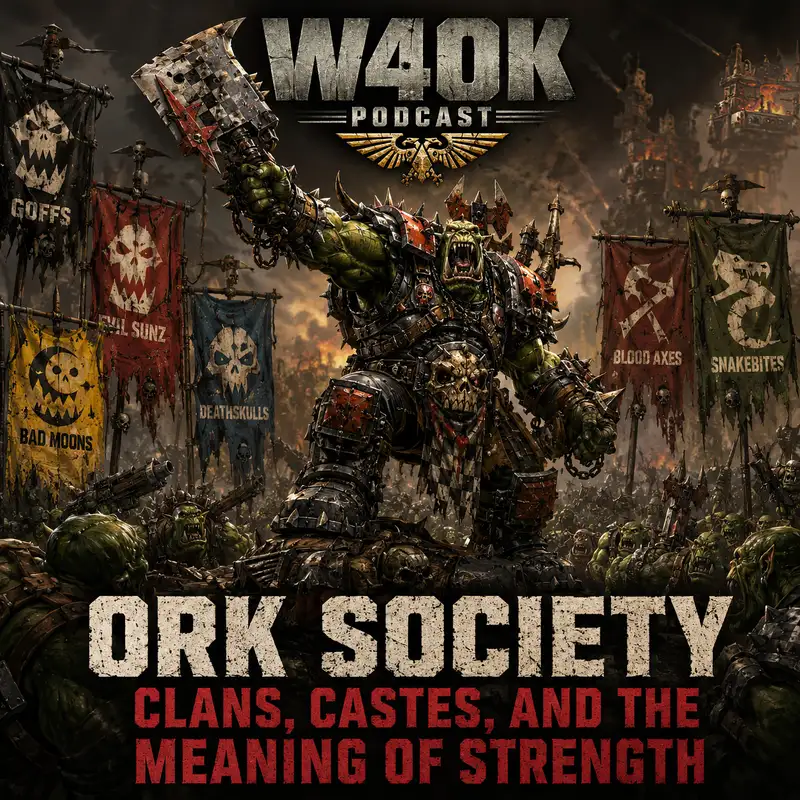
This distinction explains why two Goffs may fight each other while a Goff and a Bad Moon serve in the same army. Clan loyalty shapes identity, but allegiance follows the boss. Orks do not consider this contradictory. A Goff can despise the ostentation of a Bad Moon Nob, mock his yellow armour, and still charge beside him because both expect the campaign to produce a satisfying amount of destruction. If their Warboss weakens, those differences may become reasons to split apart. Until then, rivalry supplies energy. An Ork alliance is often held together by the shared conviction that there are better enemies available elsewhere.
At the bottom of the specifically Ork hierarchy are the youngest and least established Orks, often called yoofs, and above them stand the great mass of Boyz. Boyz are the ordinary warriors, labourers, raiders, guards, drivers, and willing participants in almost any plan that ends with noise. They gather into mobs under leaders who have proved larger, harder, or more dangerous. Their lives are not peaceful between battles. They brawl, gamble, trade, boast, repair weapons, bully smaller creatures, and search for opportunities to improve their standing. Social mobility exists, but the interview process is unusually direct.
Above the Boyz are the Nobz, the ruling caste of Ork society. A Nob is bigger than an ordinary Boy, better armed, more heavily armoured, and entitled to a larger share of whatever has recently been stolen. Nobz command mobs, enforce the Warboss's orders, and watch one another for signs of weakness. Their position is not ceremonial. A Nob who cannot dominate his followers will lose them, and perhaps several important parts of his anatomy. A successful Nob grows in reputation and often in physical stature, gathering better weapons and more followers until he is strong enough to become a boss in his own right.
At the summit stands the Warboss, although the summit may contain several peaks. A large tribe can include subordinate bosses, specialist bosses, powerful Nobz, and allied warlords who retain their own followers. The strongest among them becomes the centre of gravity. His personal size is a visible argument, but his real authority is measured by momentum. Does he win? Does he find enemies? Do the Meks receive enough scrap to build greater weapons? Do the Boyz return with trophies? Does each victory bring more Orks into the horde? If the answer remains yes, the boss becomes harder to challenge because his success has made everyone around him stronger as well.
This creates a feedback loop between biology, reputation, and war. Orks continue to grow throughout their lives, and those who survive repeated battles become larger and more formidable. Their increased size brings status, better equipment, and command. That status gives them access to more fighting and more resources, which creates further opportunities to grow. The hierarchy is therefore written onto the body. An Ork does not need a rank badge to recognise that the immense figure in scarred mega armour has probably won more arguments than he has lost.
The arrangement is ruthless, but it is not random. A weaker Ork generally obeys a stronger one because resistance is dangerous and because the stronger Ork may lead him toward profitable war. A boss who suffers one defeat does not automatically lose everything. Orks can enjoy a magnificent fight even when they are driven from the field. Repeated failure is different. A leader who cannot provide victories, loot, movement, or believable promises begins to look small before he physically shrinks in anyone's estimation. Challenges follow. Ork politics rarely requires polling, though it frequently produces a recount.
The six great clans express different ideas about what strength should look like. They are not separate nations, and they do not usually maintain fixed territories across the galaxy. They are recurring Ork cultures that appear wherever large Ork populations develop. Each favours its own colours, glyphs, weapons, habits, and methods of war. An Ork does not select a clan after calmly reviewing the available philosophies. Clan identity seems to arise from deep-seated Ork nature, reinforced by imitation, rivalry, and the inherited knowledge built into the species.
The Goffs present strength in its most direct form. They value toughness, discipline by Ork standards, and close combat delivered without unnecessary decoration. Black is prominent in their wargear, often broken by checks, and their leaders tend to respect the plain evidence of a foe struck down at arm's reach. Goffs are not incapable of strategy, as Ghazghkull Thraka demonstrates rather decisively. They simply distrust any plan that appears to avoid the essential business of meeting the enemy and proving who is harder. For a Goff, sophistication is acceptable so long as it eventually produces a headbutt.
The Evil Sunz understand strength as speed. They are drawn to engines, warbikes, roaring vehicles, and the belief that red machines go faster. Their forces may appear less orderly than those of a human armoured regiment, but their enthusiasm for mobility gives them a clear military character. They want to arrive first, strike before the enemy is ready, and leave only when another target promises a faster route to violence. An Evil Sunz boss gains authority by possessing the loudest vehicle, surviving the most reckless manoeuvres, and proving that hesitation is merely cowardice with the engine switched off.
The Bad Moons turn wealth into power. Their teeth grow faster than those of other Orks, giving them a natural advantage in an economy that uses teeth as currency. They buy superior weapons, extravagant armour, and the services of skilled Meks. Yellow and black display their status, while oversized guns make the same point in a language everyone understands. Other clans may call them soft or flashy, usually while attempting to steal their equipment. A Bad Moon leader proves strength by owning what others cannot afford and by remaining alive despite advertising that fact from a considerable distance.
The Deathskulls find strength in possession, salvage, and luck. They are relentless looters who strip battlefields, wrecks, settlements, and occasionally the belongings of allies who looked away at an unfortunate moment. Blue paint is associated with good fortune, and Deathskulls combine superstition with a remarkable ability to turn stolen material into useful wargear. Their culture reveals something important about Ork intelligence. They may not preserve technical knowledge in academies, but they observe, imitate, dismantle, recombine, and test. A machine that explodes is a failure. A machine that explodes in the enemy's direction may still qualify for promotion.
The Blood Axes define strength through cunning, preparation, and the selective theft of enemy methods. They use camouflage, organised tactics, ambushes, retreat, and even negotiation with humans when it serves their interests. Other Orks regard much of this behaviour as suspiciously un-Orky. The Blood Axes endure the insults because surviving an ambush is more satisfying than honourably walking into it. Their existence proves that Ork society does not reject intelligence. It rejects intelligence that cannot defend itself. A Blood Axe who wins will be mocked and obeyed, which is often all the recognition an Ork requires.
The Snakebites look backward rather than outward. They preserve old customs, favour squigs and great beasts, and distrust many of the more elaborate machines beloved by other clans. This is not simple ignorance. Snakebites understand strength as toughness, endurance, and closeness to the ancient Ork way of life. They survive harsh environments, wrestle creatures that sensible species would observe from orbit, and treat discomfort as evidence that training is proceeding properly. Their traditionalism provides another route to status. An Ork covered in scars and riding an enormous beast requires very little written explanation.
These clan ideals constantly overlap. A Goff may ride in an Evil Sunz vehicle. A Deathskull may become rich enough to rival a Bad Moon. A Blood Axe may command a direct assault once deception has placed the enemy in the correct position. A Snakebite may accept a powerful gun if it has been made sufficiently brutal, or if refusing it would allow someone else to have it. Clan culture shapes preference, not destiny. The strongest Warbosses exploit these differences, giving each clan a role that flatters its identity while binding all of them to a larger campaign.
Not every Ork remains comfortably inside the major clan pattern. Freebooterz leave or are driven from their old communities and gather beneath pirate Kaptins whose authority rests on plunder and reputation. Kommandos embrace stealth that many Boyz consider deeply suspicious. Stormboyz sometimes experiment with drill, uniforms, and obedience, alarming their elders with behaviour that would appear almost normal in another species. These groups survive because Ork culture is more flexible than its slogans suggest. An eccentric method becomes acceptable when it produces victory, loot, or a sufficiently impressive explosion.
Ghazghkull's rise offers the clearest example. Accounts of his early conquests portray him bringing rival clan leaders under control through campaigns, challenges, and contests that addressed their own understanding of strength. An Evil Sunz leader could be beaten through speed. A Goff challenger could be broken in a direct physical contest. More calculating bosses could be shown that service promised greater war than resistance. Whether every detail of these Ork traditions is reliable is doubtful. The broader pattern is convincing. Ghazghkull did not unite Orks by making them less Orky. He became powerful by giving their rival instincts a single direction.
The word caste is useful for describing Ork society, but it must be handled carefully. Nobz and Boyz form genuine layers of status, yet rank can change through growth, violence, and success. Other positions are specialist callings rather than promotions. Mekboyz possess an instinctive grasp of machinery. Painboyz understand surgery in the same alarming fashion. Weirdboyz channel the psychic pressure generated by nearby Orks, whether they enjoy the experience or not. Runtherds control grots, snotlings, and squigs. These specialists are often grouped as Oddboyz because their abilities mark them out from ordinary warriors.
Oddboyz complicate the rule of the biggest. A Mek may be smaller than a Nob but indispensable to the Nob's supply of weapons. A Painboy may be bullied until the moment a Warboss needs an arm reattached. A Weirdboy may be treated as dangerous livestock, yet his powers can shatter enemy lines. Their status comes from capability protected by fear, patronage, and practical necessity. Ork society does not grant them professional respect in the human sense. It grants them workshop space, assistants, payment, and enough personal danger that negotiations remain lively.
Beneath the Orks live the smaller greenskin species, especially Gretchin, usually called grots, and the even smaller snotlings. Calling them lower Ork castes is misleading because they are distinct parts of the Orkoid ecosystem. In social terms, however, they form an exploited underclass. Grots cook, carry ammunition, maintain equipment, herd squigs, crawl into machinery, clear mines, and perform tasks an Ork considers boring or insufficiently violent. They are clever, resentful, and capable of organisation, but individual grots rarely possess the physical power to resist their masters for long.
This reveals the limit of calling Ork society meritocratic. An Ork Boy can rise by surviving, growing, and defeating rivals. A grot can display courage, intelligence, and technical skill and still be kicked aside by an Ork who regards size as the final argument. Strength creates opportunity only for those already permitted to compete. Ork society is open to talent, but only within a structure of species, violence, and intimidation. It is less a ladder than a heap of fighters, with everyone climbing and the largest individuals standing on the rest.
Even the Ork economy reflects this social order. Teeth serve as currency because they regrow, circulate, and eventually decay, preventing wealth from remaining stable forever. Orks earn, steal, gamble, trade, and seize them from defeated rivals. Better weapons increase the chance of victory, while victory brings more teeth and loot. Wealth therefore supports strength, and strength permits the acquisition of wealth. The Bad Moons begin with an advantage, but no Ork fortune is secure when every customer is armed and the distinction between taxation and robbery depends mainly on the boss's tone of voice.
At a larger scale, the system turns private aggression into collective expansion. A successful boss attracts mobs. Mobs become a warband. Warbands and tribes gather around greater leaders. Meks build larger engines, Weirdboyz feel rising psychic pressure, and the shared excitement of battle becomes part of the phenomenon Orks call the Waaagh. The term can describe the psychic energy surrounding them, the great war movement driven by it, and the cry that announces both. As momentum increases, Orks who would normally fight each other are drawn toward the same enemy and the same promise of greater conflict.
This is why Ork invasions can grow with terrifying speed. Their society does not require a long process of ideological conversion. The successful boss offers proof through results. His army is larger today than yesterday. His guns are louder. His ships are moving. Enemies are gathering. Every new victory tells nearby Orks that this is where strength is becoming visible. They join because the boss appears right, and he appears right because they join. The Waaagh becomes a political movement, an industrial mobilisation, a religious experience, and the largest brawl in the region, all without creating a department responsible for coordination.
Gork and Mork embody the same balance. One represents brutality sharpened by cunning, while the other represents cunning delivered with brutality. Orks disagree enthusiastically about which is which, but the distinction matters because their ideal leader needs both. Pure force can win a duel and lose a campaign. Pure cleverness earns little respect if it cannot survive contact with an angry Nob. The greatest Ork leaders combine personal violence with the ability to read their followers, exploit clan rivalries, reward useful specialists, and keep the horde moving toward a future worth fighting for.
Ork strength is therefore not a fixed measurement. It is a relationship between body, reputation, followers, resources, instinct, and momentum. The biggest Ork is obeyed because he is dangerous, but he remains the biggest figure in society because others gather around his victories. Clans provide competing visions of strength. Castes and specialist roles turn those visions into working armies. Grots and lesser creatures bear much of the cost. The whole structure remains stable only while its leaders can transform internal violence into outward conquest.
When that transformation fails, the tribe fragments and the contenders begin again. When it succeeds, factories rise from scrap, warships gather in orbit, and worlds hear the first distant thunder of a Waaagh. Ork society does not ask whether power is lawful, compassionate, or wise. It asks whether power can prove itself, whether it can survive challenge, and whether it can lead to a better fight. For an Ork, strength means more than being able to crush the rival before you. It means becoming the reason every rival nearby decides to face the same direction.