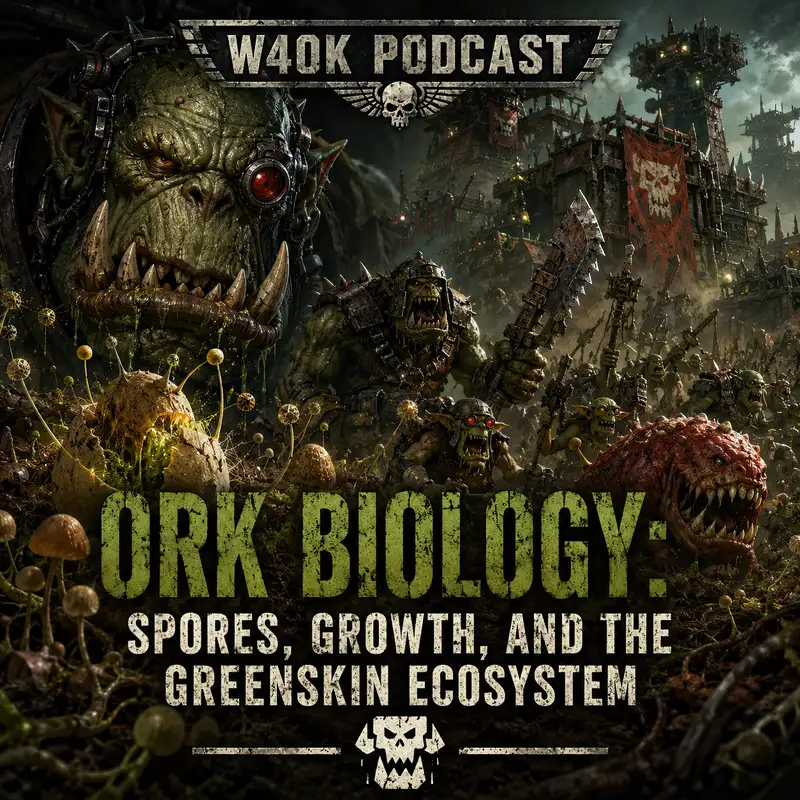
Ork Biology: Spores, Growth, and the Greenskin Ecosystem
The war is over when the last Ork stops moving. That is what the officers report, what the priests proclaim, and what the exhausted survivors desperately need to believe. The bodies are burned. The wreckage is dragged into heaps. Patrols sweep the tree line and find nothing larger than a frightened scavenger. Months pass. Then unfamiliar mushrooms appear in the shell craters. Small, vicious animals begin raiding supply dumps. Something laughs in the drainage tunnels. Years later, a farmstead vanishes beneath a crude green assault, and the authorities discover that the defeated invasion never truly left. The Orks had already buried their return beneath the soil.
An Ork invasion is easy to misunderstand because it looks like an army. There are warriors, commanders, vehicles, artillery, and a great deal of shouting. Yet the army is only the visible stage of something larger. Orks do not merely conquer territory. They carry a complete biological system with them, one capable of producing food, labourers, beasts, specialists, and eventually more Orks. The greenskin threat is therefore not simply a population of alien soldiers. It is a self-seeding ecosystem built for survival, expansion, and war. Defeating the army removes the branches. The roots remain.
Imperial scholars have struggled to classify Ork biology in familiar terms. An Ork is not simply an animal that happens to be green, nor is it literally a walking mushroom. Its body combines animal tissue with fungal and algal elements so thoroughly that the categories begin to lose their usefulness. Muscle, bone, crude organs, and resilient fungal material work together as a single organism. This helps explain the Ork’s remarkable strength, its tolerance for injury, and its ability to survive medical treatment that would be prosecuted as murder in most civilised systems. The resulting creature is inelegant, brutally efficient, and very difficult to discourage.
The most important feature of that biology is reproduction. Orks do not form families, bear children, or maintain bloodlines in the human sense. They release microscopic spores throughout their lives, shedding them wherever they travel, fight, sleep, eat, or argue over who owns a particularly impressive axe. The release becomes especially heavy when an Ork dies. A battlefield filled with greenskin corpses is therefore not merely a site of enemy casualties. It is a broad dispersal event. Every fallen Ork may leave behind the beginnings of another infestation, which lends a certain biological ambiguity to the phrase decisive victory.
Most spores never become anything dangerous. Conditions matter, and a galaxy in which every spore matured would have become entirely green long ago. Enough survive, however, to settle into soil, ruins, swamps, cave systems, refuse pits, and other sheltered ground. There they develop below the surface in fungal growths and gestation sacs. The exact process remains imperfectly understood, not least because Imperial research teams studying active Ork infestations have a regrettable tendency to become part of the local food chain. What emerges is not always an Ork. The spores can generate several forms of Orkoid life, each suited to a place within the wider system.
The sequence often begins quietly. Fungal beds spread first, creating hardy growths that can survive in poor ground and provide nourishment for later creatures. Squigs appear in bewildering varieties, filling roles that other ecosystems would divide among livestock, predators, parasites, tools, and occasionally personal grooming. Snotlings follow, small Orkoids associated with tending fungus and handling the lesser squigs. Gretchin, or grots, emerge as a more capable labour caste. Only after the supporting ecology has begun to establish itself do the larger Orks appear in meaningful numbers. The system does not begin by producing an army that immediately starves. It grows the camp before it grows the conquerors.
Squigs are the clearest sign that the Orkoid ecosystem is more sophisticated than it first appears. The name covers an enormous range of creatures, usually aggressive, frequently edible, and almost always unpleasant to hold. Some are raised for meat. Some are used as attack animals. Others become mounts, living ammunition, medical resources, or crude substitutes for equipment. Certain varieties are valued for teeth, hides, secretions, or other useful traits. The details can sound comic until one recognises the underlying principle. The Orks possess a biological toolkit. Where another army requires supply contracts, veterinary units, spare parts, and agricultural support, a greenskin settlement can grow many of its necessities from the same spreading foundation.
Snotlings and Gretchin occupy less glorious places in that arrangement, though glory is not a resource the Orks distribute generously. Snotlings are tiny, easily bullied, and used for menial tasks that even grots consider beneath them. Gretchin are more intelligent and far more useful. They scavenge, cook, maintain camps, carry ammunition, crew guns, tend squigs, and perform the endless labour that allows Orks to devote themselves to fighting. Their position is miserable, but their ecological function is essential. A mob of Orks without grots can still wreck a settlement. A growing Ork society with grots can build fortifications, repair weapons, organise supplies, and prepare for the next war.
When young Orks emerge, they are often called Yoofs. They are smaller, less experienced, and uncertain of their place, although uncertainty among Orks is usually resolved by hitting something until the social question becomes clear. They mature quickly and enter a culture that requires no parents, schools, or formal coming-of-age rituals. The surrounding mob teaches through imitation, intimidation, and violence. An Ork learns where it belongs by testing those around it. It discovers who can be bullied, who must be obeyed, and which mistakes result in being thrown into a squig pen. This is not a failure of social development. It is the method by which Ork society sorts itself.
Orks continue growing throughout their lives, and their growth is tied to success. An Ork that wins fights, gathers followers, and imposes its will becomes larger, stronger, and more commanding. Size is not merely a symbol of authority. It is both the result of dominance and the means of preserving it. A large Ork can defeat rivals, and each victory reinforces the conditions that allow it to grow larger still. Boyz become Nobz. Nobz become bosses. The most successful bosses become warlords whose physical presence reflects the scale of the violence they command. Among humans, rank may be represented by insignia. Among Orks, rank can block the doorway.
This creates a hierarchy without written law. Orks do not need a constitutional settlement to decide who leads. They fight, and the winner acquires followers. Rival mobs clash until one boss proves stronger or more cunning. The resulting order is unstable, cruel, and surprisingly functional. Internal conflict removes weak leaders, hardens survivors, and concentrates the mob around figures capable of directing larger campaigns. Ork infighting certainly wastes lives and equipment, but it also acts as a permanent selection process. The system is always testing itself. Once a boss becomes powerful enough to point that violence outward, a collection of feuding mobs can become a Waaagh.
The Waaagh is more than a migration or military campaign. Large gatherings of Orks generate a collective psychic energy, a pressure created by their shared instincts, excitement, and belief. Weirdboyz channel it most visibly, often with spectacular consequences for everyone standing nearby. The field also appears to strengthen the cohesion and momentum of Ork society as numbers increase. It does not mean that an empty metal box becomes a cannon merely because an Ork insists that it is. Ork technology still requires mechanisms, fuel, ammunition, and someone reckless enough to operate it. The psychic effect seems better understood as an amplifier, making an already functional greenskin system perform beyond what an outside observer expects.
Population changes what the Orks are capable of becoming. A few scattered survivors may remain feral, armed with crude blades and scavenged weapons. As numbers rise, more complex behaviour and specialist knowledge appear. Meks feel compelled to build engines, guns, aircraft, and increasingly improbable machines. Painboys understand surgery in the instinctive Ork fashion, which combines genuine biological skill with a relaxed attitude toward consent. Runtherds manage grots and squigs. Weirdboyz emerge to contain, or fail to contain, the mob’s psychic force. These specialists do not require a university, an industrial tradition, or a recovered technical archive. Their knowledge is carried within the species and awakened by circumstance.
That inherited knowledge may be the most dangerous part of the entire ecosystem. A conventional colony depends on teachers, records, trained experts, and supply chains. Destroy those institutions and the colony may collapse. Orks can rebuild complexity from biology. Spores produce a population. The population produces specialists. Specialists produce weapons and vehicles. Those weapons enable conquest, which brings scrap, captives, fuel, and more territory for spores. The cycle feeds itself. A greenskin settlement can advance from scattered feral bands to an industrial war camp without first reconstructing the long educational history that such technology should require. The design is inelegant, but elegance has never stopped a battlewagon.
Ork resilience supports the same pattern. Their bodies are thick, muscular, and padded by tough internal tissues. They can survive blood loss, amputation, organ damage, and infection at levels that would kill most humans. Painboys replace limbs, bolt metal into living tissue, and have even performed successful head transplants, though the owner of the receiving body may not have been consulted. This durability reduces the cost of constant violence. Orks can fight one another, suffer grotesque injuries, and return to the mob with scars, metal plates, or an upgraded mechanical arm. Their culture would destroy a more fragile species. Ork biology makes that culture sustainable.
Even Ork commerce is tied to this living design. Orks use their own teeth, known as teef, as currency. The teeth grow, are lost, and are replaced throughout an Ork’s life. They also decay after removal, which limits long-term hoarding and keeps wealth moving through the settlement. Bigger Orks tend to have bigger teeth and can usually acquire additional payment by extracting it from smaller neighbours, so biology, status, and economics remain politely aligned. A Mek can trade weapons for teef, spend those teef on labour or materials, and know that the mob will eventually grow more money. The system is crude, local, and resistant to the collapse of distant financial institutions, a concern that has troubled remarkably few warbosses.
The ecosystem also transforms the land around it. Native plants are displaced by aggressive fungal growth. Squigs spread through the undergrowth and ruins. Grots dig, scavenge, and reshape settlements. Orks clear ground through fire, industry, and recreational demolition. Over time, the original environment can become an Orkoid landscape in which nearly every useful niche serves greenskin life. Food grows close to the camps. Predators double as weapons. Waste feeds fungus. Wreckage becomes construction material. The distinction between military occupation and ecological replacement gradually disappears. The world is not merely held by Orks. It begins to function like an Ork world.
The same pattern travels between worlds. Spores cling to armour, wreckage, cargo, and the filthy interiors of Ork vessels. Roks, hulks, and ramshackle ships do not carry only warriors. They carry fungal traces, squigs, grots, scraps of established growth, and every biological ingredient needed to begin again after landing or crashing. An Ork fleet is therefore a moving habitat as much as a naval force. Even a wrecked vessel can contaminate the ground around it, while survivors scatter spores as they raid for food and weapons. The greenskins do not need to preserve a clean separation between army, colony, and ecosystem. To them, all three are simply different moments in the same expanding brawl.
For defenders, this changes the meaning of victory. Killing the warboss may shatter a Waaagh. Destroying the main horde may save a city or a continent. Neither action guarantees that the planet is clean. Spores can remain hidden in remote valleys, sewer networks, mine workings, jungles, or the ash fields beyond a ruined hive. Years or decades later, squigs and grots may reappear. Feral Orks gather in places the authorities stopped watching. A new boss rises, and the descendants of the victorious defenders discover that they have inherited the same war. The original invasion becomes an ecological wound that keeps opening.
Eradication therefore requires more than battlefield success. Infested regions must be burned, searched, and searched again. Caves, drainage systems, refuse zones, and wilderness areas require long-term patrols. Fungal growths must be destroyed before they mature. Isolated greenskin bands must be hunted before they gain enough numbers to produce stronger leadership and specialised support. On some worlds, the effort continues for generations. The Imperium is capable of such persistence when sufficiently motivated, although it is equally capable of declaring the matter resolved, reallocating the troops, and filing the first reports of renewed attacks under unexpected agricultural disturbances.
The Orkoid system should not be mistaken for a hive mind. Orks remain individuals, and those individuals are argumentative, competitive, and frequently treacherous. They do not cooperate because a central intelligence assigns them roles. They cooperate because strength attracts followers, instinct produces specialists, and shared excitement creates momentum. The ecosystem accepts enormous internal waste because it produces enormous numbers. Rivalry is not a flaw accidentally left in the design. It may be one of the forces that keeps the species aggressive, adaptable, and ready for war. Peace would deprive Orks of the pressure that shapes them. Fortunately for their biology, they are careful to avoid it.
The origins of this system reach back into the oldest and least reliable histories of the galaxy. Ork legends speak of the Brain Boyz, mysterious creators whose identity changes with the telling. Other ancient accounts describe the Krork, a powerful warrior species associated with the Old Ones and the wars that scarred the galaxy before humanity existed. The relationship between the Krork and modern Orks is strongly suggested, though the surviving evidence does not provide a neat biological record. What matters is that Ork physiology bears the marks of design. It resembles not an animal adapted to one environment, but a colonisation weapon intended to bring its own environment wherever it goes.
Seen in that light, every part of greenskin life fits together. Spores provide dispersal. Fungus provides a foundation. Squigs provide food, materials, and specialised creatures. Snotlings and grots provide maintenance and labour. Orks provide force. Oddboyz restore technical and medical capability. Competition produces leaders. The Waaagh field binds growing numbers into greater momentum. None of these pieces needs to be perfect. They only need to be abundant, replaceable, and capable of rebuilding the next layer. The ecosystem survives the loss of individuals because individuals were never the point. Its true organism may be the entire infestation.
This also explains why Orks can seem primitive in one war and frighteningly advanced in another. A small feral population expresses only the lower levels of the system. Give it time, territory, conflict, and numbers, and new possibilities emerge. Larger bosses appear. More capable Meks construct heavier weapons. Settlements become cities. Cities support fleets. In exceptional Ork empires, leaders display intelligence and physical development far beyond the common boy. The difference is not necessarily a separate species or a sudden miracle. It may be the same biological architecture reaching a scale that most greenskin populations are too divided, or too frequently destroyed, to achieve.
There is a grim efficiency in the absence of family. No Ork waits for a breeding season, protects a vulnerable infant, or spends years teaching a child the knowledge required for survival. Spores scatter without planning. New Orkoids emerge into an environment already prepared by earlier forms. Social identity comes from the mob, the clan, the boss, and the work an Ork feels driven to perform. This makes their culture brutally impersonal, but it also makes it difficult to break through the methods used against ordinary societies. There are no dynasties to end, no parent generation whose loss prevents the next, and no educational system whose destruction erases essential knowledge.
The greenskin ecosystem is therefore one of the great strategic horrors of the forty-first millennium precisely because it does not look like one. It arrives aboard crude ships and ramshackle hulks. It announces itself with gunfire, smoke, and laughter. Its warriors appear undisciplined. Its machines look unsafe because they usually are. Yet beneath that disorder lies a survival system older than the Imperium, perhaps older than most living civilisations. Orks can lose armies, warlords, fortresses, and worlds while the species continues spreading through the unnoticed biological residue of defeat. Their apparent simplicity conceals a design built to endure catastrophe.
So the first battlefield was never truly empty. Beneath the ash, spores waited without orders, memory, or fear. Fungus would prepare the ground. Squigs would fill the dark places. Grots would build amid the ruins. Young Orks would climb into the light and begin the old argument over who was strongest. From that argument would come a boss, from the boss a mob, and from the mob another war. The Ork is not merely a soldier who reproduces after conquest. The conquest reproduces with him. Burn the body, break the army, silence the guns, and the greenskin ecosystem may still be there, quietly growing its next invasion.