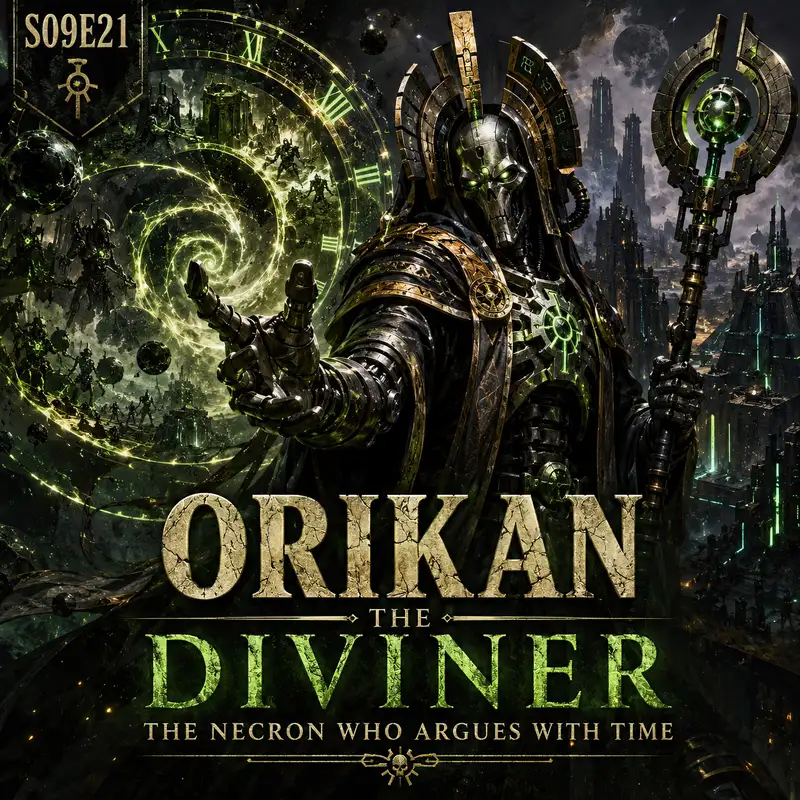
Orikan the Diviner: The Necron Who Argues With Time
The court had already heard the argument. It had heard the witnesses, considered the evidence, and endured the insults. Then, without anyone noticing, it heard them again. A gesture changed. A question arrived earlier. One answer was withheld and another was sharpened. Only Orikan remembered the discarded version of events, because only Orikan had stepped backward through the moment and rearranged it. For most beings, time carries the verdict. For Orikan the Diviner, time is merely an uncooperative witness, and witnesses can be pressured.
That is the contradiction at the center of Orikan. He is celebrated as the greatest astromancer among the Necron dynasties, a mind capable of reading the movement of stars and tracing consequences across ages. Yet when the future refuses to match his calculation, he does not quietly revise the calculation. He revises the future. Sometimes he revises the past as well. Orikan does not simply foresee history. He disputes it, appeals it, and, when necessary, returns to an earlier hearing with better preparation.
Long before he became a metal skeleton draped in the symbols of a Cryptek, Orikan was one of the Necrontyr, the short-lived people who built the civilization that would become the Necron empire. He was born into a family of warriors, but his body was too frail to follow the path expected of him. He failed to enter the ranks of the Immortals, the professional soldiers his father wanted him to join. In a culture obsessed with conquest, hierarchy, and the humiliation of mortality, physical weakness was not a small inconvenience. It was a verdict on what a life was permitted to become.
Orikan escaped that verdict by looking upward. He studied the stars, not as objects of worship, but as components in an immense system of cause and effect. A human astrologer looks for symbols. A Necrontyr astromancer calculates pressure, motion, conjunction, probability, and consequence on a scale that makes ordinary prediction look like guessing whether it might rain. Orikan learned to see empires inside orbital patterns and wars inside the slow drift of celestial bodies. His body had denied him the warrior's road, so he cultivated a weapon no soldier could parry: advance knowledge.
That knowledge brought him to the most important decision in Necrontyr history. Their rulers, led by the Silent King, accepted the bargain of the star gods known as the C'tan. The promise was release from diseased flesh and victory in the War in Heaven. The price was biotransference, the conversion of an entire species into bodies of living metal. Orikan opposed the bargain. He warned that the C'tan could not be trusted and that the offer concealed ruin. His warning failed. When the furnaces were lit, he did not enter willingly. He was taken in chains.
He emerged immortal, powerful, and vindicated in the worst possible way. The Necrontyr gained bodies that could rebuild themselves and armies that could fight without fatigue, but their old lives were gone. Most lost nearly everything that had made them individuals. The nobles and specialists retained more, though memory itself became damaged, selective, and vulnerable to pride. The C'tan fed upon what the Necrontyr had surrendered, and the people who had demanded freedom from death discovered that eternity could also be a prison. Orikan had predicted the trap. Being correct did not save him from it.
Among the Necrons, Crypteks occupy a place somewhere between scientist, engineer, court sorcerer, and jealously guarded weapons program. Their disciplines include command of matter, energy, dimensions, minds, and time. They sell their expertise to dynasties while protecting the methods that make them indispensable. Orikan is exceptional even among these specialists. His knowledge grants him access to rulers who dislike him, and his foresight gives him leverage against patrons who might otherwise silence him. He serves dynasties, but he is not truly owned by one. A king may command armies. Orikan can tell the king which army will still exist tomorrow.
That failure explains much of what followed. Orikan's arrogance is real, but it is not empty vanity. He once identified the greatest catastrophe in his people's history and was ignored by those with the authority to prevent it. Every later prophecy carries the shadow of that moment. To Orikan, a prediction is not merely an intellectual exercise. It is proof that his mind sees what kings, generals, and gods refuse to see. When events contradict him, they do more than threaten his reputation. They reopen the ancient wound of being right and powerless.
Necron accounts credit Orikan with foreseeing events far beyond the rise and fall of individual dynasties. He is said to have anticipated the collapse of the Aeldari empire, the rise of humanity's Imperium, the civil war of Horus, and the arrival of the Tyranid hive fleets. Claims made by ancient Necron nobles should not be accepted with the innocence of a newly awakened scarab, but Orikan's lesser predictions are useful enough that overlords tolerate his contempt. He can forecast fleet movements, political betrayals, and the moment when a battle line will break. He is unbearable, but accurate. In most courts, one of those qualities would cancel the other. Necron courts have had millions of years to lower their expectations.
His manner follows naturally from this position. Orikan addresses nobles with the confidence of someone who has already watched them make their mistakes. Rank impresses him less than competence, and competence rarely impresses him for long. This scorn is dangerous in a society whose rulers remember insults for geological periods, but retaliation is difficult when the intended victim may know the plan before its author has finished conceiving it. Orikan's survival is therefore partly a triumph of usefulness and partly the result of making revenge feel administratively exhausting.
His predictions are not magic in the human sense. They rest upon calculation so advanced that it becomes indistinguishable from prophecy to almost everyone else. Orikan reads the galaxy as a connected mechanism. A star shifts. Gravity alters a path. A fleet arrives at a different hour. A commander receives different information. A dynasty survives. The difficulty is that the galaxy contains forces that do not behave politely. The Warp, in particular, treats causality as a suggestion. Psychic intervention, daemonic influence, and the instability of Warp travel can introduce variables that refuse to remain inside any sane equation.
When those variables spoil a prediction, Orikan uses the art he guards most closely. He is not merely an astromancer. He is a chronomancer, able to manipulate the passage of time and, under the right conditions, return to an earlier point while retaining knowledge of what happened before. One Imperial example tells of dockyards that survived an Ork assault because the Silver Skulls Space Marines intervened. Their success contradicted Orikan's forecast. Rather than accept an imperfect model, he went back and ambushed the rescuers, ensuring that the dockyards fell as predicted. Orikan's prophecies are therefore best understood as heavily armed recommendations.
The distinction matters. A seer observes a future. Orikan enforces one. On the battlefield, this makes him almost impossible to engage fairly, not that fairness enjoys a long life in the forty-first millennium. He can anticipate attacks before they are made, shift his position ahead of danger, and strike with the Staff of Tomorrow, a weapon that exists fractionally ahead of the present. An enemy may begin an action only to discover that Orikan has already answered it. If the exchange still goes badly, he can attempt the moment again with the benefit of experience.
Chronomancy is not limitless. It demands energy, concentration, and equipment capable of preserving the user's awareness across altered events. Other Necron devices and chronomancers can obstruct it. The Warp can make it unreliable. Repeated manipulation also places strain upon reality itself. A sequence may be reset so many times that the local fabric of the universe weakens, with consequences that can surface years or decades later. Orikan can win an argument with time and leave someone else to deal with the hole burned through the wall. This is considered efficient by several ancient standards.
No relationship reveals Orikan more clearly than his rivalry with Trazyn the Infinite. Trazyn looks backward. He preserves armies, artifacts, people, and entire moments inside the galleries of Solemnace. Orikan looks forward. He regards the past as a failed state from which the Necrons must escape. Trazyn wants to remember what was lost. Orikan wants to become something that can never be lost again. Their feud is amusing because they are petty, but it endures because each represents a different answer to the same civilizational trauma.
Their greatest struggle centered on the Astrarium Mysterios and the supposed tomb of the ancient Necrontyr ruler Nephreth. Orikan believed the mystery concealed knowledge that could advance his grand design. He does not dream of returning the Necrons to ordinary flesh. To him, flesh is merely the first prison, metal the second. His desired future is transcendence into beings of pure energy, freed from decay, mechanical limitation, and the compromised identities left by biotransference. Nephreth appeared to offer evidence that such an ascent had once been achieved.
Trazyn had his own interest in the relic and, more importantly, a profound objection to Orikan taking anything from his collection without permission. Their dispute passed through theft, sabotage, military violence, legal proceedings, and several attempts at murder. Because both are functionally immortal and possess replacement bodies, escalation becomes less a barrier than a form of correspondence. A human feud may end when one participant dies. A Necron feud can continue after both participants have died repeatedly and filed complaints about the inconvenience.
Orikan's use of time during their legal battles exposes both his brilliance and his weakness. He can return to an earlier point in a hearing, alter his questions, adjust his manner, and test different paths toward the judgment he wants. The procedure resembles perfect preparation only because everyone else is trapped in the first attempt. Yet each revision also reveals his dependence on control. He does not persuade the court once. He rehearses reality until the court produces an acceptable answer. Victory becomes indistinguishable from refusing to allow any other outcome to remain real.
The search continued across thousands of years on a world known by different names to different rulers. Aeldari, Orks, humans, and hidden Necron mechanisms left their marks upon it while Trazyn and Orikan pursued a secret beneath the surface. Civilizations rose, renamed the planet, built monuments, fought wars, and disappeared. The two rivals treated these transformations as weather passing over a buried door. Their scale of attention is one of the most alien things about them. An empire can flourish between two appointments and be extinct by the time they resume the argument.
The planet eventually became the Imperial world of Serenade, and the hunt for the tomb drew both rivals into disaster. Orikan was trapped below the surface when Imperial destruction tore the world apart. He spent centuries digging his way free. Chronomancy made the ordeal worse rather than easier. When a route failed or danger caught him, he reset the attempt and tried again. From the outside, his escape consumed centuries. From Orikan's perspective, the repeated failures accumulated into far longer. He had made time obey, and time answered by ensuring that he remembered every unsuccessful version.
This is the quiet horror beneath his power. Orikan can erase an event from history without erasing it from himself. The dead may live again because he changed the sequence, but he remembers their deaths. A humiliation may never have happened for anyone else, yet it remains part of his experience. Chronomancy does not free him from consequence. It concentrates consequence inside the one mind that insists upon revision. The master of time carries a private archive of discarded worlds, failed arguments, and futures that no longer exist.
When the tomb was finally opened, Nephreth's promise proved false. The entire quest had been shaped by a shard of the Deceiver, one of the same C'tan whose bargain had destroyed the Necrontyr. The supposed path to transcendence was bait. Orikan, who had warned his people against the star gods, had been manipulated by one across ages. There are defeats that destroy a body, and there are defeats that force a prophet to confront the possibility that his certainty has become a lever in someone else's hand.
Trazyn and Orikan survived only by working together. Trazyn emptied portions of his impossible collection into the battle, releasing warriors and creatures taken from across history. Orikan applied the calculating mind that had guided dynasties and redirected timelines. The conflict was not a dignified reunion of ancient allies. It was two bitter rivals discovering that mutual hatred is less urgent when a star god intends to consume them both. Cooperation arrived late, suspiciously, and with several reservations, which makes it one of the more sincere partnerships in Necron history.
At the height of the battle, Orikan reached the transformation he had pursued. Drawing upon immense celestial power, he became a radiant being capable of confronting the Deceiver's shard on its own impossible terms. Metal form, physical limitation, and familiar identity fell away beneath something vast and luminous. For a brief period, the frail Necrontyr who had once been denied a warrior's future possessed power sufficient to fight a fragment of a god. He had not merely predicted his destiny. He had become it.
The transformation should have proven that Orikan was right. Instead, it revealed the danger hidden inside his ambition. As a transcendent being, ordinary lives and worlds became small. Energy became hunger. The distinction between liberation and the nature of the C'tan grew disturbingly thin. Orikan seeks to save the Necrons from soulless metal by raising them into forms of pure energy, but the galaxy already contains examples of what immortal energy beings can become. His dream may be an escape from biotransference. It may also be biotransference repeated at a higher and more terrible level.
That possibility separates Orikan from a simple prophet. He is not trying to preserve a fixed destiny delivered by some benevolent cosmic order. He is designing a future that will vindicate his understanding of existence. Every temporal intervention becomes part of the construction. Every corrected prediction reinforces the belief that the universe is safest when it agrees with him. He has seen rulers choose disaster over his warning, so he no longer trusts rulers. He has seen gods offer salvation, so he no longer trusts gods. The remaining authority is Orikan.
Even that authority has limits. The Deceiver fooled him. The Warp disrupts his calculations. Rivals can counter his devices. Each return through time risks damage that he may not fully control. His greatest successes can produce the conditions for later catastrophe. This does not make him a fraud. It makes him something more dangerous: a genuine genius whose evidence of past correctness gives him excellent reasons to dismiss every future objection. The universe has already admitted that he was right once. Orikan intends to make that admission permanent.
In the Pariah Nexus, the Silent King again sought Orikan's service. The Diviner initially refused. Then the arrival of Vashtorr's forces changed his decision, apparently because his calculations revealed a threat severe enough to outweigh old contempt. The same ruler whose command had carried the Necrontyr into biotransference now found himself relying upon the prophet who had opposed it. For the Silent King, Orikan's cooperation was hardly reassuring. When a being famous for seeing catastrophe changes course without explaining why, obedience can sound very much like an alarm.
Orikan argues with time because time once proved him right after it was too late to matter. He foresaw the betrayal of the C'tan, yet still entered the furnaces in chains. He survived the end of his species, but survival gave him no power to undo the choice that defined them. Every later loop, corrected battle, altered hearing, and engineered prophecy is an attempt to prevent that helplessness from happening again. He will never again be the frail voice at the edge of the chamber while kings choose ruin.
That is why his power is both magnificent and tragic. Orikan can examine possible futures with a precision few minds can approach. He can step backward, move a piece, and watch history form around the change. Yet he cannot accept that uncertainty is part of reality rather than an insult directed at him. The harder he forces time into agreement, the more discarded suffering he carries and the more fragile reality becomes beneath his hands. He wins the argument by making every losing version disappear.
Orikan the Diviner is not defined by seeing the future. He is defined by refusing to be wrong about it. Beneath alien stars, the ancient Cryptek calculates, intervenes, and calculates again, pushing the galaxy toward a destiny only he fully understands. Somewhere behind that cold brilliance remains the memory of chains, furnaces, and a warning no one obeyed. Time ignored him once. For the rest of eternity, Orikan intends to ensure that it never does so again.