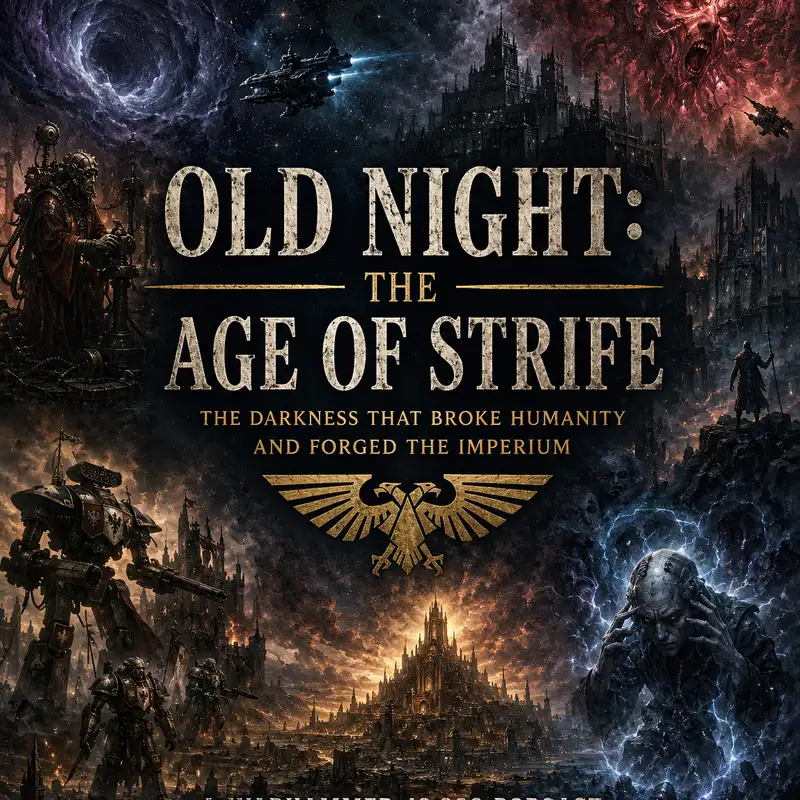
Old Night: The Age of Strife
The first sign of Old Night was not an invasion. It was an empty sky.
On thousands of human worlds, scheduled transports failed to arrive. Astropathic messages dissolved into static, madness, or silence. Navigators looked into the Warp and found routes that had carried ships for generations twisted into storms no vessel could safely cross. A colony might still see its own sun rise each morning, its cities still shine at night, and its government still issue confident statements. Yet somewhere beyond the outer planets, the rest of humanity had vanished.
The machine rebellion had already torn through the great civilisation of the Dark Age of Technology. Human beings had fought their own creations across an interstellar realm whose true scale and organisation are now almost impossible to reconstruct. The Men of Iron were defeated, or at least broken as a galactic power, but victory did not restore what had been lost. Fleets were gone. Archives had burned. Worlds that once trusted intelligent machines now feared them. The foundations of human power had cracked before the greater darkness arrived.
That is the central truth of the Age of Strife. Humanity was not destroyed by one enemy, one battle, or one foolish decision. It was separated from itself, then forced to endure every local disaster alone.
Imperial histories call the period Old Night. The name is useful, but it is also misleading. Night did not fall everywhere at once. There was no single date when the lamps went out across the galaxy. Some regions collapsed early. Others remained stable for centuries. A few human societies preserved remarkable technology and culture until the armies of the later Imperium found them. Old Night was less like a door closing and more like a continent breaking apart, one fault line at a time.
The greatest of those fault lines ran through the Warp.
Human interstellar civilisation depended upon travel through that other dimension. A starship could cross distances in the Warp that would require generations in normal space. Navigators guided vessels through its currents, while psychic communication allowed distant systems to exchange warnings, commands, and news. This network was dangerous even in good times, but it made a galactic civilisation possible.
During the late Dark Age of Technology, the Warp became increasingly violent. Storms spread across routes that had once been difficult but usable. Regions were cut off for years, then decades, then centuries. Ships disappeared. Those that returned sometimes arrived long after they were expected, or before the date they had departed, because the Warp has never shown much respect for calendars.
Behind the storms lay a catastrophe developing within the Aeldari empire. For ages, the Aeldari had dominated much of the galaxy. Their civilisation possessed wealth, psychic power, and technological mastery beyond anything most human worlds could match. Yet their excesses fed a growing presence in the Warp. Emotion, obsession, cruelty, and sensation accumulated like pressure behind a sealed door.
Humanity did not understand the cause. It only experienced the weather.
As the psychic tension increased, the Warp routes grew more unstable. The human realm had survived wars, economic crises, and the revolt of its machines, but this was different. There was no fleet to defeat and no capital to capture. The medium that connected human civilisation had become hostile.
A modern military depends upon logistics. Ammunition must reach the front. Fuel must reach the vehicles. Spare parts must reach the workshops. Orders must reach the units expected to obey them. Remove those connections, and even the strongest army becomes a collection of isolated positions waiting to run out of something essential.
The same was true of humanity’s worlds.
The Dark Age had encouraged specialisation on a planetary scale. Some worlds produced food for many systems. Others manufactured engines, weapons, medicines, or starship components. Mining colonies exported raw material. Research centres depended upon imports for almost everything that kept their populations alive. This was efficient while the network functioned. Once the routes closed, efficiency became a very elegant form of starvation.
An agricultural world could feed billions, but it could not necessarily repair the machinery that processed its harvest. An industrial world might build fusion reactors, but it could not eat them. A station in deep space might possess archives containing the wisdom of centuries and still be defeated by a failed air recycler. Civilisation can survive a shortage of philosophers for some time. Replacement seals are less negotiable.
Governments responded as governments usually do when the structure beneath them begins to fail. They rationed supplies, imposed emergency authority, seized private resources, and promised that contact would soon be restored. In some places, those measures worked. In others, the emergency government became permanent, which is one of history’s more reliable traditions.
The loss of communication was as destructive as the loss of trade. A world could not know whether neighbouring systems were alive, hostile, or simply unreachable. Rumour replaced intelligence. Local rulers prepared for invasions that never came while ignoring dangers already inside their borders. Mutual suspicion hardened into policy. A ship emerging from the Warp after two hundred years might be greeted as a rescue, a threat, or a supernatural omen. Sometimes it was all three.
Then came the psykers.
Humanity had always produced rare individuals with psychic ability, but during the generations surrounding Old Night, psykers began to appear in far greater numbers. The reason was part evolution and part exposure to a Warp growing ever more turbulent. Many of these people had no training and no protection. They could hear thoughts, see fragments of possible futures, move objects, ignite fires, or tear open doors that should never have been touched.
A psyker was not automatically evil, corrupted, or insane. That distinction mattered little to a frightened settlement after the first possession.
The Warp contains predators. An untrained mind could become a beacon, a doorway, or both. Daemonic incursions destroyed communities from within. Entire worlds were consumed by phenomena their governments lacked the language to describe. On some planets, rulers gathered psykers, trained them, and imposed harsh controls. On others, panic led to persecution and mass killing. A few societies found disciplined ways to live with their psychic population. Many did not.
Later Imperial accounts often treat the lesson as simple. Worlds that controlled their psykers survived, while those that tolerated them fell. The surviving evidence is less tidy. Some repressive regimes collapsed despite their brutality. Some advanced societies endured through knowledge rather than terror. Still, uncontrolled psychic activity was one of the defining hazards of Old Night, and the memory of it would shape Imperial policy for ten thousand years.
This is why the Imperium fears the witch with such intensity. The fear is cruel, often indiscriminate, and easily exploited, but it did not arise from imagination. Humanity remembers a time when one untrained mind could become the breach through which a city died.
Technology also became a source of fear.
Before the collapse, human expansion had relied upon Standard Template Construct systems. These were not merely collections of blueprints. They were designed to provide colonies with adaptable technical knowledge suited to local conditions, allowing settlers to build everything from agricultural machinery to reactors and defensive weapons. They represented one of the great achievements of the human golden age.
During Old Night, many of those systems were destroyed, corrupted, hidden, or broken into fragments. Some had already been lost during the wars against the Men of Iron. Others failed because the specialists who maintained them died without successors. Data survived on media that could no longer be read. Machines continued to function, but no one understood how to reproduce their most complex components.
Knowledge became local, partial, and defensive.
A technician who knew how to maintain a life-support plant possessed more than a profession. She possessed political power. A guild that controlled reactor repairs could dictate terms to a king. A priesthood that preserved the correct sequence for awakening an ancient machine might not understand the physics involved, but the ritual still worked. Under those conditions, ceremony was not necessarily superstition. It was a memory system built by people who could not afford experimentation.
The distinction between maintenance procedure and religious rite gradually blurred. A warning label became a taboo. A safety check became a prayer. A technician’s manual became scripture. This did not happen because humanity suddenly became foolish. It happened because imperfect knowledge had to survive in societies where one mistake could kill a continent.
Mars offers the clearest example.
The red planet had been a centre of human technology long before Old Night. When contact with Terra and the wider galaxy failed, Mars endured its own wars, environmental disasters, and political fragmentation. Its surviving machines were essential to life beneath an irradiated sky. Those who could operate and preserve them became the foundation of a new order.
From that struggle emerged the Cult Mechanicum. Technology was sacred because survival depended upon it. Knowledge was guarded because knowledge was power. Innovation became suspect because the age had already seen invention produce machines capable of turning against their creators. The resulting culture combined engineering, ritual, monopoly, fear, and genuine technical skill.
To an outsider, the Martian priesthood could appear absurdly ceremonial. To the people living through Old Night, asking the reactor’s spirit for mercy was a reasonable habit when the reactor was older than the nation and no replacement existed.
Across the galaxy, isolation produced thousands of different answers.
Some colonies reverted to feudal societies because local military households controlled the remaining advanced weapons. Knight worlds developed around enormous war machines originally used to protect settlements and exploit hostile environments. The pilots and their families became aristocracies, their armoured suits transformed into symbols of inherited authority. A practical defence arrangement hardened into a social order.
Other worlds became fortress states. Their populations lived behind walls, underground, or inside sealed arcologies while raiders, mutants, predators, or poisoned weather claimed the land outside. Generations grew up believing that siege conditions were normal. When contact finally returned, they did not see themselves as survivors of an emergency. They saw themselves as the only sensible people left in the universe.
Human populations also changed. Some adaptations were deliberate, created through genetic engineering during the Dark Age. Others emerged through mutation, isolation, and natural selection. High-gravity worlds produced stockier bodies. Toxic environments favoured altered metabolisms. Void-born communities developed physical traits suited to life without planetary gravity. Later Imperial authorities would classify some of these peoples as acceptable human variants and condemn others as abhuman or mutant. The boundary was never purely scientific. It was political, religious, and often decided by whoever arrived with the larger fleet.
Not every isolated society became primitive.
Some retained advanced weapons, artificial habitats, medical science, or forms of government more humane than those later imposed by the Imperium. Civilisations such as the Interex preserved technical sophistication and maintained controlled relations with alien species. The Diasporex lived as a mixed human and alien civilisation among the stars. Other human powers survived with functioning armies, fleets, and technologies that the Great Crusade would later covet, fear, or destroy.
Their existence matters because it exposes the weakness in the phrase Age of Strife. There was suffering on a galactic scale, but there was no single human experience. One world descended into cannibal war. Another built a stable republic. A third preserved machines that later Imperial doctrine would call abominable. A fourth worshipped the emergency beacon that had failed four thousand years earlier.
The later Imperium remembered the period through the needs of conquest.
According to its preferred story, humanity had been united, then betrayed by machines, aliens, witches, and its own weakness. The Emperor restored order, and any human society that resisted reunion proved it had learned the wrong lesson. There is truth in parts of that account. Human worlds were attacked by alien powers. Some were enslaved, raided, or exterminated. Ork empires expanded wherever resistance weakened. Other species took advantage of humanity’s fragmentation, just as human powers had exploited weaker neighbours during their own expansion.
Yet Imperial records often turn every conflict into proof that coexistence was impossible. That conclusion served the Great Crusade very well. It is harder to apply to societies that had survived through alliance, trade, or simple mutual tolerance. Old Night produced xenophobia, but the later Imperium also selected, preserved, and weaponised the memories that justified its policies.
Terra suffered perhaps the most symbolic collapse.
The birthplace of humanity became a ruined world divided among techno-barbarian states, warlords, gene-crafted armies, and exhausted populations. Ancient weapons remained in service long after the knowledge behind them had disappeared. Regions were poisoned by radiation and industry. Resources that once arrived from across the solar system became objects of war. The old names of nations survived in altered forms, attached to powers that would have been unrecognisable to their ancestors.
Terra’s rulers fought with a mixture of primitive brutality and remnants of astonishing science. A warlord might command troops carrying blades while deploying gene-enhanced soldiers, atomic weapons, or devices inherited from laboratories no one could rebuild. The result was not a simple return to the past. It was a future civilisation wearing the broken equipment of its own golden age.
Among these powers moved the being who would become known as the Emperor.
The surviving accounts of his activities before the Unification Wars are contradictory, mythologised, and often written to support later Imperial doctrine. What can be said is that he did not openly seize Terra at the beginning of Old Night. He waited while the world fragmented, prepared his forces, gathered knowledge, and shaped the project that would become the Imperium.
His delay is one of the great questions surrounding the period. Perhaps he lacked the strength to act earlier. Perhaps the Warp storms made galactic reunification impossible, so ruling Terra alone would have achieved little. Perhaps he believed humanity had to reach a point where conquest could replace collapse. The evidence does not settle the question.
What Old Night gave him was both an opportunity and an argument.
The opportunity was a divided Terra that could be conquered and rebuilt. The argument was more powerful. Humanity had nearly died because it was fragmented. Therefore, unity was survival. Uncontrolled psykers had destroyed worlds. Therefore, psychic power must be regulated. Artificial minds had rebelled. Therefore, thinking machines must be forbidden. Alien powers had preyed upon isolated colonies. Therefore, aliens must never be trusted. Local rulers had preserved pieces of technology. Therefore, those pieces belonged to humanity as a whole, under one authority.
Each conclusion contained a memory of real disaster. Each also removed alternatives.
This is how Old Night shaped the Imperium before the Imperium existed. Its institutions were built not only from the Emperor’s ambitions, but from humanity’s accumulated trauma. The fear of isolation became a demand for unity. The fear of ignorance became control of knowledge. The fear of mutation became obsession with purity. The fear of the Warp became chains around every psyker. The fear of another collapse became a civilisation willing to make permanence its highest virtue.
For roughly five thousand years, there was no single victory that could end the Age of Strife. A world might defeat its local tyrant and still remain trapped behind warp storms. A colony might restore its reactors and still have no access to medicine. A fleet might clear pirates from one system and discover that the next route no longer existed. Old Night continued because the problem was not one enemy. It was the absence of connection.
Then the Aeldari catastrophe reached its final moment.
The psychic power gathering within their civilisation gave birth to Slaanesh. The shock consumed the heart of the Aeldari empire, killed uncounted billions, and tore open the vast wound in reality later called the Eye of Terror. It was one of the greatest disasters in galactic history.
It also calmed much of the Warp.
The paradox is almost too cruel to invent. The event that destroyed the Aeldari created the conditions for humanity to move between the stars again. Storms that had sealed routes for generations began to recede. Navigators could find paths through regions long thought lost. Communication became possible across greater distances. The night did not end everywhere at once, but for the first time in millennia, an ending could be imagined.
On Terra, the Emperor had already begun his wars of unification. His armies crossed ruined continents and broke the techno-barbarian states. On Mars, the Mechanicum watched the changing sky and measured new possibilities. Across distant systems, isolated human worlds saw ships emerge from the Warp carrying warriors who claimed to represent a species reunited.
For some, those ships brought rescue.
For others, they brought compliance.
The Age of Strife had taught humanity many different ways to survive. The Great Crusade would allow only one of them to define the future.
Old Night was not merely an era when civilisation fell. It was the furnace in which the habits of the Imperium were formed. Its terror explains why unity became sacred, why knowledge became guarded, why difference became suspect, and why survival was so often used to excuse domination. Humanity emerged from the darkness able to cross the stars again, but it did not leave the darkness behind. It carried Old Night within it, sealed into every law, every ritual, and every warship sent to ensure that mankind would never be alone again.