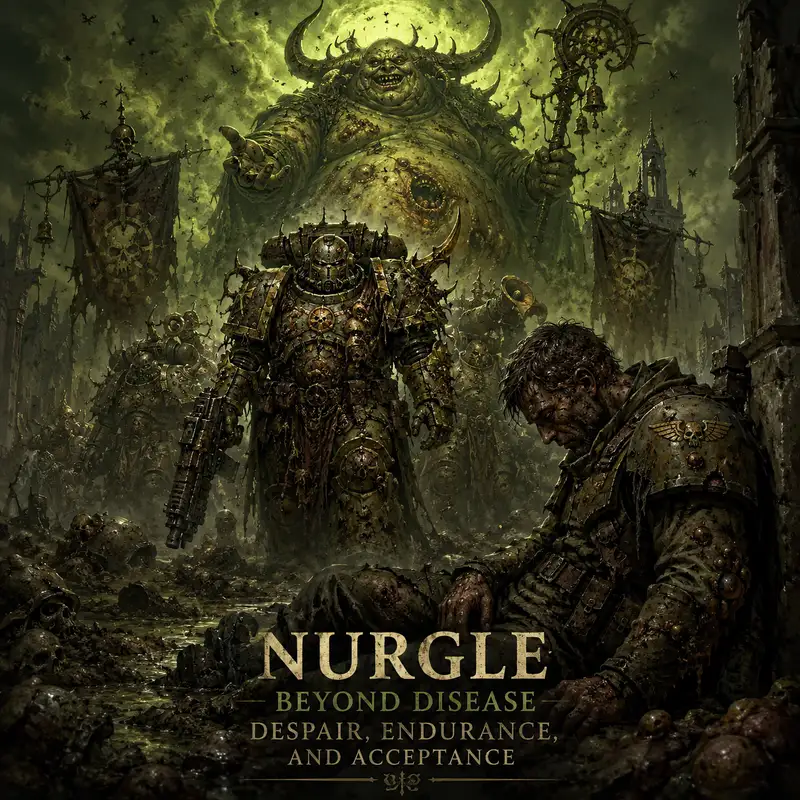
Nurgle Beyond Disease: Despair, Endurance, and Acceptance
At the end of a plague siege, the defenders do not always die screaming. Some simply stop being afraid. Fever has burned through the barracks, ammunition is running low, the water tastes wrong, and the wounded have begun to smile at injuries that should leave them senseless. Outside the walls, bells toll through a cloud of flies. The enemy advances without haste because haste is unnecessary. One soldier looks at the ruin of his own body and feels, for the first time in weeks, no pain at all. The silence inside his mind feels almost like mercy. That moment is more important than the breach in the wall. Nurgle has already won. Disease is his most obvious weapon, but it is not the deepest source of his power. The Plague God reaches people through exhaustion, grief, fear, and the terrible relief that comes when resistance finally ends. To understand Nurgle, the real question is not why anyone would want to rot. It is why surrender can sometimes feel like salvation.
Nurgle is the Chaos God of decay, disease, and despair. His titles are numerous, but his followers most often call him Grandfather. That name sounds almost affectionate, and that is deliberate. Khorne arrives like a blow. Tzeentch appears as a possibility. Slaanesh whispers that one more sensation, victory, or perfection will finally be enough. Nurgle offers something quieter. He tells the suffering that they no longer need to struggle. He does not promise that the wound will heal. He promises that the wound will cease to matter. He does not promise that death can be defeated. He promises freedom from the fear of death. In a universe where countless lives are spent in pain, obedience, and war, this is not a minor temptation. It may be the most understandable offer made by any of the Dark Gods, which is precisely why it is so dangerous.
There is a form of acceptance that requires courage. A person can recognise mortality, endure loss, and still choose what to do next. Nurgle’s acceptance is different. It removes the next choice. It takes the honest recognition that some things cannot be changed and expands it until nothing should be changed. Pain becomes natural. Corruption becomes inevitable. Injustice becomes another season. Hope is recast as childish denial, and resistance as a pointless refusal to understand the universe. This is the heart of Nurgle beyond disease. He transforms endurance from the strength to continue into the willingness to remain exactly where one has fallen. He turns acceptance into paralysis, then calls the paralysis peace. The victim may feel relief, but the price of that relief is agency. Nurgle does not merely help people bear their chains. He teaches them to love the weight.
The Imperium creates ideal conditions for that lesson. Most of its citizens do not live heroic lives beneath inspiring banners. They labour in manufactorums where the air shortens life, crowd into hive districts where sanitation is a distant administrative ambition, and watch institutions consume generations without ever learning their names. Armies abandon worlds because another front has been judged more important. Relief fleets arrive late, if they arrive at all. A clerical error can condemn a district as efficiently as an orbital strike, though generally with less paperwork afterward. When plague enters such a place, the population may already have spent years being told that suffering is duty. Nurgle offers a corrupted answer to a real condition. He welcomes the abandoned, the sick, the exhausted, and the unwanted. His cults promise that no deformity will disgust him, no failure will shame him, and no dying person will be left alone.
That promise explains the strange warmth surrounding his worship. Nurgle’s followers speak of gifts, family, and belonging. Great Unclean Ones often display a hideous joviality. Nurglings caper through filth like children in a garden. Beasts of Nurgle can possess an almost innocent enthusiasm as they crush, drown, or dissolve the creatures they are trying to befriend. Plaguebearers are less cheerful. They trudge through eternity counting diseases and recording their spread with the weary irritation of officials assigned to an audit that began before civilisation and has shown no sign of concluding. The humour is grotesque, but the pattern matters. Nurgle’s daemons do not usually behave as if they are inflicting meaningless pain. They act as though they are sharing a condition that has already brought them contentment. Their victims disagree, often with considerable urgency.
The transformation of a mortal follower follows the same logic. Infection brings fever, weakness, swelling, and terror. Medicine fails. Prayers go unanswered. Friends retreat behind masks, doors, or firing lines. At the point when the victim can no longer imagine recovery, Nurgle’s presence offers release. The disease may remain. The body may become even more corrupted. Yet the pain dulls, the fear recedes, and the ruined flesh acquires an impossible resilience. What would kill an ordinary person becomes merely another mark of favour. The follower has not been cured. Instead, the meaning of sickness has been reversed. Symptoms become blessings, contagion becomes communion, and the body becomes proof that Grandfather has noticed one of his children. It is a very efficient theology. Every new horror confirms the faith it should have disproved.
This is also why Nurgle’s supposed kindness cannot be separated from coercion. A bargain made under endless agony is not freely made simply because the victim eventually says yes. Nurgle creates, spreads, or exploits unbearable conditions, then presents submission as the only escape. He may genuinely offer relief from pain, but only after arranging a universe in which pain has become the argument. His love is possessive. It does not restore the wounded person to themselves. It remakes them into something that can no longer reject the gift. The most unsettling interpretation is that Nurgle’s affection may be sincere by the standards of a Chaos God. He may truly regard his servants as family. Yet he cannot love anything without absorbing it into his own cycle. He accepts every wound, failure, and deformity. What he does not accept is the right to remain separate from him.
The Garden of Nurgle expresses this contradiction on a cosmic scale. It is a realm of decay, but also of frantic life. Swamps bubble. Fungi bloom. Insects breed in impossible numbers. Rot feeds mould, mould feeds vermin, and every fallen thing becomes soil for something more infectious. Nurgle embodies entropy, yet his realm is not empty or still. It is fertile in the way a corpse can be fertile. His followers see this as proof that decay is not an ending but part of an eternal cycle. They are not entirely wrong. Life does consume death. Forests do grow from fallen organisms. Civilisations rise, age, and pass away. Nurgle takes that truth and removes every limit that makes a living system bearable. His garden grows, but nothing within it is free. Renewal serves contamination, and every new form of life exists to spread the same dominion.
On the battlefield, this philosophy becomes a method of war. Nurgle’s armies do not need the perfect charge or the brilliant manoeuvre. They advance through punishment that would destroy other forces, while the environment collapses around them. Armour rusts. Food spoils. Engines clog. Wounds fester. The air becomes an enemy, then the ground, then the bodies of one’s own comrades. A fortress can resist artillery. It has more difficulty returning fire at its water supply. Nurgle attacks the belief that battle can still be won. His forces make every hour worse than the one before it, until defenders cease asking how to defeat the enemy and begin asking how much longer they can endure. That change in the question is the true breakthrough. Once hope has been reduced to surviving another minute, surrender is already close.
This makes endurance central to Nurgle’s identity. His champions are slow, swollen, and difficult to kill. They do not merely withstand injury. They make injury appear irrelevant. A Plague Marine can cross a killing field under fire, leaking corrupted fluids from breaches in his armour, without changing pace. A Great Unclean One can absorb punishment like a moving hill of diseased flesh. The spectacle carries an argument. Resistance expends itself, while decay remains. Nurgle’s armies often seem less like invaders than approaching conditions. One does not duel a winter or outflank an epidemic. One survives until one cannot. The military terror of Nurgle lies in that apparent inevitability. His servants do not have to look victorious at every moment. They only have to remain when everything else has failed.
No force demonstrates this better than the Death Guard. Long before they worshipped Nurgle, the Fourteenth Legion valued endurance, self-control, and the ability to fight in environments that would kill lesser warriors. Under Mortarion, they became masters of attrition. They advanced through poison, radiation, chemical weapons, and grinding resistance, accepting casualties and hardship as the cost of duty. Their pride lay not in elegance but in remaining functional under conditions others could not bear. This strength reflected Mortarion himself. Raised on the toxic world of Barbarus beneath cruel overlords, he hated tyranny and despised weakness, especially weakness in himself. He distrusted sorcery and the powers of the warp. He wanted to be the liberator who could survive any poison and climb any mountain. Nurgle did not invent those convictions. He found the point where they could be turned against their owner.
During the Horus Heresy, as the Death Guard travelled toward Terra, treachery within the Legion helped draw their fleet into a trap in the warp. Typhon, who would become Typhus, had already committed himself to Nurgle. The ships became becalmed, and a supernatural plague spread through the Legion. These were Space Marines bred to withstand toxins and continue fighting through wounds that would kill ordinary soldiers. None of that mattered. The disease did not grant them a clean death. It trapped them in unending corruption and agony. Their legendary endurance became the instrument of their torture, because they could survive what they could not escape. Mortarion heard the suffering of his sons and faced the one enemy his entire identity could not defeat. No weapon could strike it. No march could outlast it. No act of will could force it aside.
Mortarion finally submitted to Nurgle to save his Legion. The bargain ended their helpless suffering, but it did not restore them. It transformed them into the Plague God’s favoured warriors and damned them to his service. The moment is the purest expression of Nurgle’s power. He did not defeat Mortarion by proving stronger in battle. He made resistance indistinguishable from cruelty. Every additional moment of defiance meant more agony for the sons Mortarion claimed to protect. Surrender could therefore be presented as compassion. The primarch who hated tyrants accepted a master. The Legion that defined itself through endurance accepted relief. They survived, but survival no longer belonged to them. Nurgle had taken their greatest virtue and closed it like a shackle around their throats.
The Death Guard that emerged were not simply diseased versions of the warriors who entered the warp. Their relationship with suffering had changed. Nurgle’s corruption insulated them from many of the worst effects of their afflictions. Injuries became tolerable. Decay brought strength. Some embraced a grim or even rapturous satisfaction in their condition. Yet the Legion did not become emotionally uniform. Typhus acts as an eager herald, carrying plague across the galaxy with missionary purpose. Mortarion remains bitter, proud, and often resentful, bound to a god whose power confirms everything he once refused to believe. Other Death Guard display their own mixtures of loyalty, fatalism, nostalgia, and contempt. Nurgle’s acceptance does not erase every personality. It traps each personality inside a world where escape has been declared impossible.
That distinction matters because the joy of Nurgle’s servants is sometimes mistaken for evidence that they are happy in a harmless sense. They are not merely cheerful people with unfortunate skin. Their contentment depends upon a supernatural order that spreads suffering to others and then offers the same surrender as relief. A plague cult may begin as a community caring for those abandoned by Imperial authorities. It may feed the sick, bury the dead, and welcome people whom respectable society has rejected. Those acts create genuine loyalty. Then the doctrine changes. Cure becomes betrayal. Quarantine becomes persecution. Infection becomes generosity. The cult’s members no longer ask whether others want their condition, because they have learned that refusal is only fear speaking. A gift that cannot be refused is conquest wearing a smile.
Many victims receive no offer at all. Nurgle’s diseases cross battle lines, ventilation systems, pilgrim routes, and voidship decks without regard for belief. Poxwalkers and plague-ridden populations demonstrate that his dominion is not founded solely on willing conversion. The language of family hides an empire of contamination. His followers often insist that everyone will eventually understand, because everyone will eventually decay. This allows them to treat resistance as temporary confusion rather than a meaningful choice. The infected are future relatives. The dying are recruits who have not yet recognised the blessing. Nurgle’s mercy therefore expands until it becomes universal violation. He does not merely accept the unwanted. He eliminates the possibility that anyone might want something else.
Among the four great Chaos Gods, Nurgle is the patron of the exhausted answer. Khorne tells the wounded to strike back. Tzeentch tells them that circumstances can be changed. Slaanesh tells them that some greater experience can overwhelm the emptiness. Nurgle tells them to lie down. His ancient opposition to Tzeentch is more than a rivalry between two monstrous powers. Tzeentch feeds on hope, ambition, and transformation, while Nurgle feeds on despair, resignation, and the certainty that all efforts end in decay. Each offers a distorted response to suffering. One can trap a person in endless schemes for a better future. The other can make the very idea of a better future seem foolish. Nurgle’s temptation grows strongest when the victim is too tired to imagine another attempt.
That is why despair, rather than disease alone, is the key to his power. Disease can be fought. It can be studied, contained, cured, or endured. Despair changes what the sufferer believes is worth attempting. It closes doors before anyone tests them. A city gripped by plague is a military and medical crisis. A city convinced that plague is inevitable has become a spiritual conquest. Nurgle thrives in the distance between those two conditions. He does not need every victim to worship him consciously. Fear of decay, grief after loss, and the conviction that nothing can improve all create the emotional climate he embodies. When wars multiply and institutions fail, that climate spreads faster than any single pathogen. The Plague God is patient because time appears to support his argument.
Yet inevitability is also his great deception. Everything decays, but decay is not the only truth. Living beings repair wounds, create communities, resist infection, preserve memory, and choose meaning even when permanence is impossible. Acceptance does not require approval. Endurance does not require submission. A person can acknowledge that death will come without helping it arrive for someone else. Nurgle collapses these distinctions because they threaten him. He takes the fact that suffering exists and turns it into a commandment that suffering should spread. He takes the wisdom of recognising limits and turns it into obedience to every limit imposed by cruelty, disease, or power. His followers stop fighting not only impossible battles, but necessary ones.
This is what makes Nurgle more than a monster covered in sores. He is a philosophical danger. He offers belonging without judgement, endurance without pain, and peace without uncertainty. Each offer answers a real human need. Then he removes the part that keeps the need human. Belonging becomes absorption. Endurance becomes stagnation. Peace becomes the absence of choice. Even his laughter reflects this corruption. Grandfather is cheerful because, from his perspective, all struggles end the same way. Kingdoms fall. Bodies fail. Stars cool. Every refusal is temporary. He can afford patience, affection, and humour because he believes the universe is already moving toward him.
So the bells continue to toll beyond the ruined walls. The Plague Marines advance through smoke, not quickly, but without interruption. Behind them, gardens bloom in corpses and rust spreads across abandoned guns. Ahead of them, someone who has not slept in days wonders how good it would feel to stop being afraid. That is the opening Nurgle seeks. Disease may carry his mark, but despair opens the gate. Endurance makes his servants formidable, but stolen endurance is not courage. Acceptance gives them peace, but peace without freedom is only surrender made comfortable. Nurgle’s most terrible gift is not that he makes the dying live. It is that he teaches them to call their captivity peace.