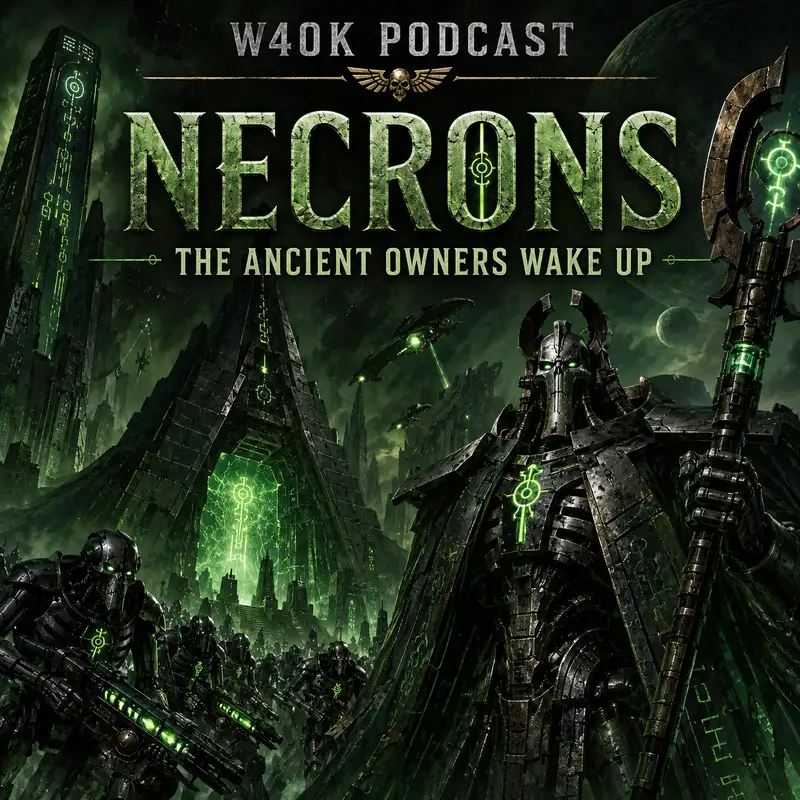
Necrons: The Ancient Owners Wake Up
The first warning is usually mistaken for a power failure.
Lights flicker across a newly founded Imperial settlement. Auspex screens fill with static. Deep beneath the hab blocks, something begins drawing energy through cables that were never connected to anything. Then the ground opens along lines too straight to be natural, and green light spills from chambers buried before humanity had learned to stand upright.
The soldiers sent below expect ruins. They find corridors cleaning themselves. They find machines repairing walls that have not seen daylight for millions of years. They find ranks of metal figures waiting in perfect silence.
The world was never empty. The Imperium had simply built a colony on someone else’s roof.
That is the central fact behind the Necrons. They do not think of themselves as invaders arriving to conquer the galaxy. They believe they are returning to property that already belongs to them. Every human city, Aeldari outpost, Ork fortress, and T’au colony raised over a tomb world is, from their perspective, an infestation established during a brief and regrettable absence.
Brief, in this case, means roughly sixty million years.
Yet the Necrons who wake are not merely ancient owners reclaiming an undisturbed estate. Their empire is broken. Their rulers are divided. Their memories are damaged. Their bodies are immortal, but the people who once inhabited those bodies may no longer exist in any complete sense. They awaken with legal certainty, military power, and a profound difficulty remembering exactly what they intended to do with either.
Long before the Imperium, before the rise of the Aeldari empire, and before most current species had begun their climb toward civilisation, there were the Necrontyr.
They were a people shaped by mortality. Their homeworld orbited a violent star whose radiation shortened their lives and filled them with disease. Even when Necrontyr science became advanced enough to cross the stars, it could not free them from the legacy of that sun. Their dynasties built monuments, necropolises, and kingdoms under the shadow of early death. Status mattered because time was short. Memory mattered because individuals did not last. Death was not an occasional interruption to Necrontyr life. It was the organising principle of their civilisation.
Their society was divided among powerful dynasties, each ruled by nobles who guarded honour, territory, and grievance with equal devotion. Civil war was common. The Triarch, led by the figure later remembered as the Silent King, claimed authority over the whole species, but authority is easier to carve into a monument than to maintain across an interstellar empire.
Then the Necrontyr encountered the Old Ones.
The Old Ones were ancient even by the standards of that age. They possessed long lives, mastery of the webway, and an understanding of biology and the warp that the Necrontyr could not match. To a civilisation obsessed with death, the Old Ones appeared to possess the answer to the only question that truly mattered.
The Necrontyr sought the secret of immortality. The Old Ones refused them.
The surviving accounts do not allow us to know precisely how that refusal was delivered, or whether the Old Ones could have granted what the Necrontyr wanted without consequences of their own. Necron memory is not neutral, and the Old Ones left no convenient archive explaining their position. What matters is how the Necrontyr understood the answer. They saw arrogance. They saw beings blessed with long life denying salvation to those condemned to die.
The Silent King also saw an opportunity. A war against an external enemy could unite dynasties that might otherwise tear the Necrontyr empire apart. The logic was politically familiar. If the people will not stop fighting one another, find them someone else to hate.
The war went badly.
The Old Ones’ mobility through the webway allowed them to strike, withdraw, and reposition beyond the reach of conventional Necrontyr strategy. Their command of living science produced weapons and servant races suited to a conflict on a scale almost impossible to reconstruct. The Necrontyr had formidable technology, but technology alone did not erase the advantages of the Old Ones. Defeat deepened the humiliation that had begun with the refusal of immortality.
It was during this crisis that the Necrontyr discovered beings feeding upon the energy of stars.
These were the C’tan, entities of immense power that existed as vast concentrations of living energy. The Necrontyr gave them bodies of necrodermis, a self-repairing metal capable of containing and shaping their presence. Once clothed in forms that could speak and act among material beings, the star gods offered the Necrontyr what the Old Ones had denied. Immortality.
The offer came with machinery, ceremony, and a promise that the weakness of flesh could be discarded forever. The Necrontyr entered the furnaces of biotransference by the billions. Organic bodies vanished. Metal bodies emerged.
What happened to the souls of the Necrontyr is one of the darkest parts of their history. The C’tan consumed them. Whether every Necrontyr understood the price before entering the furnaces is doubtful. The nobles retained much of their intellect, memory, and personality, although even they were altered. Warriors and labourers received far less. Entire populations became obedient metal forms with only the fragments of awareness required to follow commands.
The Necrontyr had escaped death by ceasing to be the Necrontyr.
They were now the Necrons.
The Silent King possessed command protocols that bound the transformed race to his authority. With the C’tan beside them and immortal armies at his disposal, he renewed the war against the Old Ones. The conflict that followed is remembered as the War in Heaven, although the name is almost too tidy for what it describes.
This was not one war fought along a single front. It was an age of wars, migrations, engineered species, stellar weapons, shattered worlds, and disasters that damaged the relationship between the material universe and the warp. The Old Ones fostered younger races as weapons and allies. Among those associated with their struggle were the ancestors of the Aeldari and the brutal beings from whom the Orks would descend. Psychic warfare grew more intense. The warp, once calmer, became increasingly turbulent and predatory.
The Necrons had bodies that could rise after destruction, weapons that stripped matter apart, and gods that fed upon stars and living essence. They fought with the patience of machines and the hatred of a people who believed existence itself had cheated them.
In the end, the Old Ones fell. Their civilisation collapsed beneath war, rebellion, and the horrors unleashed through the warp. Yet victory did not restore what the Necrons had lost. The C’tan had used them. Their souls were gone, their society had been reduced to a hierarchy of command codes, and the gods who had promised liberation were now feeding upon the galaxy the Necrons meant to rule.
The Silent King turned against them.
The Necrons could not safely destroy the C’tan as whole beings. The star gods had become too deeply connected to the fabric of physical reality. Instead, Necron weapons shattered them into fragments. These shards retained terrifying power, but they could be imprisoned and compelled to serve. The masters became weapons in the hands of those they had deceived.
It was revenge, but not justice. Nothing could return the consumed souls. Nothing could restore the millions whose personalities had been erased. The Silent King had won the galaxy and discovered that victory had made him ruler of a mausoleum.
Another power was rising. The Aeldari, heirs to part of the Old Ones’ legacy, were becoming dominant. The Necrons had survived the War in Heaven, but they were exhausted, and their enemies were numerous. The Silent King ordered the dynasties into the Great Sleep. Tomb complexes were sealed beneath worlds across the galaxy. Their inhabitants would wait while the Aeldari empire rose, ruled, and eventually declined.
Then, according to Necron tradition, the Silent King released his people from the command protocols that had bound them to him. He departed into the darkness beyond the galaxy, carrying regret that no ceremony could remove.
The plan was simple in the way only plans involving sixty million years of unattended machinery can be simple.
Tomb worlds were designed to preserve entire dynasties. Stasis crypts held nobles, soldiers, servants, war machines, and the legions of basic Necron warriors. Canoptek constructs maintained the facilities, repaired damage, removed intruders, and attempted to keep the sleepers intact. Some tombs lay beneath barren planets. Others were buried below worlds where seas shifted, mountains rose, and new species built civilisations without suspecting what rested beneath them. Time was not kind.
Stars changed. Planets fractured. Tectonic movement crushed chambers. Radiation corrupted systems. Meteor strikes destroyed control nodes. Alien settlers dismantled devices they did not understand. The Aeldari found and eliminated some tomb worlds before awakening could begin. On other worlds, the automated caretakers continued their duties long after those duties had become irrational.
When the awakening protocols finally activated, they did not restore a single united Necron empire. They opened thousands of damaged vaults belonging to rival dynasties with ancient borders, old grudges, and incompatible ambitions.
Some tomb worlds awoke in good order. Their nobles emerged with memories largely intact, their legions responsive, and their war machines ready. Others produced damaged rulers, mindless courts, or armies trapped inside corrupted routines. Some slept on. Some may never wake.
This is why Necrons can appear, at first glance, to be a single army of identical metal skeletons and then reveal themselves as one of the most individual and politically fractured powers in the setting.
The ordinary Necron warrior is indeed little more than a remnant. It can march, aim, kill, and obey. It may contain a trace of the person who entered the biotransference furnaces, but if that person remains, it has almost no way to express itself. The nobility are different. Overlords, phaerons, crypteks, and other high-ranking figures can retain elaborate personalities. They remember dynastic law, personal insult, military custom, and rivalries older than the human species.
They also remember themselves imperfectly.
For an immortal machine intelligence, memory is identity. When memory degrades, the result is not ordinary forgetfulness. It is the erosion of the self. A ruler may repeat ancient rituals because the ritual remains after its meaning has vanished. Another may speak to courtiers who died before the Great Sleep. A commander may interpret modern enemies as rival Necrontyr dynasties and conduct battle according to codes of honour that no one else understands.
Nemesor Zahndrekh is one famous example. He remains a brilliant commander, but his perception of reality is unreliable. He may treat enemies as honourable Necrontyr opponents, granting courtesies to beings who have no idea why the murderous metal warlord has suddenly become so polite. His condition is tragic, dangerous, and occasionally inconvenient for everyone attempting to survive the encounter. Other forms of damage are worse.
The Destroyer curse drives afflicted Necrons toward the elimination of all organic life. They do not merely hate particular enemies. They develop an obsessive need to erase the living, sometimes calculating methods for exterminating organisms down to the smallest forms. The Flayer curse transforms Necrons into creatures that drape themselves in stolen flesh, as though some broken fragment of biological memory is trying to force its way through a body that can never live again.
Immortality did not cure the Necrons of madness. It gave madness unlimited time to refine its arguments.
Even among those who remain functional, there is no agreement about what restoration should mean.
Imotekh the Stormlord seeks dominion through conquest and strategic discipline. He has built the Sautekh Dynasty into one of the most formidable Necron powers, and he does not accept that ancient rank automatically makes the Silent King worthy of obedience.
Trazyn the Infinite pursues preservation of a different kind. He collects people, artefacts, armies, and moments of history, storing them within galleries on the tomb world of Solemnace. To Trazyn, the galaxy is vanishing into catastrophe, and someone must preserve representative examples. The representatives are rarely consulted. His collection is part museum, part prison, and part proof that immortality does not necessarily produce healthy hobbies.
Orikan the Diviner studies the movements of stars and the structure of time. He predicts possible futures and manipulates events to make favourable outcomes more likely. His rivalry with Trazyn reveals something important about Necron character. These are not interchangeable machines. They are ancient aristocrats whose feuds can be petty, brilliant, and catastrophically well equipped.
Some Necron rulers want to reverse biotransference and recover bodies of flesh. Others regard flesh as a weakness they are fortunate to have escaped. Some wish to rebuild the dynastic empire as it existed before the War in Heaven. Others have adapted to machine existence and seek forms of power the Necrontyr could never have imagined. A few rule organic populations rather than immediately destroying them. Others consider all younger species vermin.
Their methods on the battlefield reflect this sense of returning authority.
Necron armies do not always advance with the speed or fury of other factions. They often move with dreadful deliberation. Warriors rise from hidden chambers. Monoliths appear through impossible green light. Gauss weapons strip targets apart layer by layer. Fallen Necrons vanish in flashes of energy or pull themselves back together as repair systems restore damaged bodies.
To a human soldier, this creates a special kind of despair. An enemy who can be killed is frightening. An enemy who stands up after being killed encourages theological reconsideration.
Necron technology is not magic, although to the Imperium the distinction can become academic. Their mastery of matter, dimensional movement, living metal, and stellar forces descends from a civilisation that fought gods and then broke those gods into usable pieces. Crypteks manipulate physical laws with the confidence of engineers adjusting a familiar machine.
Yet Necron power has limits. Reanimation can fail. Bodies can be damaged beyond recovery. Tomb networks can be disrupted. Command structures can collapse. Their greatest weakness is often not technological but political. A dynasty may refuse aid to a rival. A noble may pursue a personal grievance while a greater threat grows. An overlord may possess the means to win and the personality required to misuse them.
The return of the Silent King has made those divisions sharper.
Szarekh came back from exile claiming that the galaxy faced threats severe enough to require Necron unity. The Tyranids consume the biological material some Necrons may need if they ever hope to reverse biotransference. The warp spills corruption across reality, threatening a material order the Necrons understand far better than psychic chaos. Blackstone structures and vast null fields offer ways to suppress the warp, but a galaxy made silent and spiritually inert may not be salvation for anyone still alive within it.
The Silent King presents himself as the ruler capable of guiding his people through these dangers. Not every dynasty accepts his claim. Ancient obedience was broken before the Great Sleep. Pride survived. Rival rulers remember that Szarekh led the Necrontyr into the bargain that destroyed their souls, even if he later rebelled against the C’tan.
His greatest qualification is also his greatest indictment. No one understands the Necrons’ catastrophe better than the monarch who helped cause it.
This leaves the awakening Necrons in a strange position. They possess a genuine claim to antiquity. Their tombs were buried beneath many worlds before current civilisations existed. Their science exceeds almost everything the younger species can reproduce. Their rulers remember an age when the great powers of the present were absent, primitive, or not yet born.
But antiquity is not the same as ownership.
During the Great Sleep, the galaxy did not remain vacant. Species evolved. Empires rose. Worlds changed hands countless times. The Aeldari built a civilisation and destroyed it. Humanity spread across the stars, collapsed, and rose again beneath the Imperium. Orks fought wherever fighting was available, which was nearly everywhere. Entire cultures lived and died on planets the Necrons regarded as sealed storage facilities.
When a tomb world awakens beneath an inhabited planet, both sides can believe they are defending their home. The settlers may have known no other world for generations. The Necron dynasty may possess records proving that its palace lies beneath their capital. The dispute is legally complicated and usually resolved with gauss fire.
The phrase ancient owners therefore contains both truth and delusion.
The Necrons were among the first great masters of the galaxy. They shaped its history in wars so old that later civilisations remember only fragments. Their ruins are not abandoned monuments. Their armies are not newly arrived conquerors. In many places, they really are waking beneath territory they once ruled.
Yet the civilisation returning is not the one that went to sleep. The Necrontyr are gone. The Necrons inherited their names, their dynasties, their grudges, and some of their memories, but not their souls. They claim continuity because the alternative is to admit that the C’tan won in the most important sense. The bodies survived. The empire survived in pieces. The people did not.
That is why their awakening is more unsettling than a simple invasion. The Necrons are not strangers seeking a new home. They are the remains of an old civilisation demanding that the present surrender to its memory of the past.
Across the galaxy, tomb doors continue to open. Green light returns to corridors beneath cities that never knew they were built above a throne room. Metal kings rise, summon legions, and consult maps drawn before the continents took their current shape.
The ancient owners have awakened, but the house has changed, the heirs are at war, and somewhere inside the immortal machinery, the original owners are gone.