Necron Dynasties: Courts, Codes, and Ancient Politics
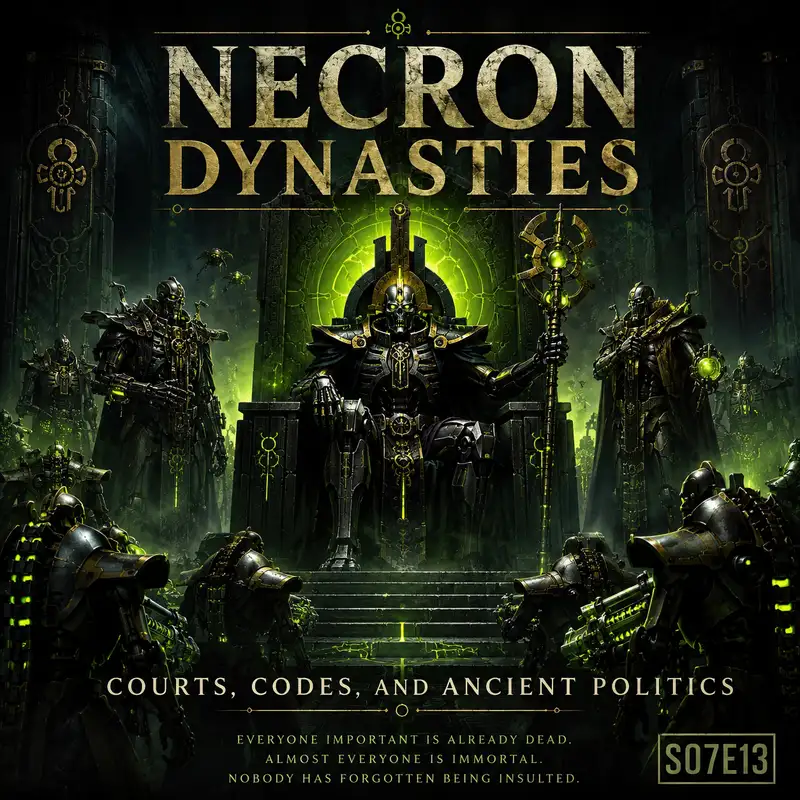
The throne room wakes before its king. Black stone pillars rise from a floor untouched for sixty million years. Scarabs pour through cracked walls, repairing conduits and polishing symbols whose meaning younger species never learned. One by one, the figures around the throne lift their heads. A royal warden checks the chamber. Crypteks whisper across hidden channels. Lesser nobles search damaged memories for the proper order of precedence. When the ruler finally opens his eyes, the first question is not which human world must burn. It is who still owes him allegiance. Beyond the tomb, another lord may have awakened first, claimed the same territory, inherited the same vassals, and decided that a functional ancestor is no longer required. Necron politics begins where most civilisations would have ended. Everyone important is already dead, almost everyone is immortal, and nobody has forgotten being insulted.
That is the central contradiction of the Necron dynasties. They appear to be armies of identical metal bodies, advancing in silent ranks beneath a single will. From the outside, they look less like a civilisation than a weapon. Yet behind those ranks stand courts, royal houses, vassal states, military offices, scientific orders, old treaties, disputed inheritances, and grudges measured in geological ages. The Necrons are not one united empire returning on schedule. They are the broken political remains of an empire, awakening at different times and in different conditions. Their warriors may be programmed to obey, but their rulers are not. The result is a species that can calculate the death of a star, yet still divide a court over succession, protocol, and the respect owed to a rival whose ancestors were considered vulgar before humanity evolved.
The roots of that system lie in the Necrontyr, the living people the Necrons once were. Necrontyr society was dynastic, hierarchical, territorial, and bitterly competitive. Great royal houses ruled worlds and star systems. Lesser nobles served them, challenged them, married into them, or waited for an opportunity to replace them. When biotransference moved the Necrontyr into bodies of living metal, it did not distribute immortality equally. The ruling classes retained far more memory, personality, and independent thought than the common population. Most ordinary citizens became Necron Warriors, reduced to obedient shells with only traces of what they had been. Nobles received more sophisticated bodies and minds. The old social order was therefore not merely preserved by tradition. It was built into the new species. Status determined how much of a person survived, which meant political privilege became a form of consciousness itself.
At the summit of a dynasty stands a Phaeron, or in some cases a Phaerakh, the sovereign of an entire royal domain. Beneath that ruler are Overlords who govern territories, crownworlds, and military hosts. Lords administer lesser realms or serve in the courts of greater masters. A Nemesor is a high commander and strategist, while a Vargard serves as a trusted champion and protector. Royal Wardens translate dynastic will into battlefield order. Lychguard defend their rulers with a loyalty that can survive disasters, betrayals, and the occasional ruler who has become visibly unsuitable for command. Titles vary in importance between dynasties, but the principle is consistent. Authority flows downward through nobles, officers, servants, and programmed legions. A Necron army is also a political diagram with gauss weapons.
A royal court is not simply a collection of advisers standing around a throne because the room would otherwise look empty. It is the place where authority is interpreted and made operational. A Phaeron may declare that a system is to be reclaimed, but Crypteks must awaken the necessary engines, Overlords must provide forces, Nemesors must plan the campaign, and subordinate rulers must decide whether the order is lawful, practical, or likely to remove them from the succession. Necron command protocols allow nobles to impose their will upon those beneath them, sometimes with a directness human tyrants could only envy. Yet those protocols do not eliminate politics. They make control itself political. Whoever possesses recognised authority can turn a court decision into marching phalanxes, opening portals, and worlds stripped clean. In many civilisations, a disputed decree produces paperwork. In a Necron dynasty, the paperwork has an annihilation beam.
Court ritual matters because the Necrons have lost so much else. Their bodies no longer breathe, age, eat, or produce descendants. Many sensations and emotions survive only as weakened echoes. Memory has decayed. Personal identity can fracture. In that emptiness, title, genealogy, heraldry, and ceremony provide continuity. A noble may no longer remember the warmth of sunlight on living skin, but still remember that an ancestor held precedence over a rival house. The claim becomes proof that the past was real. Formal address, the position of a throne, the right to speak first, and the display of ancient relics are not harmless vanity. They establish who a ruler is and where that ruler belongs in the surviving order. To surrender a title may feel like surrendering another piece of the self. Necron arrogance is often ridiculous from the outside, but it is also defensive architecture built around a damaged mind.
The Crypteks complicate this hierarchy. They are not technicians attached to repair whatever a noble has broken. They belong to ancient scientific traditions and specialise in forces younger species mistake for sorcery. Chronomancers manipulate time. Technomancers command repair systems and constructs. Plasmancers weaponise destructive energy. Psychomancers turn fear and perception into instruments. A powerful Cryptek may serve a court, bargain with it, manipulate it, or pursue a project that a ruler understands only in the broadest terms. Dynasties need Crypteks because much of Necron power depends upon knowledge even nobles do not possess. Crypteks need dynasties because laboratories, armies, tomb complexes, and political protection remain useful. Their relationship resembles an alliance between monarchy and a guild of scientists who can fold space, forecast possible futures, and become extremely technical when asked what happened to the previous king.
Other institutions stand partly outside the normal dynastic chain. The Triarch Praetorians once served the ancient Triarch, the supreme ruling council of the Necrontyr empire. They remained active while most Necrons slept, preserving fragments of law and culture and attempting to ensure that the dynasties did not collapse completely. They carry the authority of the old order rather than that of one local ruler. In principle, they can censure even a Phaeron who violates ancient edicts. This makes them guardians, judges, political officers, and reminders that every dynasty once belonged to something larger. Lychguard, by contrast, are tied to particular nobles and courts. One institution protects the continuity of the wider civilisation. The other protects the person who currently claims to embody it. When those loyalties point in different directions, the resulting legal discussion can become remarkably energetic.
The ancient codes are the grammar of Necron politics. They regulate rank, obligation, diplomacy, warfare, and the conduct expected between nobles. They are often called codes of honour, although honour here should not be confused with mercy. Their purpose is to make conflict orderly and legitimate. A declaration, challenge, surrender, punishment, or transfer of allegiance gains meaning because it occurs within recognised forms. Even inter-dynastic warfare may be constrained by expectations about acceptable methods and proper provocation. Weapons or troops regarded as shameful can be avoided when Necrons fight one another, even if those same restrictions vanish when they face species considered vermin. The codes do not prevent violence. They decide which violence counts as lawful, which victory creates a valid claim, and which ruler can be condemned as a criminal rather than merely disliked.
That distinction is essential. Necron honour is not human chivalry with metal faces. A ruler may offer a rival a formal chance to withdraw, then erase the rival’s cities once the offer is refused. A Nemesor may treat a capable enemy as a worthy opponent while considering the enemy’s entire species an infestation. Codes can restrain assassins, Destroyer Cults, or Flayed Ones in disputes among nobles, not because the victims deserve compassion, but because such methods contaminate the legitimacy of the contest. A victory gained in the wrong manner may invite censure, rebellion, or revenge. A properly conducted atrocity, on the other hand, may be celebrated as impeccable statecraft. The Necrons have achieved many things beyond mortal comprehension. Separating ethics from procedure with perfect confidence is one of the less technologically demanding.
The Great Sleep turned this rigid order into a field of unanswered questions. Tomb worlds did not awaken together. Some opened early because of damage, intrusion, or failing systems. Others remain dormant. Entire courts emerged with missing rulers, corrupted records, or command networks that no longer recognised ancient authority. A subordinate might awaken to find the Phaeron destroyed and the dynasty leaderless. An Overlord could assume emergency powers, rule for centuries, and then discover that a superior had finally returned. Vassal worlds might swear loyalty to a protector because the old dynasty appeared dead. When the original claimant reappeared, both sides could point to tradition. The returning monarch possessed ancient right. The replacement possessed actual power. Necron law had procedures for hierarchy, but it was not designed for an empire that had slept through the rise and fall of whole species.
Damage to Necron minds makes every dispute worse. Some nobles awaken lucid. Others return obsessed, paranoid, or trapped in distorted memories. Nemesor Zahndrekh, one of the Sautekh Dynasty’s greatest commanders, often perceives current wars through the conventions of the ancient Necrontyr past. His tactical brilliance remains, but his understanding of who he is fighting can be filtered through a vanished age. His Vargard, Obyron, protects him not only from enemies but from the political consequences of his condition. Their relationship reveals something important about Necron courts. Loyalty can be programmed, traditional, personal, or all three at once. A damaged ruler may still be legitimate. A sane subordinate may still be unable, unwilling, or emotionally incapable of replacing him. Immortality does not remove the burden of caring for someone who is no longer entirely the person remembered.
Territory gives these disputes a galactic scale. Every dynasty remembers, or claims to remember, the borders it possessed before the Great Sleep. During the intervening ages, younger species settled those worlds, mined them, built shrines upon them, or carried away relics from tombs they did not understand. To the Imperium, a Necron invasion may be a sudden alien assault. To the dynasty, it is an eviction delayed by sixty million years. The Nihilakh Dynasty is especially driven to recover domains and treasures lost during its slumber. Its campaigns are acts of restoration in its own records, regardless of how many generations of living inhabitants are destroyed. This difference in perspective makes negotiation difficult. Humanity produces deeds, charters, and burial records. The Necrons produce the original owner.
Dynastic identity also shapes policy. The Szarekhan carry the prestige of the Silent King and relics from the height of the old empire. The Sautekh are vast, aggressive, and expansionist under Imotekh the Stormlord. The Mephrit were once executioners for the Silent Kings. The Novokh preserve traditions of ritualised slaughter. The Nephrekh march in bodies of living gold, transformed through exotic energies. The Nihilakh are wealthy, territorial, and determined to reclaim what was taken. These are not merely colours or preferred weapons. Each dynasty preserves a political culture, a story about its rightful place, and an answer to what the returning Necron empire should become.
Imotekh demonstrates how a ruler can use that culture to seize power. He awoke to find the Sautekh leadership diminished and its court consumed by lesser struggles. He did not wait patiently for a more traditional candidate to become competent. He took control, crushed rivals, and turned the dynasty into the most powerful expansionist Necron state in the galaxy. His authority rests partly on title, but even more on performance. He wins campaigns. He breaks enemies. He forces other rulers to choose between submission and destruction. That success attracts vassals who may admire him, fear him, or simply conclude that surviving beneath the Stormlord is preferable to being remembered as a cautionary inscription. Imotekh is a usurper from one perspective and the dynasty’s saviour from another. Necron politics leaves room for both judgments, provided the speaker has sufficient troops.
Then the Silent King returned. Szarekh had once ruled the entire Necrontyr people and carried responsibility for the bargain that led to biotransference. After the Necrons overthrew the C’tan and prepared for the Great Sleep, he destroyed the command protocols that had bound the race directly to his will and went into exile. That decision defines the present crisis. Szarekh has immense prestige, ancient authority, and followers who see him as the only ruler capable of restoring unity. He does not possess a simple command that compels every awakened Phaeron to kneel. His return therefore requires politics. He must persuade, intimidate, reward, and outmanoeuvre rulers who have governed without him for ages. Some welcome the old sovereign. Others remember that his greatest decisions delivered immortality without souls, victory without peace, and an empire into ruins.
The rivalry between Szarekh and Imotekh is not merely a contest between two powerful characters. It is a dispute over the meaning of legitimacy. Szarekh claims continuity with the ancient Triarch and presents unity as necessary against threats such as the Tyranids, Chaos, and the disorder consuming the galaxy. Imotekh can point to the empire he has actually built while the Silent King was absent. He regards himself as a ruler who earned supremacy through strategic achievement, not inherited guilt and ceremonial grandeur. Their supporters are choosing between restoration and replacement, between the authority of the oldest crown and the authority of proven conquest. Neither side needs to reject Necron tradition. Each can argue that the other has betrayed it.
That is why the developing civil war in the Pariah Nexus is so revealing. Dynasties loyal to the Silent King fight those aligned with the Stormlord while human forces struggle to survive inside the same region. Imotekh has denounced Szarekh’s authority, but the conflict is not presented as mindless rebellion. It is fought through claims, provocations, alliances, and observance of ancient forms. By appearing to respect the codes, a challenger can depict resistance as lawful correction rather than treason. By winning without needless damage to Necron strength, that challenger can attract lesser nobles who doubt their current master. A battle therefore has two audiences. The first is the enemy in front of the guns. The second is every undecided court watching to see which ruler behaves like the true heir of the Infinite Empire.
Vassalage makes those audiences decisive. A great dynasty is not held together only by direct possession. Lesser rulers may retain their courts, territories, and pride while acknowledging a stronger sovereign. Their loyalty can depend on protection, fear, legal obligation, personal admiration, or the expectation of reward. When a supreme ruler appears weak, vassals begin to calculate. They rarely describe this as opportunism. They discover a neglected clause, an ancestral grievance, or a suddenly urgent concern for the purity of the codes. An immortal aristocracy has had ample time to perfect the dignified explanation of self-interest. Each defection shifts fleets, tomb worlds, dolmen gates, Cryptek resources, and military hosts. A court changing allegiance can alter a campaign without a single Warrior understanding that anything political has happened.
The fate of the Ithakas Dynasty shows the darker side of this system. Its nobles struggle with pride, exile, inheritance, and the slow collapse of their people. Oltyx, a dispossessed heir, is forced to confront the difference between possessing a throne and preserving a dynasty. Court politics drives him outward, but catastrophe eventually makes the old rivalries look small. His story exposes the burden hidden beneath Necron kingship. A ruler inherits more than armies and titles. He inherits damaged minds, impossible traditions, ancient crimes, and subjects whose capacity to obey may be greater than their capacity to live. The court can protect continuity, but it can also preserve habits long after they become suicidal. An institution designed to keep a dynasty eternal may become the mechanism by which it refuses to change.
The courts, codes, and dynasties therefore answer the question of why the Necrons remain divided. Their civilisation survived too well in some ways and not well enough in others. It preserved hierarchy without preserving social trust. It preserved rulers without preserving all memory. It preserved law without preserving a universally accepted sovereign. It preserved ancient identity while the galaxy erased the world that gave that identity meaning. Every awakened court tries to reconstruct order from damaged records and personal claims. Some seek unity. Some seek empire. Some seek revenge. Some merely repeat the last command they remember. Their politics is not a distraction from their military power. It is the system that decides where that power moves and whose vision of the past it will enforce.
A Necron dynasty is an ancient state trapped inside an immortal ruling class, and its court is where memory becomes command. The codes can restrain ambition, but they can also legitimise it. Titles can preserve identity, but they can also imprison rulers inside roles that no longer serve their people. The Silent King may yet gather the dynasties beneath the old crown. Imotekh may prove that the future belongs to the ruler who can take it. Countless lesser nobles will swear that their choice was dictated by honour, law, and the welfare of the Necron race. Some may even believe it. In the throne room, the king sits motionless while his courtiers bow. Beyond the walls, legions wait for a single recognised command. The empire has been dead for sixty million years, and its politics has never been more alive.