Navigators: The Mutant Houses That Guide Humanity
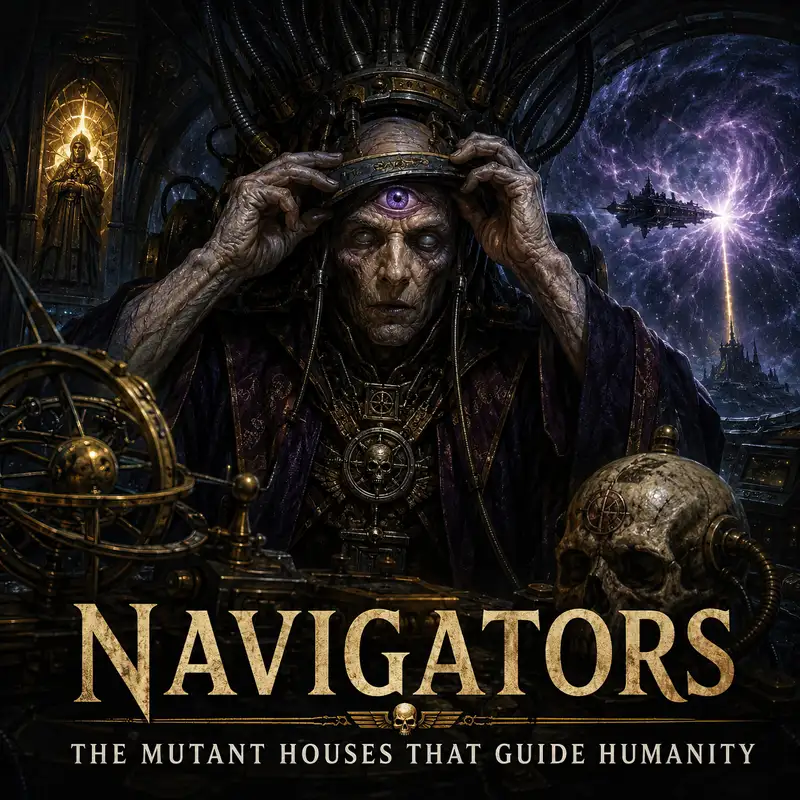
The ship’s captain has ordered every hatch sealed, every weapon secured, and every prayer spoken. Deep inside the vessel, behind doors that most of the crew will never be permitted to open, one figure sits beneath a crown of cables and brass instruments. The figure appears human until a hand lifts the band from the forehead. A third eye opens. The engines tear a wound into reality, the Gellar field closes around the hull, and the stars vanish. From that moment, the survival of tens of thousands of people depends upon what the Navigator can see in a place no ordinary mind was built to witness.
That arrangement reveals one of the Imperium’s deepest contradictions. Imperial doctrine teaches humanity to fear mutation as a sign of corruption, instability, or spiritual decay. Mutants are segregated, exploited, or burned. Yet the Imperium also grants titles, palaces, fortunes, and extraordinary legal protection to hereditary families whose mutation is impossible to conceal forever. These are the Navigator Houses, collectively known as the Navis Nobilite. They are tolerated for a simple reason. Without them, the Imperium would not merely become less efficient. It would begin to come apart.
An Imperial voidship can cross a star system using its conventional drives, but the distance between stars is another matter. To cross that gulf in useful time, the ship must enter the Warp, the psychic dimension that lies beneath and beside material reality. The Warp allows a vessel to bypass enormous distances, but it is not empty space. It is a realm shaped by emotion, thought, memory, and nightmare. Its currents change. Its storms rise without warning. Time does not behave properly there, which is an inconvenience of the sort the Administratum prefers to record on a form and then blame on the crew.
The machinery of a warp journey performs several distinct tasks. The warp drive forces an opening between realities. The Gellar field creates a bubble of realspace around the ship, preventing the things within the Warp from enjoying unrestricted access to the passengers. The plasma drives still provide movement. None of this tells the vessel where to go. A ship can make a short calculated jump by studying local conditions before translation, following a predicted course, and returning to realspace before the original calculation becomes dangerously obsolete. Such jumps are slow, cautious, and limited. For long journeys, the ship needs someone who can look into the Warp while the vessel is already inside it and adjust the course as conditions change.
That someone is a Navigator. The third eye is not a decorative badge of office. It is the visible expression of the Navigator gene, a stable hereditary mutation that allows its bearer to perceive the Immaterium directly. Even then, directly is a generous word. The Warp cannot be understood as a normal landscape. A Navigator’s mind translates it into symbols that can be endured and interpreted. One may perceive an ocean filled with tides, reefs, and predatory shapes. Another may see a forest of impossible paths. A third may understand the same passage as music, colour, scent, or the movement of vast celestial beasts. The image is personal. The danger is not.
Within that shifting unreality, the Navigator seeks the Astronomican. This is the great psychic beacon projected from Terra, fuelled by the sacrifice of trained psykers and directed by the will of the Emperor. It is not a lighthouse in the ordinary sense, and it does not provide a neat arrow marked destination. A Navigator judges its strength, angle, and character, then compares that perception with secret charts, inherited knowledge, local beacons, and the signs of the Warp itself. The Astronomican gives orientation. Skill turns orientation into a route.
The Navigator therefore does not steer a ship in the manner of a sailor gripping a wheel. The vessel may be kilometres long, crewed by generations of voidborn workers, and commanded by an officer whose family has served the fleet for centuries. Yet during warp passage, all of that mass and tradition must respond to the Navigator’s judgement. Course corrections are transmitted through the ship’s systems. Engines change thrust. The vessel climbs through one current, avoids another, and searches for a safe point of emergence. A captain may command the ship in every legal and military sense, but arguing with the Navigator during a storm is a privilege usually reserved for captains who wish to become cautionary tales.
The third eye also explains why Navigators inspire fear even when standing on solid ground. When fully opened upon another living being, it exposes the victim to the power of the Warp. The result may be terror, madness, physical destruction, or death. Some Navigators learn to use this ability as a weapon, though doing so is dangerous and can draw unwanted attention from the Immaterium. Most conceal the eye beneath a band, circlet, hood, or elaborate piece of jewellery. The covering protects everyone else, but it also makes a useful political statement. A Navigator entering a court with the eye veiled is practising restraint. A Navigator removing that veil has ended the discussion.
The origins of the Navigator gene are uncertain. The most reliable traditions place its emergence during the Dark Age of Technology, long before the Imperium. Whether the first Navigators arose naturally, were created through deliberate genetic engineering, or resulted from a programme whose purpose has been forgotten is not settled. Some later Imperial beliefs credit the Emperor, but the Navigator bloodlines appear to be older than his public rule of Terra. The distinction matters because the Navis Nobilite is not simply another Imperial department. It is an ancient human institution that entered the Imperium carrying its own wealth, secrets, and claims of legitimacy.
Once humanity learned to breed Navigators reliably, interstellar expansion changed. Routes that had been too dangerous became usable. Voyages that had required repeated short jumps could be attempted across far greater distances. Trade networks widened. Colonies remained connected to their founders. Fleets could concentrate rather than arriving in fragments over decades. The Navigator families understood their value and organised themselves accordingly. They became houses, then dynasties, then a nobility whose product was not land, grain, or soldiers, but access to the stars.
A Navigator House is part family, part commercial empire, part intelligence service, and part genetic archive. Its leader controls contracts, marriages, estates, agents, and the service of its trained Navigators. The greatest houses maintain palaces on Terra and holdings across the Imperium. Others live almost entirely aboard ships, carrying their culture from port to port. Some houses have declined into poverty but retain fragments of ancient expertise. Others have been cast out and survive by serving pirates, renegades, or masters who ask fewer questions. Even among the sanctioned houses, old feuds may last longer than planetary civilizations.
Their rivalries are not merely matters of wounded pride. A reliable route can enrich a house for generations. A failed contract can destroy it. A marriage may join two banks of navigational knowledge, settle a trade dispute, or secure access to a fleet. A rumour about instability in a rival bloodline can reduce the value of every Navigator that rival offers. The houses guard their charts, genealogies, and techniques with the severity of military secrets because that is exactly what they are. An Imperial admiral may own the warships, but a house that controls the route controls when those warships arrive.
The Navigator gene makes family politics even more ruthless. It must be preserved through carefully controlled unions between Navigator bloodlines. Marriage is therefore a strategic instrument, and children are the future capital of the house. Pairings may be chosen for political alliance, proven navigational ability, or the hope of strengthening a particular expression of the gene. Affection is possible, but it is not the first item on the contract. The Imperium has many institutions capable of turning a person into a resource. The Navigator Houses have simply had longer to refine the paperwork.
This breeding preserves the mutation, but it also concentrates its consequences. Every Navigator bears the third eye, yet many develop other changes as they age. Skin may become unnaturally pale or translucent. Limbs may lengthen. Fingers may become webbed or clawlike. The body can grow thin, swollen, or strangely jointed. Members of the same house may share characteristic mutations, a physical signature of their common blood. Some changes are concealed by robes, surgery, isolation, or courtly etiquette. The most severely altered may vanish into private chambers and subterranean vaults, protected from a society that needs their gifts but would recoil from the cost.
That cost gives the title mutant houses more than rhetorical force. These families are not ordinary nobles with an unusual heirloom. Their entire existence is built around maintaining a controlled departure from baseline humanity. They produce children knowing that some will be powerful, some weak, some dangerously unstable, and some too visibly altered to be shown beyond the house. They celebrate the gene as proof of superiority while fearing what it may become. They are proud of their difference because pride is easier to live with than admitting that the Imperium’s roads are maintained by a mutation no one fully understands.
A young Navigator may spend years learning from relatives, memorising routes and developing the discipline required to look upon the Warp without being consumed by it. Service aboard a ship can then last for decades or longer. The Navigator usually occupies private quarters or a sealed spire, supported by servants, guards, medicae personnel, and junior members of the family. On some vessels, the Navigator is a trusted companion of the captain. On others, the relationship is formal and cold. Crews may regard the veiled noble with awe, disgust, or superstitious gratitude. Most are sensible enough to do so from a respectful distance.
The relationship between a ship and a Navigator House often extends across generations. Rogue Trader dynasties may remain tied to the same house through ancient compacts. Naval commands negotiate for reliable Navigators as carefully as they secure ammunition and fuel. Space Marine Chapters require them despite the objections of warriors who may consider mutation a stain on humanity. This dependence can produce genuine loyalty. A Navigator who has guided the same dynasty through war, disaster, and discovery may become part of its identity. It can also produce resentment, because nothing irritates an Imperial aristocrat quite like discovering another aristocrat is indispensable.
Indispensability creates power. The Navis Nobilite does not govern the Imperium, but it influences nearly every institution that attempts to move through it. Its houses can demand wealth, privileges, protection, and favourable terms. They can place agents in trading concerns, naval courts, and noble households. They can reward allies with skilled Navigators and punish enemies through delay, inflated contracts, or sudden unavailability. A house need not openly strand a fleet to make its displeasure known. It can simply explain that every qualified Navigator is regrettably committed elsewhere.
This power has limits. The Inquisition watches the houses, especially when a bloodline becomes unstable or a Navigator is suspected of serving forbidden masters. Rival houses expose one another’s failures. The Imperial Navy cannot allow private feuds to halt major campaigns. The Navis Nobilite must therefore protect its monopoly without appearing to threaten the state that protects it. It survives through a careful balance of service and secrecy. Too weak, and the houses become servants. Too arrogant, and someone on Terra begins drafting warrants. Imperial politics is often described as a knife fight beneath a banquet table. The Navigators merely bring a third eye to the proceedings.
At the summit of their society stands the Paternova, the supreme figure of the Navis Nobilite, ruling from the Palace of the Navigators on Terra. The office carries political, dynastic, and mysterious psychic significance. The Paternova does not normally take a seat in the Senatorum Imperialis personally. A Paternoval Envoy speaks for the Navigator nobility and has often stood among the High Lords of Terra. That representation is not ceremonial flattery. It acknowledges that decisions about war, taxation, colonisation, and trade are meaningless if ships cannot carry them across the stars.
The houses are also alert to anything that might weaken their position. Archaeotech capable of improving unguided warp travel is not merely a scientific curiosity. It is a threat to a monopoly older than the Imperium. During the age of the Great Crusade and the Horus Heresy, the possibility of stable human passage through the Webway carried the same implication on a far greater scale. A human empire no longer dependent on Navigators would transform their noble houses from essential partners into hereditary curiosities. At least some among the Navis Nobilite understood that danger very clearly. Institutions rarely greet their own obsolescence with detached philosophical interest.
Even so, the monopoly is not a complete fiction. Navigators are not simply suppressing a convenient machine that could replace them tomorrow. The Warp remains fundamentally unstable, and no chart stays reliable forever. Calculated jumps can carry ships across short distances, especially along known routes, but each jump requires caution, reorientation, and time. An Imperium limited to such travel would be smaller, slower, and far less capable of concentrating force. A rebellion might be over before a fleet arrived. A world could starve while grain ships worked through a chain of cautious translations. A crusade would become a sequence of disconnected expeditions rather than a single campaign.
Nor can a Navigator make warp travel safe. The best can only make it survivable more often. Storms can hide the Astronomican. Daemonic powers can distort perception. The psychic shadow cast by a Tyranid hive fleet can smother the signs upon which navigation depends. Routes may close between one voyage and the next. A vessel can emerge far from its intended destination, or discover that years have passed in realspace while only weeks were experienced aboard. In rare cases, the order can be reversed, leaving Imperial clerks to decide how to date a ship that arrived before it departed. One suspects the ship is easier to manage than the form.
The Navigator bears the strain of these dangers directly. During a difficult passage, the crew may hear distant voices, suffer nightmares, or feel the deck move beneath feet that instruments insist are still. The Navigator sees the cause. Every current may contain predatory intelligence. Every apparent landmark may be a lure. Every decision must be made while the Warp presses against the mind and the Gellar field holds back entities that regard human souls as food. A mistake can doom a city-sized vessel. Hesitation can do the same. The Navigator’s privilege is therefore matched by a burden few ordinary humans could endure.
The opening of the Great Rift demonstrated this dependence on a galactic scale. As the Cicatrix Maledictum tore across the galaxy, the Astronomican vanished from perception for a time. Ships already in transit were isolated within a suddenly changed Warp. Routes failed. Fleets scattered. Worlds lost contact not because their transmitters had broken, but because the psychic geography between them had become hostile. When the beacon returned, it could not restore the old order everywhere. Across Imperium Nihilus, on the far side of the Rift, Navigators often work without a clear view of Terra’s light, relying on uncertain routes, lesser beacons, inherited instinct, and whatever fragments of guidance remain.
That darkness does not make the Navigator Houses less important. It makes them more so. A mediocre Navigator on a stable route may be adequate. A master who can guide a ship where the Astronomican is faint, distorted, or absent becomes a strategic asset of almost incalculable value. Houses with knowledge of surviving passages can determine which worlds receive reinforcements and which are left alone. Their charts become military intelligence. Their marriages become alliances between corridors of movement. Their private family secrets shape the public survival of entire sectors.
This is why the Imperium honours what it otherwise condemns. It does not tolerate Navigators because it has become enlightened about mutation. It tolerates them because necessity has overwhelmed doctrine, then dressed the compromise in titles, ritual, and ancient law. The same society that teaches purity depends upon bloodlines deliberately bred away from the human norm. The same priest who denounces the mutant may travel aboard a ship guided by one. The same inquisitor who investigates a house’s hidden vaults still requires a Navigator to reach them. Imperial consistency has never been allowed to interfere with Imperial survival.
The Navigator Houses are therefore more than pilots, and more than nobles. They are living infrastructure. Their bodies contain a technology humanity can reproduce only through inheritance and cannot fully explain. Their dynasties preserve routes that no public archive can safely replace. Their politics influence commerce and war. Their mutation opens the road between stars, while slowly separating them from the species they serve. They stand inside the Imperium’s ruling class and outside its definition of acceptable humanity.
And so, whenever an Imperial fleet gathers above a threatened world, the decisive figure may not be the admiral beneath the battle honours, the general studying invasion plans, or the warrior sealed in sacred armour. It may be the solitary mutant behind a locked door, lifting a band from an eye that should not exist. The guns can win the battle only if the fleet arrives. The orders can rule a million worlds only if someone carries them. Humanity’s empire is held together by ships, those ships are carried through nightmare, and through that nightmare they are guided by the children of the houses the Imperium can neither trust, replace, nor survive without.