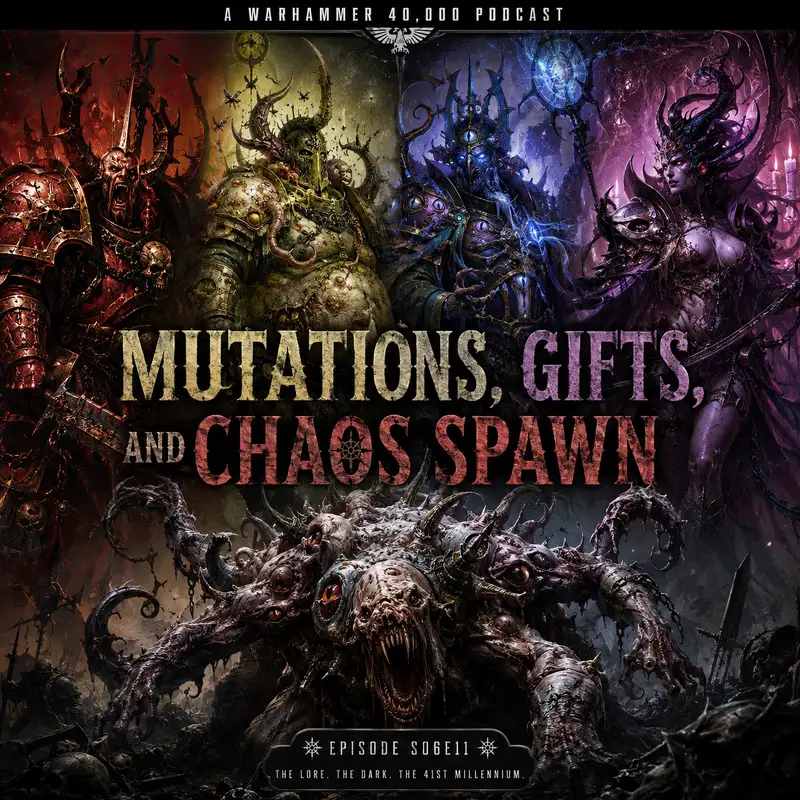
Mutations, Gifts, and Chaos Spawn
The first mutation may be no more than a ridge of bone beneath the skin. It can be hidden under armour, explained as a battle wound, or displayed as proof that something in the Warp has noticed. The second is harder to dismiss. A hand closes around a weapon with claws it did not possess yesterday. An eye opens where no eye should be, and it sees things ordinary sight was never meant to find. Among the servants of Chaos, this is called a gift. The word is not entirely dishonest. The change may bring strength, endurance, speed, or sorcerous power. It may also begin the destruction of the person receiving it. That is the central cruelty of Chaos mutation. A blessing and a wound can be the same event, and the difference may not become clear until there is too little of the recipient left to care.
The Imperium uses the word mutation with the delicacy of a flamethrower. Uncontrolled physical change is treated as evidence of contamination, spiritual weakness, or treason, often all three at once. Yet humanity in the forty-first millennium is already varied beyond anything its ancestors would have recognised. Stable abhuman strains serve Imperial armies. Navigators carry inherited alterations without which interstellar civilisation would collapse. Psykers are feared, registered, exploited, and sometimes honoured. Space Marines are rebuilt through extreme genetic and surgical intervention, although the Imperium places that transformation in a more respectable category. These distinctions matter. Not every mutant serves Chaos, and not every unusual body is a portal to damnation. The Imperium's habit of treating difference as guilt creates victims. It also drives some of them toward the powers the authorities claim to be preventing.
Chaos mutation is different because it is not merely biology going wrong. It is the logic of the Warp entering flesh. The Warp responds to emotion, symbolism, belief, and will. When its power presses into a mortal body, anatomy stops behaving like a fixed blueprint. Desire can become muscle. Obsession can become an organ. Hatred can harden the skin, while despair can teach ruined flesh to keep moving. A mutation may arise through Warp exposure, sorcery, contact with a tainted relic, or the direct attention of a Chaos power. Sometimes the change appears useful. Sometimes it is grotesque. Frequently it is both. A mouth that speaks forbidden names may whisper when its owner is trying to sleep. An arm strong enough to tear open armour may no longer remember how to release what it grasps.
The followers of Chaos call these changes gifts because power is part of the transaction. A champion who wins battles, offers sacrifices, spreads corruption, or advances a patron's purpose may attract the gaze of the gods. That gaze is dangerous, but being ignored can be worse. Chaos warbands are societies built around visible favour. A new horn, unnatural aura, or impossible regeneration can serve as a badge of rank more convincing than formal promotion. The gifted warrior has evidence that the universe has acknowledged them. Rivals may kneel, flatter, or begin planning an accident. The system has one considerable administrative weakness. There is no reliable appeals process. The Chaos Gods do not reward according to fairness, effort, or need. They reward according to their own nature, which their servants rarely understand.
A Chaos gift is also a claim of ownership. Each transformation makes the recipient more capable of serving the power that caused it, while making ordinary life less possible. The warrior who grows too large for human clothing no longer belongs among ordinary humans. The cultist whose blood burns with Warp fire cannot return quietly to a factory shift. The sorcerer whose shadow moves independently has acquired an impressive conversation piece and a shortage of trustworthy neighbours. Isolation deepens dependence. The recipient needs the warband, cult, or patron that calls the change honour rather than horror. Chaos changes the social world around the body until damnation looks like the only community still willing to open the door.
Mutation is not the same as possession, although Chaos makes the boundary untidy. A possessed mortal shares or surrenders the body to a daemon, and the resulting form reflects the struggle or union between them. A mutated follower remains, at least initially, the primary inhabitant of their flesh. Their body has been rewritten, but it has not necessarily gained a second tenant. A Daemon Prince is different again. That is a mortal champion elevated into daemonic existence, no longer bound to ordinary flesh or a natural lifespan. Chaos Spawn occupy another category. They are not lesser daemons, and they are not merely ugly mutants. They are mortals whose transformation has destroyed the coherence of body and mind. These distinctions matter because all four conditions can produce claws, horns, impossible strength, and a room that suddenly feels much too small.
Khorne's gifts tend to make the body a more direct instrument of violence. Strength increases. Bone thickens. Hands become claws or merge with weapons. The face may take on the brutal features of the Blood God's daemonic servants. Rage becomes easier to summon and harder to dismiss. Such changes may look crude beside the transformations of other gods, but Khorne has little interest in decorative ambiguity. A gift is valuable if it helps the recipient kill, survive the counterstroke, and kill again. The cost is often a narrowing of the self. Patience, mercy, reflection, and restraint become weaknesses to burn away. The champion may gain the power to defeat every enemy before them, only to discover that the definition of enemy now includes allies, servants, and anyone who speaks while the axe is being sharpened.
Tzeentch offers change in its most unstable and seductive form. His followers may develop new eyes, altered limbs, avian features, luminous skin, or senses tuned to the Warp. A mutation can arrive with psychic talent, prophetic insight, or the ability to shape reality through sorcery. It may also change again before the recipient learns how to use it. Tzeentch is the god of ambition, hope, conspiracy, and transformation. His gifts encourage the belief that the current form is temporary and the next will be closer to perfection. This makes failure strangely survivable. A disastrous mutation can be described as a necessary stage in a larger design. The plan remains flawless. The planner has merely acquired three additional elbows and an urgent need to revise the sleeves.
The Thousand Sons reveal the terror beneath that promise. Even before their open fall to Chaos, the Legion suffered the flesh-change, an eruption of mutation that twisted warriors into unstable forms. Magnus sought knowledge powerful enough to save his sons and believed he had found relief through a bargain with forces he did not fully understand. The corruption returned. After the Heresy, Ahriman attempted a grand act of sorcery to stop it. His Rubric ended the flesh-change for much of the Legion by ending their flesh altogether. Many Thousand Sons were reduced to dust sealed inside their armour, their spirits bound to war-plate that could still march and fight. The most powerful psykers survived as sorcerers. It was a victory in the style Chaos favours. The stated problem was solved. The people suffering from it were largely destroyed.
Nurgle's gifts defy the body's limits by surrendering every standard that once defined health. Flesh bloats, splits, rots, and hosts diseases that should kill within hours. New mouths, tendrils, horns, and organs emerge amid the decay. Yet the recipient continues. Pain may fade. Wounds cease to matter in the ordinary way. A Plague Marine can endure damage that would leave another warrior as a stain on the deck. To Nurgle's followers, this endurance can feel like liberation. Fear of illness, age, and death loses its grip because those processes are accepted rather than resisted. The gift is real. So is the corruption. Nurgle does not restore the body. He teaches it to remain useful while it collapses, then surrounds that collapse with affection and the claim that resistance was always pointless.
Slaanesh reshapes the body around sensation, performance, and the pursuit of experiences ordinary nerves cannot provide. A follower may gain heightened reflexes, exquisite hearing, unnatural grace, additional sensory organs, or a voice capable of overwhelming the mind. Beauty and monstrosity cease to be opposites. The same form can be alluring at a distance and unbearable at close range. These gifts are rarely enough for long. Improved senses make yesterday's pleasures dull. Perfect skill reveals smaller imperfections. Greater speed creates a craving for motion faster still. The recipient becomes dependent on escalation. A Slaaneshi mutation does not simply grant enjoyment. It expands the capacity to feel while ensuring that satisfaction retreats at the same pace. The body becomes a magnificent instrument that can never finish tuning itself.
Followers of Chaos Undivided may receive blessings that do not fit neatly within one divine style. Some champions court several powers while refusing complete submission to any one of them. Others serve Chaos as a whole, or believe they can use the rival gods without being used. Their mutations can become a record of that dangerous diplomacy. One limb expresses brutal strength, another impossible flexibility. The skin carries plague without weakening, while the eyes burn with sorcerous light. Such combinations may produce formidable champions, but they also reveal a body pulled by competing principles. Unity among the Dark Gods is temporary at best. A mortal trying to contain all their favour has volunteered to become the conference room in which the Great Game continues its arguments.
The physical form receives most of the attention because it is difficult to ignore a tentacle pushing through a breastplate. The deeper transformation is often psychological. Chaos gifts reward patterns of thought until those patterns become identity. The servant of Khorne learns that anger brings clarity and power. The servant of Tzeentch learns that every relationship is a scheme. The servant of Nurgle learns to call surrender wisdom. The servant of Slaanesh learns that limits are insults. Each lesson contains a fragment of truth. Anger can cut through fear. Change can break oppression. Acceptance can ease suffering. Excellence can create beauty. Chaos takes the useful fragment, removes every boundary around it, and builds a prison from the result. Mutation makes that prison visible.
This is why the Path to Glory is not simply a ladder of stronger abilities. A Chaos champion seeks victories, followers, relics, sacrifices, and recognition. With each success, the champion hopes to draw a patron's eye and receive another boon. The process is competitive because other champions want the same attention. It is theatrical because deeds must be noticed, not merely accomplished. It is unstable because divine favour is not a medal awarded for service. A champion may be elevated after one spectacular act, ignored after centuries of devotion, or ruined by a reward the patron considers appropriate. Mortal ambition tries to turn this into a system. Chaos keeps reminding mortals that it is a relationship, and the stronger partner has no obligation to be consistent.
Within a warband, mutation is both military asset and political crisis. A champion who grows stronger may challenge the warlord. A sorcerer who gains new sight may claim access to secrets no one else can verify. A warrior whose body begins to fail may conceal the change, fearing comrades will see rejection by the gods. Others display every alteration proudly, opening their armour for horns, tendrils, or mouths. Followers watch one another for signs of favour and collapse, often using the same evidence for both. A trembling hand might signal prophetic power. It might also signal Spawndom. In a sensible organisation, a medical officer would investigate. Chaos warbands favour a more flexible approach involving superstition, knives, and succession disputes.
At one end of the champion's road stands daemonhood. A mortal judged worthy may be remade as a Daemon Prince, gaining immense power and an existence tied to the Warp. The new prince retains enough ambition, cunning, and identity to continue ruling and pursuing ancient grudges. This is the reward many champions imagine whenever the first mutation appears. Every painful change can be interpreted as preparation. Every lost piece of humanity becomes evidence that mortality is being left behind. Yet daemonhood is not freedom. A Daemon Prince is more deeply bound to Chaos than the mortal ever was, shaped by the patron's power and dependent on conditions that allow daemonic beings to manifest in realspace. The cage has become larger, stronger, and decorated with wings. It remains a cage.
At the other end waits the Chaos Spawn. Spawndom begins when change overwhelms the structure that made the victim a person. The body no longer follows a stable design. Limbs divide, fuse, or vanish. Eyes and mouths emerge without purpose. Muscle, hide, bone, and organs rearrange as if several unfinished creatures are trying to occupy the same space. The mind cannot endure the process. Memory fragments. Language disappears. Desire collapses into hunger, fear, rage, and reflex. What remains may be enormously strong, difficult to kill, and incapable of understanding what it has become. Descriptions often call this the result of too many gifts. That is useful shorthand, but there is no reliable numerical threshold. Chaos is not a rewards card, and the final mutation is not free after the tenth act of devotion.
A follower may become a Spawn through accumulated corruption, sudden divine displeasure, uncontrolled Warp exposure, or deliberate sorcery. A rival can be reduced to Spawndom as punishment. A failed champion can be discarded that way. A devoted servant may simply receive a transformation that flesh and sanity cannot contain. This uncertainty is essential to the horror. If Spawn were produced only by obvious failure, champions could tell themselves that skill would protect them. If they resulted only from cowardice, courage would be enough. Instead, the road to Spawndom runs beside the road to daemonhood for almost its entire length. The same attention that promises immortality can erase the recipient. The gods know the difference between elevation and ruin. Their servants usually discover it during the procedure.
Chaos warbands do not always destroy their Spawn. Some abandon them. Others chain, herd, or drive them toward the enemy as living shock weapons. A creature that once commanded warriors may now be dragged behind those same warriors, snapping at anything within reach. It can break infantry lines, absorb gunfire, and spread terror through biological impossibility. Former comrades may preserve scraps of armour, heraldry, or restraints that hint at what it used to be. Whether they do this from sentiment, mockery, or practical identification depends on the warband. Chaos permits a broad range of management styles. The result is the same. A person who pursued recognition has become a weapon that no longer recognises anyone.
That remnant of identity makes Chaos Spawn more disturbing than an unknown monster. A Tyranid beast was never human. A daemon is a creature of the Warp, however much it resembles mortal fears. A Spawn may have had a name, a command, and a plan for eternity. It may have remembered the Siege of Terra, led a rebellion against an Imperial governor, or whispered prayers in a hab-block basement. The precise history does not matter. Someone once looked through those eyes before there were too many of them. The creature's violence is terrible, but the greater horror is continuity. The flesh is still present. The life has not cleanly ended. It has been stretched past the point where personhood can survive.
The Imperium understands part of this danger and responds with its preference for solutions that are simple, absolute, and large enough to be seen from orbit. Uncontrolled mutation can signal Warp corruption. A population exposed to a rift, cursed relic, or daemonic incursion may change in ways that threaten everyone around it. Quarantine and investigation are not irrational. The problem is that Imperial policy often treats suspicion as proof and suffering as guilt. Stable mutants, accidental victims, and people born visibly different can be persecuted before Chaos reaches them. A cult then arrives offering food, protection, and a theology in which the hated body is not a mistake but a sacred sign. The offer is manipulative. It is also more compassionate than the first response many mutants received from the Imperium, which is a low bar the Imperium still limbos beneath.
For the outcast, the first Chaos gift can feel like vindication. The limb that drew mockery becomes strong enough to break an enforcer's shield. The voice condemned as unnatural begins to command a crowd. The disease that should have killed becomes proof of Nurgle's protection. The visions that brought a death sentence become a channel for Tzeentchian power. Chaos rarely announces the final cost. It begins by naming the wound, praising the survivor, and offering a way to make the persecutor afraid. That is why mutation is such an effective instrument of corruption. It converts humiliation into identity and helplessness into power. By the time the recipient understands that the gift also contains a leash, they may have burned every road back.
A gift from Chaos is neither simply a reward nor simply a punishment. It is a transformation that serves the giver first. It may save a life, win a battle, cure fear, expand perception, or grant strength beyond mortal limits. It also makes the recipient more useful to a power whose nature cannot stop at moderation. Every boon pushes the servant toward a narrower and more extreme existence. The final possibilities reveal the bargain with brutal clarity. The fortunate champion becomes a Daemon Prince and carries ambition into immortality, though never independence. The unfortunate becomes a Chaos Spawn and carries only flesh forward. Both have been noticed. Both have been remade. The difference is not whether the gods gave them what they wanted. It is whether enough of the person survived to understand the gift.