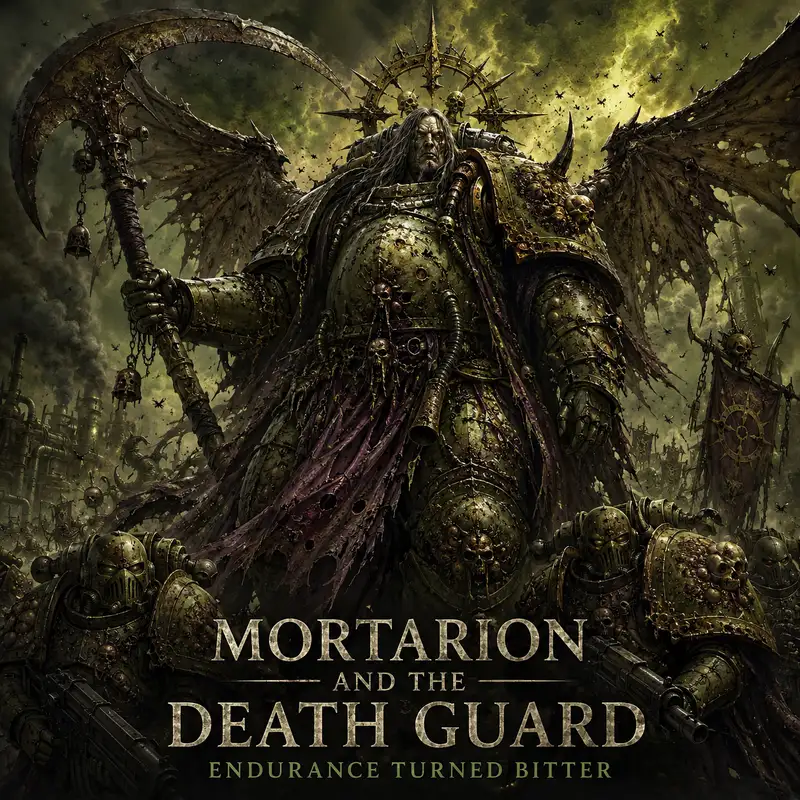
Mortarion and the Death Guard: Endurance Turned Bitter
Mortarion spent his youth teaching human beings how to breathe poison. He spent the rest of his existence proving that survival, by itself, is not freedom. The lesson came aboard a fleet trapped in the warp, where the Death Guard discovered an enemy they could not shoot, outmarch, or simply endure. Their armour remained sealed. Their discipline held. Their bodies did not. Disease moved through the Legion without mercy, leaving warriors who had crossed radiation fields and toxic continents begging for an end that would not come. At the centre of that suffering stood Mortarion, the primarch who had built his entire identity around never yielding. When he finally surrendered, he did not escape the prison. He made it eternal.
That is the contradiction at the heart of Mortarion and the Death Guard. They began as liberators shaped by hardship. They became conquerors who believed hardship made them righteous. In time, endurance ceased to be a tool and became a creed. Pain was proof. Resentment was loyalty. Mercy looked suspiciously like weakness. By the time Nurgle claimed them, the transformation was monstrous, but it was not entirely unfamiliar. The Plague God merely took the values they already possessed and removed every limit.
Mortarion’s story begins on Barbarus, a world where the atmosphere itself enforced a social order. Human settlements clung to the low valleys beneath mountains drowned in poisonous mist. Above them lived inhuman overlords, ancient beings who used necromancy, warped science, and armies made from the dead. The higher one climbed, the more lethal the air became. The overlords could descend to hunt, punish, and harvest the people below. The humans could not follow them home. Geography had become tyranny, and the weather served as border guard, prison wall, and executioner.
Into this world fell one of the Emperor’s lost sons. The greatest of Barbarus’s overlords found the infant and raised him. Later accounts often call this creature Necare, though the records surrounding Barbarus are neither complete nor entirely trustworthy. He named the child Mortarion, a name bound to death, and treated him less as a son than as a weapon under construction. The young primarch was tested against stronger toxins, harsher heights, and increasingly terrible enemies. His home was a fortress built at the edge of what his body could survive. Even childhood had been arranged as an endurance trial.
Mortarion learned war from monsters. He learned command, weapons, surgery, and the brutal arts by which the overlords maintained their power. He also learned that affection offered by a tyrant is simply another chain. His foster father kept him isolated from the humans below, but isolation rarely survives curiosity. Mortarion eventually escaped into the valleys and discovered people who looked fragile beside him, yet were unmistakably his own kind. Their speech, their labour, and even their ordinary laughter revealed the scale of the lie in which he had been raised.
The humans did not immediately welcome him. From their perspective, an enormous pale figure had walked out of the fog wearing the manner of the beings who had tormented them for generations. Suspicion was reasonable. Mortarion answered it with work. He strengthened their settlements, laboured in their fields, and waited for the chance to prove whose side he had chosen. When an overlord descended with its creations, Mortarion met it with a great harvesting scythe and killed it. That weapon would become part of his legend, but the important act was not the killing. It was the choice. For the first time, Mortarion used the strength given to him by an oppressor against oppression itself.
He taught the people of Barbarus to fight. Blacksmiths became armourers. Crude firearms were produced. Protective suits and breathing equipment allowed soldiers to climb into regions that had once meant certain death. Mortarion selected the strongest and most determined fighters and called them his Death Guard. The name existed before the Space Marine Legion bore it. These first Death Guard were mortal humans advancing uphill through poison because remaining below meant allowing the raids to continue.
Here, endurance had a clear purpose. It allowed the weak to reach the strong. It transformed suffering from a condition imposed by tyrants into a burden willingly accepted for liberation. Mortarion’s armies climbed higher each year. Fortress after fortress fell. The overlords, so accustomed to immortality and impunity, discovered that their victims had acquired respirators, artillery, and a remarkably poor attitude toward the established order.
At last, only Mortarion’s foster father remained, protected by the most poisonous heights on Barbarus. Mortarion could not reach him. His equipment failed before the summit, and even a primarch’s body could not survive the air indefinitely. Then the Emperor arrived.
The reunion was badly timed and worse handled. Mortarion had spent years freeing Barbarus through his own labour and the blood of its people. The Emperor appeared at the moment of final victory, offering aid and claiming him as a son. To Mortarion, the offer did not feel like rescue. It felt like replacement. Another powerful father had descended from above, praised his strength, and expected obedience.
A challenge followed. If Mortarion could kill the last overlord alone, the Emperor would leave Barbarus. If he failed, the Emperor would finish the task, and Mortarion would accept his place in the Imperium. Whether the Emperor intended to teach humility, force a decision, or simply bring a dangerous confrontation to an end remains open to interpretation. Mortarion heard only the suggestion that he was not strong enough.
He climbed before he was ready. The poison destroyed his breathing apparatus. His flesh blistered. His lungs began to fail. Within sight of the fortress, Mortarion collapsed as the being who had raised him came down through the fog to kill him. The Emperor intervened, slew the overlord, and saved Mortarion’s life.
Barbarus was free. Mortarion had lost.
That was how he remembered it. The Emperor had accomplished the goal Mortarion wanted, but had also taken the vengeance Mortarion believed belonged to him. Gratitude and humiliation became inseparable. He kept his oath and joined the Great Crusade, yet a wound remained beneath every act of obedience. Mortarion did not merely dislike being rescued. He treated dependence itself as evidence of domination.
The Space Marine Legion given to him was already known for endurance. The Fourteenth Legion had fought as the Dusk Raiders, heavy infantry descended in part from the hard military traditions of Old Albia on Terra. They favoured disciplined assaults, close-range fire, and attacks made as daylight failed. They were stubborn, self-reliant, and proud of an identity forged before finding their primarch. Mortarion took those qualities and remade them in the image of Barbarus.
The Dusk Raiders became the Death Guard. Ornament disappeared. Battle damage was left visible as proof that both warrior and armour had endured. The Legion learned to operate in radiation zones, chemical wastes, lethal climates, and battles of attrition that other forces avoided. Their formations were simplified. Their command structure was direct. Mortarion had little interest in elegant manoeuvres when a steady advance through the enemy’s strongest position would serve. His preferred solution to a difficult battlefield was to make it survivable for his own troops and unsurvivable for everyone else.
This was not mere stupidity dressed as toughness. Mortarion possessed a sharp military mind. He understood the rhythm of attritional war, the point at which an enemy line would fail, and the value of soldiers who could continue fighting after ordinary forces had collapsed. The Death Guard could advance with limited support, endure losses, and maintain pressure across ground that poisoned machines and men alike. They became the Legion sent to do the work nobody wanted and few could complete.
The price was that Mortarion increasingly confused capability with virtue. Because his sons could endure terrible conditions, he believed enduring them made the Legion purer. Because they accepted losses, he regarded restraint as softness. Because Barbarus had been freed through merciless struggle, he came to believe mercy itself protected oppressors. His stated purpose remained human liberation, but the definition of liberation narrowed until it meant destroying whatever Mortarion judged capable of imposing chains.
This is where endurance turned bitter. Hardship was no longer something to overcome. It became the measure by which Mortarion judged everyone. Those who could not bear what he bore were weak. Those who offered assistance were seeking control. Those who questioned his methods lacked resolve. A man who had once built respirators so others could climb began demanding that everyone breathe his poison.
His hatred of psykers followed the same pattern. Barbarus had been ruled by witch-lords whose powers made them untouchable. Mortarion therefore saw psychic ability not as a tool but as the natural weapon of tyrants. He opposed the Librarius within the Legions and became one of the strongest voices against psychic practice. The fear was understandable. The certainty was dangerous. Mortarion treated every use of the warp as though it were simply another version of the mountain fog, controlled by someone above and used to keep others below.
Beside him stood Calas Typhon, one of his oldest companions from Barbarus and later First Captain of the Death Guard. Typhon shared the Legion’s severity, but concealed psychic power of his own. He understood Mortarion’s suspicion well enough to hide what he was, and understood his pride well enough to guide him without appearing to do so. The relationship would eventually become one of the great poisoned loyalties of the Heresy. Mortarion trusted a man who embodied the thing he hated, while rejecting almost anyone honest enough to challenge him.
Horus found Mortarion ready to listen. The Warmaster treated him with respect and spoke to grievances Mortarion had carried since Barbarus. The Emperor preached freedom from superstition while employing psykers, Navigators, and powers he did not fully explain. The Imperium destroyed tyrants while demanding absolute compliance. Mortarion did not invent these contradictions. They were real. His failure was deciding that Horus offered freedom rather than another hierarchy with a more flattering invitation.
When the rebellion began, Mortarion chose the Warmaster. That choice must not be reduced to a childhood wound or an inevitable slide. Many primarchs suffered humiliation. Many distrusted the Emperor. Mortarion still decided that betrayal was preferable to imperfect loyalty, and then ordered his Legion to follow.
At Isstvan the Third, the traitors attempted to purge the loyal warriors from their own ranks. Virus weapons were unleashed upon the surface, followed by bombardment and ground assault. Death Guard killed Death Guard. The Legion that had once climbed through poison to liberate the oppressed now used poison to erase brothers who refused an unlawful command.
The purge did not go as planned. Loyalist Death Guard endured the attack and fought back with the same stubbornness Mortarion had cultivated. Captain Nathaniel Garro and a small band escaped aboard the Eisenstein to warn Terra. Their survival exposed a truth Mortarion could not control. Endurance did not belong to him. It did not prove his cause was right. The same virtue could sustain loyalty, rebellion, compassion, vengeance, or fanaticism. Hardship sharpens conviction, but it does not choose what the conviction serves.
The Death Guard went on to fight at the Drop Site Massacre and across the widening civil war. They were still recognisably themselves. Their armour had not yet become bloated with corruption. Their weapons, discipline, and battlefield methods remained those of the Great Crusade, now turned against the Imperium they had helped build. Mortarion continued to condemn sorcery even while allied with forces increasingly dependent upon it. This contradiction did not trouble him enough to change sides. Resentment has a useful talent for making one hypocrisy appear unforgivable and another merely inconvenient.
His encounters with Jaghatai Khan exposed the weakness beneath his certainty. The Khan also valued freedom, but understood it differently. For Jaghatai, freedom required movement, judgment, and the willingness to refuse every master, including one’s own anger. Mortarion offered him rebellion against the Emperor, yet could not explain why serving Horus was liberation. Their conflict was more than a dispute between brothers. It was a clash between freedom as independent choice and freedom as the destruction of whoever had caused pain.
The decisive betrayal came from within the Death Guard. As Horus’s forces moved toward Terra, Typhon engineered the Legion’s isolation in the warp. The fleet became becalmed, trapped beyond ordinary rescue. Then disease appeared.
This was not a natural plague and not a weapon that armour could exclude. It attacked Space Marines whose altered bodies could survive poisons that would kill ordinary humans in moments. Flesh ruptured and healed only to rupture again. Organs failed without granting death. The Legion’s famous resilience prolonged the agony. Every gift that had once allowed the Death Guard to fight on now ensured they could suffer longer.
Mortarion tried every answer he understood. He demanded discipline. He sought a material cause. He raged against witchcraft. He killed Typhon, or tried to, only to discover that the First Captain had become host to the Destroyer Hive and would not remain dead. There was no enemy line to break and no summit to climb. The plague had turned endurance into a torture device.
Nurgle waited behind it.
The Plague God’s offer was not simply power. Nurgle offered an end to resistance. His servants would still rot, but they would no longer experience decay as a thing to fear. Pain would become warmth. Disease would become belonging. Despair would be answered not by hope, but by acceptance so complete that hope was no longer necessary. It is a dreadful form of comfort, which is precisely why it can tempt those who have exhausted every other answer.
Mortarion surrendered. He did so under the suffering of his sons and his own inability to save them. There was love in that choice, or at least responsibility, but it had been deformed by pride long before the fleet entered the warp. He could not accept rescue from the Emperor because rescue created obligation. He accepted damnation from Nurgle because it could be described as endurance’s final victory.
The bargain transformed the Legion. Mortarion became a daemon prince. Typhon became Typhus, herald of the Plague God. The Death Guard became Plague Marines, their bodies swollen, ruptured, and fused with corroded armour. They gained the ability to survive wounds and environments beyond even their former limits, but survival had lost all connection to freedom. They could endure almost anything because they now carried their prison inside them.
By the Siege of Terra, the Death Guard marched beneath clouds of flies and contagion. The defenders faced not only bolters and blades, but sickness spreading through trenches, fortifications, and exhausted bodies. Mortarion, now winged and immense, seemed to embody the principle he had always pursued. He could not be worn down. He could not be poisoned. He could not be killed by ordinary means.
Jaghatai Khan faced him again at the Lion’s Gate spaceport. Mortarion possessed greater raw endurance and daemonic strength. The Khan understood that this advantage had become a weakness. Mortarion needed suffering to confirm his identity. He needed his brother to break. Jaghatai endured long enough to deny him that satisfaction, then struck with everything he had. The Khan was left near death. Mortarion was banished to the warp. Even transformed into the perfect survivor, he could still lose to someone who endured for a purpose beyond endurance itself.
Ten thousand years later, Mortarion remains a lord of the Death Guard, ruling from the Plague Planet and carrying Nurgle’s wars into realspace. His sons spread diseases that collapse cities, fleets, and worlds. They are not mindless. They retain hierarchy, memory, rivalry, and fragments of the Legion they once were. Some follow Mortarion. Others look to Typhus, whose independence is a continuing insult to his primarch. The man who could not bear control has spent millennia unable to command even the loyalty of his own most famous captain without dispute.
Mortarion has fought Roboute Guilliman and brought plague war to Ultramar, still presenting corruption as liberation from weakness. Yet every campaign repeats Barbarus in reverse. Once, Mortarion gave ordinary people the means to climb into poisoned heights and kill the monsters who ruled them. Now he descends from those heights as an immortal lord surrounded by toxic fog, commanding altered servants and offering submission as the only escape from pain.
His tragedy is not that endurance failed. Endurance served him extraordinarily well. It freed a world, forged a Legion, and carried warriors through battles no other force could survive. The tragedy is that Mortarion stopped asking what endurance was for. He allowed suffering to become identity, then allowed identity to become judgment. He could forgive cruelty more easily than weakness, betrayal more easily than dependence, and slavery more easily than rescue.
The bitter heart of the Death Guard is therefore not disease. It is the belief that because pain cannot be avoided, it must be worshipped. Nurgle did not teach Mortarion to endure. Barbarus had already done that. Nurgle taught him to call the cage a sanctuary, the chain a gift, and the poison in his lungs proof that no one could ever make him kneel again.