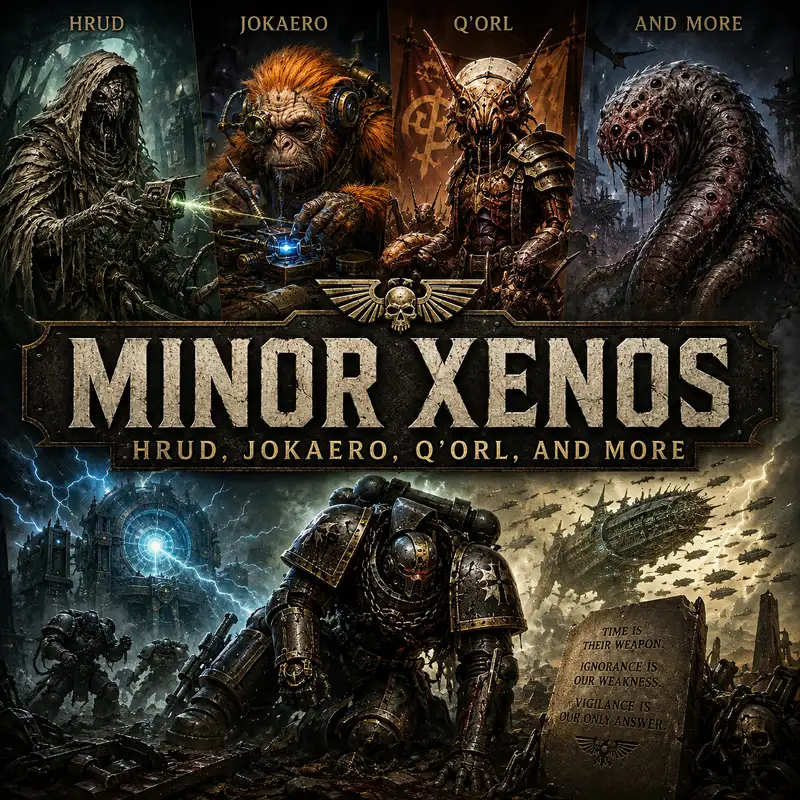
Minor Xenos: Hrud, Jokaero, Q’Orl, and More
During the campaign in the Sak'trada Deeps, Iron Warriors watched ceramite pit, seals crumble, and weapons decay as though centuries had passed between one heartbeat and the next. Their enemies were difficult to see, harder to target, and surrounded by fields that made time itself hostile. The Legion had come to clear an inconvenient region of space. Instead, one of the most formidable armies of the Great Crusade learned that a people dismissed as vermin could maul a primarch's fleet and leave a Space Marine old before his time. The enemy was the Hrud, and the lesson was larger than the campaign.
Imperial histories prefer a galaxy with a manageable cast. Humanity stands at the centre. Around it gather the great powers whose wars can be named, mapped, and filed into suitably enormous archives. Orks, Aeldari, Necrons, T'au, Tyranids, and the servants of Chaos dominate the record because they repeatedly force themselves into it. Beyond them wait the peoples usually called minor xenos. The word sounds reassuring. It suggests a limited problem, perhaps one cruiser, one regiment, and a concise report marked resolved. In practice, minor often describes the attention given to a species, not the danger it presents.
The Imperium is not a solid block of territory. Its worlds are islands connected by uncertain routes through the warp, with vast regions between them that may remain unexplored, mischarted, or simply ignored. Entire alien societies can survive inside those gaps. Some lack reliable warp travel. Some hide beneath other civilizations. Some have no central empire to conquer. Some are already reduced to scattered survivors. Others are powerful enough to devastate a sector but have not yet become a problem for Terra. The Hrud, the Jokaero, and the Q'Orl reveal three very different ways an alien people can remain outside the galaxy's usual story.
Even the appearance of the Hrud resists certainty. Imperial accounts describe hooded, crouching figures, nocturnal scavengers, and long-limbed creatures concealed beneath layers of filth and ragged material. Some reports disagree so sharply that they seem to describe different species. That may reflect bad records, mistaken identification, or the effects of the distortion surrounding the Hrud themselves. Their bodies generate an entropic field called the ssaak. Light bends around it. Time behaves badly within it. A stationary Hrud can become little more than a dark flicker inside shimmering air, while nearby matter suffers accelerated age.
The effect is not merely camouflage. Armour corrodes. Flesh withers. Machinery fails after experiencing years, centuries, or far more in moments. Hrud weapons add deliberate cruelty to an already unnatural battlefield. Their fusils project energy that can phase through protection before becoming lethal inside a target. Other devices twist time directly, aging victims, displacing them along their own time stream, or forcing matter into impossible relationships. Against such weapons, a wall is not secure because it is thick, and a warrior is not safe because he is strong. Both are temporary arrangements. The Hrud simply make the temporary part arrive early.
That makes them sound like creatures of pure destruction, but Hrud society is more complicated than the word infestation allows. They form tribes and extended family groups. They build warrens beneath worlds, inside ancient structures, and within the forgotten spaces of voidships. They are scavengers, but scavenging is not the same as stupidity. Hrud communities preserve archives, guard inherited knowledge, and carry records with them when they move. An Imperial officer may see refuse arranged in a tunnel. A Hrud may see tools, ancestry, and the material memory of a people that has survived by using what larger civilizations throw away.
Migration is central to that survival. When a Hrud population becomes too large for its warren, part of the tribe departs. Some travel aboard their own vessels. Others move through the hidden spaces of ships and drifting hulks, emerging far from where the journey began. To the Hrud, this is continuity. To the civilization whose mines, lower decks, or cities lie in the path, it is an invasion with no declaration and no obvious command structure. The distinction offers little comfort when clocks fail, food spoils, support beams weaken, and soldiers age while trying to aim at shadows.
Late in the Great Crusade, the War Council ordered Perturabo and the Iron Warriors into the Sak'trada Deeps. The region offered little strategic value, and Perturabo understood that. He obeyed anyway. His Legion had become accustomed to assignments that required endurance, calculation, and an alarming willingness to spend lives. The Hrud turned those virtues against them. Siegecraft assumes that material strength can be measured. Logistics assumes that supplies remain usable between inspection and issue. Command assumes that time passes at roughly the same rate for everyone involved. In the Deeps, each assumption became negotiable.
Perturabo eventually worked with the Mechanicum to create a great stasis device capable of suppressing much of the Hrud entropic effect. It was an extraordinary answer, precise and monumental, exactly the kind of solution the Lord of Iron preferred. It also transformed a difficult purge into a mass flight. Hrud populations began moving out of the threatened systems by the billions. Migration vessels filled the void. Vast warrens broke free from infested worlds. The Iron Warriors had found a way to win the local engagement and, in doing so, produced a larger disaster. This is a recurring Imperial specialty, although rarely with so many broken clocks.
The escaping Hrud unleashed a temporal shockwave that tore through the Iron Warriors fleet. Ships were ruined. Formations were scattered. Perturabo's flagship survived only through desperate action, and large portions of the Legion's strength had been consumed for worlds its primarch had never considered worth the price. On Golghis, Warsmith Barabas Dantioch lost most of his command and endured thousands of years of artificial aging. He survived as an old man inside the body of a Space Marine, then questioned the value of the campaign. Perturabo answered criticism as he often did. Dantioch was disgraced and sent away.
The Hrud did not defeat the Imperium by conquering its capital or founding a rival dominion. They defeated an Imperial assumption. The campaign treated them as a fixed population occupying ground that could be cleared. The Hrud behaved as a mobile civilization whose biology, technology, and social structure made conventional conquest ruinously expensive. Their apparent weakness was partly a failure of perspective. They did not possess the sort of empire the Imperium recognized, so the Imperium mistook the absence of familiar institutions for the absence of power.
The Jokaero create a different problem. They resemble the orange-furred great apes once known on ancient Terra, yet they possess an instinctive command of technology beyond the understanding of most human engineers. A Jokaero can examine damaged equipment, rearrange it with quick hands, and produce a device whose operation may be obvious only after it saves someone's life, destroys a wall, or leaves the local tech-priest reconsidering several cherished doctrines. Their particular talent for miniaturization has produced digital weapons, compact energy systems, force-field modifications, and other devices sought across the Imperium.
Their origins are usually connected to the Old Ones and the final ages of the War in Heaven. The surviving accounts suggest that the Jokaero were shaped as living technologists, able to create and adapt machinery without the long education other species require. Whether that knowledge is instinct, intellect, or some union of the two remains unresolved. The question persists because the Jokaero do not explain themselves in ways humans find satisfying. They do not deliver lectures, submit technical diagrams, or join debates over the proper definition of consciousness. They build what they need and move on.
Jokaero travel in family groups aboard open, geometric starframes whose structures channel forces that human observers only partly understand. These vessels can manoeuvre through space and the warp by altering their own configuration. A few pieces are moved, a lattice changes shape, and the craft behaves as though someone has revised a law of physics in the margin. Attempts to capture Jokaero usually end with the captives constructing an escape device from whatever happens to be nearby. Confining one with tools is clearly unwise. Confining one without tools merely encourages a more creative definition of tool.
The Imperium sometimes includes Jokaero weaponsmiths in Inquisitorial retinues. This arrangement exposes one of the Imperium's sharper contradictions. Imperial doctrine teaches that the alien is corrupt, dangerous, and unfit to share humanity's destiny. An inquisitor may nevertheless travel with an alien technologist because the alien can improve a las weapon, repair a field generator, or make a ring capable of firing like a gun. The philosophical difficulty is handled through classification. If the Jokaero is treated as a useful creature acting through instinct rather than a reasoning person, cooperation becomes more administratively comfortable.
The Jokaero may have opinions about this. Their behaviour offers enough evidence for cooperation, planning, loyalty to family, trade, and coordinated action. At the Blackstone Fortress known as the Seventh, Jokaero became craftsmen, repairers, and medical specialists within the community at Precipice. When one of their number disappeared, the others withheld their services until the missing individual was returned. That is not proof of a human-style civilization, but it is difficult to dismiss as a wrench with fur. The Imperium's uncertainty may be genuine. It is also extremely convenient.
Their minor status comes from the absence of conquest. The Jokaero do not seem interested in ruling sectors, converting populations, or defending a fixed border. They appear, acquire materials, solve immediate problems, and depart. Yet a species that can improvise starships and weapons from wreckage cannot be called primitive in any useful sense. The Jokaero demonstrate that technological superiority does not have to produce an empire. Power can exist without administration, ideology, or the desire to plant a flag. This possibility is almost offensive to the Imperium, which has accumulated vast quantities of all three and still struggles to keep the lights working.
The Q'Orl stand at the opposite extreme. They are not hidden migrants or wandering technologists. They possess a territorial civilization called the Swarmhood, centred on the holy Swarmworld of Loqiit in the Segmentum Pacificus. They are insectoid, highly organized, and divided into specialized forms shaped during larval development. A queen produces the eggs from which the Swarmhood's many strains emerge. Workers, warriors, and other forms are not separate species but expressions of a single biological and political system.
Most individual Q'Orl live for roughly a decade by human standards. The queen may endure for centuries or longer. That difference shapes their culture. A short-lived worker inherits unfinished tasks from those who came before and expects later generations to continue them. Their projects become collective acts extending far beyond one life. The dead are preserved with care, and ancestral labour remains part of the living Swarmhood. Human observers often mistake individuality for the only possible measure of intelligence. The Q'Orl offer a civilization in which continuity belongs primarily to the colony.
They communicate through scent and chemical signals, although they also possess a written system grounded in mathematical relationships. Their monuments proclaim the superiority of the Swarmhood and its claim to territory. This is not a passive species awaiting discovery. Q'Orl chainships are advanced, heavily armed, and built from connected sections that can separate when threatened. An enemy may believe it has trapped one vessel, only to watch the target divide and scatter in several directions. The design reflects the society. The whole can divide without ceasing to remain the whole.
For all their sophistication, the Q'Orl have long faced one decisive limitation. They lack a reliable means of travelling through the warp. Their ships can dominate local space, expand across neighbouring systems, and build an extensive regional power, but enemies capable of warp travel can escape them or bypass their borders. In the geography of the forty-first millennium, that limitation is the difference between a formidable empire and a galaxy-wide contender. It is also a technical problem, and technical problems have an uncomfortable habit of being solved.
Imperial records describe Q'Orl efforts to capture Navigators, the mutant human specialists who guide ships through the warp. At least one captured Navigator was found with a larval organism implanted in his brain, apparently allowing external control. Q'Orl vessels have also been seen carrying machinery of Imperial origin, raising fears that salvaged or captured warp systems are being incorporated into their ships. The evidence does not establish that the Swarmhood has mastered long-range warp travel. It does show that the Q'Orl understand the obstacle and are experimenting with solutions.
That possibility changes the scale of the threat. The Swarmhood already possesses numbers, industry, social cohesion, and armed fleets. Its confinement is geographical rather than civilizational. Should the Q'Orl gain dependable warp navigation, the label minor could become obsolete with remarkable speed. The danger is not that they will suddenly become intelligent or organized. They already are. The danger is that a barrier which has kept their ambitions regional may fail. Terra has survived many threats by destroying them. It has also survived because some threats could not yet reach it.
Beyond these three are species that survive in still darker corners of the record. The Slaugth, sometimes called the worms that walk, are patient infiltrators whose bodies resemble masses of joined, maggot-like organisms. They operate through human agents, criminal networks, and carefully encouraged civil wars. Rather than attack a strong world, they help its inhabitants weaken it, then arrive to feed among the ruins. Their methods exploit greed, secrecy, and institutional decay. In other words, they have selected materials the Imperium can provide in industrial quantities.
The Rak'Gol of the Koronus Expanse are less subtle. They are large, many-limbed marauders whose culture exalts the hunt and whose bodies accumulate crude but effective cybernetic alterations. Their ships are brutal constructions driven by radiation-producing engines. Their weapons favour barbed projectiles, rapid fire, blades, and radiation. Imperial survivors often describe them as beasts, but Rak'Gol packs coordinate, set traps, maintain ranks, modify themselves, and pursue alien technology with purpose. Calling them animals does not make their ambushes less intelligent. It merely helps the victims die while preserving a tidy theory.
The Khrave present another form of invasion. These ancient psychic predators can dominate minds, steal memories, and build networks of controlled hosts. A world under Khrave influence may still display human faces, human uniforms, and human chains of command. The alien presence is inside the decision-making process. During the Great Crusade, the Dark Angels broke a major Khrave power and killed the ancient being that ruled it, but scattered Khrave survived. Their threat is difficult to count because the relevant number is not ships or soldiers. It is compromised minds.
These species do not form one alliance, share one destiny, or occupy a single rung beneath the galaxy's great powers. The category gathers together whatever Imperial history has not placed at the centre. A regional empire, a migratory people, a family of technologists, a hidden parasite, and a raiding culture may all receive the same adjective despite having almost nothing else in common. The classification is useful for filing documents. It is far less useful for surviving contact.
There is also a moral danger in the language. To call a people minor makes extermination sound small. A Hrud warren becomes an infestation. A Jokaero becomes equipment. A Q'Orl colony becomes a biological hazard. Some of these species are openly predatory, expansionist, or murderous. Others are dangerous because their needs collide with human survival. None require sentimental treatment. Yet accurate understanding matters, especially in war. An enemy described only as vermin will eventually exploit every fact the description concealed.
The galaxy's greater powers dominate attention because they can sustain long wars and return across centuries. Minor xenos reveal the galaxy beneath those wars. It is crowded, local, and full of civilizations whose histories may never intersect with Terra until one migration, one recovered engine, or one broken quarantine brings them into view. Many have already survived catastrophes older than the Imperium. Their obscurity is not proof of weakness. Sometimes it is the method by which they endured.
The Hrud show that a people without a conventional empire can break a Legion by refusing to remain fixed in place. The Jokaero show that supreme technical ability need not lead to conquest, or even to a form of society humans recognize. The Q'Orl show that a vast and ambitious civilization can remain strategically contained by one missing capability. The Slaugth, Rak'Gol, and Khrave show how many kinds of war disappear when the archive looks only for fleets and front lines.
Minor xenos are minor only from a distance, and distance is never permanent in the forty-first millennium. To the settlement beneath which the Hrud are gathering, to the voidship caught by a Rak'Gol pack, or to the Navigator waking with something alive behind his eyes, there is nothing secondary about them. The Imperial star chart marks many regions as empty because no compliant world sends a tithe from them. Empty is the wrong word. Those dark spaces are occupied by peoples the Imperium has not understood, has not destroyed, and in many cases has not yet noticed looking back.