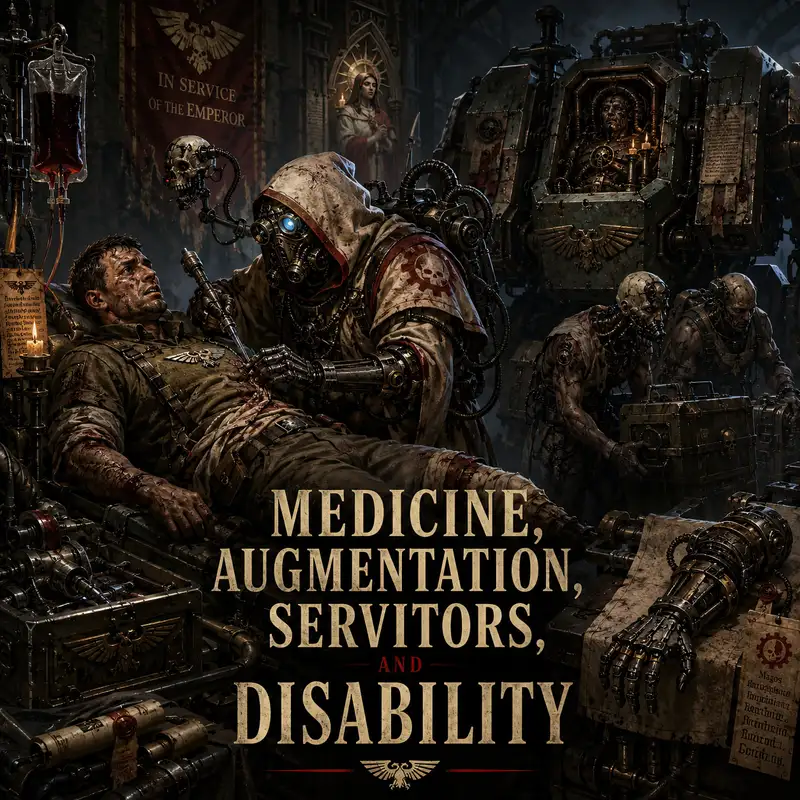
Medicine, Augmentation, Servitors, and Disability
The wounded guardsman is still conscious when the medicae officer reaches him. That is not necessarily good news. Consciousness means pain, fear, and the ability to understand the quiet calculation taking place over his body. Can he survive transport? Can he return to duty? Is the limb worth saving, or would a mechanical replacement be faster? In another age, medicine might begin with the question, how do we make this person whole? In the Imperium, it often begins with a harsher one. What can this body still be used for?
That question connects nearly every form of Imperial medicine. It lies behind the grand clinics of noble houses, the blood-slicked aid stations of the Astra Militarum, the sanctified laboratories of the Adeptus Mechanicus, and the cold workshops where servitors are made. The Imperium possesses technologies capable of replacing organs, rebuilding limbs, extending life for centuries, and sustaining a shattered warrior inside a walking war machine. It also allows billions to die from infected wounds, industrial toxins, untreated disease, and simple exhaustion. The contradiction is not accidental. Imperial medicine is not one system. It is a hierarchy of survival shaped by wealth, duty, faith, location, and usefulness.
On a prosperous civilised world, a patient may encounter trained medicae personnel, diagnostic machines, synthetic blood, organ grafts, and carefully fitted augmetics. On a remote feudal world, the local healer may have herbs, a saw, and a prayer to the Emperor. Both are Imperial medicine. The Imperium does not require every world to reach the same standard of care. It requires obedience, tithe payments, and continued function. If a planet meets those obligations, the wider state may show remarkably little curiosity about how many children die in childbirth or how many miners cough themselves to death before the age of thirty.
Even within one hive city, medicine changes from level to level. In the upper spires, noble families may employ private physicians, chirurgeons, and specialists whose equipment would appear miraculous to the workers far below. They can replace damaged organs, correct inherited conditions, repair disfiguring injuries, and purchase rejuvenat treatments intended to slow the visible and internal effects of age. Such treatments do not make a person immortal, but they can extend a powerful life far beyond the natural span available to most Imperial citizens. A governor may rule for generations while the labourers who support that rule are born, work, and die without ever seeing the sky.
Lower in the hive, care becomes more practical. A factory clinic is likely to value speed, infection control, and the rapid restoration of useful movement. A worker with a crushed hand may receive a crude mechanical replacement, not because the Imperium is committed to accessibility, but because replacing the worker is temporarily less efficient. Another worker with the same injury may simply be dismissed if the factory has an abundant labour pool. The technology exists. Access to it is the scarce resource. Imperial civilisation can cross the stars, but it has never discovered a universal waiting room.
This does not mean Imperial medical workers are universally cruel. Many are skilled, exhausted people attempting to preserve life inside institutions that treat life as inventory. Medicae staff serve in cities, ships, regiments, pilgrim routes, manufactoria, and disaster zones. Some are devout caregivers. Some are hardened professionals. Some are corrupt. Many are all three before lunch. Their choices are shaped by shortages, doctrine, command authority, and the knowledge that one patient may be saved only by abandoning another.
Disease adds another layer of fear. In a crowded hive, plague is not merely a health problem. It is an economic threat, a political threat, and sometimes a spiritual accusation. Quarantine can mean sealing an entire district and leaving those inside to survive as best they can. Authorities may burn contaminated hab blocks, purge suspected carriers, or suppress news to prevent unrest. These actions can be brutally effective, completely misguided, or both at once. The Imperium has genuine reasons to fear contagion. Natural disease can kill millions, while warp corruption and the plagues associated with Nurgle can turn illness into something far worse. Unfortunately, an administration trained to fear corruption may find it easier to destroy the sick than to understand them.
Military medicine reveals Imperial priorities with unusual clarity. The Astra Militarum fights wars on a scale that makes individual tragedy difficult to record and easy to ignore. Field medics and medicae teams stabilize wounds, control bleeding, administer pain suppressants, and move casualties away from the firing line when circumstances permit. Circumstances are often uncooperative. A regiment under artillery fire may have minutes to decide who can be saved. A transport may have room for twenty wounded soldiers and a hundred who need it. The official language is triage. The lived experience is choosing who gets another chance.
Those who survive may receive augmetic limbs, eyes, lungs, or other replacements. The quality varies enormously. A well-connected officer might receive an elegant bionic hand with fine motor control and sensory feedback. A common trooper may be fitted with a heavy industrial device that can grip a rifle, withstand mud, and cause constant pain. Both are described as restored to service. Only one is likely to be invited to demonstrate the success of Imperial medical science at a formal dinner.
Among the Adeptus Astartes, medicine becomes inseparable from military tradition and genetic inheritance. A Space Marine Apothecary is a battlefield healer, but he is also the guardian of his Chapter’s gene-seed. He treats wounds, judges whether a battle-brother can be saved, and recovers the precious genetic organs from the dead. That duty creates a severe order of priorities. The individual warrior matters, but the Chapter’s future may matter more. An Apothecary kneeling beside a dying Space Marine is not only deciding whether a life can continue. He is protecting the biological legacy from which future Space Marines may be made.
Space Marines commonly accept augmetic replacement because their identity is rooted in duty rather than bodily completeness. A mechanical arm, eye, or leg can become a mark of survival. Some Chapters display such replacements openly. Others conceal them beneath armour or treat them according to local custom. The technology is usually far superior to what an ordinary citizen could obtain, though even an advanced augmetic may never fully replace what was lost. Pain, altered sensation, phantom memories of movement, and the psychological weight of injury do not disappear merely because the replacement can crush steel.
The Dreadnought is the most extreme expression of this logic. When a Space Marine is too badly wounded to live in an ordinary body, he may be placed within an armoured life-support sarcophagus and installed inside a powerful war machine. This is described as an honour, and it often is. The warrior can continue serving his Chapter for centuries. He may advise younger battle-brothers, preserve memories of ancient campaigns, and return to battle when awakened. Yet the honour has a cost. The occupant exists in darkness, pain, isolation, and long periods of artificial sleep. The body is preserved, but ordinary life has ended. The Imperium calls this salvation because the warrior can still fight.
The Orders Hospitaller of the Adepta Sororitas represent a different medical tradition. Their members are trained to heal the wounded, operate field hospitals, and bring disciplined care into places where suffering is overwhelming. Their medicine is inseparable from faith. Prayer, ritual, and clinical action may occur together because the Sisters do not see them as competing methods. A Hospitaller can be compassionate without being gentle by modern standards. She may comfort the dying, amputate a limb under fire, and condemn a corrupted patient with the same absolute conviction. Mercy in the Imperium often carries a weapon.
The Adeptus Mechanicus approaches the body through another set of beliefs. To many tech-priests, flesh is temporary, unreliable, and vulnerable to decay. Metal promises endurance, precision, and closer communion with the Machine God. Augmentation is therefore not merely a treatment for injury. It can be a sacrament, a sign of rank, a professional tool, and a declaration of identity. A novice may begin with modest implants. A senior Magos may possess so little visible organic tissue that an outsider can no longer tell where the person ends and the machine begins.
This process is not uniform. The Mechanicus contains many disciplines, forge world traditions, and private theological arguments. Some tech-priests preserve recognisably human forms. Others adopt bodies designed for a specific task, with additional limbs, sensory arrays, sealed life-support systems, or locomotion that bears little resemblance to walking. These changes may increase ability in one area while making ordinary human experience impossible in another. A Magos built to interface with a starship’s engines may perceive temperature, pressure, radiation, and data flows with extraordinary precision, yet no longer be capable of sitting at a family table. The Mechanicus would generally regard that trade as sensible. The family may have a different opinion.
Outside the priesthood, augmetics are common enough to be familiar but not equal enough to be ordinary. Veterans, voidsmen, industrial workers, enforcers, nobles, pilots, and officials may all carry mechanical replacements. Some are subtle. Some are brutal. Some outperform the original body part. Others merely keep the user alive. Maintenance matters. A bionic limb requires power, adjustment, replacement components, and technicians who understand its design. On a forge world, that support may be routine. On an isolated frontier world, a damaged augmetic can become a dead weight attached to the body it was meant to help.
This is where disability in the Imperium becomes difficult to describe with one rule. The Imperium has no single, consistent understanding of disability because it has no single understanding of citizenship, labour, medicine, or even acceptable humanity. A person’s condition may be treated as an injury to repair, a burden for the family, a test of faith, a sign of corruption, a source of specialist ability, or a reason to discard them. The same impairment can lead to an honoured augmetic on one world and exile on another.
Imperial society usually judges bodies by function. Can the person work, fight, pray, reproduce, navigate, calculate, command, or serve? That standard can produce adaptation. A blind official may receive augmetic eyes. A veteran who cannot walk may be given mechanical limbs or reassigned to training duties. A worker with damaged lungs may receive crude filters because the manufactorum needs another decade of labour. Yet the same standard can become merciless when no profitable function is visible. The Imperium rarely promises dignity simply because a person exists.
Family and local culture still matter. The Imperium is enormous, and ordinary people often care for one another in ways the state neither notices nor rewards. A wounded parent may be supported by children. A veteran may become a respected storyteller. A shrine community may protect someone whose condition is interpreted as sacred. A regiment may keep an injured comrade on the rolls long after official doctrine would have removed them. These small acts do not transform the system, but they prevent the system from being the only human reality.
The boundary between disability, mutation, and suspected corruption is especially dangerous. Imperial authorities often distinguish acceptable variation from mutation through local law, religious doctrine, and political convenience rather than careful medicine. Stable abhuman populations may be tolerated because they are useful and officially classified. Other visible differences can provoke fear, persecution, or execution. A person born with an unusual body may be treated as ill, disabled, mutant, or heretic depending on who is holding the clipboard and whether the mob has arrived first.
No institution exposes the Imperial view of the body more clearly than the servitor system. A servitor is a human or human-derived organism reduced to a controlled biological platform and integrated with machinery. Some are vat-grown for the purpose. Others are made from condemned criminals, failed workers, captives, or people judged disposable by authorities with the power to make that judgment permanent. Their higher thought is destroyed or suppressed, their bodies are altered, and their remaining nervous systems are used to perform repetitive tasks.
Servitors load cargo, maintain machinery, carry ammunition, process data, guard facilities, assist with surgery, and perform countless forms of labour. They are found in palaces and factories, aboard starships and inside temples. Their presence is so common that many Imperial citizens barely notice them. A servitor may stand motionless in a corridor for hours, waiting for a command, while people discuss faith, law, or human dignity within arm’s reach. The Imperium’s greatest moral horrors are often part of the furniture.
Why use a human brain at all? Because the Imperium fears artificial intelligence. The ancient rebellion of thinking machines left a civilisational trauma that became religious law. Complex automation is permitted only within tightly controlled boundaries, often relying on human neural tissue, limited machine spirits, or systems whose true sophistication is carefully denied. The result is a culture that can construct a starship but may prefer to wire a mutilated human into the loading mechanism rather than risk creating an independent machine mind. The solution is technologically impressive, theologically compliant, and terrible for the person selected to become equipment.
Official doctrine commonly presents servitor conversion as efficient, lawful, and final. The condemned individual has supposedly ceased to matter. Yet stories across the Imperium repeatedly raise the possibility that fragments of awareness can remain. A gesture, a hesitation, a remembered name, or a moment of terror may suggest that the person has not vanished completely. The surviving records do not establish one universal answer. Servitors are produced by different methods, under different standards, with different levels of neural destruction. Some may truly possess almost no self-awareness. Others may retain enough to suffer. The uncertainty makes the practice darker, not safer.
The contrast between a servitor and a Dreadnought reveals the Imperium’s moral structure. Both are damaged human beings sustained through machinery. Both may lose ordinary bodies and ordinary lives. Both can be awakened to perform a task. Yet the Dreadnought is honoured because the person inside is considered valuable. His name, memory, and identity are preserved as far as possible. The servitor is useful because identity has been erased. One is a revered warrior wearing a machine. The other is a machine built from someone the Imperium chose not to remember.
Tech-priests occupy a third position. Their transformation is often voluntary, though choice inside a religious hierarchy is never entirely simple. They remove flesh to gain capability, status, knowledge, and spiritual purity. Unlike servitors, they preserve agency and may expand their intellectual reach. Unlike most patients, they do not seek a return to an earlier bodily state. Their ideal is transformation itself. The Mechanicus therefore demonstrates that augmentation can be empowering, but only when the individual retains control over what is changed and why.
Wealthy Imperial elites pursue a different form of transformation through rejuvenat procedures, organ replacement, chemical therapies, and surgical maintenance. Their goal is not to become visibly mechanical but to remain powerful for as long as possible. A noble may preserve a youthful appearance while accumulating decades of political experience and private decay. These treatments can extend life dramatically, but they do not remove age, fear, or mortality. They postpone the final accounting while ensuring that everyone else must continue dealing with the same ruler.
The Emperor himself stands at the centre of the greatest Imperial contradiction. The state worships a human figure whose ruined body is sustained by an ancient machine beyond ordinary understanding. The Golden Throne is life support, prison, weapon, sacred relic, and foundation of the Imperium’s survival. The Emperor’s condition is treated not as disability but as divine sacrifice. No citizen would be permitted to speak of it in ordinary medical terms, yet the image is unmistakable. The Imperium’s highest object of worship is a body that cannot live without machinery, preserved because the civilisation built around it cannot imagine continuing without his function.
That may be the clearest answer to how the Imperium understands medicine. Healing is rarely about returning a person to a freely chosen life. It is about preserving a role. Augmentation can restore movement, sight, strength, and independence, but it can also bind the recipient more tightly to an institution. A mechanical arm may let a veteran hold a child again. It may also ensure that the veteran is sent back to the front. The same technology can liberate or enslave. The difference is not the metal. It is who controls the decision.
Disability in the Imperium is therefore neither erased by advanced technology nor understood through one consistent prejudice. It is filtered through class, faith, labour, military need, local custom, and fear. Some people are honoured because they endure. Some are rebuilt because they are needed. Some are protected by communities that refuse to abandon them. Others are hidden, discarded, punished, or converted into tools. The Imperium can replace almost any part of the human body, but it has far greater difficulty recognising value that cannot be measured in service.
Back on the battlefield, the guardsman hears the medicae officer call for a cutting tool. Perhaps the limb will be removed. Perhaps an augmetic will replace it. Perhaps the soldier will survive long enough to learn whether the replacement is a gift, a debt, or an order to return to duty. Around him, the war continues with complete indifference. In the Imperium, medicine can perform miracles. The patient’s first concern is whether the miracle will still belong to him.