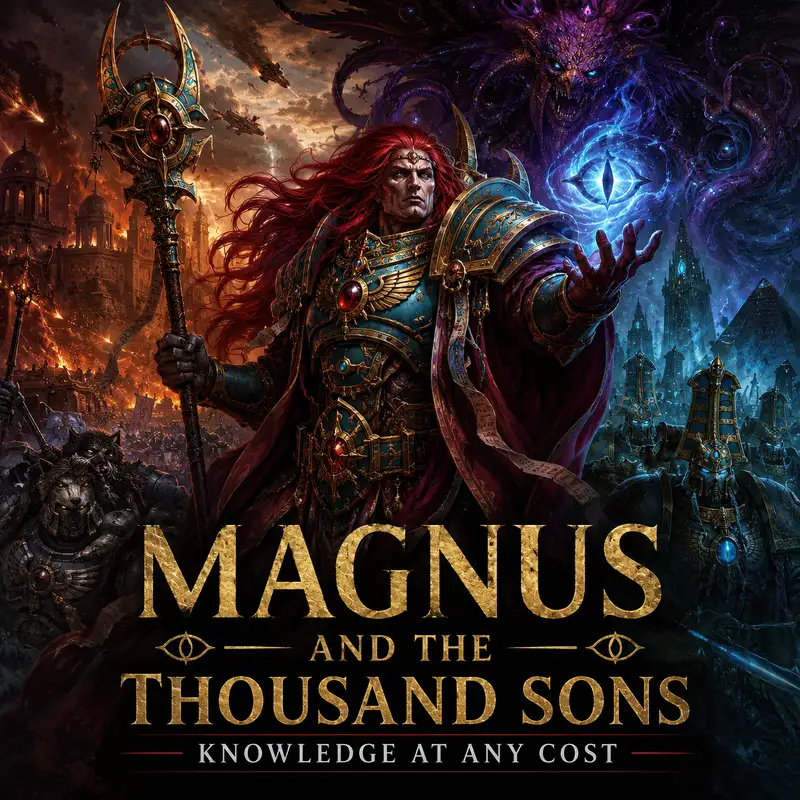
Magnus and the Thousand Sons: Knowledge at Any Cost
The disaster began with a warning that was completely correct. Horus had betrayed the Imperium. Terra was in danger. Magnus the Red understood this before almost anyone else, and he crossed the immaterial depths of the Warp to tell his father. The warning reached the Emperor. It also tore through the hidden defences of the Imperial Webway project, opened a path for daemons beneath the Imperial Palace, condemned Magnus’s home world, and drove the Thousand Sons toward the power that had been waiting for them all along. Few failures in Imperial history were built from such accurate information. The question is not whether Magnus knew too little. It is how a primarch devoted to reason, scholarship, and humanity’s enlightenment came to believe that knowledge made him exempt from caution.
Magnus was not created to be a simple conqueror. He was a giant even among the primarchs, a being of immense psychic power whose intellect ranged across history, philosophy, science, and the mysteries of the Warp. He believed humanity could become more than a frightened species sheltering behind guns and superstition. Where some of his brothers saw the Great Crusade as a war to reunite mankind, Magnus saw it as the beginning of an intellectual awakening. Worlds were not merely to be conquered. Their libraries were to be searched, their lost sciences recovered, and their surviving wisdom preserved. This was not a disguise for cruelty. Magnus sincerely believed that ignorance had nearly destroyed humanity once, and that only understanding could prevent it from happening again.
His Legion had learned the price of ignorance long before they found him. At its founding, one thousand warriors knelt before the Emperor, a number that became both their name and an omen repeated throughout their history. The Fifteenth Legion began with unusual promise, but its warriors were haunted by the Flesh Change, a terrible mutation that could twist a Space Marine’s body beyond recognition. The surviving records do not settle whether this disaster arose from unstable gene-seed, psychic corruption, deliberate interference, or some combination of them. What is clear is that it consumed the Legion from within. Warriors who had mastered battlefields lost command of their own flesh. Brothers were hidden in stasis vaults, suspended between life and death while their comrades searched for a cure. By the time the Legion was reunited with its primarch, it had been reduced to the edge of extinction.
Magnus saved them. At least, that was how it appeared. He turned the full force of his learning and psychic strength against the Flesh Change, and the mutations receded. The exact method was never openly explained. Later accounts strongly suggest that Magnus reached into regions of the Warp he did not fully understand and made a bargain whose true price had not yet been collected. Whether he recognised it as a bargain is less certain. He may have believed he had defeated a hostile intelligence, mastered a natural force, or simply taken power from something too distant to threaten him. Whatever happened, his sons lived. For the Thousand Sons, that made Magnus more than their gene-father. He was the man who had rescued them from annihilation, and gratitude is a powerful foundation for obedience.
Their new home was Prospero, a world of deserts, mountains, and bright cities built by a population rich in psychic talent. Its capital, Tizca, became a city of towers, pyramids, schools, archives, and cultivated memory. Magnus transformed it into the centre of his vision for mankind. Here, knowledge was not treated as a suspicious relic to be locked away by officials who had forgotten the key. It was studied. Ancient texts were translated. Alien artefacts were examined. Dangerous ideas were debated rather than immediately burned, which by Imperial standards already placed the fire brigade on alert. Prospero represented what Magnus thought the Imperium could become: disciplined, enlightened, psychically capable, and unafraid of the universe.
He remade the Thousand Sons in the same image. Psychic talent and intellectual excellence became central to the Legion’s identity. Its warriors were organised through fellowships, circles, and the five great Prosperine cults, each devoted to a different expression of psychic power. Some read possible futures. Some shaped living flesh. Some manipulated force and matter. Some reached into minds, while others wielded fire with terrifying precision. Magnus also became a leading champion of the Librarius project, which sought to train and regulate psychic Space Marines across the Legions. To him, this was the sensible answer to an obvious fact. Psychic power existed. More humans would develop it. Refusing to understand it would not make it disappear.
The difficulty was that the Warp was not merely a field of energy waiting for a sufficiently educated operator. It was a realm shaped by emotion, inhabited by predatory intelligences, and governed by rules that did not reward confidence with safety. Magnus understood more about it than almost any living human, but knowledge of a danger can create a second danger: the belief that familiarity equals control. He saw warnings from lesser minds as evidence of their fear. He saw restrictions as obstacles placed by people unable to follow his reasoning. Every successful experiment strengthened his conviction that the risks were manageable, and every survival became proof that his methods worked. The possibility that survival itself was being permitted for someone else’s purpose did not fit comfortably inside his calculations.
Even the Thousand Sons’ tutelaries should have been a warning. These apparently helpful spirits accompanied many of the Legion’s psykers, offering guidance and extending their abilities. The Thousand Sons treated them as useful companions from the Great Ocean. Later understanding identifies them far more darkly, as daemonic entities wearing reassuring shapes. That deception reveals the central weakness in Magnus’s entire project. He did not mistake the Warp for harmlessness. He knew it contained threats. His mistake was assuming that his intellect could always identify the threat before the threat identified his desire. Tzeentch, the Chaos god of change, sorcery, ambition, and intricate schemes, did not need Magnus to become foolish. It only needed him to remain certain.
That certainty followed the Thousand Sons through the Great Crusade. They fought effectively, but they also searched conquered worlds for fragments of forgotten learning. To Magnus, destroying a civilisation without first recovering its knowledge was a second act of barbarism layered upon the first. Other primarchs were less impressed. Some distrusted psychic warfare. Some had seen uncontrolled psykers ruin worlds during the Age of Strife. Some regarded the rituals of Prospero as sorcery disguised beneath scholarly language. Their objections were not all ignorant, and Magnus’s refusal to distinguish reasonable fear from blind prejudice made compromise increasingly difficult. He wanted his brothers to recognise that psychic power could be disciplined. Too often, he presented disagreement as proof that they lacked the imagination to understand him.
The dispute came to judgment at the Council of Nikaea. The question was larger than Magnus, but he stood at its centre. Supporters of the Librarius argued that trained psykers were valuable and that suppression would waste a power humanity needed. Opponents argued that the Legions were already dangerous enough without encouraging warriors to bargain with forces they barely comprehended. The Emperor ruled against Magnus. The Librarius departments were to be dissolved, and Space Marines were forbidden from employing their psychic powers. The decision was sweeping, perhaps disastrously so, but its meaning was not obscure. Magnus had been warned by the one authority he claimed to serve.
He accepted the judgment in public and rejected it in substance. The Thousand Sons returned to Prospero, where their studies continued. Magnus did not interpret Nikaea as the final word of a wiser father. He treated it as a political concession to fear, a temporary mistake that history would eventually correct. This response is crucial. Magnus is often described as a victim of intolerance, and he was. The Imperium feared what it did not understand, applied a broad prohibition to a complicated danger, and concealed information that might have changed his choices. Yet Magnus also decided that his own assessment outranked an explicit command. He was not forced to believe himself the exception. He chose it.
Then Horus fell. Through psychic vision and investigation, Magnus learned that the Warmaster had turned against the Emperor. He attempted to intervene and failed to prevent the corruption. With rebellion approaching and ordinary communication too slow or uncertain, Magnus decided to send a warning directly to Terra through the Warp. The need was real. The danger was immediate. His motive was loyal. Every part of the situation encouraged the conclusion he already preferred: that only his forbidden knowledge could save the Imperium, and that success would prove the judgment of Nikaea wrong.
The path to Terra was protected by barriers Magnus could not easily penetrate. Rather than stop, he gathered greater power. A vast psychic working carried his consciousness across the galaxy, and when he encountered the final obstruction, a presence in the Warp offered the strength needed to break through. Magnus accepted. He forced his way into the Emperor’s hidden work beneath the Palace and delivered his warning. In doing so, he ruptured the wards protecting the human-built entrance into the Webway. The breach allowed daemons to pour into a project intended to establish a human route through the Webway and reduce mankind’s dependence upon dangerous Warp travel. The Emperor’s great secret did not merely fail. It became a war beneath Terra that consumed lives, armies, and time the Imperium could not spare.
Magnus had been right about Horus and catastrophically wrong about nearly everything else. His message warned the Emperor of one disaster while creating another at the centre of the Imperial defence. The Webway breach forced the Emperor to devote himself to containing the damage, limiting his ability to confront the rebellion directly. The irony is brutal, but it should not be simplified into a joke about arrogance. Magnus had not been told the true nature of the project. The Emperor demanded obedience while withholding the reason obedience mattered. That secrecy helped construct the trap. Yet the locked door did not compel Magnus to smash it. Both father and son behaved as though explanation was unnecessary because authority or brilliance would be enough.
The Emperor ordered a censure force to Prospero, led by Leman Russ and reinforced by the Custodes and the Sisters of Silence. Its stated purpose was to apprehend Magnus and bring him to Terra for judgment. Horus, still able to exercise the authority of Warmaster, helped turn that mission toward destruction by feeding Russ’s anger and suspicion. The surviving accounts differ in emphasis, and later retellings do not always agree on precisely how the orders were interpreted. The essential result is clear. A force designed to compel Magnus’s submission arrived prepared for war, led by a brother who regarded the Thousand Sons’ sorcery as proof that restraint had already failed.
Magnus saw the punishment coming. Crushed by guilt, he chose not to defend Prospero at first. He obscured the approaching fleet from his sons, silenced warning systems, and prevented an organised response. This may have been intended as submission through self-destruction. He believed he had ruined the Emperor’s great design and that his own death was deserved. Yet once again, Magnus made the decision alone and allowed others to pay for it. The Thousand Sons did not know they had been condemned. The people of Prospero were not consulted. A primarch who claimed to value enlightened reason imposed his private judgment upon an entire world.
When the Censure Host attacked, Prospero became a killing ground. The Space Wolves descended upon Tizca. The Sisters of Silence weakened psychic powers simply by their presence, while the Custodes brought the direct authority and lethal skill of the Emperor’s household. The Thousand Sons, confused and enraged, fought back with weapons and sorcery. Their cultivated city became a battlefield of collapsing towers, burning archives, shattered armour, and uncontrolled mutation. The Flesh Change returned among warriors pushed beyond their limits. Books gathered across decades vanished in flame. The irony was complete. A Legion devoted to preserving knowledge was destroyed partly because its primarch had kept too much knowledge to himself.
Magnus eventually abandoned his refusal to fight. As his sons died and Tizca burned, he confronted Russ. Their battle was not merely sorcerer against warrior. It was the violent conclusion of an argument the Imperium had failed to resolve through trust, law, or brotherhood. Russ prevailed, breaking Magnus’s body and bringing him to the edge of death. At that moment, the power behind so many of the Legion’s misfortunes offered salvation again. Magnus accepted the escape. Prospero’s surviving Thousand Sons were drawn through the Warp to the Planet of the Sorcerers. The Legion survived, but its home, its independence, and much of its future did not.
Magnus was also shattered in a more literal sense. His being fractured into psychic shards, each carrying portions of his character and power. What emerged from Prospero was no longer the complete primarch who had once imagined a rational golden age. Grief, rage, pride, and the influence of Tzeentch pulled the fragments toward damnation. Magnus did not begin the Heresy as a willing servant of Chaos. His fall came through stages: a hidden bargain to save his sons, the continued use of forbidden practices, the disastrous warning, the destruction of Prospero, and the acceptance of rescue from the very power that had arranged the need for rescue. Tzeentch did not win by disproving Magnus’s ideals. It made those ideals instruments of his ruin.
On the Planet of the Sorcerers, Magnus withdrew into bitterness and attempted to preserve what remained of Tizca’s learning. He regarded the wider war with cold distance before finally taking his place among Horus’s forces. By the Siege of Terra, the son who had once tried to warn the Emperor returned as an enemy, seeking lost parts of himself and a reckoning with the father who had judged him. His transformation into a daemon primarch completed the bargain in spiritual terms. The champion of human psychic evolution became the immortal servant of a god whose every gift contains another arrangement, another dependency, and another concealed price.
The tragedy continued through Ahzek Ahriman, once chief librarian of the Thousand Sons. The Flesh Change returned after Prospero, threatening the survivors with the same extinction Magnus had once prevented. Ahriman responded exactly as his primarch had taught him. He gathered forbidden knowledge, trusted his own ability, and attempted a grand act of sorcery to save the Legion. The Rubric of Ahriman halted the mutations, but most Thousand Sons who lacked sufficient psychic strength were reduced to dust sealed inside their armour. Their bodies vanished. Their enchanted shells continued to march when commanded by the surviving sorcerers. Ahriman had found a cure with the efficiency of an executioner.
That outcome was not an unrelated punishment attached to the end of the story. It was the Thousand Sons’ central pattern repeated by the next generation. Magnus saved his Legion from the Flesh Change through a mysterious intervention and placed them under a greater threat. Ahriman saved them from mutation by taking away almost everything that mutation could destroy. Both acts were motivated by loyalty. Both relied on exceptional knowledge. Both were performed without the meaningful consent of those being saved. The Legion’s scholars became masters commanding the armoured remains of their own brothers, surrounded by the preserved evidence that intellect without humility can become another form of tyranny.
In the forty-first and forty-second millennia, the Thousand Sons remain among the galaxy’s most formidable sorcerers. Their living psykers pursue occult knowledge, lost relics, hidden names, and designs layered across centuries. Rubric Marines advance beside them as near-silent automata, the dust of ancient Legionaries bound within ornate armour. Magnus rules as a daemon primarch of Tzeentch, still mighty, still brilliant, and still entangled in plans whose full shape may not be his own. They possess secrets for which worlds would burn, yet the Legion that wanted to elevate humanity now serves a power that turns every search for certainty into another change of direction.
Knowledge was never the true crime of Magnus the Red. The Imperium’s fear of learning, its reliance on secrecy, and its habit of answering difficult questions with force all helped destroy him. The Thousand Sons were not wrong to believe that psychic power required study. They were wrong to believe that study removed the need for limits. Magnus’s fatal conviction was that every barrier could be crossed if the purpose was noble and the mind crossing it was his own. He repeatedly accepted costs without understanding them, then allowed his sons, his world, and the Imperium to settle the account.
That is why the title of their tragedy is not knowledge, but knowledge at any cost. The phrase sounds courageous until one asks who chooses the price and who is made to pay it. Magnus wanted to save his Legion, warn his father, preserve the past, and guide humanity into a brighter future. None of those desires was contemptible. The catastrophe lay in his certainty that good intentions and superior understanding granted him the right to act without restraint. At the end, the libraries were ash, the scholars were dust, and the brightest student of the Emperor had become the possession of a god who had always understood one thing better than he did: a man who must know everything can be led anywhere.